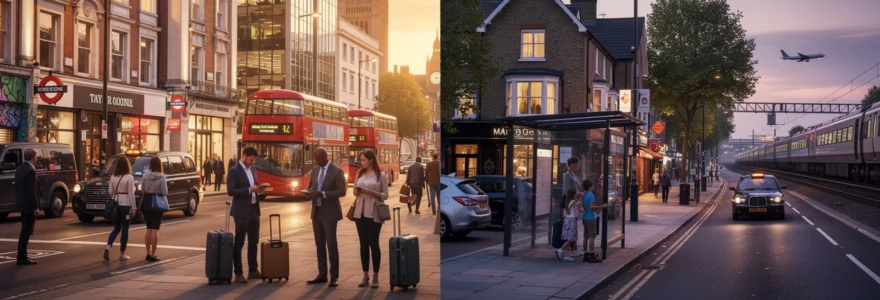
Choosing the perfect location for your London stay can make or break your travel experience. The eternal debate between central accommodation and peripheral lodging continues to perplex visitors, each option offering distinct advantages that cater to different travel preferences and budgets. London’s unique urban structure, lacking a single defined centre, presents travellers with an intricate web of neighbourhoods, each possessing its own character and charm.
The decision extends far beyond simple geography. Central locations promise immediate access to iconic attractions, whilst outer areas offer authentic local experiences and better value for money. Modern travellers must weigh convenience against cost, tourist attractions against cultural immersion, and bustling activity against peaceful retreat. Understanding these trade-offs becomes essential for maximising your London adventure.
Urban core accommodation analysis: central business district versus suburban lodge selection
Central London accommodation provides unparalleled proximity to the capital’s most celebrated attractions. Areas such as Covent Garden and Mayfair place visitors within walking distance of theatres, museums, and royal palaces. The convenience factor proves particularly valuable for short-stay visitors who wish to maximise their sightseeing time without lengthy commutes.
However, this convenience comes at a premium. Central hotels typically charge rates 40-60% higher than comparable properties in outer zones. A luxury hotel room in central London averages £300-500 per night, whilst similar quality accommodation in zones 3-4 costs £150-250. The price differential becomes even more pronounced during peak tourist seasons when central availability decreases significantly.
Suburban accommodation offers compelling advantages beyond cost savings. Areas like Hackney and Earl’s Court provide authentic London living experiences, complete with local markets, community pubs, and residential atmosphere. These neighbourhoods showcase the city’s diverse cultural tapestry, from traditional British establishments to contemporary international cuisine reflecting London’s multicultural identity.
The choice between central and peripheral accommodation fundamentally shapes your London narrative, determining whether you experience the city as a tourist destination or a lived environment.
Space considerations also favour suburban options. Central London properties often feature compact rooms designed for maximum occupancy efficiency. Suburban hotels and serviced apartments typically offer 30-50% more space at comparable price points, including amenities like kitchenettes and separate living areas that enhance longer-stay comfort.
Transport infrastructure assessment: underground networks and pedestrian accessibility metrics
London’s transport infrastructure fundamentally influences accommodation decisions, with connectivity quality varying dramatically across different zones. Understanding these variations helps travellers make informed choices about location versus accessibility trade-offs.
Metropolitan rail connectivity: central london zones 1-2 versus outer zone coverage
Central London zones 1-2 benefit from the highest concentration of Underground stations, with average walking distances to stations rarely exceeding 400 metres. Multiple line intersections create redundancy, ensuring alternative routes during service disruptions. The Circle, District, and Piccadilly lines provide comprehensive coverage across prime tourist areas.
Outer zones present more varied connectivity patterns. Zone 3 maintains reasonable Underground access, with stations typically within 800-1200 metres of accommodation. However, service frequency decreases during off-peak hours, with trains running every 5-8 minutes compared to 2-3 minutes in central zones. Night tube services operate on limited routes, primarily serving central areas.
Bus route frequency analysis: night services and Cross-City connection patterns
London’s bus network compensates for Underground limitations in outer areas. Over 700 bus routes provide comprehensive coverage, with night services maintaining connectivity when tube operations cease. Routes like the N25 and N207 connect suburban areas directly to central London throughout the night, ensuring 24-hour accessibility.
Frequency varies significantly by location and time. Central routes operate every 3-5 minutes during peak hours, whilst suburban services range from 10-20 minute intervals. Weekend services typically reduce frequency by 25-30%, impacting travel planning for leisure activities.
Walking distance calculations: attraction proximity and safety corridor assessment
Central accommodation minimises walking distances to major attractions. From
central hubs like Covent Garden, you can reach major theatres, galleries, and landmarks in 5–15 minutes on foot. This compactness significantly reduces your reliance on public transport, which is especially useful if you are travelling with children, have mobility concerns, or simply want to avoid navigating the network late at night.
By contrast, staying in outer districts often means treating walking as a secondary mode of transport rather than your primary one. While many suburban high streets have their own attractions, you are unlikely to walk from there to the British Museum or Trafalgar Square. You will usually need to factor in a 10–15 minute walk to the nearest station, followed by 20–35 minutes on the Tube or Overground. For some travellers this is a welcome trade-off for quieter streets and cheaper hotels; for others, those extra steps and minutes quickly add up over a four or five day visit.
Safety along key walking corridors is another factor. Heavily trafficked central routes, such as the South Bank promenade or the streets around Leicester Square, remain busy well into the night, with good lighting and constant footfall. Suburban routes may be less crowded after 10 pm and can feel more isolated, even if official crime rates are comparable. When evaluating where to stay in London, looking at walking routes on a map – not just distance, but lighting, main roads versus backstreets, and late-opening venues along the way – can help you choose a base that feels safe and comfortable.
Taxi and ride-sharing cost matrices: peak hour pricing from peripheral locations
Taxi and ride-sharing costs are where the central versus outskirts debate becomes very tangible. A black cab from Heathrow to a central London hotel can easily reach £70–£90 at peak times, whilst a similar journey from zones 3–4 might be £40–£60, depending on distance and traffic. However, the day-to-day costs often tell a different story: short central hops of 1–2 miles typically cost £10–£18 by cab or £7–£14 via ride-share, which can be quite manageable if you only use them late at night or when tired.
From outer London, those “quick rides” quickly become 25–40 minute journeys. A late-night ride from Soho back to a zone 4 suburb can cost £35–£60, especially on Friday and Saturday nights when surge pricing applies. Over a long weekend, two or three of these spontaneous trips can erase any savings you made by booking cheaper accommodation in the first place. If your itinerary involves frequent evenings out in the West End, central London theatre trips, or late dinners on the South Bank, staying closer in can reduce your reliance on expensive last-minute rides.
There is also the question of predictability. Central journeys are shorter and less vulnerable to dramatic cost swings because many of them can be walked if prices spike. In peripheral areas, you may have fewer public transport alternatives after midnight, so you are more exposed to surge pricing or extended wait times. When you compare central versus suburban accommodation options, it is worth estimating how many late-night taxi or ride-share journeys you are likely to make and building those into your total trip budget.
Airport transfer logistics: heathrow express versus suburban transit route efficiency
Airport transfers are often overlooked when choosing where to stay, yet they can significantly affect your arrival and departure experience. If you are based in central London near Paddington, the Heathrow Express becomes a compelling option: non-stop trains cover the distance in around 15 minutes, with services every 15 minutes during most of the day. For business travellers or anyone with limited time, this can make a central stay particularly efficient, even if hotel rates are higher.
Suburban locations closer to Heathrow, such as parts of west London in zones 3–4, may offer even shorter total journey times via the Piccadilly line or local buses. However, those routes are slower and more crowded at peak hours. A direct Tube ride from Earl’s Court to Heathrow can take 35–45 minutes, but you avoid the need for transfers and can save substantial money compared to premium rail services. For travellers with large luggage or young children, the simplicity of a single-seat journey often outweighs the extra time spent on the train.
Other airports tell a similar story. Gatwick is best accessed from central hubs like Victoria or London Bridge, while Stansted and Luton favour connections through Liverpool Street or St Pancras. If you are flying into one airport and out of another, a centrally located base in zones 1–2 often minimises total travel time, as you can access multiple mainline stations easily. When weighing up city centre versus outskirts in London, plotting your airport transfer routes first can reveal which locations genuinely offer “better experience” rather than just lower nightly rates.
Cultural immersion opportunities: heritage sites and local community integration
Beyond transport and pricing, the question many travellers ask is: “Where will I actually feel London the most?” Central districts deliver instant access to flagship heritage sites, while residential outskirts expose you to everyday rhythms, local parks, and neighbourhood rituals. Neither is inherently better; they simply offer different types of cultural immersion that shape how you remember your trip.
Central areas like Bloomsbury, the City of London, and the South Bank are dense with historic buildings, institutions, and world-class museums. Walk just a few blocks and you can trace 2,000 years of history – from Roman walls to Victorian railway hotels and glass-and-steel financial towers. In contrast, staying in places like Hackney, Dalston, or Earl’s Court lets you observe daily life in a modern metropolis: school runs, dog walkers, local markets, and the quiet hum of people who are not on holiday but simply at home.
Historic quarter exploration: georgian architecture and medieval street pattern navigation
Central London’s historic quarters are a textbook in urban evolution. The City of London preserves the medieval street pattern – narrow lanes, unexpected courtyards, sudden church spires – overlaid with modern skyscrapers. Meanwhile, Bloomsbury showcases Georgian and early Victorian townhouses arranged around leafy squares, offering a different, more ordered kind of beauty. Staying within these quarters means history is not just something you visit; it is what you walk through on your way to breakfast.
When you base yourself further out, you often encounter later layers of the city’s growth. Victorian and Edwardian terraces dominate in areas like Clapham and Islington, while interwar and post-war estates appear in outer boroughs. These neighbourhoods still reflect London’s story, but through the lens of suburban expansion rather than medieval origins. If your dream London break involves wandering centuries-old alleys near St Paul’s Cathedral or strolling past 18th-century façades in Marylebone, a central stay will serve you better.
Navigation is another subtle factor. Historic central areas are compact and walkable, but their labyrinthine layouts can feel disorientating at first – much like exploring an old European town where streets curve and change names frequently. Suburban layouts tend to be more grid-like or radial, making them easier to learn quickly. Consider which you find more appealing: the romance of getting “delightfully lost” among ancient lanes, or the predictability of straight, tree-lined streets leading back to your hotel.
Neighbourhood market access: borough market versus local high street shopping districts
Markets are often where a city’s character is most visible. In central London, Borough Market is the star attraction: a historic food market packed with artisanal bakers, cheese mongers, and street-food vendors. Staying nearby on the South Bank or around London Bridge gives you the luxury of dropping in early, before the crowds, for coffee and pastries – a very different experience from the midday crush that day-trippers encounter.
Outer districts, however, thrive on local high streets and weekend markets rather than global destinations. Think of Broadway Market in Hackney, the antique stalls of Portobello Road, or small farmers’ markets in residential squares. These spots tend to serve regulars rather than tourists, with prices and products reflecting local demand. If you want to pick up picnic supplies, chat to stallholders, or simply observe how Londoners shop, basing yourself near one of these markets can be deeply rewarding.
From a practical standpoint, access to a good supermarket or produce market also affects your daily comfort. Central neighbourhoods like Covent Garden can be oddly short on everyday shops, focusing instead on restaurants and luxury retail, whereas suburban centres almost always feature several well-stocked supermarkets. For travellers staying more than a few nights, having a local grocer nearby can make a significant difference to both budget and routine.
Pub culture authenticity: traditional taverns versus chain establishment prevalence
Pub culture is a cornerstone of London life, and where you stay will strongly influence the kind of pubs you encounter. In central tourist zones, especially around Leicester Square and the busiest parts of Soho, you will find many large, branded pubs and bars designed to handle heavy foot traffic. They are convenient and lively, but can feel somewhat generic, with menus and interiors duplicated across multiple venues.
Venture slightly beyond the very centre and the pub landscape changes. In areas like Bloomsbury, Islington, or Hackney, you are more likely to stumble upon traditional neighbourhood taverns with idiosyncratic décor, local regulars, and rotating real ales. Some have been serving pints for centuries, evolving slowly while retaining original features like wood panelling, open fireplaces, and etched glass. Staying nearby lets you experience these spaces at quieter times – weekday afternoons, early evenings – when you can actually chat to staff and locals.
There is no single “best” pub experience: some travellers prefer the buzz and anonymity of central chain venues, while others seek out intimate locals with quiz nights and Sunday roasts. When comparing city centre versus outskirts for your London stay, ask yourself what kind of social life you want at your doorstep. Are you happy to walk a little further to reach a characterful backstreet pub, or do you prefer the instant gratification of busy bars right around the corner from your hotel?
Street art and cultural movement epicentres: shoreditch versus suburban gallery spaces
London’s contemporary culture often flourishes at the edges of traditional tourist maps. Shoreditch, Hackney Wick, and nearby areas have become epicentres of street art, independent galleries, and experimental dining. Murals change regularly, pop-up exhibitions appear in former warehouses, and small venues host everything from poetry nights to underground music. Staying here gives you front-row access to this evolving cultural conversation, especially in the evenings when the neighbourhood really comes alive.
By contrast, suburban cultural spaces tend to revolve around local arts centres, libraries, and community theatres. These venues can be surprisingly ambitious, showcasing emerging talent and offering workshops, film screenings, and performances at accessible prices. While they may lack the international buzz of Shoreditch, they provide a more grassroots view of London’s creative life. If you are staying longer term or travelling frequently to the city, this quieter, community-focused scene can be particularly rewarding.
Of course, flagship institutions such as the Tate Modern, National Theatre, and Southbank Centre sit in central districts, placing world-class exhibitions and performances within walking distance of many zone 1–2 hotels. You might think of it as choosing between two lenses on the city’s culture: the polished, institution-led experience of the centre versus the raw, street-level experimentation of the inner suburbs. Both are valid, and your accommodation choice simply determines which one you wake up closest to.
Accommodation pricing dynamics: peak season rates and hidden cost variables
On paper, the price debate seems straightforward: central London costs more per night than the outskirts. In practice, the equation is more nuanced, especially once you factor in seasonality, transport costs, and how you actually use your accommodation. Central hotels in areas like Mayfair or Covent Garden often double their rates during peak months (May–September and major holidays), while more residential zones see gentler increases.
One key hidden variable is length of stay. For short breaks of two or three nights, paying extra to be central can make sense because you maximise your time and minimise commuting fatigue. Over a week or more, however, those higher nightly rates accumulate quickly, and a comfortable apartment in zones 3–4 can become more attractive. You may also gain amenities like kitchen facilities and laundry, which lower your overall spend on meals and services.
Another consideration is day-of-week pricing. Business-focused districts such as the City of London frequently offer steep weekend discounts, making a central stay surprisingly affordable from Friday to Sunday. Conversely, heavily leisure-driven areas maintain high prices at weekends but may drop midweek. When you compare city centre versus outskirts in London, looking at a full week’s rate calendar rather than a single night can reveal unexpected deals.
Then there are incidental costs many travellers overlook: breakfast charges, resort-style fees, mini-bar prices, and parking if you are driving. Central hotels often charge more for on-site dining and extras, while suburban properties may include breakfast or parking in their rates. However, being in the city centre gives you immediate access to budget-friendly cafés and supermarket meal deals, which can offset hotel food prices. To work out which option truly offers “better value”, it helps to sketch out a sample daily budget that includes accommodation, transport, meals, and any likely add-ons.
Security considerations: crime statistics and late-night safety protocols
Safety is a major factor in choosing where to stay, especially for solo travellers, families, and those unfamiliar with large cities. Official crime statistics show that central boroughs often record higher incident rates, largely because they host more people, nightlife, and tourist activity. However, headline figures can be misleading: many recorded offences in central areas involve pickpocketing, minor theft, or alcohol-related disturbances rather than serious violent crime.
From a practical perspective, central zones offer some inherent safety advantages. Main streets are typically well lit, heavily monitored by CCTV, and busy late into the night. You are rarely far from an open shop, hotel lobby, or station if you feel uncomfortable. In outer districts, streets can become quieter after 10 or 11 pm, with longer gaps between active storefronts. This does not necessarily mean they are more dangerous, but it can affect how secure you feel walking home, particularly if you are new to the area.
Accommodation type also matters. Large, central hotels usually have 24-hour reception, controlled access to guest floors, and established security protocols. Many suburban guesthouses and small hotels provide a more informal environment, which can be charming but may involve limited night staffing or simpler security arrangements. When comparing options, it is wise to read recent reviews mentioning “safety”, “area at night”, or “front desk staff” to gauge how previous guests have experienced the surroundings.
Ultimately, sensible precautions apply wherever you stay: keep valuables out of sight, use hotel safes where available, and plan your late-night routes in advance rather than improvising when tired. London’s public transport is generally safe and well-policed, but if you are returning very late and feel unsure, taking a licensed cab or pre-booked ride-share from a well-lit location can provide extra peace of mind, whether your base is in the city centre or on the outskirts.
Lifestyle preference matching: business traveller versus leisure tourist requirement analysis
Choosing between the city centre and outskirts in London is not just a financial or logistical decision; it is a lifestyle match. Business travellers often prioritise rapid access to meeting districts, reliable Wi‑Fi, quiet workspaces, and streamlined airport transfers. Leisure tourists, by contrast, may value atmosphere, proximity to attractions, and opportunities to explore different neighbourhoods at a relaxed pace. Knowing which profile you fit – or whether you blend both – is the first step towards a better stay.
For business-focused trips, central zones like Mayfair, the City of London, and the South Bank around Waterloo often provide the best base. You can walk between offices, government buildings, and conference venues, cutting down on commuting time and uncertainty. Premium hotels in these districts typically offer strong business facilities, from quiet lounges to meeting rooms and reliable in-room workspaces. If your schedule is tight, being able to step out of your hotel and reach your destination in minutes may outweigh any extra accommodation cost.
Leisure travellers have more flexibility and may find the sweet spot in areas that straddle central convenience and local character: think Bloomsbury, South Kensington, or inner east London districts near Shoreditch. These neighbourhoods offer easy transport links and walkable access to many sights, alongside residential streets, independent cafés, and local parks. They are particularly well-suited to slow travel styles, where you spend as much time enjoying your “home” district as you do ticking off major attractions.
Hybrid trips – combining meetings with sightseeing or remote work with exploration – benefit from a slightly more strategic approach. You might stay centrally for the first few intense business days, then relocate to a more relaxed, residential area for a long weekend. Alternatively, choosing a well-connected zone 2 neighbourhood with fast links to both the West End and your business district can deliver the best of both worlds. By aligning your accommodation with the rhythm of your trip, you turn the central versus outskirts choice from a dilemma into a deliberate tool for shaping your London experience.