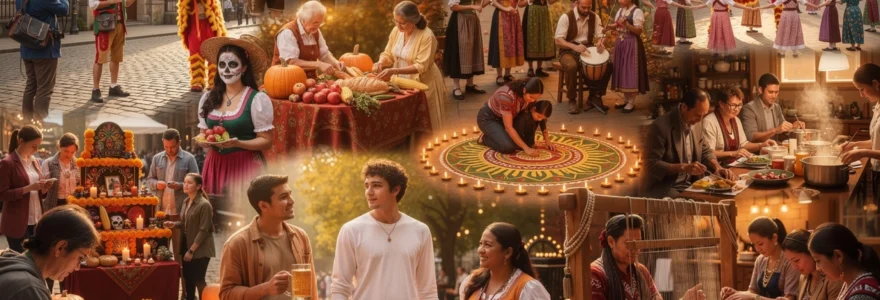
Local festivals represent one of humanity’s most enduring methods for preserving and transmitting cultural heritage across generations. These vibrant celebrations serve as living repositories where ancient customs meet contemporary expression, creating powerful spaces for cultural continuity and community identity formation. From the colourful processions of Diwali to the rhythmic drumbeats of Celtic gatherings, festivals offer participants direct access to traditional practices that might otherwise exist only in historical records or distant memories.
The significance of festival participation extends far beyond mere entertainment or tourism. These events function as immersive educational experiences where individuals can engage with traditional crafts, ceremonial practices, culinary heritage, and artistic expressions that define cultural identity. Through active participation rather than passive observation, festival-goers develop authentic connections to cultural traditions whilst contributing to their preservation and evolution. This dynamic relationship between tradition and participation creates opportunities for meaningful cultural exchange that benefits both local communities and visitors seeking genuine cultural experiences.
Cultural anthropology framework for Festival-Based heritage preservation
The anthropological study of festivals reveals their fundamental role as mechanisms for cultural transmission and community cohesion. These events serve as concentrated periods where traditional knowledge, social hierarchies, and cultural values are both reinforced and renegotiated within community settings. Festival environments create unique opportunities for ethnographic documentation, allowing researchers and participants alike to observe how traditional practices adapt to contemporary contexts whilst maintaining their essential cultural significance.
Understanding festivals through an anthropological lens illuminates their function as cultural anchors that ground communities in shared heritage whilst enabling cultural evolution. This framework recognises that authentic tradition preservation requires active engagement rather than static museum-like conservation. Festivals provide the dynamic environment necessary for traditions to remain vital and relevant to successive generations.
Ethnographic documentation methods at edinburgh festival fringe
The Edinburgh Festival Fringe exemplifies how contemporary festival environments can serve as laboratories for cultural documentation and artistic innovation. Ethnographers utilising participant-observation methodologies during this massive celebration gain insights into how traditional Scottish performance arts interact with international artistic expressions. Documentation techniques include audio-visual recording of traditional Highland games demonstrations, structured interviews with kilt-making artisans, and photographic documentation of pipe band formations that maintain centuries-old musical traditions.
Digital ethnographic approaches at Edinburgh enable real-time documentation of cultural transmission processes as visitors learn traditional Scottish dances or participate in clan heritage presentations. These methodologies capture not only the formal aspects of traditional practices but also the informal knowledge exchange that occurs between participants, revealing how authentic cultural learning happens through direct engagement rather than formal instruction.
Ritual symbolism analysis through día de los muertos celebrations
Día de los Muertos festivals provide exceptional opportunities for analysing the symbolic frameworks that underpin traditional commemorative practices. The intricate symbolism embedded in altar construction, marigold arrangements, and sugar skull decorating reveals complex theological and philosophical concepts about death, memory, and family continuity. Anthropological analysis of these elements demonstrates how traditional festivals maintain their spiritual significance whilst adapting to diverse cultural contexts as Mexican communities have migrated globally.
Participation in ofrendas creation allows individuals to understand the traditional Mexican worldview regarding ancestor veneration and cyclical concepts of life and death. This hands-on engagement with ritual symbolism provides deeper comprehension than academic study alone, enabling participants to internalise cultural perspectives through embodied experience rather than intellectual analysis.
Community identity formation during oktoberfest traditional ceremonies
Oktoberfest celebrations demonstrate how festival participation contributes to both individual and collective identity formation within traditional Bavarian cultural frameworks. The ceremonial aspects of beer brewing demonstrations, traditional costume workshops, and folk dance instruction create opportunities for participants to embody Bavarian cultural practices whilst developing personal connections to Germanic heritage traditions.
Community identity formation during these festivals occurs through shared participation in traditional activities such as maypole dancing, yodelling competitions, and brewery tours that emphasise traditional production methods. These experiences foster cultural belonging amongst participants regardless of their ethnic backgrounds, demonstrating how festival environments can create inclusive cultural communities that honour traditional practices whilst welcoming diverse participation.
Intergenerational knowledge transfer at harvest festival gatherings
Harvest festivals create particularly effective environments for intergenerational knowledge transfer as they combine practical
agricultural skills with symbolic rituals that mark the transition from labour to celebration. Elders demonstrate seed saving, crop rotation techniques, and traditional food preservation methods, while younger generations contribute contemporary music, digital storytelling, and new forms of artistic expression. This reciprocal exchange ensures that farming knowledge, seasonal customs, and local myths remain embedded in everyday life rather than confined to textbooks or museums.
In many regions, harvest festivals also provide a platform for discussing sustainable agriculture and food security, linking ancestral practices with modern environmental concerns. Community members may organise workshops on heirloom varieties, regenerative farming, or seed-sharing circles that echo older forms of communal resource management. By positioning traditional harvest celebrations as spaces for both remembrance and innovation, communities create fertile ground for living heritage that can respond to climate change, shifting diets, and changing rural economies.
Immersive participation strategies for traditional festival experiences
For travellers and locals alike, the most meaningful way to connect with traditions at festivals is through immersive participation rather than distant observation. When you step into a workshop, learn a song, or help prepare ritual foods, you move from audience member to active culture bearer. This shift transforms festivals into powerful learning environments where traditional practices are internalised through the body as much as the mind.
Designing immersive participation strategies requires sensitivity to local protocols and community needs. Organisers must balance openness to visitors with the protection of sacred knowledge and the avoidance of cultural exploitation. When done thoughtfully, however, participatory activities such as craft workshops, music sessions, community kitchens, and artisan demonstrations can strengthen both cultural preservation and responsible cultural tourism.
Craftwork apprenticeships during diwali preparation workshops
In the weeks leading up to Diwali, countless households and neighbourhoods transform into informal craft studios where lamps, rangoli designs, and decorative garlands are prepared. Structured Diwali preparation workshops that invite visitors into these spaces can function as short-term apprenticeships, allowing participants to learn traditional techniques directly from local artisans. Rather than purchasing mass-produced decorations, visitors discover how clay diyas, hand-painted lanterns, and intricate floor patterns are created step by step.
Such workshops often introduce participants to the symbolic meanings encoded in Diwali craftwork: the lamp as a beacon of knowledge, the rangoli as a protective threshold, or colour combinations associated with prosperity and protection. By learning how to roll clay, mix natural pigments, or pattern coloured powders, you gain access to an embodied vocabulary of light, fortune, and renewal. For communities, these Diwali craft apprenticeships generate supplementary income, encourage younger residents to value heritage skills, and counter the homogenising effects of mass-market festival goods.
Musical tradition acquisition at celtic music festival sessions
Celtic music festivals, from Ireland to Brittany and Cape Breton, frequently centre on the concept of the session: informal gatherings where musicians share tunes in pubs, community halls, or outdoor spaces. For learners, these sessions provide a rare opportunity to acquire musical tradition in its natural habitat, absorbing repertoire, style, and etiquette through close listening and gradual participation. Unlike formal concerts, sessions invite you to sit nearby, record tunes with permission, and eventually join in on simpler melodies or rhythmic accompaniment.
Festival organisers increasingly complement these organic spaces with structured workshops, slow sessions, and instrument clinics led by master musicians. Here, participants explore ornamentation techniques, regional tune variations, and the unwritten rules that govern communal playing. This layered approach, combining immersive listening with guided practice, mirrors the way traditional musicians have always passed on their art. Over several days, a festival becomes an accelerated microcosm of apprenticeship, where you not only learn tunes but also understand the social bonds, humour, and storytelling that give Celtic music its enduring power.
Culinary heritage learning through thanksgiving community kitchens
Community-based Thanksgiving kitchens, whether organised by churches, cultural centres, or mutual aid groups, offer fertile ground for experiencing culinary heritage in action. Volunteers of all ages come together to peel vegetables, bake pies, and prepare regional dishes, turning meal preparation into a shared ritual rather than a solitary task. In this context, recipes become oral histories: elders explain why certain spices are used, how ingredients were sourced in earlier decades, or which dishes honour Indigenous contributions to local foodways.
For newcomers and younger generations, joining a community Thanksgiving kitchen is a direct route into understanding the complex, often contested narratives that surround the holiday. Conversations can address the history of colonisation, the role of Indigenous harvest ceremonies, and contemporary efforts to “decolonise” the Thanksgiving table. By chopping, stirring, and serving alongside others, you participate in a living dialogue about gratitude, responsibility, and historical memory—demonstrating how culinary heritage can serve both comfort and critical reflection.
Textile arts mastery at navajo nation fair demonstrations
The Navajo Nation Fair, often described as the largest American Indian fair in the United States, showcases a wide array of traditional arts, with weaving and textile work taking centre stage. Demonstrations at the fair allow visitors to witness the full lifecycle of a textile: from sheep shearing and wool carding to natural dyeing and complex loom techniques. Master weavers explain the cosmological and landscape-based inspirations behind patterns, revealing how each design encodes stories of place, kinship, and resilience.
Some programmes at the fair are designed as intensive mini-apprenticeships, particularly for Navajo youth who may live far from traditional herding areas. Participants learn to warp looms, spin yarn, and interpret design motifs while elders share teachings about balance, harmony, and the responsibilities that come with artistic knowledge. For non-Navajo attendees, respectful observation and beginner workshops can deepen appreciation for textile heritage without appropriating sacred designs. In this way, the fair operates as both a public showcase and a protected learning ground where textile arts mastery is nurtured for future generations.
Regional festival typology and traditional practice categorisation
When we look across cultures, local festivals might seem endlessly diverse, yet they often cluster around a few recurring themes: the land, the sacred, the seasons, and the ancestors. Cultural anthropologists use this typology to analyse how different societies structure time, express values, and maintain continuity with the past. For travellers and community members, understanding these categories can make festival participation more meaningful, helping you recognise the deeper patterns beneath the surface spectacle.
Classifying festivals by their primary focus—agricultural, religious, seasonal, or ancestral—also illuminates how traditions evolve in response to political and economic change. A harvest festival might incorporate environmental activism, or an ancestral rite may be adapted for urban diasporic communities. This flexible typology therefore serves less as a rigid box and more as a map, guiding us through overlapping layers of meaning that shape festival-based cultural heritage.
Agricultural cycle celebrations: lammas day and lughnasadh observances
Lammas Day and Lughnasadh, historically observed across parts of the British Isles, mark the beginning of the harvest season and the first fruits of the grain crop. Traditionally, communities baked loaves from newly harvested wheat, offered sheaves in church, or held fairs featuring games, markets, and matchmaking rituals. These festivals expressed gratitude for sustenance while acknowledging the precarious balance between abundance and scarcity in agrarian life.
In recent decades, Lammas and Lughnasadh have experienced a revival within neo-pagan, folk, and rural heritage movements. Contemporary observances might combine historical reenactments, community-supported agriculture fairs, and workshops on seed sovereignty or wild foraging. By framing these events explicitly as agricultural cycle celebrations, organisers draw attention to the continuity between older subsistence economies and today’s concerns about food security and climate resilience. Participants leave not only with a sense of seasonal rhythm but also with practical tools for supporting sustainable local food systems.
Religious commemoration events: vesak festival buddhist traditions
Vesak, which commemorates the birth, enlightenment, and passing of the Buddha, stands as one of the most important religious festivals across many Buddhist-majority countries. Temple complexes come alive with lantern processions, chanting, and offerings of flowers and incense, creating an atmosphere that is both celebratory and contemplative. These ritual actions serve as embodied lessons in core Buddhist values such as compassion, impermanence, and non-attachment.
In diaspora communities, Vesak festivals often assume an additional role as markers of ethnic identity and intergenerational connection. Youth groups may stage dramas about the Buddha’s life, while elders lead meditation sessions or explain the symbolism of different ritual objects. Increasingly, Vesak observances also incorporate social service activities—blood drives, vegetarian food distributions, or environmental clean-up campaigns—that translate devotional ideals into practical action. For visitors who participate respectfully, Vesak offers a pathway into understanding how religious commemoration events sustain both spiritual practice and cultural continuity.
Seasonal transition rituals: chinese new year lion dance ceremonies
Chinese New Year, or Lunar New Year, encapsulates a rich tapestry of seasonal transition rituals that blend family reunion, spiritual cleansing, and community spectacle. Among the most recognisable elements is the lion dance, performed to usher in good fortune and dispel malevolent influences. The choreography, costumes, and accompanying percussion ensemble are steeped in symbolism: the lion’s expressive face, the syncopated drum patterns, and the playful interactions with the audience all enact the victory of vitality over stagnation.
Learning about lion dance traditions reveals the depth of training, discipline, and teamwork required to animate these colourful creatures. In many cities, lion dance troupes operate as cultural schools, offering year-round instruction in martial arts, musical rhythm, and ritual protocol. During the New Year period, performances at homes, temples, and businesses stitch these skills back into the broader social fabric. For younger generations navigating globalised identities, joining a lion dance troupe can be a powerful way to embody heritage and maintain connection to seasonal rituals, even in highly urbanised environments.
Ancestral honour festivals: bon odori japanese memorial practices
Bon Odori, part of the broader Obon period in Japan, exemplifies ancestral honour festivals that blend solemn remembrance with joyful reunion. Communities gather at temples, shrines, and public squares to dance in circular formations, moving to rhythms that have carried through centuries. The circular motion symbolises the cyclical nature of life and death, while the lanterns and altars invite ancestral spirits to visit and receive offerings of food, incense, and prayers.
In contemporary Japan and Japanese diaspora communities, Bon festivals have become important sites of cultural negotiation. Pop music and modern choreography sometimes mix with older dance forms, and food stalls feature both traditional sweets and global street food. Yet the core act of dancing for and with the ancestors remains central. For participants, especially those far from their ancestral villages, Bon Odori offers a physically grounded way to acknowledge lineage, process grief, and reaffirm belonging within a transnational Japanese community.
Digital documentation technologies for festival heritage recording
The rapid development of digital technologies has transformed how we record, share, and safeguard festival-based traditions. High-quality video, spatial audio, 3D scanning, and virtual reality now allow us to document not only the visual spectacle of a procession or performance, but also the subtle textures of sound, space, and movement that define a festival’s atmosphere. For communities concerned about the erosion of traditional knowledge, these tools can act like extended cultural memory, preserving details that might otherwise fade as elders pass away or neighbourhoods change.
However, digital documentation is not a neutral act. Decisions about what to film, how to edit, and where to store or publish materials shape which aspects of a festival are foregrounded and which are marginalised. Collaborative approaches—where local cultural custodians co-design documentation projects, manage archives, and control access—help ensure that digital records serve community priorities rather than external agendas. When thoughtfully implemented, technologies such as participatory mapping apps, crowd-sourced photo archives, and immersive 360-degree recordings can enhance both research and community pride.
Cross-cultural festival exchange programmes and traditional knowledge sharing
Cross-cultural festival exchange programmes create structured opportunities for artists, ritual specialists, and community organisers to learn from one another in situ. Instead of merely importing performances as entertainment, these initiatives prioritise dialogue, joint workshops, and co-created events. Imagine a delegation of traditional drummers from West Africa collaborating with Indigenous dancers in Canada, or Buddhist lantern-makers from Sri Lanka working alongside European stained-glass artisans; in each case, the festival becomes a temporary classroom where diverse knowledge systems meet on equal footing.
For such exchanges to support genuine traditional knowledge sharing, they must be grounded in ethical frameworks that recognise intellectual property rights, consent, and fair compensation. Organisers need to address questions like: who benefits from the circulation of cultural practices, and how are visiting communities represented in media and marketing? When these concerns are taken seriously, cross-cultural exchanges can revitalise local festivals, inspire young participants, and challenge stereotypes, all while reinforcing the idea that cultural heritage is not a static possession but a shared human resource.
Sustainable tourism models for authentic festival cultural engagement
As interest in cultural tourism grows, many local festivals face a paradox: the very influx of visitors seeking “authentic” experiences can strain infrastructure, disrupt rituals, and commercialise sacred traditions. Sustainable tourism models aim to resolve this tension by aligning visitor engagement with long-term community wellbeing and heritage preservation. Instead of maximising ticket sales or social media impressions, these models prioritise carrying capacity, equitable revenue distribution, and the protection of core cultural values.
Practical strategies include limiting visitor numbers for sensitive ceremonies, creating code-of-conduct guidelines for photography and behaviour, and reinvesting a portion of tourism income into cultural education for local youth. Community-led tour organisations, homestay networks, and cooperative craft markets can ensure that economic benefits reach those who maintain festival traditions year-round. For travellers, choosing such initiatives means accepting a slower, more respectful form of participation—one where you might spend an afternoon learning a single craft technique or story rather than rushing through a checklist of attractions. In return, you gain a deeper, more reciprocal connection with local traditions, helping festivals remain vibrant for generations to come.