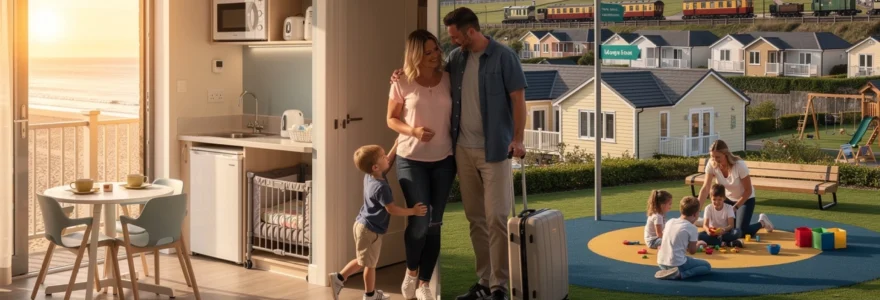
Family travel presents unique challenges that extend far beyond simply booking a place to sleep. The difference between a stressful holiday and a genuinely relaxing break often comes down to the accommodation itself. When you’re managing children’s routines, dealing with unpredictable sleep patterns, and trying to maintain some semblance of normal family life whilst away from home, the right accommodation becomes not just a nice-to-have but an essential component of successful family travel. Modern family-friendly properties have evolved significantly, moving beyond simply offering a cot and high chair to providing comprehensive solutions that genuinely reduce the logistical burden of travelling with children. Understanding which features truly make a difference can transform your family holiday from an exhausting exercise in damage limitation into the rejuvenating experience it should be.
Suite configurations and Multi-Room layouts for seamless family logistics
The physical layout of your accommodation fundamentally shapes how your family functions during a holiday. Traditional hotel rooms, designed for couples or business travellers, simply don’t accommodate the reality of family life—where children need early bedtimes whilst adults crave evening space, where teenagers require privacy, and where everyone benefits from designated zones for different activities. The most effective family accommodations recognise these needs through thoughtful spatial design that balances togetherness with personal space.
Connecting adjoining rooms with lockable internal doors
Connecting rooms represent perhaps the most versatile solution for families, offering flexibility that suits various family configurations. These arrangements typically feature two separate hotel rooms linked by an internal door that can be locked from either side, providing parents with reassurance that children are merely steps away whilst maintaining distinct sleeping spaces. This configuration proves particularly valuable for families with teenagers who require independence or when travelling with babies whose unpredictable sleep patterns might otherwise disrupt everyone’s rest. The beauty of this arrangement lies in its adaptability—you can maintain connection during daytime whilst ensuring everyone gets proper sleep at night. Many major hotel chains now guarantee connecting rooms when booked in advance, though availability varies significantly by property, making early reservation absolutely essential if this feature matters to your family.
Studio apartments with kitchenettes and separate sleeping zones
Studio-style accommodation offers a middle ground between hotel convenience and self-catering flexibility, particularly suited to families seeking some independence without full housekeeping responsibility. These units typically feature a compact kitchenette area with basic cooking facilities, a living space that doubles as parents’ sleeping quarters, and a separate alcove or partitioned area for children. The kitchenette proves invaluable for preparing quick breakfasts, storing snacks, and heating baby food—eliminating the pressure of restaurant schedules whilst significantly reducing meal costs. Modern studio apartments increasingly incorporate clever design elements such as murphy beds, sofa beds with proper mattresses rather than uncomfortable fold-outs, and storage solutions that prevent the chaos of family belongings overwhelming limited space. The key consideration when evaluating studio apartments involves honestly assessing whether the space will feel comfortable rather than cramped once everyone’s belongings are unpacked and daily life begins.
Two-bedroom villa configurations at center parcs and landal GreenParks
Purpose-built holiday parks such as Center Parcs and Landal GreenParks have refined the family villa concept over decades, creating accommodation that genuinely understands family dynamics. These two-bedroom configurations typically provide proper separation between adult and children’s sleeping areas, full kitchen facilities that allow normal meal routines to continue, and crucially, outdoor space such as decking or small gardens where children can play safely whilst remaining supervised. The forest or parkland settings of these properties mean children can move between villa and outdoor activities independently once they reach appropriate ages, reducing the constant supervision burden that comes with urban hotel stays. Many families find these villa arrangements particularly valuable for multi-generational trips, where grandparents appreciate having their own bedroom and the communal living areas facilitate family time without constant proximity. The self-contained nature of villas also means less concern about children disturbing other guests—a significant source of parental stress in traditional hotels.
Loft-style family suites with privacy partition systems
Increasingly popular in urban family hotels, loft-style suites utilise vertical space to create distinct zones within a single unit. These innovative layouts typically feature an upper sleeping area accessed by stairs or ladder—
creating a cosy den-like bedroom for children and a calmer sitting area for adults below. For families, the advantage lies in having visual and acoustic separation without paying for multiple rooms. Look for suites that offer solid privacy partitions, sliding doors, or blackout curtains that can fully close off the sleeping zones, allowing younger children to nap while older siblings read or watch a film. When assessing loft-style family suites, pay close attention to stair design and railing height, particularly with toddlers; some properties now install gated stairs or offer portable stair gates on request. As with any vertical layout, safety and nighttime bathroom access should be key deciding factors rather than afterthoughts.
Child-centric amenities that reduce parental burden
Truly family-friendly accommodations do more than tolerate children—they actively anticipate their needs. Child-centric amenities can dramatically reduce the mental load of travelling parents, cutting down on the sheer volume of gear you need to pack and manage. From sleep equipment to meal-time essentials, every item provided on-site is one less thing to fit into your luggage or remember at 5am before a flight. When you evaluate family travel accommodation, it helps to think in terms of daily routines: sleep, eat, play, wash. Properties that support those four pillars well tend to feel like a genuine home base rather than an obstacle course.
Complimentary cot hire, sterilisation units and bottle warmers
For parents of babies, sleep and feeding logistics often determine whether a trip feels manageable. Many hotels and self-catering properties now offer complimentary cot hire, but the quality varies wildly—from full-sized wooden cots with proper mattresses to flimsy travel cots that creak with every movement. When you book, ask specifically about mattress thickness, bedding provision, and maximum age or weight guidelines so you can decide whether to bring familiar sheets or a travel cot of your own. Increasingly, larger resorts and city aparthotels also provide communal sterilisation units or in-room microwave sterilisers, along with bottle warmers you can borrow from reception.
These seemingly minor extras can transform late-night feeds from a logistical headache into a simple, repeatable routine. If you are travelling long-haul or changing accommodation mid-trip, choosing properties with baby-feeding infrastructure can be as important as picking the right airline. Some family-focused brands now list baby amenities in their room descriptions, so filter for terms like steriliser, bottle warmer, and baby bath when you research. You might even email ahead with your child’s usual schedule; many family-friendly accommodations are surprisingly willing to pre-set cots, blackout blinds, and kettles so the room is genuinely ready when you arrive.
On-site laundry facilities with child-safe detergent provision
One of the most underrated features in family travel accommodation is reliable laundry access. When you are dealing with food spills, playground mud, and the occasional bout of travel sickness, the ability to wash clothes on-site means you can pack lighter and stress less. Apartment-style stays and holiday parks often include communal laundry rooms, while some premium family suites feature in-room washer-dryers. Before you book, look for clear information on costs, machine availability, and opening hours; there is little value in a laundry room that closes before bedtime when you most need it.
Child-safe detergents are a newer but welcome development, especially for families dealing with eczema or sensitive skin. A handful of UK and European brands now advertise hypoallergenic or fragrance-free options as standard, and some will provide smaller detergent pods on request rather than large vending machines of generic soap. If your child reacts to unfamiliar products, it is wise to either bring your own travel-sized detergent or confirm that the accommodation can supply a mild alternative. Think of laundry access as your safety net: you may not need it daily, but when you do, it can rescue both luggage space and your holiday mood.
Supervised kids’ clubs at eurocamp and haven holiday parks
Structured, supervised activities are often the difference between parents getting a genuine break and spending the entire holiday as on-duty entertainers. Eurocamp and Haven holiday parks have invested heavily in children’s clubs designed around age-specific programmes, from toddler music sessions to teen sports tournaments. These kids’ clubs usually operate in secure, dedicated spaces with trained staff, giving you confidence to step away for an hour’s swim or a quiet coffee. Many families find that even a short daily session of supervised play resets everyone’s energy levels and reduces friction between siblings.
When comparing kids’ clubs, look beyond the colourful brochures and ask practical questions: What are the staff-to-child ratios? Are the team members first-aid trained? Do they run sign-in and sign-out procedures with ID checks? At Eurocamp and Haven, sessions are often bookable in advance during peak weeks, so it pays to reserve key time slots shortly after you confirm your accommodation. A well-run kids’ club should feel like an extension of school or nursery in terms of safety, but with a holiday-level dose of fun, crafts, and outdoor play; if it passes that test, you will likely feel comfortable using it as a daily anchor in your family schedule.
Childproofing kits including socket covers and stair gates
Even the most stylish family suite can become stressful if you spend your entire stay redirecting a curious toddler away from hazards. That is where childproofing kits come in—packs of simple safety items that temporarily turn a standard room or apartment into a more secure space. Typical kits include socket covers, corner protectors, cupboard latches, and sometimes door stoppers to prevent tiny fingers being trapped. In duplex or loft-style setups, stair gates are essential; some aparthotel brands and villa resorts now offer them as standard for families with under-fives.
Before you travel, it is worth asking whether the property can pre-install basic childproofing items in your unit, rather than handing you a bag of pieces at check-in. You can also augment what is provided with a few lightweight items of your own—think elastic bands for cabinet handles or painter’s tape to secure trailing cords. Approaching family accommodation safety like you would baby-proofing at home makes the environment feel less like a minefield and more like a manageable, shared space. After all, you are there to build memories, not to spend four days guarding a glass coffee table.
High chair availability and toddler crockery in self-catering units
Mealtimes can be surprisingly complex when you remove the familiar infrastructure of home. Self-catering units that supply sturdy high chairs, booster seats, and toddler-friendly crockery immediately simplify things. Instead of balancing a child on your knee or improvising with adult chairs and cushions, you can recreate a normal dining setup that feels safe and predictable. Many family-oriented cottages and aparthotels in the UK and Europe will list high chairs as available on request, but numbers can be limited, so make sure you reserve yours at the time of booking.
Toddler plates, bowls, and beakers might sound like an optional extra until you are faced with a cupboard of heavy stoneware and sharp cutlery. Increasingly, self-catering properties are adding lightweight plastic or bamboo sets and child-sized cutlery to their inventory, often stored in a labelled cupboard in the kitchen. If you are comparing two similar family travel accommodations, the one that includes these small but thoughtful touches will typically make day-to-day life far smoother. Think of it this way: any property that makes it easy to feed a tired, jet-lagged toddler without breakages is already doing half the work of being truly family-friendly.
Location-specific proximity features for reduced transit stress
Where your accommodation sits in relation to transport links and attractions can matter just as much as what is inside the room. Long transfers, multiple bus connections, and daily car journeys quickly eat into precious holiday time and sap everyone’s patience. By prioritising location-specific features—ground-floor access, walking distance to key attractions, and minimal luggage hauling—you reduce friction points before they even arise. With children, especially younger ones, the goal is simple: more time playing and resting, less time wrestling buggies on crowded pavements or standing in long taxi queues.
Ground-floor accessible rooms at premier inn family hubs
For families travelling across the UK, Premier Inn has become a dependable choice, particularly at their larger “family hub” locations near city centres and attractions. Ground-floor and accessible rooms in these properties are not just for guests with mobility needs; they can also be a strategic choice for parents juggling prams, car seats, and multiple suitcases. Being able to roll straight from the car park or reception to your door without lifts or long corridors significantly reduces arrival and departure stress. It also makes short trips back to the room—grabbing forgotten toys, spare clothes, or snacks—far more feasible.
When you book, use the “special requests” field or contact the hotel directly to ask about ground-floor availability and step-free routes. Some Premier Inn family hubs group accessible and larger family rooms close to reception, which can be a huge bonus if you have children who tire easily. Consider it like choosing the front row of a theatre for easy access: you may sacrifice a view but gain a smoother overall experience. For families with pushchairs or bulky sports equipment, those few saved minutes and fewer doorways can make each outing feel manageable rather than overwhelming.
Short-stay apartments near legoland windsor and alton towers
Theme-park trips often involve early starts, late finishes, and children fluctuating between high excitement and sudden exhaustion. Staying in short-stay apartments close to major parks like Legoland Windsor or Alton Towers can soften those extremes. Instead of facing a long drive or train journey at the end of a park day, you might be back in your accommodation within 15–20 minutes, ready for baths and calm. Properties in Windsor, Ascot, or Bracknell, and in villages surrounding Alton Towers, increasingly cater to families with flexible check-in times, parking, and simple kitchen facilities.
When browsing listings, search for phrases like “walking distance to Legoland” or “10 minutes from Alton Towers”, then cross-check those claims on a map. You will also want to check traffic patterns on peak days; a nominal 10-minute drive can easily double at closing time. The most family-friendly apartments often offer late checkout, allowing slower mornings after big park days. Ask yourself: will returning to this accommodation at 8pm with overtired children feel achievable? If the honest answer is yes, you are probably looking at a location that will support, rather than sabotage, your trip.
Beachfront bungalows with direct sand access in cornwall
For coastal holidays, proximity to the beach can transform the rhythm of your days. Beachfront bungalows in Cornwall with direct sand access eliminate the need for car trips, parking battles, and hauling equipment across long promenades. If you can step from your terrace straight onto the beach, it becomes easy to fit in short bursts of play between naps and meals—ideal for younger children who do not cope well with long, single-session outings. Parents often liken the experience to having a giant, natural playground at the bottom of the garden.
When evaluating beachfront family travel accommodation, check not only distance but also gradient, steps, and tidal patterns. A steep cliff path or multiple flights of steps can be challenging with buggies or grandparents in tow, even if the property looks close on a map. Some Cornish family resorts now advertise “pushchair-friendly beach access” or boardwalks, which can be valuable if you travel with lots of gear. It is also worth considering noise levels; beaches popular with surfers or evening events may be lively late into the night, so look for reviews from families who stayed at similar times of year to gauge the real atmosphere.
Railway station adjacent properties in edinburgh and york
City breaks by train can be wonderfully straightforward with children—provided you do not then face a complex urban transfer at the far end. Properties adjacent to major railway stations in cities like Edinburgh and York can cut your onward journey to a five-minute walk, often under covered walkways or along flat pavements. For families managing suitcases, scooters, and perhaps a travel cot, that short distance can feel like a lifeline. In Edinburgh, hotels and serviced apartments near Waverley Station place you within easy reach of the Old Town, while in York, staying close to the station still leaves you just a short stroll from the city walls and museums.
Of course, station-adjacent accommodation brings trade-offs: you may encounter more noise or smaller room sizes compared with out-of-centre properties. To balance convenience and comfort, look for rooms that explicitly mention soundproofing or double glazing, and read recent family travel reviews that mention sleep quality. Think of these locations as urban base camps: you sacrifice a little space in exchange for minimal transit stress and very flexible sightseeing options. For short city stays of two or three nights, the ease of rolling your suitcase straight from platform to check-in often outweighs the downsides.
All-inclusive meal plans and dietary accommodation systems
Feeding a family away from home can become a surprisingly large slice of your holiday budget and mental bandwidth. All-inclusive meal plans and half-board options are designed to remove some of that pressure by bundling food costs upfront and centralising mealtimes within the accommodation grounds. For families, the real value lies in predictability: you know roughly what your children will eat, when food is available, and how much you will spend. Modern family-friendly resorts have moved beyond generic buffets to offer live cooking stations, child-height serving areas, and flexible dining times that match varied bedtimes and nap schedules.
If you are travelling with allergies, intolerances, or specific dietary requirements, the quality of a property’s dietary accommodation systems becomes a crucial selection factor. Many European and UK family resorts now train staff in handling common allergens and label buffet items clearly with icons for gluten-free, dairy-free, vegetarian, and vegan options. Before you commit, email the property with detailed questions about cross-contamination procedures and whether the kitchen can prepare simple, safe alternatives on request. A resort that responds clearly and promptly is far more likely to deliver in practice than one that sends generic assurances.
At all-inclusive beach or pool resorts, snack availability between main meals can be surprisingly important, especially for younger children who graze throughout the day. Look for mentions of snack bars, ice-cream sessions, and fruit or yoghurt stations that remain open outside set meal times. While it is easy to be swayed by the sheer volume of food on offer, focus instead on whether the setup supports your family’s usual routines. Can you get an early breakfast before an excursion? Is there somewhere quiet to sit with a tired toddler who needs an early dinner? When the answers are yes, all-inclusive catering shifts from being a novelty to a genuine facilitator of easy family travel.
Integrated entertainment infrastructure within accommodation grounds
Family holidays flow more smoothly when entertainment is woven into the fabric of your accommodation rather than requiring daily excursions. Integrated entertainment infrastructure—playgrounds, splash pads, indoor pools, mini-golf, and low-key evening shows—allows children to burn off energy in short, manageable bursts. You are not committing to a full day out; instead, you can dip into activities as and when moods and weather allow. This approach is particularly valuable in destinations with unpredictable climates, where plans may need to pivot rapidly from beach to indoor play.
When assessing the entertainment offering of a family travel accommodation, consider both variety and proximity. A campsite or resort might boast an impressive activity list, but if the soft play is a 20-minute walk from your lodge or the pool is only accessible via steep steps, you may not use it as much as you think. Properties that cluster key facilities—pool, playground, café—within a central hub tend to work best for families because you can combine adult and child needs in one outing. One parent might grab a coffee while the other supervises the slides, or grandparents can sit comfortably nearby while younger relatives explore.
Evening entertainment can be a double-edged sword: some families relish mini-discos and family quiz nights, while others dread loud music echoing past bedtime. Reviews from other parents are invaluable in understanding the true character of a property after dark. Ask yourself: does the entertainment programme match your children’s ages and your own tolerance for noise and structure? A property with a modest but thoughtful infrastructure—perhaps a small cinema room, lending library, and quiet playground lighting—may suit some families better than a full-scale holiday park with nightly shows. The key is alignment with your preferred pace, not sheer quantity of options.
Flexible cancellation policies and family emergency protocols
Even the best-planned family trip can be derailed by illness, school changes, or work emergencies. In that context, flexible cancellation policies are not just a financial safety net; they also reduce the emotional load of committing to travel months in advance. Many family-oriented hotels, aparthotels, and holiday parks now offer semi-flexible rates that allow changes or cancellations up to a few days before arrival, often for a modest premium over non-refundable deals. For parents, paying slightly more for this flexibility can feel like buying peace of mind, especially in cold and flu season.
When you compare rates, look beyond the headline price to the fine print: What are the deadlines for free changes? Can you shift dates rather than cancel outright? Are credits issued for future stays, and how long do they remain valid? Some larger brands introduced more generous policies in recent years and have retained them because families clearly value that security. As a rule of thumb, if losing the full cost of the booking would significantly impact your budget, opt for a flexible or semi-flexible option wherever possible.
Beyond cancellations, it is worth considering how a property handles in-stay emergencies—from medical issues to sudden early departures. Does the accommodation have clear protocols for calling local doctors, arranging hospital transport, or assisting with rebooking flights and trains? Larger family resorts and city aparthotels often maintain up-to-date contact lists for nearby clinics and pharmacies, and some can provide written documentation to support travel insurance claims. Asking a few targeted questions before you book can reveal a lot about an accommodation’s overall attitude to guest care.
Family travel will never be entirely predictable, but choosing accommodation with robust emergency support systems makes it easier to adapt when plans change. Think of it like adding stabilisers to a child’s first bike: you may not need them for every ride, but their presence helps you relax enough to enjoy the journey. When your chosen property combines thoughtful layouts, child-centric amenities, strategic locations, and flexible policies, it genuinely becomes what every travelling family needs most—a base that makes the rest of the adventure feel not only possible, but pleasurable.