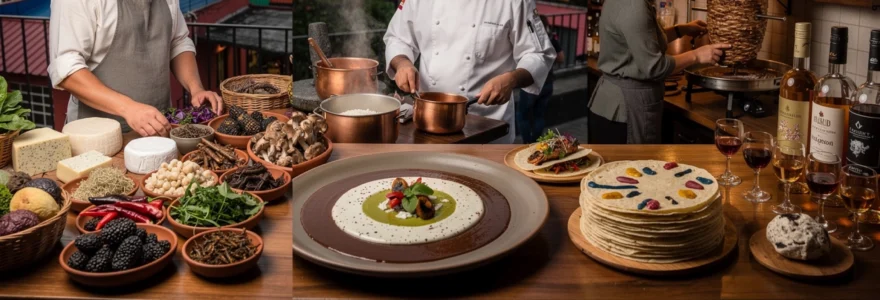
Mexico City stands as one of the world’s most dynamic culinary capitals, where millennia-old cooking techniques seamlessly merge with cutting-edge gastronomic innovation. The metropolis pulses with an extraordinary food culture that honours indigenous heritage while constantly reinventing itself through creative interpretation and global exchange. From family-run fondas serving recipes passed down through generations to avant-garde restaurants reimagining pre-Hispanic ingredients through modern culinary science, the city offers an unparalleled gastronomic landscape. This remarkable fusion isn’t merely about combining old and new—it represents a living, breathing evolution of Mexican cuisine that respects its roots whilst boldly exploring uncharted territory. Understanding this culinary ecosystem requires delving deep into the markets, mezcalerías, taquerías, and fine dining establishments that collectively define what makes eating in Mexico City such a transformative experience.
Pre-hispanic culinary foundations: aztec ingredients still defining contemporary mexican gastronomy
The Aztec civilization developed one of history’s most sophisticated agricultural systems, cultivating ingredients that remain absolutely central to Mexico City’s contemporary food culture. Maize, beans, squash, chilli peppers, tomatoes, and cacao formed the nutritional backbone of pre-Columbian society, and these foundational ingredients continue to anchor Mexican cooking today. What sets Mexico City apart is how chefs and home cooks alike treat these ancient staples not as museum pieces but as living ingredients worthy of constant experimentation and refinement.
The nixtamalisation process—treating maize with alkaline lime water—represents perhaps the most significant culinary innovation from the pre-Hispanic period. This technique, developed over two thousand years ago, transforms the nutritional profile of corn by increasing calcium content and making niacin bioavailable whilst fundamentally altering the flavour and texture. Modern chefs have elevated this ancient process into an art form, sourcing heirloom maize varieties from specific regions and carefully controlling every variable to produce tortillas with distinct flavour profiles. The reverence for properly nixtamalised corn has become something of a badge of honour among Mexico City’s culinary elite, separating those who truly understand the craft from establishments taking shortcuts with commercially produced masa.
Amaranth, chia, and various species of edible cacti also trace their culinary lineage directly to Aztec cultivation practices. These ingredients were so integral to pre-Hispanic culture that Spanish colonisers actually banned amaranth due to its ceremonial significance. Today, however, these once-forbidden foods have experienced a remarkable renaissance, appearing in everything from street snacks to tasting menu courses at world-renowned restaurants. The revival speaks to a broader cultural movement reclaiming indigenous knowledge and repositioning it as sophisticated rather than primitive—a paradigm shift that has profoundly influenced how Mexico City approaches its culinary identity.
Mercado de san juan: epicurean hub for exotic ingredients and artisanal producers
Mercado de San Juan functions as the beating heart of Mexico City’s ingredient-obsessed food culture, attracting professional chefs, adventurous home cooks, and curious food tourists in equal measure. Unlike typical markets catering primarily to neighbourhood residents, San Juan has evolved into a specialised destination where you’ll find ingredients unavailable elsewhere in the capital. The market’s reputation for stocking exotic, rare, and exceptionally high-quality products has made it indispensable to the city’s top restaurants whilst simultaneously preserving traditional food knowledge that might otherwise disappear.
Huitlacoche, escamoles, and chapulines: indigenous delicacies in modern fine dining
Walking through San Juan’s narrow aisles, you’ll encounter ingredients that challenge conventional Western notions of what constitutes desirable food. Huitlacoche, the fungus that grows on maize kernels, transforms what farmers in other countries consider crop damage into a prized delicacy with an earthy, mushroom-like flavour and striking dark appearance. High-end restaurants charge premium prices for dishes featuring this “Mexican truffle,” whilst home cooks incorporate it into quesadillas and soups for its distinctive umami richness.
Escamoles—the larvae of a particular ant species harvested from agave plant roots—represent one of Mexico’s most expensive and sought-after ingredients. Often described as having a cottage
cheese texture and a delicate, nutty flavour, escamoles are sautéed with butter, epazote, and chilli, then folded into tacos or served over scrambled eggs at some of Mexico City’s most acclaimed restaurants. Chapulines—crunchy toasted grasshoppers seasoned with lime and chilli—offer a different kind of thrill. Once a pragmatic protein source in pre-Hispanic diets, they now appear as bar snacks in mezcalerías, garnishes for guacamole, and even as a textural counterpoint in haute cuisine tasting menus. By integrating these indigenous delicacies into refined dishes, chefs challenge diners to reconsider their assumptions about sustainability, luxury, and what “counts” as gourmet.
Artisanal mole paste vendors and regional chilli varietals from oaxaca and puebla
Further inside Mercado de San Juan, stalls piled high with fragrant pastes attest to Mexico’s profound mole tradition. Vendors from Oaxaca, Puebla, and Guerrero sell artisanal mole pastes in shades ranging from brick-red to nearly black, each blend reflecting a closely guarded family recipe. These concentrated bases, made from toasted chillies, nuts, seeds, spices, and sometimes chocolate, allow both home cooks and professional chefs to recreate complex sauces without spending days at the stove.
Regional chilli varietals form the backbone of these moles and are a cornerstone of Mexico City’s food scene. You’ll find smoky chile pasilla de Oaxaca, fruity guajillo, raisin-like ancho, and fiery chile de árbol, each offering a distinct aroma and heat level. For visitors keen to cook authentic Mexican dishes at home, buying a small selection of dried chillies and mole paste is one of the most practical souvenirs. As you talk with producers, you start to understand mole not as a single sauce but as a spectrum of regional identities, shaped by climate, trade routes, and centuries of culinary creativity.
Specialty cheese purveyors: queso oaxaca, cotija, and european-style farmhouse production
Cheese counters at San Juan highlight another side of Mexico City’s food culture, where local tradition intersects with European techniques. Long, stretchy strands of queso Oaxaca are coiled into wheels, ready to be pulled apart for quesadillas or melted over tlayudas. Crumbly, piquant cotija, often dubbed the “Parmesan of Mexico,” is shaved over elote, sprinkled onto refried beans, or used to add salinity and depth to contemporary plated dishes.
In recent years, specialty vendors have expanded their offerings to include farmhouse cheeses inspired by French, Italian, and Spanish styles, produced in highland regions like Querétaro and Guanajuato. These wheels—washed rind, blue-veined, or aged in natural caves—reflect how Mexico City’s chefs embrace global influences while still prioritising regional milk and small-scale dairies. When you taste an artisanal blue cheese paired with guava paste or roasted chile poblano, the fusion feels organic rather than forced, a conversation between European technique and Mexican terroir. This kind of cross-pollination is exactly where tradition meets creativity in the capital’s cheese culture.
Wild-foraged mushrooms and seasonal quelites from milpa agricultural systems
Beyond the meats and cheeses, San Juan also showcases a quieter revolution rooted in biodiversity: wild-foraged mushrooms and quelites, or edible greens. After summer rains, baskets overflow with setas, hongos de encino, and delicate chanterelles collected from the forests surrounding Mexico City. These mushrooms star in simple quesadillas, but they also find their way into tasting menu dishes where chefs treat them with the same reverence as imported truffles, highlighting their meaty texture and forest-driven aromas.
Quelites—such as huauzontle, verdolagas, and quintoniles—come directly from traditional milpa agricultural systems, where maize, beans, squash, and native greens are intercropped. Once dismissed as “weeds,” these plants are now recognised for their nutritional density and cultural significance. By sourcing seasonal quelites and mushrooms, restaurants in Mexico City support smallholder farmers and foragers who maintain resilient, low-input growing methods. For diners, tasting these ingredients is like opening a window into pre-industrial foodways, yet prepared with the precision and elegance of contemporary cuisine.
Pujol and quintonil: enrique olvera’s nixtamalisation techniques reshaping alta cocina mexicana
No discussion of Mexico City’s food scene is complete without examining its most influential fine dining restaurants, particularly Pujol and Quintonil. These establishments have redefined what “alta cocina mexicana” can look like by putting indigenous ingredients and techniques at the centre of meticulously crafted tasting menus. Rather than simply elevating traditional dishes with luxury garnishes, they interrogate every step of the process—from how maize is nixtamalised to how sauces are fermented—offering a radical, research-driven approach to heritage cooking.
Enrique Olvera at Pujol and Jorge Vallejo at Quintonil treat nixtamalisation almost like oenologists treat fermentation, adjusting time, pH, and corn variety to produce specific textures and flavours. Their kitchens grind fresh masa daily, pressing tortillas to order so that diners can taste the difference between industrial corn flour and carefully processed heirloom maize. For guests, it raises a compelling question: if such care is given to a humble tortilla, what does that say about the value of everyday food in Mexican culture? In a sense, these restaurants function as both laboratories and temples to the country’s pre-Hispanic culinary foundations.
Aged mole madre: 2,000-day fermentation process and umami development
Perhaps Pujol’s most emblematic dish is the iconic mole madre, a sauce that has been aged continuously for thousands of days. The kitchen adds fresh mole to an existing base in a process reminiscent of a perpetual stew or a solera system used in sherry production. Over time, slow fermentation and oxidation generate layers of umami and complexity that can’t be replicated in a freshly made batch. Diners often receive a plate with two moles side by side: one young and vibrant, the other dark, deep, and astonishingly nuanced.
This approach turns mole into a living, evolving organism rather than a static recipe, and it encapsulates how Mexico City’s haute cuisine blends tradition with avant-garde technique. Fermentation, long present in indigenous foodways through beverages like pulque and ingredients such as tepache, is here analysed, controlled, and magnified. For chefs worldwide, Pujol’s mole madre has become a case study in how extended ageing can amplify flavour in savoury sauces, much like cheese or cured meats. For local diners, it’s a reminder that time itself is one of Mexican cuisine’s most important ingredients.
Heirloom maize sourcing from tlaxcala and jalisco for house-made tortillas
Central to both Pujol and Quintonil is a commitment to heirloom maize varieties sourced from states like Tlaxcala, Oaxaca, and Jalisco. Instead of relying on commodity white corn, these restaurants work with small-scale farmers who cultivate landraces in shades of blue, red, purple, and yellow. Each variety carries distinct aromatic notes—some nutty, some floral, some with an almost buttery sweetness—that come alive after careful nixtamalisation and stone-grinding.
In practice, this means that a simple tortilla at Pujol might express terroir as clearly as a single-vineyard wine. You can see and taste the difference: the tortillas are pliable yet resilient, with a toasty aroma and a satisfying chew. This attention to maize sourcing has helped kick-start a broader movement in Mexico City, where taquerías, bakeries, and even pizzerias now boast about using maíz criollo. By paying premium prices for heirloom corn and giving credit to producers, these restaurants help make traditional agriculture economically viable in a globalised food economy.
Contemporary interpretations of taco placero and street food elevated to tasting menus
One of the most engaging aspects of dining at Quintonil or Pujol is seeing how they reinterpret humble street foods like tacos, tamales, and antojitos. The taco placero—traditionally a portable market snack of tortilla, cheese, avocado, and chillies—might appear as a composed plate with deconstructed elements, heirloom beans, and pickled seasonal vegetables. The effect is a bit like hearing a familiar song rearranged for a symphony orchestra: the melody remains, but new textures and harmonies are revealed.
Street food in Mexico City has always been creative, but these restaurants frame it in a context that encourages slow contemplation. Portions are smaller, plating is meticulous, and techniques like vacuum infusion or low-temperature cooking are applied to classic fillings such as pork shoulder or carnitas. For visitors, this offers a bridge between the chaotic pleasure of late-night taquerías and the controlled environment of fine dining. It also sparks curiosity—after tasting an elevated version of a dish, many diners head straight to the streets to compare it with its everyday counterpart.
Collaboration with xoconostle growers and small-scale agave cultivators
Another defining feature of Mexico City’s top restaurants is their close collaboration with producers of niche ingredients such as xoconostle and agave. Xoconostle, a sour prickly pear variety traditionally used in salsas and stews, brings acidity and subtle fruitiness to modern dishes. Chefs work directly with growers in semi-arid regions, encouraging the preservation of drought-tolerant crops that are increasingly important in the face of climate change. You might find xoconostle transformed into a bright gel, a fermented condiment, or a delicate granita accompanying raw seafood.
Similarly, partnerships with small-scale agave cultivators ensure a steady supply of sustainably harvested plants for use in both savoury dishes and bar programmes. Instead of treating mezcal or agave syrup purely as beverages or sweeteners, kitchens play with roasted agave hearts, smoked agave reductions, and even agave fibres for texture. These collaborations blur the line between kitchen and field, showing how Mexico City’s food scene relies on an intricate web of rural relationships. For travellers, seeking out restaurants that highlight their producers by name is one of the most effective ways to support this regenerative gastronomic ecosystem.
Tacos al pastor evolution: lebanese migration, vertical trompo technology, and regional variations
If there is one dish that symbolises Mexico City’s ability to absorb global influences and make them its own, it is undoubtedly tacos al pastor. Originating from Lebanese immigrants who arrived in the early 20th century with their vertical spit-roasted shawarma, the dish gradually transformed through the use of pork instead of lamb and the addition of achiote, chillies, and pineapple. Today, the sight of a glowing trompo—a vertical cone of marinated meat spinning beside an open flame—is as iconic in the capital as any monument.
Technological refinements have played a subtle yet important role in perfecting al pastor. Modern spits allow for more precise temperature control, while taqueros develop skill over years, slicing thin shards of meat and flicking a perfectly cut piece of pineapple directly into the waiting tortilla. Some stands favour a drier, crispier edge, while others aim for a juicier cut with more marinade. Curious how deep the rabbit hole goes? In Mexico City, dedicated food tours now compare al pastor styles across neighbourhoods, treating them with the same seriousness as wine tastings in other countries.
Regional variations further illustrate the dish’s adaptability. In Puebla, you’ll encounter tacos árabes, served on thicker pan árabe or pita-like bread, closer to their Middle Eastern ancestors. In the State of Mexico and beyond, marinades might lean sweeter or smokier, and salsas will shift to include local chillies and herbs. Back in the capital, chefs experiment with lamb, duck, or even mushroom “al pastor,” reimagining the marinade and trompo technique for plant-based or premium cuts. Through these endless riffs, al pastor stands at the crossroads of migration history, street-level ingenuity, and contemporary culinary experimentation.
Mezcalería culture: single-estate spirits from santiago matatlán and artisanal distillation methods
Parallel to the revolution in Mexican food, Mexico City has witnessed an extraordinary boom in mezcal culture. Mezcalerías across neighbourhoods like Roma, Condesa, and Centro Histórico now prioritise single-estate spirits from towns such as Santiago Matatlán in Oaxaca, often called the “world capital of mezcal.” Rather than offering generic, smoky drinks, these bars treat mezcal as a terroir-driven product, where soil type, altitude, and agave species all leave clear signatures in the glass.
Artisanal producers rely on time-honoured distillation methods that contrast sharply with the efficiency-focused practices of industrial distilleries. Agave hearts are roasted in earth pits, crushed with stone tahonas, and fermented in open-air wooden vats before being distilled in copper or clay stills. The result is a spectrum of flavours—mineral, floral, vegetal, or deeply earthy—that reflect not just the plant but the hands and landscape behind it. For visitors navigating Mexico City’s mezcalerías, understanding these processes turns a casual drink into a deeper exploration of rural Mexico’s craft traditions.
Espadín, tobalá, and tepeztate: wild agave species and terroir expression
Within this expanding mezcal scene, three agave species frequently illustrate the diversity of flavours available: espadín, tobalá, and tepeztate. Espadín, the most commonly cultivated species, often serves as an entry point for new drinkers. It matures in roughly 7–10 years and typically yields approachable mezcals with balanced smokiness and notes of citrus, cooked agave, or tropical fruit. Well-made espadín can be as nuanced as any fine whiskey, proving that “common” does not mean “simple.”
By contrast, wild agaves such as tobalá and tepeztate require far more time and specific growing conditions, which is why they are often produced in limited quantities. Tobalá, a smaller plant that thrives in rocky, high-altitude terrain, can take 12–15 years to mature and often yields spirits with intense floral and herbal aromas. Tepeztate pushes this timeline further, sometimes taking 20–30 years to reach harvest, resulting in mezcals with bold, peppery, and almost eucalyptus-like profiles. Tasting these side by side, you start to grasp mezcal as a liquid map of Mexico’s climates and ecosystems, with each sip reflecting decades of growth.
Traditional palenque production versus commercial distillery practices
The contrast between traditional palenque production and commercial distillery practices lies at the heart of ongoing debates about mezcal’s future. In small palenques, families oversee every stage of the process, from cutting agave with machetes to monitoring fermentation by smell and sound rather than digital sensors. Clay or copper stills operate in small batches, and decisions are made based on experience rather than yield optimisation. This slow, labour-intensive approach preserves regional styles and micro-traditions passed down through generations.
Commercial distilleries, responding to rising global demand, often cultivate agave in monocultures, use autoclaves for faster cooking, and standardise flavour through industrial yeast and blending. While this can produce affordable, consistent bottles for export, it may also erode biodiversity and diminish the nuanced expressions that make mezcal unique. For conscientious drinkers in Mexico City, asking about production methods and seeking certifications or direct relationships with palenques becomes a way to vote with your glass. It’s the same logic driving farm-to-table dining—only here, the “farm” is a sun-baked hillside planted with agave, and the “table” is a candlelit mezcalería.
Mezcal sommeliers and tasting protocols at bósforo and la clandestina
To help navigate this complexity, many leading mezcalerías employ knowledgeable staff—essentially mezcal sommeliers—who guide guests through structured tastings. At intimate spots like Bósforo or La Clandestina, you’re encouraged to sip mezcal neat from traditional veladoras (small glass votives) or clay cups, rather than knocking it back as a shot. Staff might suggest starting with a gentle espadín before moving to wilder, more assertive varieties, explaining the plant, region, and production details along the way.
Proper tasting protocols emphasise patience: first nosing the spirit at a distance, then closer, much like evaluating a fine wine. You’ll be invited to notice how flavours evolve from the first sip to the finish—do you pick up smoke, wet earth, grilled pineapple, or fresh herbs? Paired with simple bites like orange slices dusted with sal de gusano, the experience becomes both educational and sensory. For anyone exploring Mexico City’s food and drink landscape, carving out an evening at one of these mezcalerías offers invaluable context for how agave culture underpins so many aspects of Mexican gastronomy.
Nicos and contramar: family-run institutions preserving regional recipes and seasonal cooking calendars
Alongside the headline-grabbing tasting menus and edgy mezcalerías, Mexico City’s culinary identity also rests on the shoulders of long-standing, family-run institutions. Restaurants like Nicos in Azcapotzalco and Contramar in Roma Norte have built loyal followings by honouring regional recipes and strict seasonal calendars. While their menus may seem more straightforward than those of avant-garde establishments, their impact on preserving and celebrating Mexican cuisine is profound.
Nicos, founded in the 1950s, functions almost like a living archive of traditional dishes from across the country. The kitchen pays close attention to sourcing—whether it’s chiles en nogada made only during pomegranate season or escabeches prepared with specific vinegar and spice blends. Eating there feels like being invited into a well-loved family dining room, where recipes are safeguarded as cultural assets rather than mere products. For food travellers seeking an authentic taste of Mexico City’s food scene beyond the latest trend, Nicos offers an essential lesson in continuity.
Contramar, on the other hand, showcases how coastal seafood traditions can thrive in an inland metropolis when logistics and relationships are carefully managed. Famous for its pescado a la talla—a butterflied fish grilled with red and green sauces—and its perpetually busy lunchtime atmosphere, the restaurant works closely with fishermen from both the Pacific and Atlantic coasts. The menu shifts with spawning seasons and catch availability, ensuring that popular dishes do not come at the expense of marine ecosystems. In this way, Contramar embodies a forward-looking version of tradition, one where sustainability is inseparable from flavour.
Together, Nicos and Contramar demonstrate that “where tradition meets creativity” is not always about dramatic reinvention. Sometimes, it’s about subtle evolution: refining service, improving sourcing, or updating techniques while leaving the soul of a dish intact. As diners, when we choose to support these family-run institutions—just as we celebrate cutting-edge places like Pujol or Quintonil—we participate in a broader ecosystem that keeps Mexico City’s food culture vibrant, diverse, and deeply rooted in its history.