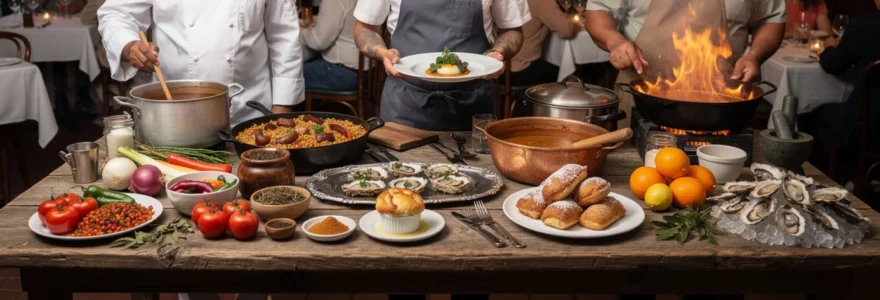
The culinary landscape of New Orleans stands as one of America’s most distinctive and influential food cultures, born from centuries of cultural convergence along the Mississippi River Delta. This vibrant gastronomic tradition emerged from the unique circumstances of colonial occupation, forced migration, and voluntary settlement that created an extraordinary fusion of flavours, techniques, and ingredients. The city’s position as a major port facilitated continuous cultural exchange, allowing diverse communities to contribute their culinary knowledge to what would become known as Creole and Cajun cuisine. From the sophisticated techniques of French colonial kitchens to the resourceful adaptations of enslaved African populations, New Orleans cuisine represents far more than mere sustenance—it embodies the complex social history and cultural resilience of one of America’s most unique urban environments.
Colonial french and spanish culinary foundations in new orleans gastronomy
The French colonial period established the foundational cooking techniques that would define New Orleans cuisine for centuries to come. French settlers brought with them classical European culinary methods, including the preparation of roux, the mother sauces of French cuisine, and sophisticated pastry techniques that would later influence iconic dishes like beignets and king cakes. These early colonists adapted their traditional recipes to accommodate local ingredients, creating the first iterations of what would become distinctly Louisiana dishes.
Creole cuisine development through french colonial techniques and ingredients
French colonial cooking methods provided the technical backbone for what would evolve into Creole cuisine. The use of roux as a thickening agent became central to numerous New Orleans dishes, from gumbo to étouffee. French settlers introduced dairy products, wine, and refined cooking techniques that elevated local ingredients beyond simple subsistence cooking. The concept of the “holy trinity” of vegetables—onions, celery, and bell peppers—emerged as a Louisiana adaptation of the French mirepoix, substituting locally available peppers for carrots that were less readily obtainable in the subtropical climate.
Spanish colonial influence on sofrito base and rice cookery methods
When Spanish rule succeeded French control in 1762, new culinary influences began reshaping local food culture. Spanish colonists introduced rice cultivation techniques and the concept of sofrito—a aromatic base of sautéed vegetables, herbs, and sometimes meat that forms the foundation of many dishes. This influence is most evident in jambalaya, which bears striking resemblance to Spanish paella but adapted to local ingredients and cooking methods. The Spanish also brought advanced preservation techniques for meats and seafood, crucial skills in the humid Louisiana climate.
West african culinary integration through enslaved population food traditions
Perhaps the most profound culinary influence came from the enslaved African populations who brought sophisticated knowledge of rice cultivation, vegetable preparation, and flavour combinations. West African cooking techniques introduced okra as both an ingredient and thickening agent, fundamentally changing the texture and character of local stews. The practice of one-pot cooking, which characterised many West African dishes, became integral to Louisiana cuisine through dishes like gumbo and jambalaya. These contributions represent far more than mere ingredients—they introduced entirely new approaches to combining flavours and creating satisfying, nutritious meals from limited resources.
Native american contribution of filé powder and sassafras root usage
Indigenous Choctaw communities provided crucial knowledge about local ingredients that would become essential to New Orleans cuisine. Filé powder, made from ground sassafras leaves, became an alternative thickening agent for gumbo, particularly valued for its distinctive earthy flavour and aromatic properties. Native Americans also shared knowledge about local seafood harvesting, seasonal ingredient availability, and preservation techniques adapted to the unique ecosystem of the Mississippi Delta.
Jazz era culinary innovation and restaurant culture evolution
The emergence of jazz music in the late 19th and early 20th centuries coincided with a golden age of culinary creativity in New Orleans. This period saw the establishment of legendary restaurants and the creation of iconic dishes that would define the city’s culinary reputation worldwide. The vibrant nightlife associated with jazz culture fostered a restaurant scene that catered to both locals and visitors, encouraging innovation and refinement in traditional dishes.
Antoine’s restaurant oysters rockefeller creation in 1899
Created at Antoine’s Restaurant in 1899, Oysters Rockefeller embodies the refined side of New Orleans cuisine at the dawn of the jazz era. The dish features oysters on the half shell baked under a rich, herb-laden butter sauce, originally so luxurious it was named after John D. Rockefeller, then the wealthiest man in America. While the exact original recipe remains a closely guarded secret, food historians agree that French techniques—such as precise sauce making and gratinéed finishes—anchor the preparation. As jazz began to spill from dance halls and clubs into the streets, Oysters Rockefeller became a symbol of the city’s elegant dining culture, offering visitors a taste of New Orleans that was as theatrical as the music itself.
Commander’s palace bread pudding soufflé development during prohibition
As New Orleans nightlife adapted to the restrictions of Prohibition in the 1920s, restaurants like Commander’s Palace leaned even more heavily on food to deliver a sense of indulgence. Bread pudding had long been a staple of Creole home kitchens, a thrifty dessert that transformed stale French bread, cream, sugar, and spices into something comforting and rich. Over time, chefs at Commander’s Palace refined this humble dish into the now-famous bread pudding soufflé, combining classic French pastry techniques with old Creole flavours. The result—light as a cloud yet anchored in rum sauce and warm custard—mirrors New Orleans itself: a city that repurposes the simplest ingredients into something unexpectedly grand. For diners today, ordering bread pudding soufflé is almost a ritual, a way to taste the layered history of New Orleans desserts in a single spoonful.
French quarter beignet culture at café du monde since 1862
Long before jazz bands filled the air of the French Quarter, beignets were already part of the city’s daily rhythm. Café du Monde, founded in 1862 in the French Market, popularised these square pillows of fried dough, showered in powdered sugar and served with chicory-laced coffee. Drawing on French dough and pastry techniques but adapted to local tastes, beignets became a democratic treat, enjoyed by dockworkers at dawn, musicians after late-night sets, and tourists at all hours. Sitting at a small green-and-white table, powdered sugar dusting your clothes as brass bands play nearby, you experience how a simple pastry can serve as a bridge between past and present. In many ways, the beignet stand functions like a public living room, where the diverse communities that define New Orleans cuisine briefly share the same table.
Preservation hall musicians’ influence on Late-Night food service patterns
With the rise of jazz performance spaces like Preservation Hall in the 1960s, the city’s food scene adjusted to the nocturnal schedules of musicians and their audiences. Late-night po-boys, bowls of gumbo, and plates of red beans and rice became as essential to the jazz experience as trumpets and trombones. Restaurants, corner groceries, and takeout counters around the French Quarter and Marigny extended their hours, creating a culinary ecosystem tailored to life after midnight. Think of these places as the backstage kitchen to the city’s musical performance—quietly fueling the artists who keep New Orleans culture alive. Even now, if you step out of a packed club near Preservation Hall, you’re rarely more than a short walk from something hot, spicy, and deeply rooted in local tradition.
Creole versus cajun culinary distinctions and regional variations
Many visitors arrive in New Orleans asking a simple question: what is the real difference between Creole and Cajun cuisine? While the two styles share ingredients and dishes, they evolved in distinct settings and reflect different histories. Creole food emerged in urban New Orleans, shaped by French, Spanish, African, Caribbean, and later Italian and German influences. Cajun cooking developed largely in rural Acadiana, created by French-speaking Acadian exiles who adapted to bayous, prairies, and swamps. Understanding these differences is crucial if you want to appreciate why a tomato-based Creole gumbo in Treme tastes so different from a dark roux Cajun gumbo served along a country roadside.
Urban creole Tomato-Based sauce techniques in treme and bywater districts
In historically Black neighbourhoods like Treme and in creative enclaves such as Bywater, Creole tomato-based sauces remain a defining feature of everyday cooking. Drawing from both French sauce technique and Spanish sofrito traditions, cooks build layers of flavour by slowly sautéing the trinity—onion, celery, and bell pepper—before adding garlic, herbs, and crushed or stewed tomatoes. These sauces become the backbone of dishes like shrimp Creole, smothered okra, and certain styles of Creole gumbo. Because New Orleans has long been a city of markets, kitchens here could experiment with imported canned tomatoes, fresh Creole tomatoes from nearby parishes, and preserved meats and seafood from local vendors. When you taste a simmering pan of tomato-based sauce in a Treme kitchen, you’re tasting centuries of urban adaptation, where global trade routes and neighbourhood traditions meet in one pot.
Acadiana parish cajun roux preparation methods and trinity vegetable base
Drive west from New Orleans into Acadiana and you enter the heartland of Cajun cuisine, where the roux reigns supreme. Unlike the lighter blond roux often used in European cooking, Cajun roux is cooked slowly to a deep chocolate colour, requiring patience, constant stirring, and an experienced eye. Home cooks describe making roux as “babysitting a pot,” and for good reason: one burned batch can ruin an entire gumbo. Once the roux reaches the desired shade, the trinity of onion, celery, and bell pepper is added to stop the cooking and infuse the fat with aromatic flavour. This technique yields gumbos and stews that are earthier and smokier than their Creole counterparts, with a depth that reflects the resourceful, rural lifestyle of Cajun communities.
Plaquemines parish citrus integration in traditional creole recipes
South of New Orleans, Plaquemines Parish has long served as the citrus basket of Louisiana, its groves producing oranges, satsumas, and Meyer lemons that quietly shaped regional recipes. Creole cooks learned to brighten rich sauces and seafood dishes with a squeeze of local citrus, achieving a balance that cut through butter and spice. Classic trout meunière, for example, often features lemon or orange accents that reveal this coastal connection. Even gumbo z’herbes and seafood gumbos may be finished with a hint of lemon to sharpen their complex flavours. For contemporary chefs focused on farm-to-table sourcing, Plaquemines citrus remains an essential ingredient, linking modern New Orleans cuisine to the orchards that line the lower Mississippi.
St. bernard parish croatian community oyster farming impact
Another less obvious influence on New Orleans cuisine comes from the Croatian immigrant community of St. Bernard Parish. Beginning in the late 19th century, Croatian fishermen and oystermen played a central role in developing the region’s oyster industry. Their expertise in cultivating, harvesting, and distributing oysters ensured a steady supply to New Orleans restaurants, from humble bars serving raw oysters to grand dining rooms plating Oysters Rockefeller and charbroiled oysters. Today, when you enjoy Gulf oysters on the half shell at a French Quarter counter, you’re tasting the legacy of this community’s labour and knowledge. Their story underscores how immigrant groups, often working behind the scenes, have shaped the seafood traditions that define New Orleans cuisine.
Caribbean and latin american migration influence on contemporary new orleans food scene
Given New Orleans’ position on the Gulf of Mexico, it is no surprise that waves of Caribbean and Latin American migration have left a distinct mark on the city’s food. Early influences came through trade with Haiti, Cuba, and other Caribbean islands, bringing spices, rum, and cooking techniques that blended seamlessly into Creole kitchens. In the 20th and 21st centuries, newer immigrant communities from Mexico, Honduras, El Salvador, and beyond added pupusas, arepas, and tacos al pastor to the city’s culinary map. Walk through neighbourhoods like Mid-City or New Orleans East today and you’ll find panaderías, taquerías, and Central American lunch counters feeding construction workers, families, and curious food lovers alike.
The result is a contemporary New Orleans food scene where gumbo might share menu space with mofongo, and where a po-boy can be stuffed with carne asada as easily as with fried shrimp. After the Vietnam War, Vietnamese refugees introduced pho and bánh mì, which are now as embedded in local life as red beans and rice. Some scholars describe New Orleans cuisine as a “perpetual gumbo,” with new cultural ingredients continually stirred into the pot without erasing what came before. For travellers and home cooks, this means that exploring New Orleans food today involves looking beyond the French Quarter to discover small, family-run spots where Latin American and Caribbean flavours intermingle with long-standing Creole and Cajun traditions.
Post-hurricane katrina culinary renaissance and Chef-Driven restaurant movement
Hurricane Katrina in 2005 devastated New Orleans, but it also marked the beginning of a profound culinary renaissance. As residents returned and rebuilt, chefs and restaurateurs saw both a responsibility and an opportunity: to preserve traditional dishes while reimagining what New Orleans cuisine could be in the 21st century. Chef-driven restaurants emerged across the city, from revitalised landmarks in the French Quarter and Garden District to bold newcomers in neighbourhoods like the Bywater, the Warehouse District, and Freret Street. Menus began to highlight local farms, Gulf fisheries, and heritage producers, blending classic preparations with global techniques.
This new wave of New Orleans restaurants often treats Creole and Cajun recipes as living documents rather than fixed relics. You might encounter duck and andouille gumbo enriched with heirloom rice, or a modern take on jambalaya featuring sustainably sourced Gulf seafood. At the same time, many chefs—both local and from away—emphasise respect for long-standing community establishments, sending diners to po-boy shops, plate-lunch counters, and sno-ball stands that helped sustain the city after the storm. For you as a visitor or cook, the takeaway is clear: New Orleans cuisine is not just something to observe in museums or old cookbooks. It’s an evolving conversation, and every new restaurant, pop-up, and food truck adds another line to the story.
Traditional new orleans cooking techniques and equipment methodology
Behind every memorable dish in New Orleans lies a set of time-honoured cooking techniques and pieces of equipment that shape flavour and texture. Heavy cast-iron pots and skillets are indispensable for making dark roux, frying beignets, or searing Gulf fish; their even heat and durability make them ideal for slow, careful cooking. Many homes and restaurants rely on wide, shallow pots for jambalaya, allowing rice to cook evenly and develop the prized “crust” on the bottom, similar to Spanish socarrat. Long-handled wooden spoons are more than nostalgic props—they’re practical tools that help cooks stir roux or simmering stews without burning their hands, a small but telling example of how form follows culinary function.
Smoking and open-fire cooking remain central techniques, especially in Cajun country but also in backyards and restaurants across the city. Smoked andouille sausage, tasso ham, and other cured meats lend depth to red beans and rice, gumbo, and greens, much like a bass line supports a jazz band. Frying—whether for oysters, catfish, or chicken—relies on maintaining consistent oil temperatures, often in deep cast-iron pots that retain heat well. Even modern kitchens, with induction ranges and convection ovens, still make room for these traditional tools because they deliver flavours that newer equipment struggles to replicate. If you’re cooking New Orleans recipes at home, investing in a good cast-iron pot, a sturdy wooden spoon, and the patience to build flavour slowly will bring you much closer to the dishes you love to eat in the Crescent City.