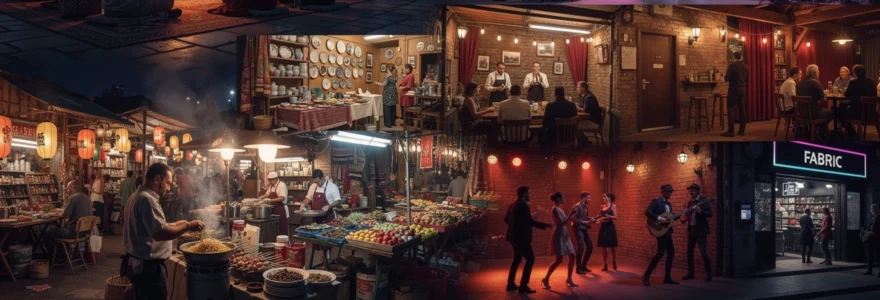
Travel transforms after sunset, revealing layers of local culture that remain hidden during daylight hours. Night markets buzz with authentic culinary traditions, underground venues pulse with alternative music scenes, and spiritual sites take on profound new meanings under starlit skies. These nocturnal experiences offer travellers authentic glimpses into the soul of a destination, far removed from typical tourist attractions.
The darkness brings forth a different rhythm of life, where locals gather in spaces that define their cultural identity. Street vendors prepare traditional recipes passed down through generations, musicians perform in intimate venues that shape entire music movements, and spiritual communities engage in centuries-old rituals. This after-hours world operates according to its own rules, creating opportunities for genuine cultural exchange and understanding.
Nocturnal cultural immersion through traditional night markets and street food scenes
Night markets represent the beating heart of local food culture, where authentic flavours emerge from humble stalls and generations-old recipes come alive. These vibrant spaces showcase culinary traditions that have evolved over centuries, offering travellers unfiltered access to regional specialities and cooking techniques rarely found in formal restaurants.
The sensory experience of navigating bustling night markets creates lasting memories through aromatic spices, sizzling woks, and animated conversations between vendors and customers. Local families gather around plastic tables, sharing meals that represent their cultural heritage, while seasoned cooks demonstrate techniques perfected through decades of practice.
Bangkok’s chatuchak weekend night market culinary authenticity
Bangkok’s Chatuchak Weekend Night Market transforms into a culinary wonderland after dark, featuring over 400 food vendors serving regional Thai specialities. The market’s narrow alleyways fill with smoke from grilling satay skewers and the sweet aroma of mango sticky rice, creating an immersive sensory experience that captures Thailand’s diverse regional cuisines.
Vendors specialise in dishes specific to their home provinces, from northern Thailand’s khao soi curry noodles to southern som tam papaya salad variations. The market provides opportunities to witness traditional cooking methods, including hand-pulled noodle preparation and coconut milk extraction using vintage equipment passed down through family generations.
Marrakech’s jemaa el-fnaa square After-Dark storytelling traditions
Marrakech’s iconic Jemaa el-Fnaa Square undergoes a magical transformation at sunset, evolving from a daytime marketplace into an open-air theatre of traditional Moroccan culture. Storytellers known as hlaiqia gather crowds around them, reciting ancient Berber tales in Arabic while food vendors prepare tagines and grilled meats over charcoal braziers.
The square’s evening atmosphere captures Morocco’s oral tradition heritage, where professional storytellers maintain cultural narratives through dramatic performances enhanced by traditional music. Snake charmers, henna artists, and musicians create a tapestry of cultural expression that represents centuries of Moroccan artistic tradition, offering visitors authentic encounters with North African cultural practices.
Istanbul’s kadıköy night bazaar local artisan interactions
Istanbul’s Kadıköy district transforms into a vibrant night bazaar where local artisans showcase traditional Turkish crafts alongside contemporary food offerings. The area’s narrow streets fill with vendors selling everything from Turkish delight variations to handmade textiles, creating opportunities for meaningful interactions with skilled craftspeople.
Local artisans demonstrate traditional techniques such as copper hammering, carpet weaving, and ceramic painting while explaining the cultural significance behind their work. The bazaar atmosphere encourages conversations about Turkish history, family traditions, and the evolution of traditional crafts in modern Istanbul society.
Mexico city’s mercado de san juan midnight gastronomic adventures
Mexico City’s Mercado de San Juan operates as a 24-hour culinary adventure, where night shifts reveal Mexico’s most adventurous food culture. The market specialises in exotic ingredients and traditional preparations that challenge conventional perceptions of Mexican cuisine, from escamoles (ant larvae) to indigenous mushroom varieties.
Late-night vendors prepare pre-Hispanic dishes using ingredients sourced from remote Mexican regions, offering tastings that connect visitors with Mexico’s ancient culinary heritage. The market’s midnight hours attract local ch
f chefs, night-shift workers, and curious locals seeking hearty meals before dawn. For travellers, these midnight gastronomic adventures provide insight into how Mexico City sustains its 24-hour rhythm, revealing a side of the city where culinary experimentation, tradition, and necessity meet under fluorescent lights rather than sunshine.
Underground music venues and alternative nightlife ecosystems
Beyond mainstream clubs and tourist-oriented bars, underground music venues reveal the creative undercurrents that shape a city’s identity. These alternative nightlife ecosystems often emerge in former warehouses, basements, or repurposed cultural spaces, where local communities experiment with sound, fashion, and social norms. Experiencing nightlife through these venues allows you to witness how residents actually gather, express themselves, and push cultural boundaries after dark.
From techno temples to intimate jazz halls, each city cultivates its own nocturnal soundtrack that reflects historical influences and contemporary struggles. Nighttime activities centred around music and dance become spaces of resistance, innovation, and community building. When you step into these venues, you are not simply attending a show; you are entering living laboratories of culture that challenge the polished image presented to daytime visitors.
Berlin’s berghain techno subculture immersion
Berlin’s Berghain has become synonymous with underground techno culture, representing a global pilgrimage site for electronic music enthusiasts. Housed in a former power plant, the club’s imposing concrete structure mirrors the raw, industrial soundscapes that define its legendary dance floors. Strict door policies and a no-photos rule protect the space as a sanctuary for self-expression, where fashion, identity, and social hierarchies are temporarily suspended.
For those who gain entry, a night at Berghain can last well into the following afternoon, blurring traditional concepts of time and nightlife. Resident DJs and international artists experiment with extended sets that turn the main room into a continuous sonic journey rather than a sequence of individual performances. By immersing yourself in this techno subculture, you gain insight into Berlin’s post-reunification identity, where abandoned industrial spaces were reclaimed as creative playgrounds for a generation seeking freedom and community.
New orleans’ preservation hall late-night jazz sessions
New Orleans’ Preservation Hall offers an intimate glimpse into the birthplace of jazz, especially during its late-night sessions. Tucked away in the French Quarter, the unassuming venue prioritises acoustic authenticity over flashy production, with wooden benches, minimal lighting, and a focus squarely on the musicians. Nighttime performances often attract both locals and informed travellers, creating a shared reverence for the city’s musical heritage.
As you listen to brass instruments and gravelly vocals fill the small room, you experience jazz as it was meant to be heard: up close, improvisational, and deeply emotional. The musicians often share stories about the history of each piece, linking the present performance to a long lineage of African American artistry and resilience. These late-night jazz sessions reveal a side of New Orleans where time slows down, and the city’s complex history is communicated more powerfully through melody than through museums.
Melbourne’s laneway bar hidden speakeasy culture
Melbourne’s famous laneways hide a thriving speakeasy culture that only truly comes alive after dark. Unmarked doors, discreet staircases, and subtle signage lead to intimate bars specialising in craft cocktails, natural wines, and local spirits. Navigating these hidden venues feels like solving a puzzle, rewarding curious travellers who move beyond the city’s main thoroughfares.
Inside, bartenders often act as informal cultural ambassadors, recommending neighbourhood eateries, local artists, and upcoming events while crafting inventive drinks. The atmosphere encourages slow conversations and a sense of discovery, contrasting sharply with louder, more commercial nightlife districts. By exploring Melbourne’s laneway bars, you glimpse a more refined, creative side of the city where design, mixology, and storytelling merge into a distinct after-hours culture.
Havana’s casa de la música live salsa performances
In Havana, Casa de la Música venues provide an essential introduction to Cuba’s vibrant salsa culture after dark. Live bands energise packed dance floors with complex rhythms that combine African, Caribbean, and Spanish influences, while locals of all ages showcase intricate dance moves. Travellers are often invited to join in, turning the night into an informal dance lesson and cultural exchange.
Experiencing salsa in its local context reveals how music functions as both entertainment and social glue in Cuban society. The interplay between musicians, dancers, and onlookers creates a participatory atmosphere where the line between performer and audience dissolves. These live salsa performances offer more than a show; they provide direct insight into Cuban resilience, joy, and community spirit, all amplified by the energy of the night.
London’s fabric club electronic music heritage
London’s Fabric club has played a foundational role in the evolution of electronic music, particularly drum and bass, house, and techno. Located in a converted meatpacking warehouse in Farringdon, the venue is renowned for its meticulously tuned sound system and labyrinthine layout of multiple rooms. Nighttime events often feature back-to-back sets from established DJs and emerging talent, reflecting the city’s ongoing commitment to musical innovation.
Attending a night at Fabric introduces you to London’s broader club culture, shaped by decades of underground raves, legal battles, and community activism. The club’s survival through licensing challenges underscores how important nightlife is to the city’s cultural ecosystem and creative economy. As you move between rooms, you witness an ever-evolving conversation between genres, generations, and communities that rarely appears in daytime city guides.
After-hours religious and spiritual observances
Spiritual sites often reveal their most profound dimensions after sunset, when crowds thin and rituals take on a more contemplative tone. Nighttime religious observances allow you to experience faith communities in their own rhythm, without the distraction of daytime tourism. Whether through chanting, candlelit processions, or silent prayer, these moments offer a window into the values and beliefs that shape local life.
Engaging respectfully with these after-hours ceremonies can feel like entering a different world, even within the same city you explored earlier that day. You may notice how architecture interacts with moonlight, how incense or bells change the atmosphere, and how participants relate to one another in sacred spaces. These experiences remind us that a destination’s identity is not defined solely by food or entertainment, but also by the spiritual practices that structure daily existence.
Varanasi ganga aarti evening prayer ceremonies
In Varanasi, the Ganga Aarti evening prayer ceremonies along the ghats of the Ganges River transform the city into a glowing tapestry of devotion. As the sun sets, priests in saffron robes perform synchronised rituals using oil lamps, incense, and chanting, honouring the river as a living goddess. Hundreds of locals and pilgrims gather on the steps or in small boats, creating a shared spiritual experience that is both intimate and monumental.
Observing the Ganga Aarti at night reveals how deeply the river is woven into the cultural and religious fabric of northern India. The flicker of flames against the dark water, combined with the rhythmic sound of bells and mantras, creates an atmosphere that is difficult to capture in photographs or daytime visits. For respectful travellers, attending the ceremony offers a powerful opportunity to reflect on concepts of life, death, and renewal that underpin Varanasi’s identity.
Jerusalem’s western wall midnight prayer gatherings
Jerusalem’s Western Wall takes on a different character after midnight, when smaller crowds and cooler temperatures foster quieter, more personal acts of devotion. Worshippers of all ages approach the ancient stones to pray, read religious texts, or simply sit in contemplation, often staying for hours. The relative calm contrasts sharply with the busy atmosphere of the Old City during the day.
Visiting the Western Wall at night allows you to witness how faith is practiced in daily life, beyond official ceremonies and tour groups. You may see families marking significant life events, students engaged in late-night study, or individuals deep in silent conversation with the divine. This nocturnal perspective highlights Jerusalem’s role as a living spiritual centre rather than just a historical attraction.
Kyoto’s fushimi inari shrine nocturnal pilgrimage routes
Kyoto’s Fushimi Inari Shrine, famous for its thousands of vermilion torii gates, offers a more introspective experience at night. After dark, the main paths remain softly illuminated, while higher mountain trails fall into near silence, broken only by the sound of wind and distant city life. Walking these nocturnal pilgrimage routes allows you to experience Shinto spirituality as a dialogue between humans and the natural world.
As you ascend through the gates, the shrine’s daytime crowds give way to solitary walkers and small groups of locals paying respects to the kami associated with prosperity and agriculture. The play of shadows and lantern light on the torii creates an almost otherworldly atmosphere, as if you are moving through a threshold between visible and invisible realms. This nighttime visit reveals a meditative side of Kyoto that balances its reputation for busy temples and tourist hotspots.
Vatican city’s st. peter’s basilica evening mass attendance
In Vatican City, attending an evening mass at St. Peter’s Basilica offers a different perspective on one of the world’s most visited religious sites. With fewer tourists and softer lighting, the immense interior feels less like a monument and more like a functioning place of worship. Choir music reverberates through the domes and chapels, drawing attention away from architectural details and toward the spiritual purpose of the space.
Participating in or quietly observing an evening service allows you to see how local residents, clergy, and international visitors engage with Catholic rituals in a more relaxed setting. The experience underscores that, despite its grandeur and political significance, the Vatican also serves as a community church. This after-hours lens helps balance the daytime image of long queues and camera flashes with a deeper understanding of living faith traditions.
Nocturnal wildlife encounters and night safari experiences
Many animals are most active at night, making nocturnal wildlife encounters a powerful way to experience a destination’s natural environment. Night safaris and guided walks reveal ecosystems that remain hidden during the day, from bioluminescent insects to elusive predators. With the right guides and ethical operators, you can observe these creatures in their natural rhythms without disturbing delicate habitats.
In locations such as Singapore, Kenya, Costa Rica, and Australia, specialised night tours use red light or infrared technology to minimise impact while maximising visibility. You might watch leopards on the hunt, hear howler monkeys calling through the darkness, or spot sugar gliders gliding between trees. These experiences highlight the importance of conservation, reminding us that the destinations we enjoy are also home to complex nocturnal communities that depend on dark skies and quiet landscapes.
When considering a night safari, it is crucial to choose operators who follow responsible wildlife tourism guidelines, such as limiting vehicle numbers, keeping a respectful distance, and avoiding flash photography. Doing so helps ensure that your nighttime adventure supports local conservation efforts rather than harming the very animals you came to see. In return, you gain insight into the fragile balance between tourism, development, and biodiversity that defines many of the world’s most remarkable destinations.
Industrial heritage tours and night shift worker communities
While many travellers focus on historic districts and cultural landmarks, industrial heritage tours reveal how cities actually function after dark. Night shift worker communities keep transportation systems running, maintain power grids, process food, and staff hospitals, often invisible to daytime visitors. Exploring this side of a destination can reshape your understanding of local economies, labour histories, and social dynamics.
Some cities now offer guided nighttime tours of ports, factories, or former industrial zones that have been converted into cultural spaces. In places like Rotterdam, Pittsburgh, or Osaka, these tours may include visits to illuminated shipyards, rail yards, or steel bridges, where guides explain how industry shaped the city’s growth. Meeting workers during shift breaks or hearing recorded oral histories helps humanise the statistics behind manufacturing and logistics, turning abstract supply chains into personal stories.
Engaging with industrial heritage at night also highlights ongoing debates around automation, labour rights, and urban redevelopment. As you observe container ships being unloaded or machinery operating under floodlights, you confront the hidden infrastructure that supports global travel and consumption. This awareness can make you a more thoughtful traveller, prompting questions about who benefits from tourism, who works behind the scenes, and how cities can honour their industrial past while planning for a sustainable future.
Astronomical tourism and dark sky observation activities
Far from city lights, nighttime opens a window to the cosmos through astronomical tourism and dark sky observation activities. Destinations with low light pollution, such as remote national parks, high-altitude deserts, or designated Dark Sky Reserves, allow you to see the Milky Way, meteor showers, and distant galaxies with stunning clarity. Stargazing experiences range from simple naked-eye observation to guided telescope sessions led by professional astronomers or trained local guides.
Regions like Chile’s Atacama Desert, New Zealand’s Aoraki Mackenzie, and parts of Namibia have become renowned for their stargazing tourism, combining clear skies with educational programming. You might learn to identify constellations from both Western and Indigenous perspectives, gaining insight into how different cultures have interpreted the night sky for navigation, agriculture, and storytelling. This blend of science and mythology turns astronomical tourism into a form of cultural immersion as well as a visual spectacle.
Participating in dark sky activities also underscores the growing global concern over light pollution, which obscures stars for more than 80% of the world’s population. By supporting destinations and accommodations that prioritise responsible lighting and environmental stewardship, you contribute to preserving the night sky as a shared natural resource. In the process, you discover a quieter, more reflective dimension of travel, where looking up at the universe helps put your journey—and the destinations you visit—into a broader, humbling context.