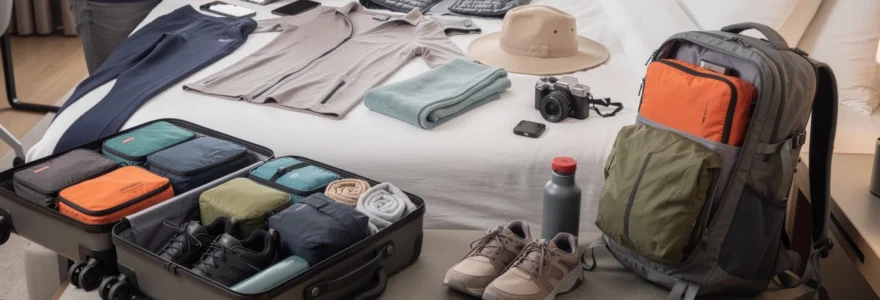
The art of mobility-focused packing represents a fundamental shift from traditional travel approaches, where convenience and efficiency take precedence over sheer quantity. Experienced travellers understand that true freedom comes not from carrying everything they might need, but from carefully selecting items that maximise utility while minimising physical burden. This strategic mindset transforms the entire travel experience, enabling spontaneous decisions, comfortable transitions between destinations, and the ability to navigate diverse environments with confidence. The modern traveller’s approach to packing reflects years of accumulated wisdom about what truly matters on the road.
Professional nomads and frequent travellers have developed sophisticated methodologies that go far beyond simple space-saving techniques. Their strategies encompass weight distribution principles, material science applications, and technological integration that creates a seamless travel ecosystem. Understanding these advanced concepts can revolutionise your own travel experiences, whether you’re embarking on a weekend city break or a months-long global adventure.
Strategic weight distribution: Multi-Zone packing architecture for extended travel
Weight distribution forms the cornerstone of mobility-focused travel, yet many travellers overlook its fundamental principles. The concept extends beyond simply limiting total weight to encompass how that weight affects your body’s natural movement patterns and energy expenditure throughout extended travel days. Professional travellers understand that a 15-kilogram load distributed incorrectly can feel significantly heavier and more fatiguing than a well-balanced 18-kilogram configuration.
The human body’s biomechanical efficiency dramatically decreases when weight shifts away from the centre of gravity. This principle applies whether you’re using wheeled luggage through airport terminals or carrying a backpack across cobblestone streets. Strategic weight placement can reduce perceived effort by up to 40%, according to ergonomic studies conducted with long-distance hikers and military personnel carrying extended loads.
Compartmentalised load management using packing cubes and compression sacks
Packing cubes represent far more than simple organisation tools; they function as modular weight management systems that enable precise load balancing. Professional travellers employ different cube densities and sizes to create predictable weight zones within their luggage. Heavy items like electronics and toiletries occupy specific cube positions that maintain optimal balance, whilst lighter clothing fills volume gaps without disrupting the established weight architecture.
Compression sacks serve dual purposes in advanced packing systems. Beyond their obvious space-saving benefits, they create weighted modules that can be strategically positioned to achieve desired balance points. A compressed down jacket, for example, becomes a dense, easily positioned weight that can counterbalance heavier items located elsewhere in the pack.
Centre of gravity optimisation in wheeled luggage systems
Wheeled luggage presents unique challenges for weight distribution, particularly when transitioning between rolling and carrying configurations. The optimal centre of gravity for rolling differs significantly from that required for comfortable lifting and carrying. Advanced travellers pack their wheeled luggage with this dual-purpose functionality in mind, placing dense items in the lower half of the main compartment whilst ensuring the handle-side weight doesn’t create excessive pulling forces during extended rolling periods.
Four-wheeled spinner luggage requires different weight distribution strategies compared to two-wheeled models. The 360-degree manoeuvrability of spinners performs best when weight remains centred both horizontally and vertically within the case. Two-wheeled designs, conversely, benefit from slightly forward weight bias that reduces the lifting effort required to initiate rolling motion.
Ergonomic load balancing for backpack configurations
Backpack weight distribution follows established principles from mountaineering and military applications, adapted for urban travel environments. The heaviest items should sit close to your back, positioned between shoulder blade level and the small of your back. This placement keeps weight aligned with your spine’s natural load-bearing capacity whilst maintaining balance during dynamic movements like climbing stairs or navigating crowded public transport.
The 80/20 principle applies effectively to backpack loading: 80% of your gear weight should occupy the main compartment’s central zone, with the remaining 20% distributed in peripheral pockets for balance and accessibility. Items you’ll need during travel days—documents, electronics, snacks—should be easily accessible without disturbing the main load’s carefully established weight distribution.
Weight-to
Weight ratio calculations become particularly important when navigating strict international flight restrictions. Many airlines now enforce 7–10 kg limits for cabin baggage and 20–23 kg for checked luggage, often with dimensional limits as well. Seasoned travellers work backwards from these constraints, assigning approximate target weights to each packing zone: core clothing, outerwear, electronics, toiletries and accessories. This deliberate allocation prevents the common scenario where one overbuilt category—usually tech gear or shoes—quietly consumes your entire allowance.
A practical approach is to calculate the weight-to-volume ratio of your heaviest categories. Dense items such as laptops, camera bodies and chargers may occupy only 20–30% of your luggage volume yet represent 50% or more of total weight. By pre-weighing these modules with a digital luggage scale and logging approximate figures, you can make informed trade-offs before departure rather than re-packing in the check-in queue. Think of it as budgeting: once you know your “weight spend” per category, you can consciously decide where to invest or cut back.
Climate-adaptive textile selection: technical fabric performance standards
Experienced travellers rarely think in terms of “outfits” first; they think in terms of textile systems matched to climate profiles. Instead of packing a different set of clothes for every destination, they rely on a small, modular wardrobe built around high-performance fabrics that function across temperature swings, humidity changes and varying activity levels. This climate-adaptive approach is the backbone of packing light for long-term travel while staying comfortable and presentable.
Modern technical textiles are engineered to manage heat, moisture and UV exposure far more efficiently than traditional cotton-heavy wardrobes. When you understand what different fabrics are designed to do—and their limitations—you can build a capsule travel wardrobe that works from air-conditioned airports to humid streets and chilly overnight buses. The goal is simple: fewer pieces, more performance, less bulk.
Merino wool base layer systems for temperature regulation
Merino wool has become a cornerstone of mobility-focused packing because of its uniquely broad comfort range. Unlike traditional wool, fine-gauge Merino fibres (typically 17–19 microns) are soft against the skin, naturally breathable and capable of regulating temperature in both warm and cool conditions. Studies from textile research institutes show Merino can absorb up to 30% of its own weight in moisture vapour without feeling wet, then slowly release it, which dramatically reduces clamminess during travel days.
Seasoned travellers typically rely on a two- or three-piece Merino base system: a lightweight short-sleeve or long-sleeve top, a pair of Merino socks and sometimes leggings for cooler climates or overnight flights. These pieces can be worn repeatedly without developing odour thanks to wool’s natural antimicrobial properties, making them ideal for trips where laundry access is irregular. You might wear the same Merino T-shirt for three flights and several city days, rinsing it only occasionally, without compromising comfort or social acceptability.
Merino’s one drawback is durability relative to synthetics, especially at lower price points. To offset this, experienced travellers treat Merino pieces as core layers rather than all-purpose workhorses: worn closest to the skin and combined with more abrasion-resistant outer layers like nylon or polyester. This system preserves the performance benefits while extending lifespan, which is important if you’re travelling for months at a time.
Synthetic insulation performance: PrimaLoft vs synthetic down alternatives
When it comes to insulating layers, the choice between different synthetic fills can have a noticeable impact on both warmth and packability. PrimaLoft, originally developed for the US military, remains one of the most respected synthetic insulations because it retains a high percentage of its warmth even when damp and compresses efficiently. Independent lab tests often show premium PrimaLoft variants approaching 80–90% of the warmth-to-weight ratio of quality down, with far better wet-weather performance.
“Synthetic down” alternatives—proprietary blends from various outdoor brands—generally aim to mimic the loft and feel of natural down clusters. They tend to be slightly bulkier than PrimaLoft for the same warmth, but they are more forgiving in everyday travel conditions and usually more affordable. For a mobility-focused packing list, many seasoned travellers favour a lightweight synthetic jacket in the 60–100 g/m² insulation range, which hits the sweet spot between urban wearability and genuine warmth on cold buses or mountain viewpoints.
How do you decide what to pack for a long trip that spans multiple seasons? A simple rule is to choose one active insulation piece (synthetic jacket or vest) that layers easily over a Merino base and under a shell. This three-layer system—base, insulation, shell—can handle everything from a cool evening in Lisbon to a sudden storm at altitude in Peru, all while fitting into a compact compression sack in your luggage.
Moisture-wicking fabric technologies: coolmax and Dri-FIT applications
Moisture management is critical for travel comfort, especially in humid climates or on long transfer days where you can’t immediately change clothes. Fabrics powered by technologies like Coolmax and Dri-FIT are designed to pull sweat away from the skin and spread it across a larger surface area for quicker evaporation. The result is less cling, fewer visible sweat patches and a more stable body temperature—key when you’re navigating crowded stations or sprinting to catch a connection.
Many travellers assume these fabrics are only for sportswear, but high-quality travel polos, T-shirts and even button-down shirts now incorporate moisture-wicking yarns. A single neutral-coloured Dri-FIT T-shirt can serve as a gym top, sleep shirt and under-layer beneath a casual shirt or jumper, dramatically increasing versatility. Just as importantly, these synthetics dry far faster than cotton after sink washing, which supports the “one-week clothing” rule many long-term travellers follow.
The main trade-off is that pure synthetics can trap odours more quickly than Merino if worn repeatedly without washing. This is why experienced packers often mix fibres: Merino or Merino-blend pieces for base layers that will be re-worn over several days, and technical synthetics for high-sweat activities where rapid drying is paramount. Treat synthetics as your “workhorse” layers and rotate them with wool to keep both performance and freshness high.
UV protection rating systems in travel garments
When you’re spending extended time outdoors—walking city streets, taking day hikes or working from sunlit terraces—UV exposure becomes an important packing consideration. Many travel garments now carry an Ultraviolet Protection Factor (UPF) rating, which indicates how effectively the fabric blocks UV radiation. A UPF 50 rating, for example, allows only 1/50th of UV rays to penetrate, providing significantly more protection than a standard cotton T-shirt, which may have an effective UPF of 5–10.
Why does this matter for mobility-focused packing? Because sun-protective clothing reduces your reliance on sunscreen for everyday exposure, which in turn lightens your toiletry kit and eliminates the need for constant reapplication on travel days. A single long-sleeve UPF 50 shirt can replace a combination of short-sleeve tops and extra sunscreen, especially in equatorial or high-altitude destinations where UV intensity is stronger. It’s a subtle optimisation that yields both health and packing benefits.
When choosing UV-protective travel garments, look for labels specifying tested UPF values rather than vague phrases like “sun protective.” Darker colours generally offer better natural protection, though modern fabric treatments can significantly improve lighter shades as well. Combine UPF clothing with a wide-brimmed hat and UV-rated sunglasses and you have a compact, highly effective sun protection system that adds almost no extra weight to your luggage.
Multi-purpose gear integration: versatile equipment selection protocols
One defining habit of seasoned travellers is their instinctive preference for multi-purpose gear over single-use items. Every object is evaluated not only for how well it performs its primary function, but also for how many secondary roles it can fulfil. This mindset is what allows professionals to travel for months with a single carry-on while still feeling fully equipped for work, leisure and unexpected situations.
Consider the difference between packing a bulky beach towel and a high-quality microfibre travel towel. The latter can serve as a bath towel, beach mat, makeshift blanket on overnight buses and even as an improvised packing padding for fragile items. A lightweight scarf or buff can become a sun shield, eye mask, neck warmer or cultural cover-up at religious sites. Each multi-role item reduces the need to pack additional objects, compounding your weight and space savings across the entire system.
To apply this in practice, establish a simple protocol before adding anything to your packing list: ask yourself whether the item can reliably perform at least two functions, ideally three. A packable down or synthetic jacket, for instance, works as your primary insulation layer, an in-flight pillow when stuffed into its own hood and an emergency cushion on hard benches. Over time, this deliberate selection process shapes a kit where every gram you carry is working hard for you, rather than just filling space “just in case.”
Digital nomad technology stack: essential connectivity hardware
For digital nomads and remote workers, mobility is not just about physical movement; it is also about maintaining a stable, secure digital environment as you move between countries, networks and time zones. The technology stack you choose directly influences how light you can travel without compromising your ability to work. Overpacking tech leads to heavy bags and tangled cables; underpacking can mean missed deadlines and unreliable connections.
The goal is to create a lean but resilient connectivity kit that functions in cafés, co-working spaces, hotel rooms and rural guesthouses alike. This typically includes a primary work device (lightweight laptop or high-performance tablet), a universal power solution, a portable WiFi hotspot for backup connectivity and a disciplined cable management system. Each component needs to be selected with weight, durability and international compatibility in mind, not just raw performance specs.
Universal power adapter specifications for global voltage compatibility
A universal power adapter is one of the few truly non-negotiable items for international, mobility-focused packing. Power outlets vary widely by country, and voltage can range from 110V to 240V; using the wrong configuration can render your tech useless or even damage it. Modern universal adapters consolidate multiple plug standards (commonly Type A, C, G and I) into a single compact unit, often with integrated USB-A and USB-C ports to charge several devices simultaneously.
When choosing an adapter, look beyond the basic plug shapes. Seasoned travellers prioritise models rated for at least 2000–2500 W to safely handle laptops and small appliances, with built-in surge protection to buffer against unstable grids sometimes found in developing regions. Many also opt for adapters with interchangeable regional modules rather than a single all-in-one block, as these tend to be more robust and easier to repair or replace component by component.
It is important to understand that most universal adapters do not convert voltage; they simply adapt the plug shape. Fortunately, nearly all modern laptops, phones and cameras are dual-voltage (100–240V) and will work worldwide when paired with the correct adapter. Always check the fine print on your device chargers, and if you carry any single-voltage appliances—such as certain hair tools—consider leaving them at home or replacing them with dual-voltage travel versions to keep your packing system simple.
Portable WiFi hotspot performance: skyroam vs GlocalMe comparison
Relying solely on local SIM cards and public WiFi can be risky if your work demands constant connectivity. Portable WiFi hotspots bridge this gap by providing a personal, encrypted network that travels with you. Two of the most popular options in the digital nomad community are Skyroam (now Solis) and GlocalMe, both of which offer pay-as-you-go or subscription-based data across dozens of countries.
Skyroam devices typically use a day-pass or monthly unlimited model, which can be attractive if you have short, intense bursts of travel or remote work. Their hardware is simple, with a single button interface and global coverage in over 130 countries. GlocalMe, by contrast, often appeals to travellers who prefer granular control over data usage, offering regional data packages and the ability to insert local SIM cards for even cheaper rates when available. Performance tests from independent reviewers frequently find both systems adequate for email, calls and standard productivity tasks, with 4G speeds where local networks support it.
Which is better for long-term, mobility-focused travel? If you move quickly between many countries, Skyroam’s flat-rate simplicity may justify its slightly higher per-day cost. If you tend to stay weeks in one region, GlocalMe’s flexible local plans and dual-SIM capabilities can significantly reduce your connectivity expenses while keeping your tech stack light. In both cases, the key advantage is reliability: having your own hotspot means you are not at the mercy of a café’s overloaded router when a deadline looms.
Cable management systems for multi-device charging solutions
Cables and chargers are deceptively small, but unmanaged they can add weight, create clutter and slow you down at airport security and co-working spaces. Effective cable management is less about buying elaborate organisers and more about ruthless standardisation. Wherever possible, experienced travellers consolidate around a single connector type—usually USB-C—for phones, tablets, some cameras and even newer laptops, allowing one or two high-quality cables to replace a tangle of proprietary leads.
To keep everything usable and accessible, many professionals use a compact tech pouch with two or three clearly defined zones: power (charger bricks and adapter), data (cables, card readers, external drives) and audio (earbuds, headset). This compartmentalised setup mirrors the load management approach used with packing cubes, making it easy to pull out exactly what you need without disrupting your entire bag. A few elastic loops or small mesh pockets are usually sufficient; the goal is predictability, not perfection.
Think of your charging kit as a miniature life-support system for your digital workflow. A single failed cable can cost you a day of productivity if you’re far from a reliable electronics shop. For this reason, seasoned digital nomads pack at least one spare of their primary charging cable and a lightweight backup wall charger. It’s a tiny redundancy that dramatically increases resilience while adding only a few grams to your overall packing weight.
Security-focused storage solutions: anti-theft luggage technologies
Mobility is not just about moving freely; it’s also about moving confidently, knowing your essential items are protected as you navigate busy terminals, public transport and shared accommodation. Anti-theft luggage technologies have evolved significantly in recent years, moving beyond simple lockable zips to integrated systems that deter opportunistic theft and make forced entry more difficult. For long-term travellers carrying laptops, cameras and passports, these features can be as important as comfort or capacity.
Modern anti-theft backpacks often combine several protective elements: cut-resistant fabrics and straps, lockable zipper channels, hidden pockets against the back panel and RFID-blocking compartments for cards and passports. Hard-shell suitcases may incorporate tamper-evident zips, TSA-approved locks and reinforced corners that resist prying. Some brands also weave stainless steel mesh into soft panels, preventing the “slash and grab” thefts that occasionally occur in crowded urban environments.
How do seasoned travellers integrate these features without overcomplicating their setup? They designate clear security tiers. Tier one is the body-close zone: a slim daypack or sling with lockable zips that always stays on your person and holds passports, wallets and primary devices. Tier two is the main luggage, secured with combination or cable locks and sometimes wrapped with a lightweight luggage strap for tamper visibility. Tier three is digital security: using encrypted drives, strong device passwords and remote-wipe capabilities so that, even if hardware is lost, sensitive data remains protected.
Ultimately, no system is completely theft-proof, and over-engineering security can compromise mobility. The objective is deterrence and risk reduction. By combining smart packing architecture with targeted anti-theft features—particularly for your most critical items—you can travel lighter both physically and mentally, focusing on your journey rather than constantly worrying about your gear.
Rapid transit packing methodologies: airport security optimisation techniques
Frequent travellers know that the real test of a packing system is not how neatly it looks on your bedroom floor, but how it performs under pressure at airport security. Efficient transit through checkpoints saves time, reduces stress and lowers the risk of misplacing items in the rush. Mobility-focused packing treats security screening as a design constraint from the outset, not an afterthought.
The core principle is single-move access to all items that need to be screened separately: laptops, tablets, liquids, sometimes cameras and power banks depending on local regulations. This means configuring your bag so that a single zip motion exposes your tech sleeve and liquids bag, which you can then remove in one or two quick actions. Watching seasoned travellers, you’ll notice a choreography: shoes off, laptop out, liquids up, all within seconds, with no digging or unpacking of deeper layers.
To achieve this yourself, dedicate a specific outer pocket or top compartment to your 1-litre transparent liquids bag, and ensure your primary device lives in a separate, unencumbered sleeve. Avoid burying electronics beneath clothing cubes; instead, treat your tech as part of the top layer of your packing architecture on transit days. Some travellers even maintain a “security mode” layout—slightly different from their day-to-day configuration—specifically optimised for fast access during flights with multiple connections.
Small behavioural tweaks complement the physical system. Before joining the queue, empty your pockets into your bag, untie laces on boots if required and have your boarding pass accessible in digital or paper form. Think of it like a checklist before take-off: the more you can standardise your routine, the less mental bandwidth each security checkpoint demands. Over time, a well-practised, mobility-focused packing system turns transit from a stressful obstacle into just another smooth step in your journey.