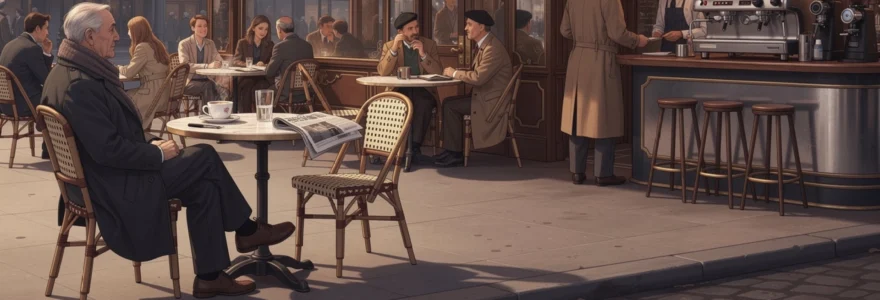
The gentle clink of porcelain against saucer, the rhythmic murmur of conversation, and the deliberate unhurried pace of service – these are the defining characteristics of authentic Parisian café culture. While the rest of the world rushes past with takeaway cups in hand, Paris maintains an almost sacred commitment to the art of lingering over coffee. This cultural phenomenon extends far beyond mere beverage consumption, representing a sophisticated approach to urban living that prioritises presence, observation, and the radical act of simply being still.
The Parisian café serves as a microcosm of French philosophy regarding time, space, and social interaction. Unlike the efficiency-driven coffee culture found elsewhere, French café tradition embraces what sociologists term “temporal luxury” – the deliberate extension of ordinary moments into meaningful experiences. This approach transforms a simple espresso into an opportunity for reflection, people-watching, and intellectual discourse that can legitimately occupy hours of one’s day.
Historical evolution of café culture in Saint-Germain-des-Prés and montparnasse districts
The roots of contemporary Parisian café culture stretch back to the late 17th century, when the first coffee houses emerged as revolutionary social spaces that challenged traditional hierarchies. These establishments democratised intellectual discourse, offering neutral territory where ideas could flow as freely as the imported coffee beans. The concept evolved from Ottoman coffee houses, adapting to uniquely French sensibilities that valued both philosophical debate and aesthetic pleasure.
Belle époque coffee house architecture and interior design principles
The architectural legacy of Belle Époque café design continues to influence modern establishments throughout Paris. The period’s emphasis on natural light, ornate metalwork, and expansive glass facades created the template for the quintessential Parisian café aesthetic. These design principles maximised both interior illumination and street visibility, establishing the café as a semi-public space that existed between private domesticity and public commerce.
Traditional Belle Époque interiors featured high ceilings adorned with decorative plasterwork, marble-topped tables, and elaborate zinc bar configurations. The strategic placement of mirrors amplified both light and the sense of spatial expansiveness, while banquette seating along windows created intimate observation posts for the practice of flânerie. These architectural elements worked in harmony to encourage extended occupancy rather than rapid turnover.
Post-war existentialist movement at café de flore and les deux magots
The intellectual renaissance that flourished in Saint-Germain-des-Prés following World War II elevated café culture to new philosophical heights. Establishments like Café de Flore and Les Deux Magots became epicentres of existentialist thought, where extended coffee consumption provided the temporal framework for profound intellectual exploration. The café environment proved particularly conducive to philosophical discourse, offering sufficient privacy for intimate conversation while maintaining the stimulating energy of urban life.
This period established the precedent for treating café occupancy as a legitimate intellectual pursuit rather than mere social loitering. The existentialist movement demonstrated that lingering could be productive, even revolutionary, challenging conventional notions of time management and social utility. The café became a laboratory for new ideas about freedom, authenticity, and the nature of human existence.
Zinc counter design and traditional parisian bar configuration
The iconic zinc counter remains the beating heart of authentic Parisian café design, serving both functional and symbolic purposes. These curved metal surfaces, polished to a mirror finish through decades of use, create natural gathering points that encourage spontaneous interaction between strangers. The zinc bar’s height and configuration promote brief, standing encounters that complement the more extended seated experiences at tables.
Traditional bar configuration typically features a tiered display system for pastries and sandwiches, positioned to catch natural light from street-facing windows. This arrangement creates visual interest while maintaining clear sight lines between staff and patrons. The zinc surface itself develops a unique patina over time, becoming a physical record of countless coffee services and conversations.
Evolution from Café-Tabac to modern third wave coffee establishments
Contemporary Parisian café culture represents a fascinating synthesis of traditional French hospitality principles and international coffee innovation. While maintaining core elements like unhurried service and extended
consumption rituals, many historic café‑tabac venues have gradually integrated elements of the so‑called third wave coffee movement. This evolution can be seen in the shift from robusta‑heavy blends served in simple bowls to carefully sourced single‑origin coffees brewed with precision equipment. Yet even as baristas weigh beans to the gram and adjust grind size for optimal extraction, the Parisian emphasis on atmosphere and lingering remains remarkably intact.
Rather than replacing traditional cafés, modern specialty coffee shops in neighbourhoods like the 11th and 10th arrondissements often coexist with older café‑tabac institutions, each serving different temporal and social needs. The morning ritual of a café au comptoir persists alongside mid‑afternoon filter coffee tastings and latte art workshops. In this way, Paris demonstrates that innovation in coffee preparation can harmonise with long‑standing cultural values surrounding time, conversation, and the quiet luxury of staying put.
Psychological and sociological dimensions of extended coffee consumption rituals
Lingering over a simple coffee in Paris is not just a charming habit; it is a complex psychological and sociological practice. The Parisian café functions as an informal laboratory where everyday behaviours reveal how humans negotiate space, time, and community. By observing how people choose their seats, manage their attention, and maintain relationships through regular visits, we gain insight into why this style of coffee culture feels so restorative compared with more hurried models elsewhere.
Urban psychologists often describe cafés as “third places”—settings distinct from home and work that support wellbeing and social cohesion. In Paris, the third place is elevated to an art form through extended coffee rituals that encourage slow observation and low‑pressure interaction. When you settle at a terrace table with a single espresso, you are participating in a subtle choreography of proxemics, temporal perception, and social signalling that has been refined over centuries.
Proxemics and territorial behaviour in café seating arrangements
The layout of a Parisian café terrace is a practical demonstration of proxemics, the study of how humans use space. Chairs typically face outward toward the street rather than inward toward each other, signalling that the primary engagement is with the city itself. This arrangement allows individuals to maintain a comfortable personal bubble even at close quarters, making it possible to sit shoulder‑to‑shoulder with strangers without feeling crowded.
Territorial behaviour appears in subtle rituals: the placement of a scarf over a chair to reserve a spot, the strategic spreading of a newspaper, or the way a half‑finished demi beer quietly communicates “I am still here.” Regulars learn to read these cues intuitively, avoiding seats that feel “claimed” even when no one is physically present. For visitors hoping to experience authentic Parisian café culture, paying attention to these micro‑signals can make the difference between feeling intrusive and feeling seamlessly integrated into the scene.
Temporal perception and flow state theory in urban leisure environments
One of the most distinctive aspects of Parisian café life is its impact on our perception of time. Whereas fast‑paced coffee culture encourages you to drink quickly and move on, the Parisian model stretches a single beverage across an hour or more. Cognitive scientists refer to this as a shift in temporal perception: external clocks still tick at the same speed, but subjective time slows as we enter what psychologist Mihaly Csikszentmihalyi describes as a flow state.
In a café context, flow rarely arises from intense productivity; instead, it emerges from gentle, immersive attention to one’s surroundings. Watching pedestrians, listening to snippets of conversation, and idly sketching or jotting notes can draw you into a state where minutes blur pleasantly together. It is the urban equivalent of being absorbed in a book—except the “text” is the living city and the turning pages are the small changes in light, weather, and passer‑by. This altered temporal experience is one reason many people report feeling unexpectedly refreshed after an hour in a café, even if they have ostensibly “done nothing.”
Social capital formation through regular café patronage patterns
Beneath the surface of casual coffee drinking, Parisian cafés serve as powerful engines for building social capital. Sociologist Pierre Bourdieu used this term to describe the networks and relationships that grant individuals access to information, resources, and support. In neighbourhood cafés, regulars accumulate a kind of informal membership status simply by appearing at roughly the same time each day and ordering familiar drinks.
Over weeks and months, these predictable patterns of café patronage generate weak ties—a nod to the barista, a shared smile with another regular, a brief chat about the weather—that gradually strengthen into meaningful connections. This social fabric often proves invaluable during moments of need: someone to water plants during a holiday, a tip about a local job opening, or even assistance navigating bureaucratic challenges. For newcomers to Paris, choosing one café and visiting consistently can be a surprisingly effective strategy for integrating into the local community.
Mindfulness practice and meditative aspects of coffee ritual observation
Long before mindfulness apps and guided meditations, Parisians were practising a form of everyday contemplation at café tables. The act of slowly sipping an espresso while observing the world encourages non‑judgemental awareness: you notice details without necessarily needing to label or fix them. The steam rising from a cup, the scraping sound of a chair, the pattern of raindrops on zinc tabletops—all become anchors for attention.
For many urban dwellers, this informal mindfulness practice serves as an antidote to digital overload and fragmented focus. If you resist the urge to check your phone and instead allow your gaze to soften, a simple coffee break can become a brief retreat from constant stimulus. Some psychologists now recommend such “analog pauses” as part of stress‑reduction strategies, arguing that these micro‑moments of presence, repeated daily, may contribute more to wellbeing than occasional, more dramatic escapes from city life.
Comparative analysis of parisian café service models and customer engagement strategies
Service in a Parisian café often surprises visitors accustomed to hyper‑attentive hospitality. What may initially be read as indifference—a waiter who disappears after taking your order, or the absence of a prompt bill—actually reflects a distinct philosophy of customer engagement. Rather than constantly checking in, staff assume that you value privacy and time, intervening only when necessary or clearly signalled.
This contrasts sharply with service models in Anglo‑Saxon coffee chains, where scripted greetings, frequent table checks, and rapid clearing encourage high table turnover. In Paris, the logic is different: you “rent” your chair for as long as you like with a single coffee, and the tacit agreement is that you will respect the space and atmosphere in return. For café owners, cultivating this trust‑based relationship fosters loyalty; regulars return precisely because they know they will not be hurried or disturbed.
Customer engagement strategies also differ in terms of pacing and ritual. Ordering at the bar and then moving to a terrace seat creates two distinct interaction points with staff, each an opportunity for brief conversation. In many traditional cafés, servers remember preferred orders and small biographical details, reinforcing a sense of being known. Interestingly, some newer specialty coffee shops in Paris are experimenting with hybrid models—combining high‑quality espresso and barista theatre with the classic French tolerance for prolonged occupancy—to attract both locals and international visitors who appreciate lingering as much as latte art.
Architectural integration of café terraces with haussmann urban planning methodology
The unmistakable sight of rows of wicker chairs lining Parisian sidewalks is no architectural accident. During the mid‑19th century, Baron Haussmann’s extensive redesign of Paris created broad boulevards, regularised building facades, and generous sidewalks that proved ideal for café terraces. The rhythm of ground‑floor commercial spaces with large windows practically invited the installation of cafés spilling out onto the street.
These terraces function as semi‑permeable membranes between private interior and public thoroughfare. When you sit at a terrace table, you are both spectator and spectacle—able to observe the city while also contributing to its visual and social vibrancy. Haussmann’s insistence on uniform building heights and cornice lines creates a theatrical backdrop against which café life unfolds, while the alignment of awnings and parasols forms a continuous horizontal band of colour and shade. From an urbanist perspective, this integration of cafés into the very fabric of the streetscape helps explain why Paris feels so uniquely conducive to slow, observational living.
Economic impact of extended dwell time on café business models and revenue optimisation
Allowing customers to linger for hours over a single drink might appear economically irrational, especially in high‑rent central districts. Yet the Parisian café model has survived for centuries, suggesting a more nuanced relationship between dwell time, pricing, and profitability. Rather than maximising rapid table turnover, many cafés prioritise consistent, moderate revenue throughout the day, relying on a mix of quick counter service and long‑stay terrace patrons.
This hybrid approach spreads income across different temporal niches: the morning rush of workers ordering at the bar, the late‑morning readers with their café crème, the lunchtime crowd, and the late‑afternoon lingerers. Each group contributes differently to the balance sheet, and extended occupancy is offset by strategic pricing and diversified offerings. When understood in this light, the art of lingering becomes not only culturally meaningful but also economically sustainable.
Table turnover rate analysis in high-rent arrondissement locations
In neighbourhoods such as Saint‑Germain‑des‑Prés or around the Champs‑Élysées, commercial rents can reach several thousand euros per square metre per year. To remain viable, café owners must carefully calibrate table turnover without undermining the leisurely experience that attracts customers in the first place. Many solve this by differentiating between interior and exterior spaces: interior tables may be informally prioritised for diners, while terrace seats remain more flexible for coffee‑only patrons.
Empirical observations by hospitality consultants in Paris suggest that terrace tables in prime locations often turn over two to three times during peak lunch hours, but may host a single occupant for most of the afternoon. The profitability of these slower periods relies on the fact that terraces act as living advertisements; a lively, well‑populated café signals quality and draws in passers‑by who may order full meals or higher‑margin drinks. In this sense, a solitary reader nursing an espresso is not just a low‑spend customer, but part of the marketing strategy that supports more lucrative transactions inside.
Pricing strategy for single-order extended occupancy management
Menu pricing in Parisian cafés subtly incorporates the expectation of long stays. A single espresso enjoyed at a terrace table might cost twice as much as the same drink consumed standing at the bar. This differential is not simply about location; it reflects an implicit time fee for occupying valuable outdoor real estate. Because this structure is widely understood by locals, it rarely provokes resentment. You are not merely paying for coffee, but for the right to linger in a prime seat overlooking the city.
To manage extended occupancy, some contemporary cafés also introduce small incentives for additional orders, such as reduced‑price refills on filter coffee or set menus combining a drink and pastry. However, the classic Parisian approach remains refreshingly straightforward: as long as you have ordered something, your place is secure. For visitors wanting to enjoy a long afternoon of people‑watching, understanding this pricing logic helps you choose where to sit and what to order without worrying that you are overstaying your welcome.
Revenue diversification through newspaper sales and tobacco licensing
Historically, many Parisian cafés supplemented beverage income through ancillary revenue streams such as tobacco sales, lottery tickets, and newspaper or magazine distribution. The traditional café‑tabac model relied on a steady trickle of small transactions throughout the day, each purchase providing a pretext for a brief stay at the counter or a quick coffee on the side. Even as tobacco consumption declines and print media shifts online, remnants of this diversified model persist.
Some establishments now replace cigarette displays with curated shelves of books, local artisan products, or branded merchandise, turning the café into a micro‑retail space. Others host ticketed events—poetry readings, small concerts, tasting evenings—that generate evening revenue without disrupting daytime lingering. These strategies acknowledge that while a single coffee may not cover the cost of a two‑hour stay, the cumulative ecosystem of sales, atmosphere, and loyalty can sustain a business that continues to prioritise presence over haste.
Contemporary challenges to traditional café culture from digital nomadism and remote work trends
The recent rise of remote work and digital nomadism has introduced new dynamics into Parisian café culture. Laptops, once a rarity on terraces, are now a common sight, particularly in neighbourhoods popular with international visitors and creative professionals. For some, the idea of transforming a café into a mobile office seems perfectly aligned with the tradition of writers and artists working in public; for others, the glow of screens and proliferation of charging cables disrupt the contemplative atmosphere that makes lingering so special.
Café owners face practical dilemmas: offering free Wi‑Fi and power outlets can attract a steady flow of customers who stay for hours, but may order only a single drink. In response, various strategies have emerged. Some establishments explicitly discourage laptop use during peak mealtimes or on terraces, reserving those spaces for conversation and observation. Others embrace the trend, designing interiors with shared tables, abundant sockets, and clear expectations about minimum spend or time limits. The challenge lies in balancing economic realities with cultural continuity, ensuring that the café remains a place for unstructured time as well as remote work.
For individuals seeking an authentic experience of lingering over coffee in Paris, these changes invite conscious choice. Do you join the ranks of screen‑absorbed workers, or deliberately leave your laptop at home and treat the café as a device‑free sanctuary? Both options now coexist in the city, often within just a few streets of each other. By selecting cafés that align with your intentions—whether that is quiet productivity or mindful flânerie—you help shape the future of this delicate ecosystem. In an era where almost every moment can be monetised or optimised, choosing to occupy a café table with nothing more than a notebook and a slowly cooling espresso remains a quietly radical act.