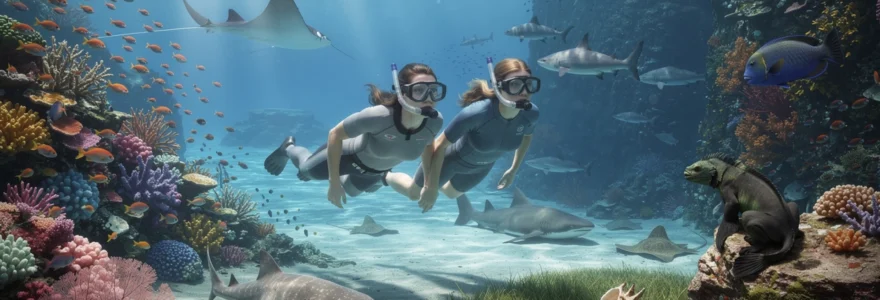
Beneath the surface of the world’s oceans lies a parallel universe where the extraordinary becomes ordinary. For snorkelers willing to venture beyond crowded tourist beaches, certain locations offer encounters with marine life so abundant and diverse that the experience transcends simple recreation. These underwater theatres showcase nature’s most spectacular performances: hammerhead sharks schooling in their hundreds, manta rays gliding through cleaning stations, pygmy seahorses smaller than a fingernail clinging to coral branches, and marine iguanas grazing on algae-covered rocks. The difference between adequate snorkeling and truly exceptional underwater experiences often comes down to understanding where specific species congregate, when they appear, and why these locations matter to marine ecosystems.
What distinguishes the world’s premier snorkeling destinations is not merely crystal-clear water or convenient access, but rather the concentration of wildlife encounters that transform observers into witnesses of ecological drama. From the biodiverse heart of the Coral Triangle to the endemic-rich waters of the Galápagos, from Caribbean nurse shark aggregations to Red Sea dugong feeding grounds, these locations offer guaranteed encounters rather than hopeful possibilities. Understanding the behaviours, seasonal patterns, and habitat preferences of target species dramatically increases the likelihood of meaningful underwater interactions.
Indo-pacific coral triangle: raja ampat’s biodiversity hotspot
Raja Ampat, positioned at the epicentre of the Coral Triangle, represents the pinnacle of marine biodiversity on planet Earth. This remote Indonesian archipelago comprises over 1,500 small islands and coral cays scattered across 40,000 square kilometres of pristine waters. Scientists have documented more than 1,600 species of reef fish and 600 species of hard corals in these waters—figures representing approximately 75% of all known coral species globally. The convergence of Pacific and Indian Ocean currents creates nutrient-rich upwellings that support this extraordinary concentration of life, whilst the complex topography of seamounts, channels, and sheltered bays provides countless ecological niches.
Pygmy seahorse colonies at cape kri and sardine reef
Pygmy seahorses, measuring barely 2.5 centimetres in length, exemplify the macro-life treasures awaiting observant snorkelers in Raja Ampat’s shallow coral gardens. These miniature marvels exhibit remarkable camouflage, with species like Hippocampus bargibanti developing colour patterns and tubercles that precisely match their host gorgonian corals. Cape Kri’s gently sloping reef, beginning at just two metres depth, hosts several documented colonies on fan corals accessible to snorkelers with keen eyesight. Sardine Reef, named for the massive baitfish aggregations that attract predators, offers similar opportunities amongst its healthy soft coral colonies. Patient observation of specific gorgonian species, particularly those in the genus Muricella, increases discovery chances. Local guides possess encyclopaedic knowledge of individual colony locations, dramatically improving encounter rates for these cryptic creatures.
Manta ray cleaning stations in dampier strait
The Dampier Strait channels between Batanta and Waigeo islands function as a manta ray superhighway, with regular sightings of both reef mantas (Mobula alfredi) and occasional oceanic mantas (Mobula birostris). Several established cleaning stations in depths of 5-12 metres allow snorkelers to observe these graceful giants as they hover motionless whilst smaller fish remove parasites. Manta Sandy, the most famous site, sees mantas visiting throughout the day, though early morning sessions between 7-9 AM typically yield the most encounters. The mantas perform elaborate barrel rolls and loop-de-loops, seemingly aware of their audience. During plankton blooms, particularly during the west monsoon season from October through April, feeding mantas execute coordinated swimming patterns, mouths agape as they filter massive volumes of water. Individual identification through unique ventral spot patterns has revealed site fidelity, with certain individuals returning to the same cleaning stations for years.
Wobbegong shark encounters at mioskon island
Wobbegong sharks, the ocean’s masters of disguise
Wobbegong sharks, the ocean’s masters of disguise, are frequently encountered around Mioskon Island’s shallow reef plateaus. These carpet sharks spend much of the day resting on sand patches or tucked under coral bommies, their tasselled skin fringes and mottled patterning rendering them almost indistinguishable from the substrate. Snorkelers drifting above at 3–8 metres depth often only spot them when a tail or gill movement gives them away. Because wobbegongs are ambush predators with a powerful bite, maintaining a respectful distance of at least two metres and never attempting to touch or corner them is essential. Early morning or late afternoon sessions typically offer the best visibility and the calmest surface conditions for safely observing these cryptic sharks from above.
Soft coral gardens and reef fish aggregations
Beyond its marquee megafauna, Raja Ampat’s true magic reveals itself in the density of life within its shallow soft coral gardens. Sites such as Friwen Wall, Sauwandarek, and the sheltered lagoons of Gam Island feature slopes carpeted in leather corals, dendronephthya soft corals, and sea whips that begin in just one to two metres of water. Here, enormous schools of anthias, fusiliers, and chromis create a living confetti that shifts and swirls with the current, while larger predators like giant trevally and Spanish mackerel occasionally blast through the fray. For snorkelers, planning sessions around moderate tidal exchanges is key: a bit of current supercharges fish activity, but excessively strong flow can turn a relaxing drift into a strenuous workout.
To make the most of these soft coral gardens, many operators in Raja Ampat provide guided snorkel-only excursions rather than mixing snorkelers with divers on the same site. This allows you to linger in the top five metres where light penetration is optimal and colours appear almost hyper-real, without being rushed along to deeper drop-offs. Using a simple freediving technique—taking a slow breath-up at the surface and making brief, controlled duck-dives—lets you inspect bommies and overhangs more closely while still staying well within safe limits. A high-quality, tinted mask and a snorkel with a splash guard also go a long way in reducing glare and improving contrast, helping the sheer abundance of reef fish stand out against the coral backdrop.
Caribbean marine sanctuaries: belize barrier reef system
Running for more than 300 kilometres along the coast of Central America, the Belize Barrier Reef is the largest reef complex in the Northern Hemisphere and a UNESCO World Heritage Site. Its mosaic of atolls, barrier reefs, patch reefs, and seagrass meadows creates a complete cross-section of Caribbean marine habitats within a compact geographic area. For snorkelers, this means you can move from shallow coral gardens packed with reef fish to shark and ray channels, turtle grass beds, and deep blue drop-offs in the space of a single trip. Because much of the reef falls within marine protected areas or regulated reserves, wildlife encounters here tend to feel less like chance sightings and more like predictable, repeatable experiences.
Hol chan marine reserve’s nurse shark alley
Hol Chan Marine Reserve, just off Ambergris Caye, is Belize’s flagship snorkel destination and a masterclass in how protection translates into wildlife density. The area known as Shark Ray Alley, once a site where fishermen cleaned their catch, now serves as a semi-natural aggregation zone for southern stingrays and nurse sharks (Ginglymostoma cirratum). Dozens of these bottom-feeding sharks, often exceeding two metres in length, cruise slowly along the sandy channel, accustomed to the constant presence of boats and snorkelers. While regulated chumming has historically been used to attract them, current guidelines increasingly restrict feeding to minimise behavioural changes and promote more natural interactions.
From a snorkeler’s perspective, the experience is both accessible and intense. The main action takes place in 2–4 metres of water, allowing even first-time snorkelers to observe nurse sharks gliding beneath them with minimal effort. Guides typically anchor on the edge of the channel and provide a safety briefing that covers proper spacing, body positioning, and why you should never attempt to ride or touch a shark or ray. To reduce your impact, aim for smaller group operators that limit passenger numbers, and consider booking early-morning departures before boat traffic peaks. Not only does this decrease crowding for the animals, it also improves visibility by reducing sediment stirred up from the sandy bottom.
Great blue hole’s pelagic species migrations
While the Great Blue Hole is primarily marketed to advanced scuba divers, its surrounding reef rim offers compelling snorkeling opportunities—especially if you are intrigued by pelagic species movements. The iconic sinkhole itself plunges over 120 metres, but the encircling coral ring sits in the 3–10 metre range and hosts a robust population of reef fish, barracuda, and cruising jacks. During seasonal plankton blooms and spawning events, larger pelagic visitors such as blacktip, Caribbean reef, and bull sharks occasionally patrol the outer drop-off, passing close enough to be seen clearly from the surface. Visibility can exceed 30 metres on calm days, giving snorkelers an almost aerial viewpoint over the vertical walls that define this geological anomaly.
The key to a worthwhile snorkeling visit here is aligning your expectations with the site’s realities. You will not be peering down into the abyss and clearly seeing the stalactites that draw deep divers, but you may witness schooling horse-eye jacks forming metallic tornadoes along the lip of the hole or eagle rays tracing lazy arcs just below you. Because the area is fully exposed and conditions can change quickly, trips are weather-dependent and are best undertaken during Belize’s dry season (roughly late November to May) when wind and swell are reduced. Wearing a brightly coloured rash guard or snorkel vest also increases your surface visibility for support boats in the open sea setting.
Glover’s reef atoll spawning aggregations
Glover’s Reef, one of Belize’s three offshore atolls, is a biological hotspot where oceanic currents converge to create ideal conditions for reef fish spawning aggregations. Along certain channels and reef promontories, species such as Nassau grouper, cubera snapper, and various jacks gather in the thousands on specific lunar cycles to release eggs and sperm in coordinated bursts. While many of these spawning events occur in depths beyond easy snorkeling range, the surface layers above them often teem with attendant predators—sharks, barracuda, and larger groupers—taking advantage of the buffet of disoriented prey. For snorkelers positioned carefully along the edge of these currents, the water can feel alive with motion, as if you have dropped into the middle of an underwater migration corridor.
Planning to witness these events requires more preparation than a typical day trip. Researchers and local guides track spawning calendars, often centred around the full moon phases of January through March, and adjust itineraries accordingly. You will need to be comfortable snorkeling in moderate to strong current, staying close to a guide and using a surface float or reef hook only where permitted and without contacting live coral. When conditions align, however, the experience rivals better-known big-animal sites around the world, with dense shoals of fish pulsing and reforming like an underwater storm front passing beneath you.
Turtle grass beds and queen conch populations
Not all of Belize’s most rewarding snorkeling happens over dramatic reef walls. The extensive turtle grass meadows that fringe cayes like Caye Caulker, Ambergris Caye, and the mangrove islands of the inner lagoon support thriving populations of queen conch, southern stingrays, and green and hawksbill turtles. These seagrass beds act as the “nurseries” of the reef, sheltering juvenile fish and invertebrates and stabilising sediments. For snorkelers, drifting slowly across a metre or two of water above waving blades of seagrass offers a chance to observe subtle behaviours: conch grazing tracks etched into the sand, rays buried with only their eyes exposed, or juvenile barracuda hanging motionless at the meadow’s edge.
Because queen conch populations have been heavily exploited across much of the Caribbean, Belize’s comparatively healthy stocks are both a conservation success story and a responsibility. When snorkeling these habitats, avoid standing in the grass, as a single misplaced fin kick can uproot plants and smother nearby shoots with silt. Look rather than collect: shells play an important role as microhabitats long after their original occupants are gone. If you are hoping to maximise sea turtle encounters, early mornings and late afternoons tend to be most productive, when turtles are actively grazing and boat traffic is reduced. A slow, non-direct approach and calm body language will often allow you to share space with feeding turtles for extended periods without altering their behaviour.
Red sea endemic species: marsa alam and ras mohammed
The Red Sea’s unique geological history and relative isolation have produced a high degree of endemism—species found nowhere else on Earth—and water clarity that routinely tops 30 metres. For snorkelers, the southern Egyptian coastline near Marsa Alam and the protected waters of Ras Mohammed National Park at the tip of the Sinai Peninsula represent two complementary windows into this ecosystem. Here, steep fringing reefs drop almost vertically into deep blue water just metres from shore, while offshore pinnacles and plateaus host everything from dugongs and turtles to oceanic whitetip sharks. The intensity of sunlight, combined with minimal river input, means corals grow in dense formations bathed in vivid colour, especially in the upper 10 metres that snorkelers frequent.
Dugong feeding grounds in abu dabbab bay
Abu Dabbab Bay, near Marsa Alam, is one of the most reliable places in the Red Sea to encounter dugongs—shy, seagrass-grazing marine mammals sometimes called “sea cows.” These large herbivores visit the bay’s extensive seagrass meadows to feed, leaving behind characteristic cropped patches that resemble underwater pastures. While dugong sightings are never guaranteed, local guides track recent observations and can often position snorkelers within viewing distance without disturbing the animals. Encounters typically occur in 3–6 metres of water, shallow enough that you can observe their methodical grazing and slow, undulating swimming style from the surface.
Because dugongs are globally threatened and sensitive to disturbance, responsible snorkel practices are paramount. Approaches should always be lateral and from behind, maintaining at least 10 metres’ distance and allowing the animal to dictate the interaction length. Excessive splashing, diving directly toward a feeding dugong, or surrounding it with multiple groups can cause stress and drive it away from critical feeding areas. Many operators in Abu Dabbab now brief guests on specific dugong etiquette and limit group sizes, recognising that long-term conservation of these charismatic mammals is essential to the bay’s appeal as a snorkel destination.
Oceanic whitetip shark encounters at elphinstone reef
Elphinstone Reef, an elongated offshore plateau north of Marsa Alam, is famed among divers for pelagic encounters—and, under the right conditions, advanced snorkelers can share in the experience. Oceanic whitetip sharks (Carcharhinus longimanus), once abundant but now classed as threatened, are known to patrol the blue water around the reef during autumn months when water temperatures begin to drop. Liveaboard vessels and specialised day boats sometimes organise controlled blue-water snorkels, with participants entering the water from a central line and remaining clustered near a support Zodiac. In these scenarios, the sharks’ long, paddle-like pectoral fins and curious approach behaviour are on full display as they investigate the unusual “school” of humans at their depth.
Such encounters demand a sober appreciation of risk and strict adherence to safety protocols. Operators typically require prior open-ocean snorkeling experience, strong swimming ability, and comfort in deep water with no visible bottom. Briefings emphasise maintaining vertical body posture, avoiding erratic movements, keeping hands close to the body, and never attempting to touch or chase the sharks. When properly managed, these interactions can be transformative, offering a rare opportunity to observe a top predator in its element while reinforcing the urgency of pelagic shark conservation in the Red Sea and beyond.
Napoleon wrasse behaviour at yolanda reef
Within Ras Mohammed National Park, Yolanda Reef and its neighbouring Shark Reef form a twin-pinnacle system that rises from deep water to within a few metres of the surface. Among the many species that frequent these coral-covered towers, Napoleon wrasse (Cheilinus undulatus) stand out—not only for their imposing size, but for their surprisingly approachable demeanour. Mature males can exceed two metres in length and display a prominent forehead hump, yet they often cruise calmly through the upper 10 metres where snorkelers float. Over time, some individuals have become accustomed to non-threatening human presence and will circle back repeatedly, allowing prolonged observation of their intricate facial markings and thick, fleshy lips.
Napoleon wrasse play a critical ecological role as predators of crown-of-thorns starfish and hard-shelled invertebrates, and their slow reproductive rate makes them highly vulnerable to overfishing. Ras Mohammed’s protected status has created a refuge where their natural behaviours—courtship displays, cleaning station visits, and foraging among coral heads—can be observed with minimal interference. As you drift along Yolanda Reef’s drop-off, keep an eye on the transition zones where the vertical wall meets sandy ledges; wrasse often patrol these boundaries in search of prey. Using a wide, relaxed fin kick and minimising splashing will make you appear less threatening, increasing the likelihood that a curious Napoleon will close the distance on its own terms.
Galápagos marine reserve: darwin and wolf islands
The Galápagos Marine Reserve, encompassing more than 130,000 square kilometres of protected waters, is a living laboratory of evolution where cold, nutrient-rich currents collide with warmer tropical flows. Darwin and Wolf Islands, remote outposts in the archipelago’s far north, sit at the crossroads of these currents and support some of the highest known biomasses of sharks on Earth. While most itineraries that reach these islands cater primarily to experienced divers, select liveaboards and seasonal expeditions incorporate guided snorkeling sessions in more sheltered zones of the broader reserve. Even outside Darwin and Wolf, the Galápagos offers surface-accessible encounters—hammerhead silhouettes, marine iguanas, penguins, and sea lions—that few other destinations can match.
Hammerhead shark schooling phenomenon
The signature image of Galápagos diving is a cathedral-like archway at Darwin Island filled with hundreds of scalloped hammerhead sharks (Sphyrna lewini). For snorkelers, direct immersion in the heart of these schools is generally beyond safe depth and current limits, yet there are still opportunities to witness the phenomenon from above. In areas where the seamounts rise closer to the surface, particularly during cooler months when thermoclines lift, hammerheads may ascend into the 10–15 metre range, their distinctive cephalofoils and sweeping tails visible as ghostly outlines against the blue. From the surface, you can sometimes track these formations as shifting, elongated clouds, especially when sunlight silhouettes the school from behind.
Why do hammerheads school in such numbers here? The prevailing theory links their aggregations to cleaning behaviour and social interactions around current-swept promontories, with Galápagos barberfish and king angelfish removing parasites from their skin. Strong, predictable currents and upwellings deliver the nutrients that support this cleaning symbiosis, turning specific points at Darwin and Wolf into shark “hubs.” If your itinerary includes any snorkel-accessible ledges near these sites, your guide may anchor you in the lee of the current and have you scan the blue water column for passing schools—a reminder that even at the surface, you are skimming the top of one of the world’s most dynamic shark ecosystems.
Marine iguana foraging behaviour in coastal shallows
Closer to the main inhabited islands, one of the Galápagos’ most surreal snorkeling experiences involves sharing the shallows with marine iguanas (Amblyrhynchus cristatus). These lizard-like reptiles, the only ocean-going iguanas on Earth, have evolved flattened tails and specialised glands that allow them to dive and graze on intertidal and subtidal algae. At sites such as Fernandina’s Punta Espinosa and Santa Cruz’s Tortuga Bay, you can watch adults clamber down black lava rocks and slip into water barely a metre deep, where they paddle slowly along the bottom, nibbling on green and red algae films. Their movements are deliberate and unhurried, more akin to a grazing tortoise than a quick darting lizard.
Snorkeling alongside marine iguanas demands a low-impact approach. The animals must carefully regulate their body temperature, alternating between cold-water foraging and sun-bathing on lava rocks, and repeated disturbances can disrupt this balance. Maintaining a horizontal position at the surface and giving foraging iguanas at least two metres of space helps ensure they continue their natural routines. You may also hear them “sneezing” salt—a behaviour where excess salt from their blood is expelled through specialised nasal glands—both underwater in bursts of bubbles and topside as audible snorts. Observing this full behavioural sequence, from basking to feeding and back again, offers a rare glimpse into how an animal has adapted almost every aspect of its physiology to a marine lifestyle.
Galápagos penguin colonies and sea lion interactions
The presence of penguins on the equator is one of the Galápagos’ great surprises. Galápagos penguins (Spheniscus mendiculus), the world’s second-smallest penguin species, concentrate along the cooler western coasts of Isabela and Fernandina Islands where the Cromwell Current surfaces. Here, rocky shorelines and lava ledges provide nesting crevices, while nearby upwellings deliver the small fish they rely on. For snorkelers, brief but electrifying encounters are possible as penguins rocket past in pursuit of baitfish, leaving silver trails of bubbles in their wake. Their speed and agility underwater bear little resemblance to their upright, slightly comical gait on land, underscoring how fully adapted they are to life in the water column.
In many of these same coves, Galápagos sea lions (Zalophus wollebaeki) cruise, rest, and play. Juveniles, in particular, exhibit a strong curiosity toward humans, swooping past and doubling back in tight spirals, inviting you into impromptu games of underwater tag. While such interactions can feel playful and intimate, it is vital to avoid approaching hauled-out sea lions on beaches or blocking their exit routes to the water, especially when pups are present. In the water, letting the animals set the distance—rather than swimming directly toward them—results in more natural, longer-lasting interactions that are safer for both you and the resident colonies.
Whale shark seasonal aggregations
Between June and November, as cooler waters dominate the Galápagos, the nutrient-rich conditions that favour hammerheads and other sharks also draw whale sharks (Rhincodon typus) to the offshore seamounts around Darwin and Wolf. Many of the individuals observed here are large, possibly pregnant females, some exceeding 12 metres in length. For divers, encounters often occur in the blue at mid-water, but on rare occasions, whale sharks cruise shallower, bringing them within marginal range of supervised snorkeling in calm surface layers. Even when direct snorkel encounters are not offered, simply watching a dorsal fin and tail slice the surface near your vessel—as a patterned giant passes beneath—reinforces the Galápagos’ status as a critical waypoint in global whale shark migrations.
Scientific tagging projects in the region are beginning to map out these movements, revealing that Galápagos whale sharks may use the archipelago as a navigational node before heading west into the open Pacific. As a visiting snorkeler, supporting operators that collaborate with such research—by sharing sightings data or facilitating non-invasive tagging—helps turn your brief encounter into a contribution to broader conservation. If you are given the chance to enter the water, standard whale shark etiquette applies: remain to the side of the animal, never in front of its path; keep a minimum distance of three to four metres; and limit flash photography, which can startle or disturb these gentle filter-feeders.
Southeast asian macro photography sites: lembeh strait and anilao
Not all world-class snorkeling revolves around big animals and sweeping reefs. In northern Sulawesi’s Lembeh Strait and the Batangas region of the Philippines around Anilao, the focus shifts to the miniature and the bizarre. Volcanic black sand slopes, rubble plains, and patchy coral heads that might look barren at first glance are, in reality, nurseries for some of the ocean’s strangest creatures. While these destinations are best known in the scuba community, certain bays and shallows in both Lembeh and Anilao are calm and shallow enough for snorkelers to engage in “macro snorkeling,” hovering a metre or two above the substrate and scanning carefully for motion and unusual shapes. With patience, the experience becomes less like sightseeing and more like participating in a slow-motion treasure hunt.
Mimic octopus and wonderpus photogenicus sightings
Among the most sought-after residents of these muck habitats are the mimic octopus (Thaumoctopus mimicus) and the closely related wonderpus (Wunderpus photogenicus). Both species inhabit shallow sandy flats, often between 2–8 metres deep, where they bury themselves or shelter in discarded shells and debris. The mimic octopus is famed for its ability to imitate the shapes and movement patterns of other marine animals—lionfish, flatfish, and banded sea snakes among them—while the wonderpus is instantly recognisable by its high-contrast brown and white banding. For snorkelers, catching a glimpse of either species emerging from the sand or flowing across the bottom like animated silk is a highlight on par with far larger encounters elsewhere.
Because these cephalopods are sensitive and often nocturnal or crepuscular, timing and guiding are crucial. Early morning and late afternoon snorkels over gently sloping sand flats, ideally with an experienced spotter, maximise your odds. Once located, maintaining a high, non-threatening position in the water column and avoiding bright torch beams or repeated flash photography allows the animal to continue its natural behaviour—hunting small crustaceans, exploring, or displaying its repertoire of camouflage and mimicry. In many ways, observing a mimic octopus adapt its posture to perceived threats is like watching a live evolutionary experiment unfold beneath you.
Frogfish species diversity in volcanic sand habitats
Lembeh and Anilao are also epicentres of frogfish diversity, with multiple species of these ambush predators inhabiting shallow rubble slopes, sponge fields, and discarded man-made objects. Ranging in size from thumbnail juveniles to adults as large as a football, frogfish employ cryptic colouration and a specialised lure (the illicium) to attract unsuspecting prey within striking distance. To the untrained eye, they resemble lumpy sponges or encrusted rocks, but once you learn to recognise their upturned mouths, pectoral “leg” fins, and beady eyes, you begin to see them everywhere—perched motionless on rope ends, nestled in bottle necks, or clinging to coral heads.
For snorkelers, the challenge is twofold: locating frogfish in the first place and then resisting the temptation to get too close once you do. Guides often know the whereabouts of individual residents, especially larger painted and giant frogfish, and can point them out from a respectful distance. Floating quietly above and slightly down-current allows you to watch their hunting behaviour—slowly inching toward a target, then erupting in a lightning-fast gulp—without disturbing the scene. Because frogfish rely so heavily on camouflage, even minor substrate damage or rearrangement caused by careless fins can ruin their chosen ambush site, so maintaining perfect buoyancy and avoiding contact with the bottom is essential.
Nudibranchs and sea slug biodiversity hotspots
If ever there were an argument that the ocean harbours its own equivalent of a tropical rainforest canopy, it would be the nudibranch communities of Lembeh and Anilao. These shell-less gastropods come in an astonishing array of colours, patterns, and forms, many of which serve as warning signals advertising the toxins they accumulate from their prey. In depths of just one to five metres, you can encounter everything from translucent, leaf-like sacoglossans grazing on algae to flamboyant chromodorids with neon stripes and frilly gills. Some species are no larger than a grain of rice, while others stretch several centimetres, crawling slowly across sponges, hydroids, or bare sand.
Macro snorkeling for nudibranchs is as much about mindset as it is about location. Rather than covering distance, you might spend an entire session focused on a single small patch of reef or rubble, scanning carefully with the help of a guide or underwater slate to note distinctive shapes. Using a mask with corrected lenses or a low-volume design improves your ability to resolve fine details at short range, which is critical when the subject is the size of your fingernail. For underwater photographers, these sites are unrivalled training grounds, but even without a camera, the sheer diversity of forms—each nudibranch a small, living artwork—can radically change how you perceive “barren” or “empty” seafloor.
Temperate water kelp forest ecosystems: monterey bay and poor knights islands
While tropical reefs dominate most snorkel wish-lists, temperate kelp forests offer an entirely different kind of underwater spectacle—one where towering fronds replace branching corals and the play of light and shadow becomes part of the main event. Along California’s central coast in Monterey Bay and around New Zealand’s Poor Knights Islands, cold, nutrient-rich waters support dense stands of giant kelp and other macroalgae that form three-dimensional habitats from seafloor to surface. For snorkelers equipped with proper thermal protection, slipping into these forests is like walking into a cathedral of living pillars, with shafts of sunlight piercing the canopy and schools of fish weaving through the foliage.
In Monterey Bay, protected coves such as Lovers Point and Whalers Cove at Point Lobos State Natural Reserve provide relatively sheltered entries into the kelp for confident snorkelers. Visibility can be more variable than in the tropics, but on clear days, you’ll see kelp bass, opaleye, rockfish, and the occasional harbour seal threading effortlessly between the kelp stalks. At the Poor Knights Islands, a marine reserve off New Zealand’s Northland coast, the blend of warm East Auckland Current water and cooler southern influences creates a hybrid ecosystem where subtropical species like kingfish and butterfly perch mingle with temperate wrasses and triplefins. Massive archways and caverns, accessible at the surface, add a further sense of drama as you drift through.
Because water temperatures in these regions typically range from 10–18°C (50–64°F), a well-fitting wetsuit, hood, and gloves are non-negotiable for extended comfort. Once properly insulated, however, you will find that buoyancy control becomes easier in the salty, cool water, and the slower, more measured finning style that kelp forests demand can feel meditative. Taking time to look closely at holdfasts—the root-like structures anchoring kelp to rocks—reveals miniature ecosystems of snails, crustaceans, and juvenile fish. Sea stars, urchins, and abalone lurk among the boulders, while overhead, cormorants and other seabirds may dive past you in pursuit of schooling baitfish. In these temperate realms, underwater life steals the show not through tropical colour, but through sheer structural complexity and the constant, hypnotic motion of an underwater forest swaying with the swell.