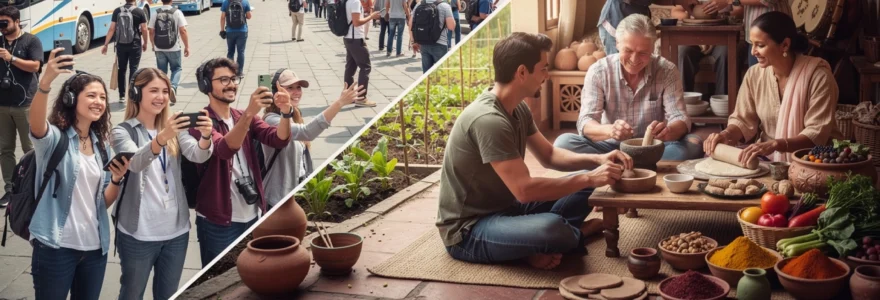
Standing before the Colosseum in Rome, camera raised, visitors capture the perfect shot and move on within minutes. They’ve seen one of the world’s most iconic monuments, but have they truly experienced it? Modern travel has become increasingly transactional—a collection of visual checkpoints rather than meaningful encounters with place and culture. This fundamental distinction between merely observing a destination and genuinely experiencing it shapes not only the quality of travel memories but also the depth of cultural understanding travellers take home. Research indicates that whilst 78% of travellers claim they seek authentic experiences, only 23% invest the time and attention required to achieve genuine cultural immersion. The gap between intention and action reveals a widespread misunderstanding about what transforms tourism into transformative travel.
The phenomenon extends beyond individual disappointment. When millions of visitors treat destinations as photo opportunities rather than living communities, the impact ripples through local cultures, economies, and ecosystems. Understanding the mechanisms that separate superficial tourism from deep engagement offers practical pathways for more meaningful travel—experiences that benefit both visitor and visited community alike.
Superficial tourism versus deep cultural immersion
The travel industry has inadvertently created a two-tier system where most visitors engage with destinations at surface level whilst a minority discovers deeper layers of cultural meaning. This division isn’t simply about budget or time availability—it reflects fundamental differences in approach, expectation, and intentionality. Superficial tourism operates on efficiency metrics: maximum sites per day, optimal photo angles, highly-rated restaurants. Deep immersion prioritises understanding over accumulation, connection over collection.
Consider how visitors approach historical sites. The superficial tourist arrives at Angkor Wat, follows the designated pathway, photographs the reflection pool at sunrise, and departs within ninety minutes. The immersive traveller learns that Angkor Wat represents Mount Meru, the centre of the universe in Hindu and Buddhist cosmology, understands the astronomical alignments built into its architecture, and recognises the bas-reliefs depicting the Churning of the Ocean of Milk. One visitor leaves with images; the other departs with comprehension of how a civilisation expressed its worldview through stone.
Photography-driven travel: the instagram effect on destination engagement
Social media platforms have fundamentally altered travel motivations and behaviours. Approximately 40% of millennials now select destinations based on their “Instagrammability” rather than personal interest or cultural significance. This photography-first approach transforms landmarks into backdrops, reducing complex cultural sites to two-dimensional compositions. The result? Visitors spend an average of 32 seconds actually observing a landmark before moving to the next frame-worthy location.
The psychological impact extends beyond missed opportunities for engagement. When you view a destination primarily through a camera lens, your brain processes the experience differently. Neurological studies reveal that constantly photographing experiences actually impairs memory formation—the act of capturing replaces the act of encoding. Ironically, travellers documenting everything remember less than those who simply observe. The photographs become proxies for memories never properly formed, creating a hollow archive of places never truly seen.
Ticking off UNESCO world heritage sites without contextual understanding
UNESCO designation has become both blessing and curse for cultural sites. Whilst the recognition brings protection and resources, it also attracts visitors motivated by completionism rather than genuine interest. Travel forums feature discussions about “bagging” World Heritage Sites, treating 1,157 designated locations as collectible achievements. This gamification strips sites of context, reducing Petra’s sophisticated water management system to merely another tick on a travel bucket list.
Without contextual understanding, even extended visits remain superficial. You might spend three hours at Machu Picchu, yet leave understanding nothing about Incan agricultural terracing, astronomical observations, or the site’s relationship to surrounding sacred peaks. The time invested matters less than the attention quality. A visitor who learns that Machu Picchu’s stones were cut so precisely that no mortar was needed—and that this precision has allowed structures to survive five centuries of earthquakes—gains appreciation that transcends visual observation.
Guided tour dependency and its impact on authentic discovery
Organised tours provide efficient overviews but often prevent the unscripted encounters that create memorable experiences. The standard tour structure—bus, landmark, photo opportunity, gift
shop—compresses complex destinations into digestible narratives. You are told where to stand, what to photograph, and which historical anecdotes matter. This efficiency comes at a cost: your curiosity muscles atrophy. When every movement is choreographed, there is little room to wander down an unmarked alley, linger in a neighbourhood café, or follow an intriguing sound coming from a side street. These unscripted choices are often where genuine cultural immersion begins.
This does not mean guided tours are inherently superficial. Their impact on authentic discovery depends on how you use them. A context-rich walking tour with a local historian can provide intellectual scaffolding that later supports your independent exploration. The key difference lies in dependency. If you never step outside the tour bus bubble—never navigate public transport, order food in the local language, or get lost and find your way back—you remain a visitor consuming a product rather than a temporary participant in local life.
Language barriers as gatekeepers to genuine local interaction
Language functions as both bridge and barrier in travel. Superficial tourism often treats language as a logistical hurdle to be minimised through translation apps, English-only services, and international hotel chains. Deep cultural immersion frames language as a gateway to understanding how people think, relate, and prioritise values. Even a handful of local phrases—thank you, please, how much?, and a simple greeting—can dramatically shift the quality of interactions you have with residents.
Research from the European Travel Commission suggests that travellers who make basic efforts to communicate in the local language report 27% higher satisfaction with their cultural experiences. Why? Because language signals respect and willingness to meet people on their terms. You may not hold complex conversations, but you can order at neighbourhood eateries, navigate markets with more confidence, and invite small acts of kindness and connection. Conversely, relying entirely on English-speaking intermediaries or tour guides keeps you within an interpretive bubble where culture is filtered, simplified, and sometimes sanitised for foreign consumption.
Sensory engagement beyond visual perception
Modern travel discourse privileges what can be photographed, yet our deepest travel memories often come from senses the camera cannot capture. The difference between seeing a place and experiencing it is frequently the difference between collecting images and cultivating multi-sensory impressions. When you consciously engage smell, sound, taste, and touch, the city or landscape around you shifts from static backdrop to living environment. Neurologically, multi-sensory input creates richer memory traces, which explains why you might forget the exact façade of a building but vividly recall the aroma of bread from the bakery downstairs.
Think of visual observation as reading the book cover of a destination. Sensory engagement is opening the pages. You can look at a photo of a Moroccan market a thousand times without ever knowing the sharp sweetness of fresh mint, the metallic clang of copper being hammered, or the slight grit of desert dust under your sandals. When you travel with all five senses switched on, you transform from spectator to participant, even if you never say a word.
Gustatory experiences: street food markets in bangkok versus tourist restaurant menus
Food is one of the most direct pathways to experiencing a place rather than merely viewing it. Nowhere is this clearer than in Bangkok, where the contrast between a curated tourist restaurant menu and a bustling street food market can mean the difference between tasting Thailand and merely consuming “Thai-style” dishes. In tourist-heavy areas, menus often flatten regional diversity into familiar stereotypes: pad thai, green curry, mango sticky rice—dishes sometimes toned down for foreign palates and plated for Instagram.
Step into a local night market, however, and the culinary landscape changes. You encounter dishes that rarely appear on hotel menus: som tam pounded to order in a mortar, charcoal-grilled gai yang, aromatic boat noodles rich with spices and herbs. You watch ingredients handled in real time, learn how locals customise flavours—more lime, less sugar, extra chilli—and observe which stalls attract neighbourhood regulars. Asking a vendor, “What do you recommend?” not only leads to better food; it opens tiny windows into local daily rituals, price sensitivities, and social interactions.
Olfactory memory formation in marrakech’s spice souks
Smell is the most ancient of our senses and the one most strongly linked to memory. Visual images fade, but a particular scent can transport you across decades and continents in an instant. Marrakech’s spice souks offer a powerful example of how olfactory engagement turns seeing a market into experiencing it. You might photograph sacks of cumin, saffron, and paprika in vivid colours, yet the true imprint comes when you lean in and inhale their layered aromas.
Neuroscientific studies show that olfactory stimuli bypass many of the brain’s usual filters and connect directly to the limbic system, which governs emotion and memory. In practical terms, this means that the first time you smell a particular blend of ras el hanout or orange blossom water in Marrakech, you are encoding not just a scent but an emotional snapshot of your surroundings. Years later, encountering that aroma in another context can revive the feeling of wandering those narrow alleys more vividly than any photograph. Travellers who consciously “collect smells” as part of their journey tend to report more textured, emotionally resonant memories of place.
Auditory landscapes: traditional gamelan in ubud versus recorded ambience
The soundtrack of a destination plays a crucial role in how deeply we experience it. Listening to a recorded gamelan playlist while scrolling through photos of Bali is not the same as sitting in a temple courtyard in Ubud as musicians rehearse for a ceremony. In person, the metallic shimmer of the instruments, the slight imperfections, and the interplay with ambient sounds—roosters, scooters, distant chatter—create a layered auditory landscape that cannot be fully replicated through headphones.
Psychologists speak of “situated listening,” where sound gains meaning from physical context. When you attend a local performance, you are not only hearing music; you are watching how elders and children respond, noticing who sings along, who grows quiet, and how the music structures community time. Recorded ambience flattens these dynamics into background noise. Experiencing a place through its live sounds—church bells in Lisbon, call to prayer in Istanbul, cicadas at dusk in rural Japan—anchors you in the present moment and deepens your sense of belonging, however temporary.
Tactile connections through artisan workshops and craft participation
Touch is often the most overlooked sense in travel, yet it is central to moving from observation to participation. Browsing a shop of handwoven textiles in Oaxaca allows you to see colours and patterns; sitting at a loom with an artisan and running your fingers along the warp and weft lets you feel the labour, time, and skill embedded in each piece. The difference is akin to looking at a painting versus holding the artist’s brushes—one is appreciation, the other is involvement.
Participating in craft workshops—pottery in Kyoto, batik in Yogyakarta, glassblowing in Murano—also reshapes your relationship with souvenirs. Instead of acquiring objects as trophies, you gain tactile memories of the process: the weight of wet clay, the heat of the furnace, the resistance of wax against fabric. These embodied experiences linger long after you return home, and they foster respect for local economies and traditions. You are less likely to bargain aggressively or treat handmade work as disposable when you have felt, quite literally, how much effort it requires.
Temporal investment and slow travel methodology
Time is the invisible architecture of travel. Two people can stand in the same square and have radically different experiences depending on how they allocate their hours and days. Fast-paced itineraries prioritise coverage—“seeing as much as possible”—which often leads to shallow impressions and destination fatigue. Slow travel, by contrast, treats time as a medium for relationship-building with a place. By staying longer, moving less, and syncing with local rhythms, you give context a chance to accumulate.
This does not mean you must take months-long sabbaticals to experience a place deeply. Rather, it involves rethinking metrics of success. Instead of counting countries visited, you might count conversations had, neighbourhoods explored on foot, or routines established in a single city. Like letting tea steep instead of dunking the bag quickly, temporal investment allows subtle flavours—small talk with baristas, recognition at the corner market, awareness of daily patterns—to emerge.
Extended stays in sicily’s agriturismos versus week-long mediterranean cruises
Consider two common ways of “seeing” the Mediterranean. A week-long cruise offers convenience and variety: multiple ports, all-inclusive meals, and pre-arranged excursions. You wake up each morning to a new postcard view but often spend only a few hours ashore, mostly within walking distance of the harbour. Your interactions with local culture are filtered through brief tours and curated shopping stops designed to fit a strict timetable. By design, cruises emphasise breadth over depth.
Now compare that to a ten-day stay at an agriturismo in rural Sicily. You sleep under the same roof each night, watching the light change across the same hills. Over breakfasts, you learn how weather affects the olive harvest or why certain recipes are tied to specific saints’ days. You might accompany the family to a local market, observe which vendors they trust, or join in seasonal tasks like grape picking. While the cruise allows you to see many places, the agriturismo stay enables you to experience one place as a living ecosystem of work, celebration, and routine.
Seasonal timing: experiencing kyoto’s hanami beyond peak cherry blossom crowds
Timing shapes experience as much as location. Many travellers plan entire trips around iconic seasonal events—Kyoto’s cherry blossom season, for instance—only to find themselves in dense crowds that make it difficult to experience much beyond the spectacle. Peak hanami weeks transform tranquil temples and riverside paths into procession routes of tour groups and selfie sticks. You see the blossoms, certainly, but often without the contemplative atmosphere that gives them cultural meaning.
Choosing to visit slightly before or after peak bloom can offer a more authentic relationship with the tradition. You might witness locals picnicking without fanfare, school groups learning about seasonal change, or workers cleaning petals from shrine steps. Even better, returning in a different season—autumn for fiery maples, winter for stark gardens—reveals how Kyoto’s spiritual and aesthetic practices extend far beyond a single photogenic moment. By aligning your travel plans with shoulder seasons rather than headline weeks, you trade viral imagery for deeper immersion in everyday cycles.
Circadian rhythm adaptation and authentic daily life integration
Experiencing a place also means aligning your internal clock with its external rhythms. Many travellers maintain their home time zone habits abroad—late breakfasts, midday museum visits, early dinners—without realising they are moving through local life slightly out of sync. This temporal misalignment often leads to experiences dominated by other tourists, because you are all following similar, convenience-driven patterns rather than local ones.
Adapting to local circadian rhythms—eating when residents eat, being out when they socialise, resting when they retreat—opens doors to more genuine encounters. In Spain, that might mean embracing late-night plazas and lingering dinners. In Hanoi, it could involve waking early to watch sunrise tai chi around Hoàn Kiếm Lake and visiting markets before the heat peaks. Sleep researchers note that even a 1–2 hour shift toward local patterns can improve mood and reduce jet lag, which in turn increases your capacity to notice details and engage with people. Are you in the city as a passing observer, or are you willing to let its clock, even briefly, shape your day?
Psychological presence and mindful exploration techniques
Being physically present in a destination does not guarantee psychological presence. Many travellers arrive with their minds still occupied by work emails, social media updates, or the logistics of what comes next on the itinerary. When your attention is fragmented, you move through remarkable environments as if behind glass—seeing but not truly registering. Mindful exploration is the practice of aligning your focus with your surroundings, allowing each moment to be fully experienced before it slips into memory.
Practical techniques can help cultivate this presence. Try beginning each day with a short, device-free walk, simply observing colours, sounds, and textures without photographing or commenting on them. Pause at key sites to take three slow breaths while you consciously note what you can see, hear, smell, and feel. Some travellers keep a small notebook to jot down impressions on the spot, which reinforces memory far more effectively than posting a caption online. By treating attention as your primary travel resource, you shift from consuming places to being in conversation with them.
Socio-cultural participation and community integration
Culture is not something that exists only in museums and monuments; it lives in relationships, routines, and shared practices. To experience a place rather than merely see it, you need at least temporary access to these social circuits. This does not require becoming “a local” in any superficial sense, but it does involve moving beyond commercial interactions—buying, booking, consuming—into spaces where people live out their daily lives.
Community integration can take many forms depending on your comfort level and time. You might choose accommodation that connects you with hosts, join group activities designed for residents rather than tourists, or contribute your skills through structured volunteering. The common thread is reciprocity: instead of treating the destination as a backdrop for your personal story, you recognise yourself as one participant among many, leaving a small but considerate footprint in the local narrative.
Homestays in rural rajasthan versus five-star resort isolation
Accommodation choices dramatically influence how you relate to a destination. A five-star resort on the outskirts of Jaipur offers comfort, security, and curated aesthetics that could exist in dozens of countries. You may have impeccable service and landscaped gardens, but much of what you encounter is engineered to shield you from local complexities—noise, smells, street life, even spontaneous interaction. You see Rajasthan through car windows and scheduled excursions, then retreat to an environment designed to feel reassuringly familiar.
A homestay in a Rajasthani village presents a different kind of luxury: access. You might wake to the sound of roosters and temple bells, share meals cooked on a traditional stove, or accompany family members to local markets and ceremonies. You learn how water is fetched, how weddings are prepared, how festivals reshape the rhythms of work. Homestays are not without challenges—reduced privacy, cultural misunderstandings, basic facilities—but precisely these frictions often lead to stronger learning. Instead of observing “Indian culture” as an abstract, you experience one family’s reality, with all its nuance and contradiction.
Volunteering programmes: WWOOF organic farming in tuscany
Volunteering abroad, when approached thoughtfully, can be a powerful vehicle for deep cultural immersion. Programmes like WWOOF (World Wide Opportunities on Organic Farms) in Tuscany exemplify how structured participation turns passive tourism into shared labour and learning. As a volunteer, you exchange your time and effort—harvesting olives, tending vines, preparing soil—for accommodation, meals, and inclusion in the household’s daily life.
This arrangement shifts the power dynamics of travel. You are not simply a paying guest but a temporary member of a working community, subject to the same weather, schedules, and constraints. You experience how climate change affects yields, how EU policies shape small-scale agriculture, how family businesses balance tradition with economic survival. Effective volunteering requires humility and a willingness to perform unglamorous tasks, but it often yields insights impossible to gain from a distance. Instead of asking, “What can this place give me?” you begin to ask, “How can I contribute while I’m here?”
Festival participation: joining songkran in chiang mai as community member
Festivals offer concentrated expressions of cultural values, but they can easily become spectacles consumed from the sidelines. Many visitors treat Songkran—the Thai New Year water festival—as a giant street party in Chiang Mai, focusing on playful water fights without understanding the deeper symbolism of cleansing, renewal, and respect for elders. Watching from a hotel balcony or staying only in tourist-heavy streets means you see the event but miss the layers that give it meaning.
Participating as a community member, even briefly, looks different. You might join a local family in gently pouring scented water over Buddha statues at a temple, or accompany neighbours to visit older relatives and offer blessings. You learn which gestures are appropriate, which spaces are sacred rather than playful, and how people feel about the influx of party-focused tourists. By asking questions, following local lead, and dressing modestly, you signal that you are there to honour the occasion rather than just exploit its entertainment value. The result is often a more profound sense of connection—and a greater appreciation of your role as a guest in someone else’s celebration.
Learning traditional skills: balinese cooking classes with local families
Skill-sharing experiences like cooking classes can serve as bridges between visitor and host cultures when they move beyond simple recipe demonstrations. In Bali, for instance, a class held in a family compound rather than a commercial kitchen allows you to see how food, religion, and social structure interweave. You might start at a dawn market selecting offerings for the house shrine, learn why certain ingredients are reserved for ceremonies, and help grind spices by hand while hearing stories about ancestral recipes.
The value lies not just in learning to reproduce nasi goreng back home, but in understanding how meals organise daily life, gender roles, and community gatherings. Asking why dishes are prepared in a particular order, who usually cooks, and how holidays change the menu opens conversations that touch on economy, history, and belief. Compared to passively consuming a buffet, learning a traditional skill requires concentration, collaboration, and vulnerability—all ingredients of genuine experiential travel.
Neurological response patterns to passive observation versus active engagement
At a neurological level, the difference between seeing a place and experiencing it is visible in how your brain processes information. Passive observation—such as riding a tour bus while listening to generic commentary—primarily activates visual and auditory cortices. You register shapes and sounds, but much of the input passes through working memory without deeper consolidation. This is why cityscapes from different trips can blur together in your mind; the brain received similar stimuli and had little reason to prioritise one over another.
Active engagement, by contrast, recruits multiple neural networks simultaneously. When you navigate a maze-like medina, your hippocampus works to form spatial maps. When you struggle to order lunch in a new language, regions linked to problem-solving and social cognition fire up. When you participate in a hands-on workshop, motor and sensory cortices join the experience. Neuroscientists refer to this as “rich encoding”: the more diverse the neural activity during an event, the more robust and retrievable the memory trace. In simple terms, doing something in a place etches it more deeply into your mind than merely looking at it.
Functional MRI studies on experiential learning support this distinction. Participants who physically explored a virtual environment later showed stronger recall and emotional response than those who watched recordings of the same environment. The implication for travellers is clear: experiencing a city through your own decisions, mistakes, and interactions leads to more enduring, meaningful memories than consuming pre-packaged views. When you choose to engage—asking one more question, taking a side street, joining a local activity—you are not only enriching your trip; you are literally rewiring your brain to carry that place with you in a more profound way.