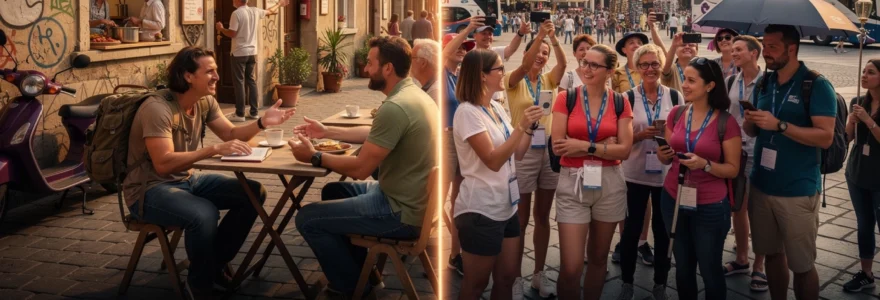
Standing in the departure lounge, passport in hand, you’re about to embark on another journey. But what defines you in this moment? Are you a tourist seeking comfort and Instagram-worthy snapshots, or a traveler chasing authenticity and cultural immersion? This question has sparked countless debates across digital platforms, hostel common rooms, and travel blogs. The distinction between these two identities has become surprisingly contentious, often clouded by elitism, social posturing, and misunderstood definitions. Yet beneath the surface of this seemingly simple binary lies a complex spectrum of human experience, motivation, and engagement with the world beyond familiar borders. Understanding where you fall on this spectrum matters less than recognizing the value in both approaches and the invisible threads connecting them.
The debate itself reveals something fascinating about contemporary travel culture: our desperate need to categorize and distinguish ourselves from others sharing similar experiences. In an era where travel has become more accessible than ever before, with budget airlines democratizing international movement and social media amplifying every journey, the labels we adopt carry surprising weight. They’ve transformed from simple descriptors into identity markers, lifestyle statements, and even moral positions. This transformation deserves examination, not to crown one approach superior, but to understand what drives our choices when we cross borders and how those choices shape both ourselves and the destinations we visit.
Defining travel identity: anthropological perspectives on movement and purpose
The academic study of tourism and travel has produced rich insights into why humans venture beyond their familiar territories and how they engage with unfamiliar environments. Anthropologists have long recognized that human movement across geographical and cultural boundaries serves multiple functions: economic exchange, cultural transmission, personal transformation, and social positioning. These scholarly frameworks help us move beyond simplistic binaries toward a more nuanced understanding of travel motivation and behavior. When examining travel identity through an anthropological lens, the distinction between tourist and traveler becomes less about superiority and more about intentionality, temporal engagement, and the nature of cultural exchange sought.
Contemporary tourism studies suggest that travelers exist on a continuum rather than in discrete categories. At one end, you find highly structured, consumption-oriented tourists who prioritize comfort, efficiency, and familiar experiences packaged for easy consumption. At the other end sit long-term wanderers who immerse themselves in local communities, learn languages, and actively resist tourist infrastructure. Most people, however, oscillate along this spectrum depending on circumstances, energy levels, financial constraints, and personal goals for specific journeys. A business traveler might adopt tourist behaviors during limited free time, while a backpacker might occasionally crave the structure and comfort of organized tours after months of independent travel.
Paul theroux’s philosophy: slow travel as immersive cultural exchange
The renowned travel writer Paul Theroux has spent decades championing what he calls « slow travel »—journeys undertaken at a pace that allows genuine observation, reflection, and connection. His philosophy emphasizes ground transportation over flights, extended stays over brief stopovers, and patient observation over checklist completion. Theroux argues that speed destroys the travel experience, reducing destinations to mere backdrops for selfies rather than living cultures deserving sustained attention. This approach aligns closely with what many self-identified travelers aspire to achieve: depth over breadth, quality over quantity, understanding over mere witnessing.
However, Theroux’s philosophy raises important questions about privilege and access. Slow travel requires resources many people simply don’t possess: extended time away from employment, substantial financial reserves, visa arrangements permitting long stays, and often the cultural capital to navigate unfamiliar environments without structured support. Critics rightfully note that elevating this approach as the « correct » way to travel effectively gatekeeps authentic experience behind economic barriers. A factory worker with two weeks of annual leave cannot adopt Theroux’s methods, yet their brief package tour to Spain may prove equally transformative within their personal context.
The phenomenology of place attachment in tourism studies
Place attachment theory, developed within environmental psychology and tourism studies, examines how individuals form emotional bonds with locations outside their primary residence. Research demonstrates that tourists can develop genuine place attachment even during brief visits, particularly when experiences align with personal values, facilitate meaningful social connections, or satisfy psychological needs. This finding challenges assumptions that only extended stays or « traveler » behaviors produce authentic relationships with destinations. A family returning to the same coastal resort annually may develop deeper place attachment than a backpacker passing through dozens of countries in as many weeks.
The phenomenological approach
The phenomenological approach invites us to look not just at what people do in a destination, but at how they experience being there. Two travelers can stand in the same square in Venice, yet inhabit radically different inner worlds: one ticking off a bucket-list attraction, the other flooded with memories of a book they once read or a grandparent’s stories of migration. This subjective dimension means that neither « tourist » nor « traveler » has a monopoly on meaningful experience. What matters is the depth of perception, reflection, and emotional resonance a person allows themselves as they move through place.
In this sense, the invisible line between traveler and tourist is drawn less on the map and more in the mind. You might rush through a city in 24 hours yet forge a powerful memory through a single conversation with a local shopkeeper. Conversely, you could spend a month in a destination and leave with little more than surface impressions if you never step outside familiar routines. Anthropological perspectives remind us that identity in travel is dynamic and negotiated: shaped by context, personal history, and the degree to which we allow places to challenge or transform us.
Dean MacCannell’s tourist gaze theory and authentic experience
Any conversation about tourist identity eventually bumps into the question of authenticity. Sociologist Dean MacCannell famously argued that modern tourism is driven by a search for « authentic » experiences in an increasingly staged world. We chase the feeling of seeing the « real » city behind the postcard, the « real » people behind the performances, the « real » food beyond the tourist menus. Yet MacCannell showed how even these supposedly authentic encounters are often organized, curated, and subtly choreographed for visitors, creating layered frontstage and backstage experiences.
MacCannell’s concept of the « tourist gaze » helps explain why some travelers feel uneasy being labeled tourists. The gaze turns destinations and local people into objects to be consumed, photographed, and compared, rather than subjects with their own complex lives. But the gaze itself is not inherently negative; it becomes problematic when we fail to recognize our own role in constructing what we see. You can stand in front of a famous temple as a tourist and still engage with humility, curiosity, and respect, or you can pursue « authenticity » in ways that invade privacy or commodify local culture. The behavior, not the label, makes the difference.
Understanding MacCannell’s theory also reminds us that there is no single, pure « authentic » experience waiting to be uncovered if only we avoid other tourists. Even so-called off-the-beaten-path villages have often adapted to visitor expectations, blending local needs with economic opportunity. Expecting to access a pristine, untouched culture is less a mark of being a traveler and more a romantic illusion. A more grounded approach accepts that authenticity is relational: it emerges from honest, mutually respectful interactions, whether they take place in a crowded UNESCO site or a quiet neighborhood café.
Nomadic consciousness: digital nomads versus package tour participants
Modern tourism has introduced new identities that complicate the traveler–tourist divide. Digital nomads, for instance, often frame themselves as the antithesis of short-term tourists: long-term residents who work remotely while slowly exploring new places. Their « nomadic consciousness » emphasizes flexibility, minimalism, and a lifestyle of perpetual movement. Package tour participants, by contrast, are frequently depicted as emblematic tourists: time-poor, schedule-bound, and content to follow pre-designed itineraries. Yet in practice, the gap between these groups is not as wide as it first appears.
Digital nomads may spend months in a destination yet remain socially insulated, interacting mostly with other foreigners in coworking spaces and expat cafés. Package tourists might have only a week but deliberately seek local encounters, guided by curiosity rather than status. Which of these is « more traveler »? The answer depends less on labels and more on daily choices: where money is spent, how relationships are formed, and whether local norms and concerns are taken seriously. Both groups are part of the same global mobility system, shaped by visa regimes, income inequality, and the infrastructure of international travel.
Interestingly, research from 2023 on long-stay visitors suggests that mere duration does not guarantee deeper integration. Many long-term visitors maintain a « bubble » lifestyle, while some short-term tourists exhibit high engagement and sensitivity despite limited time. For you, this means that aspiring to a nomadic lifestyle does not automatically place you on a higher moral ground than someone on a coach tour. The key question is not how long you stay, but how consciously you inhabit that time and what kind of footprint—social, economic, and environmental—you leave behind.
Psychological markers: intrinsic motivation versus consumption-driven exploration
If anthropology looks at structures and cultures, psychology zooms in on individual motivation. Why do you travel? Is it to collect status symbols and social media validation, or to satisfy deeper needs for growth, connection, and autonomy? Most of us carry a blend of motives, shifting between intrinsic and extrinsic drivers from trip to trip, and even day to day. Understanding these psychological markers can help you travel more intentionally, regardless of whether you think of yourself as a tourist or a traveler.
Psychologists increasingly study travel behavior as a window into well-being. Post-pandemic research shows that people who approach travel with intrinsic goals—such as learning, self-reflection, or building relationships—report higher satisfaction than those focused primarily on external rewards like photos, bragging rights, or shopping. This doesn’t mean you must renounce all outward pleasures of travel. It does suggest that when consumption becomes the main lens, experiences can start to feel hollow, no matter how impressive the destination. The invisible line here is drawn by your « why » more than your « where. »
Self-determination theory applied to travel behaviour patterns
Self-determination theory (SDT), a well-established framework in psychology, identifies three core human needs: autonomy, competence, and relatedness. When these needs are met, people function and feel better; when they are frustrated, motivation tends to become more controlled and externally driven. Applied to travel, SDT helps explain why some journeys feel deeply nourishing while others feel oddly empty, even if the photos look great. A more « traveler-like » approach often aligns with satisfying these needs, but tourists can access them too with the right mindset.
Autonomy in travel means feeling that you are the author of your own journey: making meaningful choices about what to do, where to go, and how to engage. Competence shows up when you navigate a metro system in a foreign language, successfully bargain in a market, or adapt plans when things go wrong. Relatedness emerges through moments of genuine connection—with locals, with travel companions, or even with fellow visitors sharing a fleeting but real bond. When you design trips that support these three needs, you are more likely to return home with a sense of fulfillment rather than fatigue.
By contrast, consumption-driven exploration often sidelines these needs. Over-scheduled group tours may undermine autonomy if you never have space to follow your curiosity. All-inclusive resorts can reduce competence experiences if everything is handled for you, and relatedness may be limited to transactional service interactions. This doesn’t mean you should avoid structure altogether. Instead, you can ask: Where on this itinerary can I carve out small moments of autonomy, challenge, and connection? Even a highly organized city break can include an unscripted walk, a conversation with a café owner, or a self-directed detour that shifts the experience from passive to participatory.
Flow state experiences in unstructured versus itinerary-based journeys
Another useful concept for understanding travel identity is « flow, » a mental state defined by psychologist Mihaly Csikszentmihalyi as complete absorption in an activity where challenge and skill are well matched. Many travelers instinctively chase flow without naming it: that feeling of losing track of time while hiking a mountain trail, getting lost in a street market, or learning a new craft from a local artisan. Flow states are often cited as hallmarks of transformative travel because they combine focus, joy, and a sense of growth.
Unstructured journeys, often associated with the archetypal traveler, seem designed to invite flow: there is room to follow impulses, respond to serendipity, and lean into curiosity. Yet they can also tip into anxiety if the lack of structure overwhelms your sense of competence. Conversely, well-designed itineraries can foster flow by removing logistical stress and freeing mental energy for deeper engagement. Think of a guided trek where route planning is handled, allowing you to be fully present with the landscape and your own thoughts.
The question, then, is not whether you are a traveler or a tourist, but how you calibrate challenge and comfort. Do you leave enough slack in your schedule to wander without purpose, or is every hour allocated? Do you choose activities that stretch your skills just beyond their current limit, or do you default to passive observation? By intentionally designing for flow—whether that means a solo day in a new neighborhood or a carefully chosen workshop—you align your travel behaviour with experiences that feel meaningful rather than merely busy.
Cultural intelligence quotient development through extended stays
Cultural intelligence (often abbreviated as CQ) refers to your ability to function effectively across cultural contexts. It includes cognitive understanding of norms, behavioral adaptability, and motivational openness to difference. Extended stays are frequently championed by self-identified travelers as the gold standard for developing CQ. Living in a place for weeks or months certainly increases exposure to everyday realities: bureaucratic systems, local politics, subtle etiquette, and the background rhythms that short-term visitors rarely notice.
Studies in intercultural psychology, however, caution that time alone does not guarantee growth. Some long-term expatriates remain culturally disengaged, socializing mainly within familiar communities and viewing the host culture through stereotypes. Meanwhile, short-term tourists can show surprisingly high CQ if they approach even brief stays with humility, preparation, and reflection. Reading local media, asking thoughtful questions, and observing carefully can all accelerate your learning curve, regardless of how long your visa allows you to stay.
For your own travel identity, CQ development offers a more concrete goal than simply « being a traveler. » You can intentionally build cultural intelligence by setting small challenges: learn how local people greet each other in different contexts, pay attention to how queues form, notice who speaks in public spaces and who stays silent. Over multiple trips, these micro-observations accumulate into a richer, more respectful way of moving through the world—one that matters far more than which label you use at the airport.
Fear of missing out (FOMO) and checklist tourism psychology
On the other end of the spectrum lies FOMO-driven travel: the anxiety that if you don’t see everything, photograph everything, and post everything, you have somehow failed the trip. Social media has amplified this mindset, turning destinations into highlight reels and encouraging comparison over presence. Checklist tourism—rushing to tick off « Top 10 must-see attractions »—can be satisfying in the moment but often leaves a residue of exhaustion. You might return with dozens of photos yet struggle to recall what it actually felt like to be there.
Psychologically, FOMO is tied to extrinsic motivation and social evaluation. We worry about how our travels will be perceived rather than how they will be experienced. The irony is that both tourists and travelers are vulnerable to this trap. A backpacker racing through five countries in two weeks to « do » Southeast Asia is as checklist-driven as a cruise passenger collecting magnets from every port. The invisible line is crossed when FOMO dictates your choices more than curiosity or personal values.
How do you counter this? One practical approach is to consciously build JOMO—the joy of missing out—into your travel mindset. Before your trip, decide what you are willing to not do in order to be more present for what you choose. Allow yourself to skip a famous attraction if crowds feel overwhelming that day, or to spend an entire afternoon in one park rather than rushing between five landmarks. By reframing travel success as depth of experience rather than quantity of sights, you step away from checklist psychology and closer to a more grounded, self-defined travel identity.
Temporal engagement: duration, rhythm, and seasonal integration
Time is one of the most powerful variables shaping how we experience a place. Duration, daily rhythm, and even the season in which you visit all contribute to whether you feel like an outsider peeking in or a temporary participant in local life. A three-day city break compresses experiences into an intense burst, often privileging iconic sights and efficient logistics. A three-month stay, by contrast, invites you into slower cycles: weekly markets, recurring community events, subtle shifts in weather and mood. Neither is inherently better; they simply offer different modes of engagement.
Temporal engagement also affects how visible you are as a visitor. Short-stay tourists tend to move in predictable patterns, clustered around central districts and well-known attractions. Longer-term visitors may disperse into residential neighborhoods, develop routines around specific cafés or shops, and become less obviously « other » in the urban landscape. Yet even on a short trip, you can experiment with rhythm: rise early to see a city before it wakes, or linger in one district over several days instead of sampling many. These temporal choices can blur the line between tourist and traveler more effectively than any label.
Seasonality adds another dimension. Visiting a beach town in high summer offers one reality; returning in winter reveals another, often more local-oriented life. Many travelers now deliberately seek shoulder seasons to reduce their contribution to overtourism and to experience destinations in a more balanced state. Thinking temporally—about when and how long you stay, and how you pace your days—becomes a form of ethical and experiential design. It allows you to adapt your travel identity from « consumer of peak moments » to « participant in ongoing cycles, » even if only briefly.
Spatial practices: off-the-beaten-path destinations versus UNESCO world heritage circuits
Space, like time, is often used as a marker of travel identity. Travelers are expected to seek out hidden gems, while tourists supposedly cluster at famous sites. In reality, most of us do both: we stand in awe at world-renowned landmarks and then slip down side streets in search of quieter corners. The problem arises when « off-the-beaten-path » becomes just another status symbol—another box to tick or story to perform online—rather than a genuine attempt to diversify our encounters and relieve pressure on overcrowded places.
From a spatial perspective, the tourist–traveler divide is less about where you go and more about how you move. Do you treat cities as theme parks, hopping from attraction to attraction, or as living ecosystems with residential, commercial, and sacred spaces requiring different forms of respect? Do you notice where tourism infrastructure ends and everyday life begins, and adjust your behavior accordingly? Being spatially conscious means recognizing that every step you take participates in patterns that either concentrate impact in a few hotspots or distribute it more sustainably.
Couchsurfing and homestay networks: residential immersion models
Couchsurfing, homestays, and similar models are often held up as quintessential traveler practices—ways to bypass hotels and engage directly with local households. They can indeed foster residential immersion: sharing meals, learning household routines, and seeing how daily life unfolds away from tourist corridors. Many participants report that these intimate encounters are among their most transformative travel experiences, challenging stereotypes and creating lasting cross-cultural friendships.
However, residential immersion also comes with responsibilities. Staying in someone’s home blurs boundaries between guest and family, hospitality and labor. Are you contributing fairly to the household, either financially or through other forms of reciprocity? Do you respect privacy, schedules, and cultural norms around gender, food, and space? Using immersive accommodation networks without this sensitivity can quickly turn a supposedly authentic traveler into a demanding tourist inside someone’s living room.
For those who prefer hotels or rentals, it’s important to remember that immersive experiences are not limited to where you sleep. You can cultivate similar depth by frequenting the same neighborhood café, joining a local hobby group for a week, or attending community events that are open to visitors. Residential immersion is ultimately a mindset: a willingness to step into the ordinary rhythms of a place rather than only its staged highlights.
The banana pancake trail paradox in southeast asian backpacker culture
The so-called Banana Pancake Trail—loosely defined routes through Southeast Asia frequented by backpackers—perfectly illustrates the paradox of seeking uniqueness in well-trodden spaces. Many travelers head to these regions with the goal of avoiding mass tourism, only to find entire neighborhoods designed around their presence, complete with Western menus, cheap hostels, and standardized « authentic » experiences. The result is a kind of parallel universe where travelers primarily meet each other, not local residents, while believing they have escaped being tourists.
This phenomenon shows how quickly alternative routes become their own form of mainstream tourism. The desire to be a traveler rather than a tourist can itself fuel new tourist economies, complete with their own clichés and rituals. Ordering banana pancakes in a Lao village becomes less a spontaneous local discovery and more a predictable rite of passage on the backpacker circuit. The invisible line between traveler and tourist blurs as behavior converges: bar crawls, identical Instagram shots, and a shared narrative of being more authentic than the « tour groups » seen from afar.
Recognizing the Banana Pancake Trail paradox doesn’t mean avoiding popular backpacker routes altogether. Instead, it invites you to question your assumptions. Are you seeking these places because they truly align with your interests and values, or because they confer subcultural status? When you arrive, do you venture beyond the bubble—into local markets, public transport, or community events—or remain within the comfortable ecosystem built for people like you? Honest answers to these questions matter far more than how you label yourself.
Overtourism hotspots: venice, barcelona, and conscious route deviation
Overtourism—when visitor numbers exceed a destination’s ecological, social, or infrastructural capacity—has become a defining issue of contemporary travel. Cities like Venice and Barcelona have become symbols of this tension, with local residents protesting rising rents, crowded public spaces, and the transformation of historic neighborhoods into tourist zones. In these contexts, the traveler–tourist debate acquires an ethical edge. It is no longer just about personal identity but about collective responsibility: how our presence affects the very places we claim to love.
Conscious route deviation is one response gaining attention. Instead of adding pressure to already strained hotspots, some travelers choose alternative destinations that offer similar cultural or environmental features with less impact. Others modify how and when they visit: avoiding cruise ships, staying in locally owned accommodation, visiting in low season, or spending more time in less-trafficked districts. These decisions may not seem glamorous, but they represent a concrete way to align travel behaviour with values of respect and sustainability.
Importantly, you don’t have to boycott iconic destinations entirely to travel responsibly. Even within overtouristed cities, you can make micro-choices: walk instead of taking crowded short-distance taxis, support small businesses rather than global chains, and treat residential streets as people’s homes rather than open-air museums. Whether you call yourself a traveler or a tourist, your willingness to adapt for the sake of local well-being is a more meaningful indicator of your travel ethics than your presence or absence at any one famous square or canal.
Socio-economic footprint: local economy participation versus all-inclusive isolation
Every journey leaves a socio-economic footprint. Money spent on the road flows somewhere: into multinational corporations, small family businesses, informal economies, or a mix of all three. One of the starkest contrasts in contemporary tourism is between visitors who remain largely within all-inclusive bubbles—resorts, cruise ships, gated complexes—and those who circulate through local economies. It is tempting to equate the latter with « travelers » and the former with « tourists, » but the reality is more nuanced.
All-inclusive models are not inherently unethical; they can provide stable jobs and infrastructure in some regions. Problems arise when most revenue leaks out to foreign owners, leaving local communities with low wages and high cost-of-living pressures. On the other hand, independent travelers may unintentionally fuel gentrification by concentrating demand in once-affordable neighborhoods. The socio-economic impact of your trip thus depends not only on what you choose (resort vs. guesthouse) but on how those choices intersect with local conditions.
If you want your travel identity to reflect conscious participation in local economies, you can adopt a few simple practices. Prioritize locally owned accommodation, eateries, and tour providers when possible. Seek out markets, cooperatives, and social enterprises whose benefits circulate within the community. Tip fairly and learn what « fair » means in that context rather than imposing your home standards. Even within an all-inclusive stay, consider allocating time and budget to ventures beyond the compound walls: a neighborhood restaurant, a community-led excursion, or independent shops. In this way, you shift from being a passive consumer of place to an active contributor to its economic fabric.
Language acquisition and cross-cultural communication competency
Language is one of the most visible markers of how we position ourselves abroad. Do we expect others to adapt to us, or do we make an effort—however modest—to meet them halfway? While fluency is not realistic for every destination, the degree to which we invest in communication skills says a lot about our orientation toward the world. Travelers are often stereotyped as language learners and tourists as language avoiders, but again, the truth is more mixed. Many short-term visitors diligently learn basics, while some long-term residents coast on English or other global lingua francas.
Cross-cultural communication competency goes beyond vocabulary lists. It includes understanding when to speak and when silence is respectful, how direct or indirect to be in different cultures, and how to read subtle cues in tone and posture. These skills can be developed on any trip, from a weekend city break to a year-long round-the-world journey. They require curiosity and humility more than time. When you approach each interaction as an opportunity to learn rather than a transaction to complete, you shift subtly from tourist mode—focused on services—to traveler mode—focused on relationships.
Survival phrases versus conversational fluency in host communities
Learning a few survival phrases—hello, please, thank you, excuse me—is an easy step many visitors take. Yet the spectrum of language engagement is far broader. On one end, you might rely solely on English and gestures; on the other, you might dive into formal study, aiming for conversational fluency. Most of us fall somewhere in between, picking up key phrases and patterns but never fully mastering the language. Does this gradient map onto the traveler–tourist distinction? Not neatly, but it does reveal different attitudes toward host communities.
Survival phrases function like a basic toolkit: they signal respect, reduce friction, and open doors to small moments of connection, like making a vendor smile when you attempt their language. Conversational fluency, in contrast, allows access to deeper layers of culture: jokes, frustrations, political debates, and nuanced personal stories. It can transform your experience from observing a place to partially inhabiting its inner dialogue. That said, expecting yourself to become fluent everywhere is unrealistic. You are not less of a thoughtful traveler if you focus on quality of engagement in one or two regions rather than superficial competence everywhere.
A practical compromise is to choose your linguistic investments strategically. In destinations you plan to revisit or stay in longer, commit to learning more than the basics: numbers, common verbs, and key cultural expressions. For short trips, at least master greetings and polite forms of address. Ask yourself: What level of language effort feels honest and respectful for the time I have here? Framed this way, language learning becomes less a badge of honor and more a tool for ethical and enriching travel.
Non-verbal communication literacy in cross-cultural encounters
Words are only part of the story. Non-verbal communication—gestures, personal space, eye contact, physical touch, and even silence—varies dramatically across cultures. A hand gesture that is friendly in one country may be offensive in another; direct eye contact can signal confidence or disrespect depending on context. Developing « non-verbal literacy » can be as transformative as learning vocabulary, and it often requires just as much attentive observation.
In many ways, non-verbal awareness is where the traveler–tourist line becomes most visible. Tourists who remain oblivious to local norms may speak loudly on quiet trains, pose insensitively in sacred spaces, or treat staff with a level of casual familiarity that feels rude. Travelers who pay attention adjust their volume, posture, and movements to harmonize with the setting. This isn’t about mimicry for its own sake; it’s about recognizing that your body is part of the communicative landscape and can either signal respect or intrusion.
You can build non-verbal literacy by treating each new environment like a subtle classroom. Watch how locals stand in queues, how they greet elders, how they behave in places of worship or remembrance. Notice whether people gesture expansively or sparingly, whether conversations involve overlapping speech or careful turn-taking. This kind of observational practice is like tuning an instrument before you play; it prepares you to participate more smoothly and reduces the risk of unintentional offense, regardless of your verbal fluency.
Translation technology dependency and authentic human connection
Smartphone translation tools have made international travel dramatically easier. With a few taps, you can decipher menus, navigate public transport, and even hold basic conversations through apps. This technology has clear benefits, especially for accessibility and safety. Yet it also raises a subtle question: does heavy reliance on translation tech pull us closer to people or keep us at arm’s length? Like any tool, it can either bridge gaps or reinforce distance depending on how we use it.
On the one hand, translation apps can empower shy visitors to ask more nuanced questions, understand instructions, and avoid misunderstandings. They can enable interactions that would otherwise be impossible, such as discussing a complex medical issue with a pharmacist or understanding a museum exhibit beyond the English labels. On the other hand, if you default to screens for every interaction, you may miss opportunities for shared laughter over mispronunciations, gestures, and the slow dance of mutual understanding that often creates the most memorable travel moments.
A balanced approach treats technology as a support, not a substitute, for human connection. Try speaking first, even if your vocabulary is limited, and then use translation tools to clarify or deepen the exchange. Show people the screen and involve them in the process rather than silently typing and pointing. This small shift keeps the interaction embodied and collaborative rather than transactional. Ultimately, whether you see yourself as a traveler or a tourist, what will stay with you years later are rarely the perfectly translated sentences, but the imperfect, genuine encounters where two people from different worlds still managed to meet in the middle.