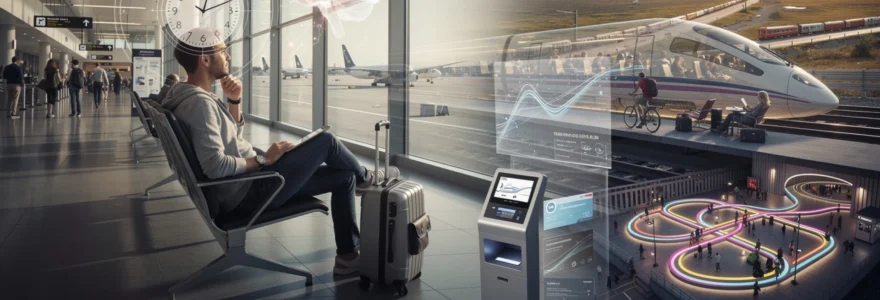
Travel fundamentally alters our perception of time, creating profound psychological effects that extend far beyond the physical journey itself. When you step into an airport departure lounge or board a long-haul flight, your brain begins processing time differently than it would during routine daily activities. This phenomenon occurs because travel environments present unique cognitive challenges and sensory experiences that disrupt our normal temporal processing patterns. Understanding these psychological mechanisms can help you optimise your travel experiences and make journeys feel more meaningful and less stressful.
The relationship between psychology and travel time perception involves complex neurological processes that affect everything from how long a journey feels to how well you remember specific moments. Research consistently shows that novel environments and experiences create richer memories, making travel periods feel more substantial and meaningful than equivalent time spent in familiar surroundings. These insights have practical implications for how transport operators design spaces, how you can better manage travel fatigue, and why certain journeys leave lasting impressions while others fade quickly from memory.
Chronostasis and temporal perception during transit experiences
Chronostasis represents one of the most fascinating aspects of temporal perception during travel, occurring when your brain temporarily freezes time perception in response to novel stimuli. This neurological phenomenon explains why the first few seconds in a new airport terminal or train station often feel elongated, creating a heightened sense of awareness that can make brief moments feel surprisingly extended. The effect typically diminishes as your cognitive system adapts to the new environment, but it plays a crucial role in shaping initial travel impressions.
Neurological mechanisms behind time dilation in airport departure lounges
Airport departure lounges create unique conditions for time dilation through their combination of sensory stimuli, spatial design, and psychological pressure. Your brain processes the constant stream of announcements, visual displays, and human movement patterns while simultaneously managing departure anxiety and anticipation. This cognitive load forces your neural networks to operate in a heightened state, creating more detailed memory encoding that retrospectively makes waiting periods feel longer than they actually were.
The architecture of modern airports deliberately manipulates spatial perception through high ceilings, expansive windows, and carefully controlled lighting systems. These design elements trigger specific neural responses in your brain’s temporal processing centres, particularly affecting the suprachiasmatic nucleus, which regulates circadian rhythms and time awareness. Research indicates that passengers in well-designed departure lounges experience less time anxiety and report feeling that waiting periods pass more quickly, demonstrating the powerful connection between environmental design and temporal perception.
Circadian rhythm disruption effects on journey duration perception
Circadian rhythm disruption during travel creates measurable changes in how your brain processes temporal information, particularly during international flights that cross multiple time zones. Your internal body clock, governed by the suprachiasmatic nucleus, becomes desynchronised from external time cues, leading to distorted perceptions of journey duration. This disruption explains why eastbound flights often feel longer than westbound flights of equivalent duration, as eastbound travel works against your natural circadian preferences.
The severity of temporal perception changes correlates directly with the number of time zones crossed and the timing of your departure relative to your home circadian cycle. Flights departing during your natural sleep period create the most significant disruption to time perception, often making journeys feel interminable despite normal duration. Understanding these patterns allows you to choose departure times that minimise temporal distortion and reduce the psychological burden of long-distance travel.
Attentional resource allocation theory in Long-Haul flight scenarios
Long-haul flights present unique challenges for attentional resource allocation, as your brain must simultaneously process limited stimuli while managing extended periods of relative inactivity. This creates a paradoxical situation where time seems to slow down due to reduced external stimulation, yet your cognitive resources remain partially engaged with flight-related concerns such as safety monitoring and comfort management. The result is a distinctive temporal experience characterised by periods of acute time awareness alternating with temporal disconnection.
Your brain’s attentional networks adapt to the confined environment by shifting focus between internal and external stimuli more frequently than usual. This adaptive response explains why some passengers report feeling restless and time-conscious during certain flight phases while becoming completely absorbed in activities during others. Airlines have increasingly recognised these patterns, designing entertainment systems and cabin lighting that work with natural attentional rhythms rather than against them.
Prospective vs retrospective time estimation in rail travel through european corridors
Rail travel through European corridors offers an excellent context for understanding the difference between prospective and retrospective time estimation. When you pay close attention to how long a journey is taking in the moment (prospective timing), time usually feels slower and each minute on the train seems to stretch. In contrast, when you later look back on the same journey (retrospective timing), your brain relies on the richness and number of memories formed to estimate how long it felt. A scenic rail journey through the Alps with multiple interesting stops can feel brief in the present but expansive and substantial in memory.
These contrasting time estimates matter when you compare high-speed rail to slower regional trains across Europe. High-speed routes compress the objective journey duration but often provide fewer distinctive cues, making the experience blur into a single block of time. Slower routes with varied landscapes, station architecture, and changing passenger dynamics create more temporal markers that your memory uses as anchors. As a result, a long but varied day on the rails can feel more rewarding and “worth the time” than a faster, more homogeneous trip.
If you want rail travel time to feel shorter while it is happening, you can reduce your focus on clock time through engaging activities like reading, onboard work, or social interaction. However, if you want the journey to feel richer in hindsight, deliberately seek out variety: change seats, visit the dining car, or spend time observing station platforms in different countries. By consciously managing both your prospective and retrospective time perception, you gain more control over how “long” your European rail journeys feel, both during and after the trip.
Cognitive load theory applications in transportation mode selection
Cognitive load theory, originally developed to explain how people learn complex material, also applies directly to how you choose between travel modes. Every transport option—plane, train, car, or bus—imposes different demands on your mental resources, from navigation complexity to ticketing procedures. When your cognitive load is already high due to work or family responsibilities, you are more likely to select options that minimise decision-making effort, even if they are not the objectively fastest or cheapest. This helps explain why many travellers repeatedly choose familiar routes and carriers: they reduce mental friction.
Understanding the cognitive load of each phase of travel, from planning to boarding, allows you to match transport choices to your current mental bandwidth. On days when you feel mentally depleted, a direct train or a taxi to the airport might be worth more to you than a cheaper but complex multi-modal route. Over time, recognising these patterns helps you design travel experiences that feel less draining, even when the objective travel time remains unchanged. In other words, managing cognitive load can make travel time feel lighter and more manageable.
Dual-process models of decision making for heathrow terminal navigation
Heathrow Airport, with its multiple terminals and intricate layout, provides a clear example of dual-process decision making in action. According to dual-process models, we rely on two systems: an intuitive, fast, automatic system (System 1) and a slower, analytical system (System 2). When you land in an unfamiliar terminal under time pressure, your System 1 intuition looks for quick cues—signs, crowds, brand logos—while your System 2 may engage only when you encounter ambiguity or conflicting information. The interplay between these systems shapes whether your time at Heathrow feels efficient or chaotic.
Wayfinding design at large hubs leverages this psychology by creating simple, highly visible cues that align with intuitive processing. Colour-coded signage, consistent iconography, and logical line-of-sight from security to gates reduce the need for effortful System 2 reasoning. However, when you face tight connections or terminal changes, your analytical system must evaluate maps, transfer times, and security queues, increasing perceived time pressure. This shift can make even short walks between gates feel disproportionately long.
To make Heathrow terminal navigation feel smoother, you can pre-load key information before you arrive, such as terminal maps and minimum connection times. By reducing the number of real-time decisions required, you free up mental resources and allow your intuitive navigation to operate more effectively. This not only shortens the subjective duration of transfers but also reduces the stress associated with complex airport environments.
Working memory constraints during multi-modal journey planning
Multi-modal journeys—combining rail, metro, buses, and flights—place significant demands on your working memory. You must hold departure times, platform numbers, ticket conditions, and contingency plans in mind, often while processing live updates and environmental cues. Because working memory capacity is limited, typically to around four chunks of information, even well-organised travellers can feel mentally overloaded. This overload makes planning stages feel longer and more effortful than they are in clock time.
Digital tools and journey planner apps partially offset these working memory constraints by externalising information. However, they can also add cognitive load when they provide too many route options, alerts, and re-routing suggestions. The key is to use technology to simplify, not complicate, your decision space. By locking in a primary route and one backup option, you reduce the number of variables your working memory must track.
If you often feel that planning a trip “takes forever,” it may be because you are exceeding your working memory limits rather than because the process is objectively long. Writing down key steps, using checklists, and batching decisions (for example, booking all rail segments at once) can make planning feel faster and more contained. In practice, optimising for working memory can significantly improve your overall perception of travel time, even before you leave home.
Information processing bottlenecks in high-speed rail ticket purchasing systems
High-speed rail ticketing systems in Europe and Asia illustrate how information processing bottlenecks shape your psychological experience of travel time. Complex fare structures, multiple seating classes, dynamic pricing, and route options can quickly overwhelm your capacity to compare alternatives. When confronted with too many choices, travellers often experience decision fatigue and resort to default options, such as selecting the first visible train or a familiar operator. This bottleneck makes the booking process feel disproportionately long and frustrating.
From a cognitive perspective, every additional fare rule or add-on—seat selection, insurance, loyalty points—adds to intrinsic and extraneous cognitive load. When systems fail to prioritise the most important decisions, you expend mental effort on minor details instead of core choices like departure time and route. This misalignment not only reduces perceived usability but also colours your expectations of the journey itself; a stressful booking experience can prime you to perceive the entire travel time as more taxing.
To minimise the impact of these bottlenecks, focus on a small set of decision criteria, such as arrival time, number of changes, and total cost. Many booking platforms allow you to filter options to a manageable subset, effectively shrinking the choice architecture. By structuring your own decision process, you reduce time spent in ambiguous comparisons and transform ticket purchasing from a mentally draining task into a quick, contained step in your travel preparation.
Cognitive mapping strategies for london underground network traversal
The London Underground is a prime example of how travellers construct and rely on cognitive maps—internal mental representations of space—to move efficiently through complex networks. Despite the schematic nature of the iconic Tube map, your brain gradually builds a more nuanced understanding that includes walking distances, interchange difficulty, and typical congestion levels. Over time, repeated journeys create “shortcuts” in your cognitive map, allowing you to plan routes and estimate journey time with less conscious effort.
When you first encounter the Underground, however, your cognitive map is sparse, and every decision demands active processing. You may overestimate distances between stations or underestimate transfer complexity, leading to a distorted sense of time. A three-stop journey with an unfamiliar interchange can feel longer than a five-stop journey on a single line you know well. This illustrates how familiarity, rather than pure distance, shapes the psychological duration of urban travel.
You can accelerate cognitive map formation by deliberately exploring alternative routes and paying attention to above-ground landmarks near key stations. Simple strategies—such as noting which interchanges are on the same physical level or which exits lead to major streets—enrich your mental model and reduce future planning time. As your cognitive map becomes more detailed, your perception of travel time on the London Underground typically compresses, making even longer cross-city journeys feel straightforward and predictable.
Psychological distance theory and destination mental representation
Psychological distance theory explains how we mentally represent events that are far away in time, space, or social relevance, and it has direct implications for how we experience travel time. Destinations that are geographically distant or scheduled far in the future tend to be represented abstractly: we think in broad themes such as “relaxation,” “adventure,” or “culture” rather than concrete details. As the departure date approaches and the physical distance shrinks, your mental representation becomes more detailed and constrained. This shift from abstract to concrete thinking changes how you value the time cost of getting there.
Consider how you might think about a hypothetical trip to New Zealand planned for “sometime next year.” At this psychological distance, a 24-hour journey may feel acceptable, even trivial, compared with the promise of a once-in-a-lifetime experience. Yet, when you start booking flights and visualising layovers, those same 24 hours can suddenly feel heavy, prompting you to seek the “shortest travel time to New Zealand” or to break the journey into stopovers. In essence, psychological distance filters how you weigh travel time against anticipated reward.
Recognising this dynamic can help you design more satisfying trips by aligning your planning horizon with your tolerance for long journeys. When a destination feels overwhelmingly far, breaking it into mental stages—planning, departure, transit, arrival—reduces the psychological gap. You might, for example, treat a long-haul flight as its own mini-retreat for reading or reflection rather than a mere obstacle. By reframing how you think about distant destinations, you change not only your willingness to travel but also how the travel time itself feels while you are in it.
Mood congruence effects and temporal anchoring in holiday planning
Mood congruence effects describe how your current emotional state influences the memories and scenarios you retrieve while planning travel. When you feel optimistic and energised, you are more likely to recall past trips where time seemed to fly by, smooth connections, and enjoyable layovers. In contrast, when you feel stressed or fatigued, your mind tends to surface memories of delays, jet lag, and long queues, making future travel time feel heavier before it even occurs. These biased recollections can significantly affect whether you perceive a journey as manageable or daunting.
Temporal anchoring further shapes holiday planning by providing reference points that structure your time expectations. Anchor events—such as public holidays, school breaks, or major festivals—serve as temporal markers around which you build your itinerary. Once an anchor is set, you often estimate travel duration and acceptable journey length relative to that fixed point. For instance, if you mentally anchor your holiday around a weekend city break, a six-hour flight may feel excessive; anchored around a two-week vacation, the same flight can seem entirely reasonable.
How can you use these psychological mechanisms to your advantage? First, be aware that planning when you are in a negative mood may lead you to overestimate the discomfort of transit time and underplay the enjoyment of being away. If possible, make key booking decisions when you feel relatively calm and balanced. Second, choose temporal anchors that fit the scale of your destination; pairing a distant location with a very short trip often creates a mismatch that amplifies perceived travel time. By aligning mood, anchors, and destination choice, you create holiday plans where the journey feels proportionate to the reward.
Flow state psychology and immersive travel experiences
Flow states—periods of deep absorption where you lose track of time—are central to understanding why certain travel experiences feel timeless. When your skills are well matched to a meaningful challenge and distractions are minimised, you can become fully engaged in the moment. In travel contexts, this might occur while navigating a complex city, hiking a demanding trail, or photographing a rapidly changing landscape. During flow, subjective time often accelerates, making hours feel like minutes while simultaneously leaving you with vivid, lasting memories.
Interestingly, travel offers more opportunities for flow than many routine environments because it naturally combines novelty, goals, and feedback. You receive immediate information about whether your route choice, language attempts, or cultural decisions are working, which keeps your attention tightly focused. This immersion not only makes travel time feel shorter while it is happening but also enhances your retrospective sense that the trip was rich and meaningful. Harnessing flow states, therefore, is one of the most powerful ways to transform the quality of your time on the road.
Csikszentmihalyi’s flow theory applications in scenic route selection
Applying Csikszentmihalyi’s flow theory to scenic route selection helps explain why indirect paths can sometimes feel shorter and more rewarding than direct ones. A scenic coastal drive or mountain pass may involve more kilometres and hours, yet the combination of visual variety, light navigation demands, and small ongoing decisions (where to stop, which viewpoint to choose) creates optimal conditions for flow. Your challenge level remains high enough to engage you, but not so high that you become anxious or overwhelmed, allowing time to pass with minimal conscious monitoring.
Think of a scenic route as a well-designed game level rather than a straight corridor. When the environment offers periodic “micro-goals”—a village to explore, a vista to photograph, a café to discover—you receive frequent feedback and rewards that sustain attention. By contrast, a monotonous motorway with little variation can make you hyper-aware of each passing minute, increasing perceived travel duration despite a shorter objective time. This is why some travellers deliberately choose “the most scenic driving route to X” even when it adds an hour or two.
If you want to experience more flow on your trips, consider balancing pure efficiency with route richness. Build in optional stops and choose paths that offer moderate navigational complexity rather than entirely automated guidance. You will often find that the added distance is more than compensated by a subjective sense that the journey flew by and was part of the holiday, not just a transfer between destinations.
Challenge-skill balance in adventure tourism activities at patagonia national parks
Adventure tourism in Patagonia National Parks offers a textbook case of the challenge-skill balance required for travel-related flow. Treks such as the W or O circuits in Torres del Paine demand physical endurance, navigation skills, and weather adaptation, but they are also highly structured with marked trails and established campsites. When hikers choose routes that slightly exceed their comfort zone, they often report days that feel intense yet strangely compressed, with long hours on the trail blending into a cohesive, energising experience.
However, when the challenge level vastly exceeds a traveller’s skills—due to extreme weather, poor preparation, or overambitious itineraries—perceived time can flip from flowing to dragging. Minutes of exposure in high winds or cold rain can feel endless, and the need for constant risk assessment monopolises attention. On the opposite end, overly easy walks on crowded, paved paths can lead to boredom, increased time awareness, and a sense that the day is moving slowly without adding much to your story.
To design adventure experiences in Patagonia that optimise your perception of time, honestly assess your current abilities and choose activities just beyond them. Guided hikes, clear briefings, and appropriate gear reduce unnecessary anxiety while preserving a sense of challenge. This sweet spot not only makes days feel more fluid but also enhances the emotional weight of your memories, which is ultimately what many travellers seek from remote, dramatic landscapes.
Autotelic experience formation during Trans-Siberian railway journeys
The Trans-Siberian Railway, spanning thousands of kilometres and multiple time zones, naturally lends itself to autotelic experiences—activities undertaken for their own sake rather than for external outcomes. On such a long journey, there is no practical way to treat travel time as merely an obstacle; instead, many travellers reframe the train itself as the primary arena of experience. Reading, journaling, conversing with fellow passengers, and simply watching the changing scenery become intrinsically rewarding activities that fill days without the need for constant external stimulation.
In this context, flow can emerge not from high-intensity challenges but from deep engagement with simple, repeating patterns. The steady rhythm of the train, the predictable structure of meals, and the slow transitions between landscapes encourage a meditative focus. Time can feel suspended, with clear distinctions between “day 3” and “day 4” fading as you adapt to the carriage’s micro-world. Later, though, your memory may compress the entire journey into a cohesive narrative that feels rich and expansive.
To cultivate autotelic experiences on very long rail journeys, approach them with intentionality rather than as an unavoidable delay. Bring meaningful projects that suit extended, uninterrupted blocks of time—long-form reading, language learning, or creative writing. By aligning your activities with the unique temporal qualities of the Trans-Siberian or similar routes, you transform what could feel like “lost days” into some of the most memorable and psychologically valuable hours of your trip.
Mindfulness-based interventions for reducing travel anxiety in claustrophobic environments
Claustrophobic travel environments—narrow aircraft cabins, packed metro cars, or small overnight compartments—can significantly distort time perception for anxious travellers. When anxiety spikes, your attention narrows to internal sensations and perceived threats, increasing the salience of each second. A 20-minute metro ride can feel endless if you are focused on your heartbeat, breathing, and the lack of immediate escape routes. This heightened vigilance amplifies both discomfort and the subjective length of the journey.
Mindfulness-based interventions offer a practical way to counteract this effect by gently redirecting attention and changing your relationship to discomfort. Techniques such as paced breathing, body scans, and non-judgmental observation of thoughts reduce the tendency to catastrophise and check the time repeatedly. For example, focusing on a slow inhale for four counts and exhale for six can anchor you in a rhythm that is independent of external constraints, gradually shrinking the perceived duration of the claustrophobic episode.
You do not need formal meditation training to apply these tools while travelling. Simple practices—such as counting 10 full breaths, naming five things you can see and hear, or feeling the texture of the seat beneath you—can diffuse anxiety and restore a sense of control. Over repeated journeys, these strategies not only make enclosed spaces more tolerable but can also retrain your brain to interpret similar environments as less threatening, smoothing your perception of travel time in the long term.
Behavioural economics of time valuation in transport choices
Behavioural economics reveals that we rarely value travel time in a purely rational, linear way. Instead, our willingness to spend or “waste” time in transit is shaped by biases such as loss aversion, present bias, and reference dependence. For instance, many travellers are willing to pay a premium for a direct flight that saves an hour, yet hesitate to invest the same hour in a more scenic route that might enhance their overall experience. This asymmetry reflects how we often frame travel time as a cost to minimise rather than as a potential source of utility.
Reference points play a crucial role in how we judge whether a journey is “too long.” If you are used to a 90-minute commute, a two-hour train ride to another city may feel acceptable; compared to a typical 30-minute daily commute, it can seem onerous. Similarly, waiting time is typically valued more negatively than in-vehicle time, which is why a 15-minute delay at a platform can feel worse than an extra 15 minutes on a moving train. Transport planners increasingly account for these behavioural patterns when designing schedules, pricing, and service information.
For individual travellers, recognising these biases opens the door to more intentional choices. Ask yourself: are you avoiding a slightly longer but more pleasant or meaningful route simply because it violates an internal “acceptable travel time” threshold? Or are you overpaying to save marginal minutes that you will likely spend passively at the destination? By reframing certain types of travel time—especially comfortable in-vehicle time—as opportunities for rest, learning, or reflection, you can adjust your internal valuation and build itineraries that feel both efficient and psychologically rewarding.