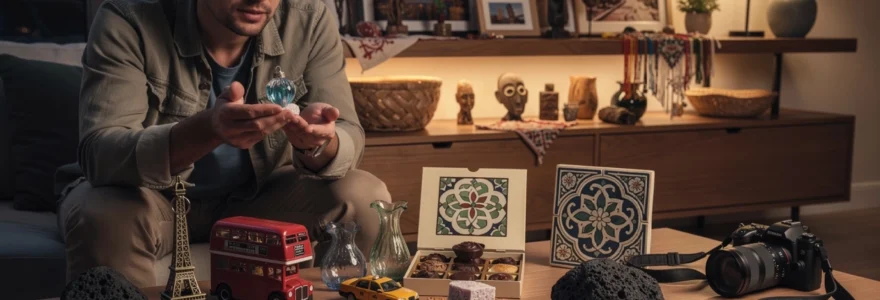
Every traveller knows the magnetic pull of a market stall displaying handwoven textiles, or the irresistible charm of a tiny shop tucked away on a cobblestoned street. The objects we carry home in our luggage represent far more than mere trinkets—they are tangible fragments of experience, physical manifestations of memory, and deeply personal narratives compressed into material form. Whether it’s a wooden whipping-top crafted by an eight-year-old boy in Lombok or a wine glass from a favourite Maui restaurant, these objects serve as portals back to moments that shaped us.
The act of selecting, purchasing, and preserving souvenirs engages complex psychological processes that intertwine memory formation, identity construction, and social bonding. Recent studies in consumer psychology suggest that up to 78% of travellers deliberately purchase at least one item during their journeys specifically to serve as a reminder of their experiences. This behaviour transcends cultures, economic backgrounds, and travel styles—from backpackers collecting woven bracelets to luxury travellers acquiring artisan ceramics.
Understanding why certain objects become cherished keepsakes whilst others gather dust reveals fundamental truths about human connection, storytelling, and the ways we construct meaning from transient experiences. The relationship between traveller and souvenir is never arbitrary; it’s a deliberate act of memory preservation wrapped in layers of cultural, emotional, and psychological significance.
The psychology of souvenir selection: cognitive triggers and memory anchoring
The human brain processes travel memories differently from routine experiences, encoding them with heightened emotional intensity and sensory detail. Neuroscientific research demonstrates that novel experiences—particularly those encountered during travel—activate the hippocampus more vigorously than familiar situations. When you purchase a souvenir, you’re essentially creating a physical anchor for this heightened neural activity, establishing a tangible connection to an otherwise ephemeral moment.
The endowment effect and tangible memory preservation
Behavioural economists have long documented the endowment effect—our tendency to overvalue objects we own compared to identical items we don’t possess. This cognitive bias intensifies dramatically with travel souvenirs. Research from the Journal of Consumer Psychology indicates that people assign approximately 40% higher sentimental value to objects acquired during meaningful travel experiences compared to functionally identical items purchased locally.
Consider the Indonesian whipping-top from the opening narrative: objectively, it’s a simple wooden toy that could be replicated anywhere. Yet the story behind its acquisition—the spontaneous connection with local children, the craftsman’s demonstration of traditional string-making, the cross-cultural exchange—transforms it into something irreplaceable. The toy becomes what anthropologists call a biographical object, its value inseparable from the narrative woven around it.
This phenomenon explains why a mass-produced keychain from Paris can carry profound meaning despite its ubiquity. The object serves as a mnemonic device, triggering cascading recollections: the café where you stopped afterward, the unexpected conversation with a stranger, the particular quality of afternoon light illuminating Notre-Dame. Neurologically, examining the souvenir reactivates neural pathways associated with the original experience, producing what psychologists term “memory reconsolidation”.
Nostalgia marketing: how vendors exploit emotional Decision-Making
Tourist markets worldwide have developed sophisticated strategies to capitalise on the emotional vulnerability of travellers. Vendors intuitively understand—or have learned through generations of practice—that tourists make purchasing decisions through emotional rather than rational evaluation. Strategic placement near departure points, limited-time framing (“last chance before you leave”), and cultural authenticity claims all target the psychological urgency travellers feel to capture their experiences before they end.
In popular destinations like Santorini and Bali, entire commercial ecosystems have evolved around souvenir psychology. Studies show that tourists spend an average of 12-18% of their total travel budget on souvenirs and gifts, with spending patterns spiking dramatically during final days when departure anxiety peaks. Shops strategically cluster near airport shuttles and port terminals, maximising exposure during this high-conversion window.
The most sophisticated vendors create narrative frameworks around their products. Rather than simply selling items, they offer stories
The most sophisticated vendors create narrative frameworks around their products. Rather than simply selling items, they offer stories about artisans, endangered techniques, or “traditional recipes passed down for generations.” This is nostalgia marketing in its purest form: you are not just buying a magnet; you are buying a tiny, idealised version of a place and time that you fear you might never fully recapture. The risk, of course, is that these narratives can become formulaic, engineered more for emotional impact than for cultural accuracy. As travellers, learning to distinguish genuine stories from manufactured sentiment is crucial if we want souvenirs that reflect reality rather than stereotypes.
Cultural authentication and the quest for genuine artefacts
Many travellers today consciously seek “authentic souvenirs,” objects that feel rooted in local culture rather than produced for mass consumption. Anthropologists describe a process called cultural authentication, in which an object moves from being a generic commodity to a culturally meaningful artefact through design, use, and narrative. When you choose hand-carved masks in West Africa or embroidered textiles in Oaxaca, you are often trying to participate in this process, aligning yourself with what you perceive as the “real” identity of a place.
However, authenticity is rarely clear-cut. That Balinese sarong sewn with modern synthetic thread, or the “traditional” Japanese yukata made in China, may still be worn in local households and festivals. Does its value diminish because it doesn’t meet a purist definition of origin? For many of us, the quest for authentic souvenirs is less about objective criteria and more about whether an object resonates with the lived experience of the trip. If a ceramic mug reminds you of the tea you drank in a family-run guesthouse in Istanbul, it becomes authentic to your story, even if it came from a wholesale market.
To navigate this tension, it helps to ask questions: who made this, where, and for whom was it originally intended? Souvenir hunting becomes less about accumulating exotic objects and more about understanding the cultural systems that produced them. When we slow down and listen, the purchase itself can feel less transactional and more like a respectful exchange.
Social signalling through material culture collection
Souvenirs also operate as powerful tools of social signalling. Displayed on shelves, worn as jewellery, or casually mentioned in conversation, they communicate where we have been, what we value, and how we wish to be seen. A wall of framed travel prints, a drawer full of concert wristbands, or a collection of museum tote bags all serve as visual shorthand, broadcasting identity in a way words rarely can. In this sense, souvenirs function similarly to diplomas or professional awards: they are tangible evidence of life experiences and achievements.
Social media has amplified this signalling function. When you share a photo of your new Berber rug or Icelandic sweater, you are not only documenting a purchase; you are curating a public narrative about your taste, mobility, and cultural awareness. Some researchers argue that this performative aspect of souvenir collecting can edge into “experience branding,” where the trip is partially shaped by how it will appear to others. Yet this does not necessarily cheapen the meaning of the objects. Many of us both genuinely love what we bring home and enjoy the subtle status that certain pieces confer.
Understanding this social dimension can actually make us more intentional. Instead of unconsciously buying what looks impressive, we can ask: what story does this object tell about me, and is that the story I want to share? When the answer is yes, the souvenir becomes a congruent part of our identity, not just clutter with a passport stamp.
Regional souvenir typologies: from eiffel tower keychains to maasai beadwork
Across the world, certain destinations have developed instantly recognisable souvenir typologies—categories of objects so strongly associated with a place that they become visual clichés. These items often exist on a spectrum from mass-produced tourist kitsch to museum-quality craftsmanship. They reveal not only how locals perceive their own culture, but also how they believe outsiders wish to consume it. Examining these patterns is like reading a global catalogue of collective imagination.
Mass-produced tourist iconography in paris, london, and new york
Walk through almost any major capital and you will encounter the same familiar displays: Eiffel Tower keychains in Paris, Union Jack mugs in London, I ♥ NY t-shirts in Manhattan. These items trade in iconography, distilling complex cities into a few instantly recognisable symbols. They are cheap, portable, and often produced far from the places they represent, yet millions of travellers buy them every year. Why do these generic souvenirs remain so popular in an age when we claim to value uniqueness?
Part of the answer lies in their function as social shorthand. A miniature Statue of Liberty on your desk requires no explanation; its meaning is self-evident. For some travellers, these objects serve as entry-level tokens—accessible ways to participate in global travel culture without deep cultural knowledge or large budgets. They also appeal to those buying in bulk for colleagues, classmates, or distant relatives. In this context, the “predictability” of the souvenir is a feature, not a flaw: it aligns expectations on both sides of the gift exchange.
However, relying solely on such items can flatten our memories into stereotypes. If you wish to elevate your souvenir game even within these hyper-touristed cities, consider pairing a small mass-produced piece with something more site-specific, like a bookmark from a neighbourhood bookshop or a postcard drawn by a local illustrator. The combination still says “Paris” or “New York,” but in a way that reflects a more personal encounter with the city.
Artisan craftsmanship: moroccan zellige tiles and venetian murano glass
At the other end of the spectrum lie artisanal souvenirs, whose value rests in skill, tradition, and scarcity. Think of hand-cut zellige tiles from Morocco, assembled into intricate geometric patterns, or delicate Murano glass from the Venetian lagoon, shaped in fiery furnaces by master glassblowers. These objects embody centuries of specialised knowledge and often require years of apprenticeship to produce. Bringing one home is akin to acquiring a fragment of living heritage.
That said, not all “artisanal” products are equal. In many famous craft centres, you will find factory-made imitations presented as handmade, with prices that reflect marketing more than labour. A key question to consider is whether you can trace the piece back to a specific workshop or maker. In Fez, for example, some cooperatives allow visitors to watch tile-cutters at work and purchase directly from them. In Murano, reputable studios often stamp or certify their glass, while unusually low prices may signal imported copies.
If you are serious about collecting meaningful artisan souvenirs, approach the process like commissioning art rather than buying decor. Ask about materials, techniques, and symbolism. Be realistic about size and fragility—shipping a large mosaic table halfway around the world may not be practical. Sometimes a single tile, carefully wrapped, can hold as much memory as a full installation.
Edible souvenirs: belgian chocolates, turkish delight, and regional gastronomy
Food-based souvenirs occupy a special place in travel culture because they engage the senses so directly. A box of Belgian chocolates, a tin of buttery Scottish shortbread, or a selection of Turkish delight can recreate the flavours of a journey weeks after you return. In many countries, airports and train stations now dedicate entire sections to regional gastronomy, from Japanese mochi to Italian limoncello. Edible souvenirs are particularly effective travel gifts because they are consumable; they offer pleasure without long-term obligations of storage or display.
Of course, edible souvenirs come with their own logistics. Customs regulations, temperature sensitivity, and shelf life all influence what you can realistically transport. Hard cheeses from France may need vacuum sealing, while fragile pastries could crumble before you reach home. When possible, buy from producers who label ingredients clearly and package items for travel. This is especially important if your recipients have allergies or dietary restrictions.
Beyond practicality, consider the storytelling potential of food gifts. A small packet of spice mix from a Marrakech souk can accompany a recipe you scribbled down during a cooking class. Coffee beans from a Rwandan cooperative can open a conversation about fair trade practices. In this way, edible souvenirs become catalysts for shared meals and deeper dialogue rather than fleeting snacks.
Natural specimens: seashells from the maldives and lava rock from iceland
Many travellers are instinctively drawn to natural souvenirs—smooth stones from a riverbank, shells from a tropical beach, or a fragment of lava rock from Iceland’s volcanic landscapes. These items feel raw and elemental, as if we are taking home a literal piece of the earth we walked on. For some, they carry more emotional weight than anything purchased in a shop. Holding a shell collected during a sunrise walk can instantly transport you back to the sound of waves and the smell of salt.
However, natural souvenir collecting raises important ethical and legal questions. In several destinations, removing stones, coral, sand, or shells is outright illegal due to environmental degradation. For example, Iceland’s authorities explicitly discourage taking lava rocks from protected areas, and many marine parks worldwide prohibit collecting coral or live shells. Even when it is technically allowed, high volumes of visitors each taking “just one” can have cumulative impacts on fragile ecosystems.
If you love nature-based mementos, look for sustainable alternatives. Some local artisans incorporate legally sourced natural materials into jewellery or decor, adding both beauty and context. Or consider “digital specimens”—macro photographs of shells, leaves, or rock formations that you can print at home. The key is to honour the landscapes that moved you without inadvertently damaging them.
Ethical dimensions of souvenir procurement and cultural heritage protection
As global travel becomes more accessible, the ethics of what we buy—and from whom—has moved from niche concern to mainstream conversation. Souvenirs sit at the intersection of culture, commerce, and heritage, which means our choices can have ripple effects far beyond our own shelves. From fuelling illicit antiquities markets to contributing to plastic pollution, the darker side of souvenir culture is real. Yet the same purchasing power can also support artisans, fund conservation, and help sustain traditional practices under pressure.
UNESCO guidelines on cultural property and antiquities trafficking
One of the most serious ethical pitfalls in souvenir shopping involves cultural property and antiquities. UNESCO and other international bodies have long warned that demand for “authentic” artefacts can inadvertently support looting of archaeological sites, destruction of sacred spaces, and funding of organised crime. That Roman coin in a flea market or that “ancient” Khmer statue with no clear provenance may not be just a bargain; it could be a piece of stolen history.
The 1970 UNESCO Convention on the Means of Prohibiting and Preventing the Illicit Import, Export and Transfer of Ownership of Cultural Property provides a framework for protecting heritage. Many countries now restrict the export of items over a certain age or of particular cultural significance. As a traveller, you don’t need to memorise legal codes, but you do have a responsibility to be cautious. Any seller claiming an item is “very old,” “from a temple,” or “from a tomb” should raise red flags rather than excitement.
If you genuinely wish to collect historical or culturally significant pieces, work with reputable galleries or museum-sponsored shops that provide documentation of legal provenance. Alternatively, consider high-quality reproductions produced by local artisans in partnership with cultural institutions. These can honour traditional aesthetics without contributing to the loss of irreplaceable heritage.
Environmental impact of mass tourism merchandising in santorini and bali
Beyond cultural issues, the sheer volume of cheap souvenirs produced for popular destinations has major environmental consequences. In places like Santorini or Bali, narrow streets and beaches are lined with stalls selling plastic trinkets, synthetic fabrics, and low-quality gadgets destined for short lifespans. Once the novelty wears off, many of these items end up in landfills or, worse, in oceans and rivers. The carbon footprint of manufacturing and transporting such goods often far outweighs their brief utility.
Consider the typical “beach holiday” souvenir set: inflatable toys, fast-fashion sarongs, novelty sunglasses, and disposable decor. Each is inexpensive in isolation, but multiplied by millions of tourists each season, the environmental cost becomes significant. Local waste management systems in many destinations are already stretched, and imported plastics can overwhelm infrastructure not designed for high tourist volumes.
As conscious travellers, we can push back against this cycle by prioritising quality over quantity and favouring materials that are durable, repairable, or biodegradable. Ask yourself: will this still matter to me in five years, or will it break on the flight home? Choosing fewer, better souvenirs is not only kinder to the planet but also more aligned with the desire for meaningful travel memories.
Fair trade certification and supporting local economies in developing nations
On the positive side, souvenir purchases can be a powerful tool for economic justice when channelled thoughtfully. In many developing nations, craft production is one of the few income sources available to rural communities and women. Fair trade certifications and social enterprises aim to ensure that artisans receive living wages, safe working conditions, and a voice in how their cultural expressions are marketed. When you buy a fair trade basket in Rwanda or a certified textile in Peru, you are participating in an alternative trade network designed to redistribute value more equitably.
Not all impactful purchases carry official labels, though. Small, family-run stalls, street vendors, and cooperatives can also directly benefit from your business, especially outside major tourist zones where tourist dollars are more thinly spread. A practical approach is to diversify your spending: perhaps buy one or two higher-priced certified items and complement them with purchases from local markets where you can see who is making and selling the goods.
To align your souvenir shopping with your values, ask simple questions: who profits from this sale, and under what conditions was this made? Choosing handwoven baskets over imported plastic decor, or buying from a cooperative rather than a large chain, can turn a simple memento into a small act of solidarity.
The semiotics of tourist objects: symbolism and narrative construction
Beyond their material qualities, souvenirs function as symbols in a personal language we construct over time. Semiotics—the study of signs and symbols—offers a useful lens for understanding why certain objects resonate so deeply. A miniature gondola is not merely a boat; it stands in for Venice, romance, and perhaps a specific evening gliding through narrow canals. A simple bracelet may symbolise independence if it was bought on your first solo trip, or reconciliation if it marked a difficult relationship mended abroad.
When we bring souvenirs home, we weave them into narratives that help us make sense of our lives. You might describe the chipped ceramic bowl on your shelf as “the one I bought when I finally quit my job and went to Mexico,” or the faded concert tee as “from that festival where I met my best friend.” These stories act as interpretive captions, turning random objects into chapters of an ongoing autobiography. In this way, a home can be read almost like a graphic novel, with each item a panel in a larger story.
Interestingly, the meanings of souvenirs are not fixed. Over time, they can be reinterpreted as relationships shift or as new experiences overlay old ones. The wine glass that once represented a romantic honeymoon may later symbolise resilience after a divorce, or simply become a beloved everyday vessel. As our identities evolve, so does the semiotic landscape of our possessions, which is why decluttering decisions can feel so emotionally loaded: we are not just discarding things, but editing our own narrative.
Digital disruption: instagram photography versus physical keepsakes
The rise of smartphones and social media has fundamentally reshaped how we document travel. Today, your camera roll might hold thousands of images from a single trip, while your suitcase contains only a handful of physical souvenirs. Some argue that digital photographs, Instagram stories, and travel vlogs have replaced traditional keepsakes, serving as lightweight, infinitely shareable memory anchors. Why buy a snow globe when a perfectly filtered skyline shot can live on your profile forever?
Yet digital mementos and physical souvenirs fulfil slightly different psychological roles. Photos prioritise visual recall and are often captured quickly, sometimes more for public sharing than private reflection. Physical objects, by contrast, require deliberation: you choose them, pay for them, carry them, and find them a place at home. This investment of effort deepens the emotional bond. Moreover, algorithms can bury old posts, while a scarf or mug remains stubbornly present in your daily routine, prompting spontaneous recollections long after the trip.
Rather than seeing digital documentation and physical souvenirs as competitors, we can treat them as complementary layers of travel memory. A printed photo book of your favourite Instagram shots placed next to a bowl from the same market creates a multi-sensory archive of one journey. The key is to avoid slipping into “capture fatigue,” where the urge to document every moment prevents you from truly inhabiting any of them. Sometimes the most powerful souvenir is a single, thoughtfully chosen object paired with a handful of images that truly mean something to you.
Souvenir display practices and home identity formation
Once we return home, the question becomes: where do these travel mementos live, and what do they say about us in that space? Interior designers and sociologists alike note that how we display souvenirs is central to home identity formation. A carefully curated shelf of objects from different continents signals cosmopolitanism and curiosity. A fridge covered in magnets from family road trips foregrounds togetherness and tradition. Even the decision to keep souvenirs tucked away in drawers reveals a preference for private over public storytelling.
Some travellers adopt thematic display strategies. They might create a “travel wall” of framed maps, tickets, and small objects, or dedicate a single cabinet to ceramics collected over decades. Others integrate souvenirs seamlessly into daily life: a handwoven rug in the living room, a tea set in regular rotation, a set of chopsticks that turns weeknight dinners into quiet reminders of a Tokyo alleyway. In each case, the home becomes a living museum where the exhibits are not static relics but active participants in everyday rituals.
Thoughtful display can also prevent souvenirs from tipping into clutter. Before buying, you might ask yourself: can I picture where this will live? Will it displace something less meaningful, or will it end up in a box under the bed? Over time, periodic editing—donating items that no longer resonate, reframing photos, rotating objects between storage and display—helps keep your environment aligned with who you are now, not just who you were when you first started travelling.
Ultimately, the stories behind the souvenirs we choose to bring back do not end at the airport. They continue to evolve in our homes, our conversations, and even our future travel decisions. Each object, whether humble or grand, invites us to remember not only where we have been, but also who we were in those moments—and who we are becoming as we carry those memories forward.