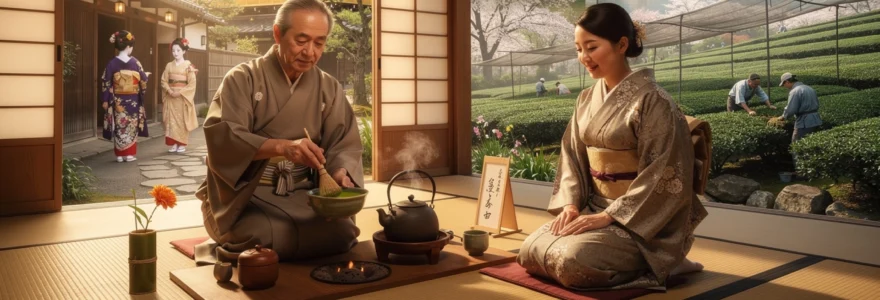
In the heart of Japan’s ancient capital, Kyoto’s tea culture represents one of humanity’s most refined expressions of mindfulness and aesthetic beauty. For over a millennium, this historic city has served as the epicentre of Japanese tea ceremony traditions, where the delicate art of chanoyu transforms a simple beverage into a profound spiritual experience. The mist-covered hills surrounding Kyoto have nurtured not only some of the world’s finest tea leaves but also the philosophical foundations that elevated tea drinking from mere refreshment to sacred ritual.
The cobblestone paths of Gion, the serene gardens of ancient temples, and the traditional machiya townhouses all bear witness to centuries of tea culture evolution. Here, the whisper of silk kimonos mingles with the gentle sound of water boiling in iron kettles, creating an atmosphere where time seems suspended. Kyoto’s tea culture encompasses far more than ceremony; it represents a living philosophy that values harmony, respect, purity, and tranquillity in every gesture and moment.
Historical evolution of kyoto’s tea ceremony traditions from heian period to modern era
The journey of tea culture in Kyoto began during the Heian Period (794-1185), when Buddhist monks first brought tea seeds from China to Japanese soil. Initially consumed primarily for its medicinal properties and to aid meditation, tea gradually evolved from a monastic practice into an aristocratic pastime. The imperial court embraced tea drinking as a sophisticated cultural activity, setting the stage for what would become Japan’s most cherished ceremonial art.
Sen no rikyū’s revolutionary Wabi-Cha philosophy and its kyoto origins
The 16th century marked a transformative period in Kyoto’s tea culture with the emergence of Sen no Rikyū, whose wabi-cha philosophy revolutionised tea ceremony practices. Rikyū’s approach emphasised simplicity over ostentation, finding profound beauty in imperfection and impermanence. His four fundamental principles – wa (harmony), kei (respect), sei (purity), and jaku (tranquillity) – became the cornerstone of authentic tea ceremony practice. This philosophy transformed tea houses from elaborate displays of wealth into intimate spaces designed for spiritual contemplation and human connection.
Rikyū’s influence extended beyond ceremony into architectural design, establishing the four-and-a-half tatami mat tea room as the ideal space for authentic tea gathering. His innovations included the nijiriguchi (crawling entrance), which required guests to humble themselves upon entry, regardless of social status. These design elements, still prevalent in contemporary Kyoto tea houses, reflect the democratic spirit that Rikyū infused into tea culture.
Urasenke and omotesenke schools: divergent tea ceremony lineages in kyoto
Following Rikyū’s death, his legacy divided into several distinct schools of tea ceremony, with Urasenke and Omotesenke becoming the most prominent lineages based in Kyoto. The Urasenke school, established in 1622, emphasises accessibility and has been instrumental in spreading tea culture internationally. Their approach focuses on preserving traditional forms while adapting to contemporary contexts, making tea ceremony more approachable for modern practitioners.
The Omotesenke school, founded slightly earlier, maintains a more conservative approach to tea ceremony traditions. Their practices emphasise precise adherence to historical procedures and seasonal considerations. Both schools continue to operate their iemoto (headmaster) headquarters in Kyoto, where they train tea masters and preserve ancient knowledge for future generations. The subtle differences between these schools – in hand positions, utensil handling, and ceremonial timing – reflect centuries of refined interpretation and development.
Imperial court tea practices during heian and kamakura periods
During the Heian Period, tea consumption within Kyoto’s imperial court followed Chinese Tang Dynasty customs, featuring elaborate tea competitions and poetry gatherings. Aristocrats would engage in tōcha (tea tasting contests), where participants attempted to identify different tea varieties
and distinguish between those produced in different regions such as Uji and Toganoo. By the Kamakura Period (1185–1333), as the samurai class rose to power, tea gatherings at the imperial court began to adopt a more disciplined, Zen-influenced tone. Aristocrats and warrior elites alike used tea as a way to demonstrate refinement, political alliances, and familiarity with Chinese culture. Written records from this era describe lavish banquets where tea was paired with poetry recitals, incense appreciation, and calligraphy, offering a glimpse into how deeply tea had become woven into Kyoto’s courtly life.
Over time, these elite tea practices gradually filtered down from the rarefied world of the palace into temples and the estates of high-ranking samurai. While the core idea of appreciating fine tea remained, the emphasis shifted from flamboyant displays of wealth to more introspective appreciation. This transition laid the groundwork for the later emergence of wabi-cha, where simplicity and inner richness replaced surface-level opulence. When you step into a Kyoto tea room today, you are still, in many ways, stepping into the refined sensibilities of the Heian and Kamakura courts—just distilled into a more minimalist, spiritual form.
Transformation from chinese tang dynasty influences to distinctly japanese sadō
Kyoto’s tea culture began under strong Chinese influence, drawing heavily on Tang Dynasty customs, powdered tea preparation methods, and elegant Chinese utensils. Early tea gatherings celebrated imported bowls, incense, and calligraphy, reflecting an admiration for continental culture. Yet as centuries passed, Kyoto tea masters started to reinterpret these elements through a distinctly Japanese lens, refining them into what became known as sadō or chadō—the Way of Tea.
This transformation was neither abrupt nor accidental. It unfolded gradually as Zen Buddhism, indigenous aesthetics, and local materials interacted with Chinese precedents. Instead of ornate Chinese ceramics, Kyoto potters created rustic, asymmetrical bowls that embodied wabi-sabi. Tea rooms shrank from grand halls to intimate huts, echoing the Japanese love for subtlety and suggestion. In the same way that a borrowed melody can inspire an entirely new composition, Tang practices served as a starting point, but the resulting Kyoto tea ceremony became a uniquely Japanese art form rooted in local climate, craftsmanship, and philosophy.
By the early Edo Period, the term sadō captured not just the act of drinking tea, but a complete spiritual path. In Kyoto, this meant integrating tea with seasonal awareness, poetry, flower arrangement, and calligraphy into a unified cultural expression. Modern visitors who join a tea ceremony in Kyoto—whether in a temple, townhouse, or dedicated tea school—are experiencing this long evolution from China-inspired recreation to a mature, Japanese Way of Tea that is both rigorous and warmly welcoming.
Sacred tea houses and historic venues preserving kyoto’s chanoyu heritage
Kyoto’s tea ceremony heritage is not only preserved in books and schools; it lives in the city’s architecture, gardens, and historic districts. Across the former imperial capital, tea houses and temple complexes have safeguarded traditional layouts, garden designs, and ceremonial protocols. Stepping into these venues, you perceive how space itself guides behaviour: low entrances encourage humility, stone paths slow your pace, and framed views of moss and maple leaves invite quiet contemplation.
Many of these historic venues continue to offer tea-related experiences, from formal chakai (tea gatherings) to more relaxed matcha tastings for visitors. For travellers, this means you can move beyond passively observing Kyoto’s tea culture and instead participate in rituals shaped over centuries. Whether you prefer the solemn atmosphere of a Zen temple or the refined charm of a Gion ochaya, Kyoto provides a spectrum of ways to engage with authentic chanoyu in situ.
Kinkaku-ji temple’s traditional tea ceremony pavilions and garden integration
While Kinkaku-ji—The Golden Pavilion—is best known for its shimmering facade reflected in a mirror-like pond, its grounds also embody key principles of Kyoto’s tea culture. Historically, sub-temples and teahouses within the precincts served as spaces where monks and visiting dignitaries could practise simplified tea rituals. The integration of pavilions, stone lanterns, stepping-stone paths, and water basins illustrates how the tea ceremony is inseparable from garden design.
As you walk the circuit path at Kinkaku-ji, consider how each turn offers a new composition, much like turning a tea bowl in your hands to admire it from different angles. This deliberate choreography of views mirrors the structure of a tea gathering, where each phase—entry, purification, tea, and departure—is carefully staged. While formal public tea ceremonies at Kinkaku-ji are limited, the temple’s layout offers a living lesson in how tea pavilions and gardens collaborate to create atmosphere. For photographers and cultural travellers alike, studying these subtle design cues can deepen appreciation for Kyoto’s tea-centric landscape architecture.
Gion district’s exclusive ochaya tea houses and geisha tea service protocols
In Gion, Kyoto’s famous entertainment district, tea culture takes on a more social and performative dimension. Traditional ochaya (tea houses) are invitation-only establishments where geiko (geisha) and maiko (apprentices) entertain guests with dance, music, conversation, and refined tea service. Unlike temple-based chanoyu, the focus here lies in hospitality, artistry, and long-cultivated relationships, often spanning generations.
Inside an ochaya, tea is served with impeccable etiquette that blends formal tea ceremony movements with the relaxed charm of Kyoto-style conversation. Bowls are selected according to season, sweets reflect local ingredients, and the timing of each course is attuned to the flow of performance. As a visitor, accessing these spaces can be challenging without a local connection, but reputable cultural tours and ryokan concierges sometimes arrange introductions. Observing geisha tea service in Gion reveals how deeply Kyoto’s tea culture is embedded in the city’s social fabric, where refinement and entertainment coexist in perfect balance.
Philosopher’s path tea establishments: hōnen-in and ginkaku-ji connections
Running alongside the canal in northern Kyoto, the Philosopher’s Path offers a quieter expression of tea culture. This scenic walkway connects Ginkaku-ji (the Silver Pavilion) with Nanzen-ji, passing small shrines, galleries, and understated tea cafés. Historically, this area was frequented by scholars and monks, including philosopher Nishida Kitarō, who is said to have walked this route daily in contemplation—mirroring the introspective spirit of chanoyu.
Near Ginkaku-ji and Hōnen-in, you’ll find intimate tea establishments that blend modern café sensibilities with traditional matcha and wagashi. Here, you can sip a bowl of Uji matcha while overlooking a moss garden or listening to the gentle flow of the canal. While these venues may not follow the full formal procedure of a tea school, they retain the core values of Kyoto’s tea culture: simple settings, seasonal awareness, and a focus on presence. For travellers who want to experience tea as part of daily life rather than a staged ceremony, the Philosopher’s Path area offers an ideal starting point.
Daitoku-ji temple complex: zen buddhism’s influence on tea ceremony architecture
Daitoku-ji, a sprawling Zen temple complex in northern Kyoto, is perhaps the single most important site for understanding the connection between Zen and tea. Many of Japan’s great tea masters, including Sen no Rikyū, were closely associated with Daitoku-ji, and several sub-temples contain historic tea rooms and gardens that directly influenced wabi-cha aesthetics. The architecture here is reserved and austere, favouring natural materials, muted colours, and carefully framed garden vistas.
Walking through Daitoku-ji, you’ll notice low eaves, narrow pathways, and small, jewel-like gardens, all of which encourage quiet reflection. Tea rooms within the complex often feature rustic plaster walls, bamboo ceilings, and hand-hewn pillars that embody the ideal of finding elegance in humility. If you have the opportunity to join a special tea event or seasonal opening at one of Daitoku-ji’s sub-temples, you’ll witness how space, light, and silence collaborate to deepen the tea experience. Even without a formal ceremony, simply sitting on a wooden veranda and viewing a raked gravel garden can feel like an informal extension of Kyoto’s tea tradition.
Maruyama park’s seasonal tea gatherings and cherry blossom viewing ceremonies
Maruyama Park in eastern Kyoto demonstrates how tea culture steps outdoors, especially during spring and autumn. During cherry blossom season, temporary tea pavilions and stalls appear beneath the illuminated sakura, offering matcha and sweets to hanami (flower-viewing) visitors. These gatherings are less formal than a full chakai, but they still observe core principles of seasonal appreciation, shared hospitality, and quietly savoured beauty.
In autumn, when maples around Maruyama Park blaze red and gold, local tea groups sometimes host open-air ceremonies that welcome curious onlookers. Participating in one of these events is an excellent way for first-time visitors to experience Kyoto tea culture without the pressure of strict etiquette. You’ll be guided gently through basic gestures—how to receive the bowl, how to express gratitude—while the spectacle of nature provides a dramatic backdrop. This blending of public park space and refined tea rituals shows how deeply Kyoto’s chanoyu heritage permeates everyday urban life.
Artisanal tea production methods and kyoto’s premium cultivars
Behind every bowl of matcha or cup of sencha in Kyoto lies a chain of craftsmanship stretching from remote mountain terraces to city tea rooms. Kyoto Prefecture, particularly the Uji region, is renowned across Japan for producing some of the country’s highest-grade teas. Strict cultivation methods, carefully managed shading, and meticulous processing all contribute to distinctive flavour profiles prized by tea masters.
Understanding these production methods can greatly enrich your experience of Kyoto’s tea culture. When you know what separates gyokuro from sencha, or how tencha becomes ceremonial-grade matcha, each sip becomes a form of informed appreciation rather than casual consumption. If you’re curious about where your tea comes from and how it is made, Kyoto’s tea fields and factories offer ample opportunities for guided tours, tastings, and even hands-on experiences during the harvest seasons.
Uji region’s gyokuro cultivation techniques and shade-growing methodologies
Uji, just south of central Kyoto, is synonymous with gyokuro, one of Japan’s most luxurious green teas. Gyokuro fields are shaded for approximately 20–30 days before harvest, often using traditional straw mats or modern netting to reduce sunlight. This shading process slows photosynthesis, increasing levels of amino acids like L-theanine while reducing bitterness—resulting in a tea with remarkable sweetness and umami.
Visiting Uji’s tea fields, you’ll see rows of low, carefully pruned bushes tucked beneath dark canopies, almost like vineyards draped with cloth. Farmers must monitor light, temperature, and moisture with precision, adjusting covers daily depending on weather conditions. Would you expect that such a delicate flavour demands so much effort? In many ways, gyokuro cultivation resembles fine wine production: terroir, microclimate, and artisanal skill all leave an imprint in the cup. When brewed at lower temperatures with care, Uji gyokuro offers a thick, almost broth-like liquor that showcases the pinnacle of Kyoto tea craftsmanship.
Tencha processing for ceremonial-grade matcha powder production
Another cornerstone of Kyoto’s tea reputation is its matcha, made from a base tea called tencha. After shaded leaves are harvested—usually by hand for the highest grades—they are quickly steamed to halt oxidation, then dried without rolling. The stems and veins are removed, leaving delicate leaf flakes that are later ground into fine powder using granite mills. This slow stone-milling process, often producing only about 30–40 grams of matcha per hour, preserves aroma and prevents heat damage.
In Uji and surrounding areas, you can tour facilities where tencha is transformed into matcha and even try operating a small stone mill yourself. Watching vibrant green flakes turn gradually into silky powder is like seeing a painting come into focus stroke by stroke. The resulting ceremonial-grade matcha is used in Kyoto’s tea schools, temples, and specialty cafés, where its colour, froth, and lingering sweetness are all carefully evaluated. For travellers, choosing a small tin of Uji matcha to take home can be one of the most meaningful—and delicious—souvenirs from Kyoto.
Yamashina district’s sencha harvesting and traditional rolling methods
While matcha and gyokuro often steal the spotlight, Kyoto also has a rich tradition of sencha production, particularly in areas like Yamashina to the east of the city. Sencha is Japan’s most commonly consumed green tea, and in Yamashina it is crafted with an emphasis on freshness and clarity of flavour. After harvesting, leaves are steamed, cooled, and then put through a series of rolling and drying stages that shape them into the familiar needle-like form.
Traditional rolling techniques require both strength and delicacy, as artisans knead and twist the leaves to break cell walls and release aromatic compounds. Think of it as gently coaxing out the tea’s character rather than forcing it. Some small producers in the Yamashina district still use older, semi-manual equipment, allowing visitors to glimpse production methods that predate full industrialisation. Tasting sencha near its source—often with views of the very hillsides where it was grown—offers a more everyday counterpart to the ceremonial intensity of matcha, rounding out your understanding of Kyoto’s tea diversity.
Organic tea farming practices in wazuka township’s mountain terraces
Further south from Uji lies Wazuka, a rural township often described as the “hidden heartland” of Kyoto’s tea country. Here, steep mountain terraces create dramatic landscapes of undulating green rows, and a growing number of farmers have embraced organic and low-input cultivation. The region’s cool nights, morning mists, and well-drained soils provide ideal conditions for high-quality leaves, while organic methods aim to preserve both flavour and ecosystem health.
Joining a tea farm tour in Wazuka allows you to walk among the terraces, learn about pest management without synthetic chemicals, and even hand-pick tender buds during harvest season. Many tours culminate in farm-to-table lunches and guided tastings, where you can compare organically grown sencha, kabusecha (lightly shaded tea), and matcha. For travellers concerned with sustainability, Wazuka demonstrates how Kyoto’s tea culture is evolving to meet modern environmental concerns without losing sight of tradition. It is a powerful reminder that every bowl of tea is a direct expression of the land and the hands that care for it.
Contemporary tea culture integration within kyoto’s urban landscape
Kyoto’s tea culture is not frozen in time; it continues to evolve alongside the city’s cafés, hotels, and creative industries. In recent years, specialty tea bars, modern matcha cafés, and hybrid spaces combining co-working and tea tasting have emerged across central Kyoto. These venues reinterpret chanoyu principles for a new generation, offering carefully curated tea flights, seasonal dessert pairings, and even tea-based cocktails that highlight Kyoto-grown leaves.
At the same time, traditional tea schools collaborate with universities, design studios, and tourism organisations to keep etiquette and philosophy accessible. You might encounter a pop-up tea ceremony inside a renovated machiya, or a hotel that offers on-site tea workshops led by certified instructors. For remote workers and digital nomads, Kyoto’s tearoom-inspired cafés provide calm environments where you can work between mindful tea breaks—an appealing antidote to the hurried pace of everyday life. By weaving tea seamlessly into modern routines, Kyoto ensures that its ancient tea culture remains vibrant and relevant.
Seasonal tea ceremonies and festival celebrations throughout kyoto’s calendar
Tea in Kyoto is inseparable from the rhythm of the seasons. Throughout the year, special ceremonies and festivals mark agricultural milestones, religious observances, and cultural holidays, each with its own tea-related customs. In spring, hanami tea gatherings celebrate cherry blossoms, while early summer brings rituals surrounding the first tea of the year, known as shincha. Autumn sees moon-viewing tea parties and harvest celebrations, and even winter has its intimate fireside gatherings that highlight the comfort of a warm bowl of matcha.
Many temples and shrines in Kyoto host public tea events during major festivals, giving visitors a chance to join locals in shared appreciation. For example, Uji’s tea festivals showcase demonstrations of traditional processing methods, while Kyoto city events sometimes feature outdoor tea pavilions staffed by students of Urasenke or Omotesenke. Planning your visit around these dates can transform your itinerary, allowing you to experience tea not just as a drink, but as a living seasonal language. If you’ve ever wondered how Kyotoites stay so attuned to nature’s subtle shifts, attending a seasonal tea ceremony is one of the most insightful answers.
Traditional tea utensil craftsmanship and kyoto’s artisan communities
No discussion of tea culture in Kyoto is complete without acknowledging the artisans who create the utensils used in every ceremony. From hand-thrown chawan (tea bowls) to finely woven bamboo whisks and lacquered tea caddies, each object reflects specialised skills honed over generations. In and around Kyoto, pottery centres like Uji’s Asahiyaki and kilns in Kiyomizu-yaki districts produce ceramics that are prized by tea practitioners across Japan. These bowls are not merely functional; they are companions in the quiet drama of chanoyu, chosen carefully to match the season, theme, and mood of each gathering.
Bamboo craftspersons in nearby regions supply chasen (tea whisks) and chashaku (tea scoops), carving and curing each piece to achieve the right balance of flexibility and resilience. Lacquer artists, metalworkers, and textile weavers all contribute to the broader ecosystem of tea utensils, from trays and kettles to scrolls and woven hanging baskets. Visitors interested in these crafts can explore galleries, attend workshops, or commission bespoke pieces, supporting communities that are vital to Kyoto’s cultural continuity. In this way, every cup of tea you enjoy in Kyoto becomes part of a larger story—one that includes not only farmers and tea masters, but also the quiet dedication of artisans whose work makes the Way of Tea tangible.