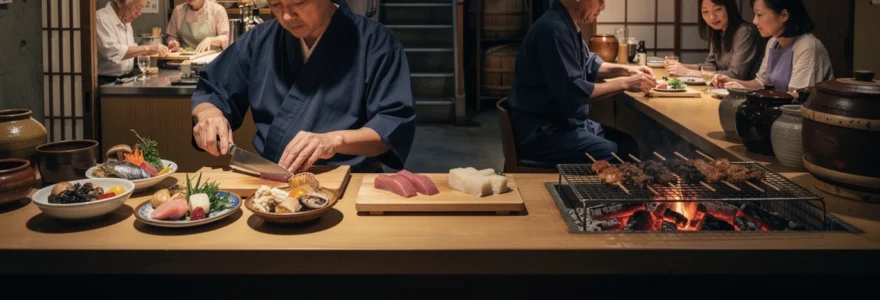
Tokyo’s gastronomic landscape operates on a principle that transcends conventional restaurant hierarchies. Beneath the glittering veneer of Michelin recognition lies a parallel universe of culinary excellence, where precision isn’t merely technique—it’s a philosophical commitment embedded in every knife stroke, every temperature adjustment, every ingredient selection. The capital’s estimated 150,000 dining establishments create a labyrinthine network where true connoisseurs navigate not by guidebook rankings, but through whispered recommendations and visual recognition of unassuming doorways. This intricate ecosystem demands understanding not just where to eat, but how Tokyo’s culinary masters achieve their extraordinary consistency through methodological discipline that borders on spiritual practice.
The city’s food culture represents centuries of refinement compressed into contemporary practice, where ancestral techniques meet modern precision. For international visitors attempting to decode Tokyo’s restaurant landscape, the challenge extends beyond language barriers—it requires appreciation for spatial design philosophy, ingredient seasonality principles, and the unspoken protocols that govern chef-diner interactions at intimate counter establishments. Understanding these elements transforms dining from mere consumption into participatory cultural immersion.
Navigating tokyo’s kakurega culture: underground dining establishments beyond michelin guides
The Japanese concept of kakurega—literally “hidden place”—describes restaurants deliberately designed to elude casual discovery. These establishments eschew prominent signage, relying instead on clientele networks and carefully curated word-of-mouth reputation. This architectural philosophy reflects deeper cultural values regarding exclusivity and authenticity, where accessibility is earned through knowledge rather than purchased through prominence.
Tokyo’s kakurega restaurants frequently occupy basement floors, converted residential spaces, or locations behind misleading storefronts. The deliberate obscurity serves multiple functions: it filters clientele naturally, maintains intimate atmosphere through limited capacity, and preserves the chef’s creative autonomy by reducing pressure from mass tourism. Recent surveys indicate approximately 40% of Tokyo’s most acclaimed independent restaurants lack English signage entirely, whilst roughly 25% require introductions from existing patrons for first-time reservations.
Decoding the architectural subtlety of shibuya’s basement izakayas
Shibuya’s commercial district conceals dozens of subterranean izakayas accessible only through nondescript stairwells marked by paper lanterns or small wooden placards. These establishments typically accommodate eight to fifteen guests, with L-shaped counter configurations facilitating direct chef interaction. The basement location serves practical purposes beyond mystique—ground-level retail commands premium rents whilst subterranean spaces maintain temperature stability crucial for ingredient storage.
Architectural design in these venues prioritises functional intimacy. Counter height typically measures 95-100 centimetres, positioning diners’ eyelines directly with the chef’s preparation surface. This elevation encourages observation and conversation whilst maintaining respectful distance. Lighting schemes favour warm-spectrum incandescent fixtures between 2,700-3,000 Kelvin, creating visual warmth that enhances food presentation whilst reducing the clinical atmosphere associated with fluorescent alternatives.
Yanaka ginza’s Family-Run shokudo: Multi-Generational culinary preservation
The Yanaka district preserves Tokyo’s shitamachi (downtown) character, where third and fourth-generation family establishments maintain recipes and techniques transmitted through direct apprenticeship. These shokudo—casual dining halls—operate on principles fundamentally different from contemporary restaurant models. Menu items often remain unchanged for decades, with preparation methods refined through daily repetition rather than innovative experimentation.
Multi-generational transmission creates remarkable consistency but faces demographic challenges. Current statistics indicate approximately 60% of Tokyo’s family-run establishments lack clear succession plans, as younger generations pursue alternative careers. This creates urgency around preservation efforts, with culinary anthropologists documenting preparation techniques before knowledge transfer chains break. The shokudo model demonstrates how precision emerges not from formal training systems but through accumulated muscle memory and sensory calibration developed across thousands of service repetitions.
Koenji’s Counter-Seat establishments and Chef-Diner proximity protocols
Koenji’s bohemian restaurant scene specialises in counter-only venues seating six to twelve guests. These configurations eliminate traditional
physical distance between kitchen and dining room, establishing a micro-theatre where every movement of the grill, every knife stroke, becomes part of the experience. Proximity protocols are subtle but codified: chefs maintain a conversational cadence tied to service flow, engaging more deeply between courses while preserving concentrated silence during critical cooking stages. You are close enough to smell the rising aroma of tare caramelising on yakitori or hear the sizzle of fish skin meeting the pan, yet the choreography prevents this intimacy from ever feeling intrusive.
In these Koenji counters, precision manifests not only on the plate but also in social timing. Regulars know when to pose questions about a particular sake pairing and when to simply observe, reading cues from the chef’s body language. Seating is often assigned strategically, grouping solo diners near the corner for effortless conversation and placing pairs where service access is most efficient. For visitors unfamiliar with such etiquette, mirroring the pace of local diners—ordering gradually, asking the chef for recommendations, and avoiding phone use at the counter—ensures seamless integration into this tightly calibrated environment.
Naka-meguro’s converted machiya restaurants and spatial intimacy design
Naka-Meguro’s canal-side streets host a growing number of restaurants housed in converted machiya—traditional wooden townhouses adapted for contemporary dining. These spaces, often less than 40 square metres, force chefs and designers to think with architectural precision. Sliding doors, low eaves, and narrow corridors are not mere aesthetic choices; they control sound levels, sight lines, and circulation so that even full houses maintain a sense of calm. The original timber beams and tatami rooms are repurposed into semi-private alcoves, allowing you to feel secluded without full isolation from the main dining area.
Spatial intimacy design in these machiya eateries supports a slower, more reflective style of dining that aligns with Tokyo’s emphasis on seasonality and craftsmanship. Table spacing is measured not just in metres but in acoustic distance—enough separation so that the soft clink of ceramic plates becomes part of the ambience rather than a distraction. Lighting is layered: low ambient ceiling light, focused task lighting over the counter, and discreet accent lamps highlighting flower arrangements or seasonal scrolls. This calibrated environment primes you to pay closer attention to the nuances of the food, from the texture of charcoal-grilled river fish to the aroma of freshly grated wasabi.
Kaiseki methodology and seasonality principles in contemporary tokyo gastronomy
Beyond hidden izakayas and informal shokudo, Tokyo’s most exacting expression of culinary precision emerges in kaiseki—multi-course seasonal menus rooted in formal tea ceremony hospitality. While Kyoto is often considered kaiseki’s spiritual home, contemporary Tokyo kaiseki chefs have evolved the form, integrating global influences without losing sight of core Japanese principles of shun (peak season) and harmony. Think of kaiseki as a symphony: each course functions like a movement, distinct yet interconnected, with timing, temperature, and texture orchestrated to create a coherent whole.
In high-level Tokyo kaiseki restaurants, meal planning often begins months in advance, with chefs projecting seasonal ingredient availability based on conversations with fishmongers, foragers, and vegetable farmers. Menus are rarely printed; instead, course structure follows classical sequence—sakizuke (amuse), hassun, sashimi, lidded dishes, grilled items, simmered preparations, rice, and sweets—while details shift daily according to what arrives at peak condition. For diners, this methodology converts a simple night out into an edible calendar, allowing you to taste micro-seasons that pass in a matter of days, such as the fleeting period when bamboo shoots are tender enough to eat raw.
Hassun composition techniques: balancing yama no sachi and umi no sachi
The hassun course, often the second in a kaiseki sequence, is where the chef establishes the meal’s theme. Traditionally served on a rectangular plate, hassun symbolically unites yama no sachi (bounty of the mountains) and umi no sachi (bounty of the sea). This is not simply a poetic notion; it is an exercise in micro-engineering of flavour, colour, and proportion. A typical Tokyo hassun might pair grilled ayu (sweetfish) from a mountain stream with a tiny cube of marinated tuna, or wild mountain vegetables with a single brined clam, presenting the ecosystem of Japan on a plate no wider than your outstretched hand.
Chefs follow unwritten ratios when composing hassun: contrasting textures (crisp, yielding, gelatinous), a balance of the five basic tastes, and visual asymmetry that still feels stable—similar to the way a carefully arranged rock garden appears natural yet deliberate. Seasonal references are embedded everywhere: a leaf cut to resemble maple in autumn, a ceramic dish glazed like melting snow in early spring. When you eat hassun, you are not just sampling finger foods; you are reading a coded message about time, place, and the chef’s interpretation of nature’s current state.
Shun ingredient sourcing networks: tsukiji outer market to ota market transitions
Tokyo’s devotion to shun depends on a sophisticated sourcing network that has evolved rapidly over the past decade. While the famed inner wholesale section of Tsukiji Market relocated to Toyosu in 2018, the Tsukiji Outer Market remains a critical node for specialist purveyors of seaweed, dried fish, knives, and ceramics. At the same time, Ota Market in southern Tokyo has become the country’s largest fruit and vegetable hub, handling over 3,000 tons of produce per day. Many kaiseki and kakurega chefs now split their early-morning routines between Toyosu’s fish auctions and Ota’s produce halls, tailoring their purchases to the day’s offerings.
Shun sourcing is a dynamic conversation more than a simple transaction. Chefs cultivate long-term relationships with vendors who act as informal consultants, flagging when the first firefly squid of the year arrive or when a particular orchard’s white peaches hit optimal sugar content. For you as a diner, this network translates into menus that might change subtly from lunch to dinner, as a chef decides that the afternoon’s shipment of young bamboo is too exceptional not to feature immediately. The precision here lies in responsiveness: knowing when to deviate from a planned menu to honour a standout ingredient at the exact moment of its seasonal peak.
Dashi extraction protocols: kombu cultivar selection and katsuobushi shaving precision
If kaiseki is a symphony, then dashi—the umami-rich stock made from dried kelp and fish—is the underlying key signature. In serious Tokyo kitchens, dashi preparation follows strict protocols that border on laboratory practice. Chefs may choose between Rishiri, Rausu, or Ma-kombu cultivars depending on the desired flavour profile: Rishiri for crystalline clarity in clear soups, Rausu for deeper, almost buttery umami in simmered dishes. Kombu is typically soaked in carefully measured soft water overnight, with temperatures monitored to stay below 60°C until extraction, preventing bitterness.
Katsuobushi—fermented, smoked, and dried skipjack tuna—adds the second dimension of umami to dashi. The precision here extends to shaving thickness: flakes for clear soup may be just 0.01–0.02 millimetres thick, while slightly thicker shavings are used for sauces or simmering. Chefs control steeping time down to the second, usually around 60–90 seconds, to capture aroma without drawing out excessive astringency. Think of this process like tuning a musical instrument; a few degrees of temperature or seconds of steeping can shift the stock from luminous to muddled. When you taste a seemingly simple bowl of miso soup in Tokyo that feels unusually deep and clean, it is often this invisible discipline you are experiencing.
Mukimono artistry: traditional vegetable carving in modern plating aesthetics
Mukimono, the art of decorative vegetable and fruit carving, once existed mainly in formal banquet halls. In modern Tokyo gastronomy, it has been reinterpreted as a subtle tool rather than a showy centerpiece. Instead of elaborate swans or chrysanthemums, you are more likely to see a single lotus root slice cut with extra petals or a radish shaved into translucent sheets that curl like petals. These carvings serve function as well as form—creating additional surface area for dressings, altering mouthfeel, or guiding how a bite breaks apart on your tongue.
Contemporary chefs borrow principles from mukimono to structure plating in ways that guide your attention. A diagonal cut in a carrot, echoed by the angle of a ceramic plate, leads the eye toward a central protein. Knife-work becomes a form of silent storytelling: scalloped cucumber implying waves beside a piece of grilled fish, or tiny maple leaves cut from carrot signalling autumn. Precision here is measured in millimetres and repetition; a chef may carve hundreds of identical garnishes in a day, each one reinforcing the restaurant’s visual language while remaining anchored in centuries-old technique.
Knife craftsmanship standards: sakai and seki blade integration in professional kitchens
The precision of Tokyo’s hidden eateries rests quite literally on the cutting edge of Japanese knife craftsmanship. Two regions dominate professional kitchens: Sakai in Osaka Prefecture, renowned for its single-bevel yanagiba and deba blades, and Seki in Gifu Prefecture, historically a samurai sword-making centre now specialising in durable double-bevel chef’s knives. In many serious Tokyo restaurants, you will find both traditions represented in a single knife rack—the Sakai blade reserved for ultrafine sashimi slicing, the Seki blade handling high-volume prep and Western-style butchery.
Chef-knife relationships in Tokyo often span decades. It is not uncommon for a head chef to invest over ¥300,000 (roughly US$2,000) in a hand-forged Sakai yanagiba, then spend 20–30 minutes every day on maintenance. Sharpening follows a multi-stone protocol—usually progressing from 1,000 to 3,000 and then 8,000+ grit waterstones—with angle and pressure kept remarkably consistent. The goal is not a generic sharp edge but a blade geometry tailored to specific tasks: a whisper-thin tip for slicing squid without tearing, or a robust heel for breaking down chicken joints.
For diners seated at a counter, watching this knife work can be as captivating as the food itself. Notice how the chef’s motions remain economical, wrists relaxed, cuts decisive yet unhurried. Each paper-thin slice of flounder or precisely cubed piece of daikon radish is a result of years of micro-adjustments in grip, stance, and angle. If you ask about a particular knife, many chefs will happily explain its origin—Sakai for that mirror-polished sashimi knife, Seki for the hammered-finish gyuto—revealing an entire ecosystem of artisans behind each seemingly effortless cut.
Fermentation mastery in tokyo’s artisan food scene: Koji-Kin applications and umami development
Fermentation is the invisible backbone of Tokyo’s flavour architecture. At its core lies koji-kin, a cultivated mould (Aspergillus oryzae) grown on rice or barley that produces enzymes capable of transforming starches and proteins into sugars and amino acids. In artisan kitchens, koji is not limited to traditional miso and sake; it appears in marinades, curing mixes, even desserts. Think of koji as the operating system of Japanese umami: once you understand how it runs in the background, the depth of flavours in Tokyo’s seemingly simple dishes becomes far less mysterious.
Over the past decade, small-batch fermenters and forward-thinking restaurants in neighbourhoods like Kanda, Kuramae, and Nihonbashi have embraced experimental koji applications. Chefs age koji-cured fish for several days to intensify savouriness without harsh saltiness, or apply shio-koji (a paste of salt, koji, and water) to vegetables to create pickles with complex, layered flavours in a fraction of the time of traditional methods. For you as a curious diner, recognising the taste signature of koji—a gentle sweetness followed by prolonged umami—can add a new dimension to your appreciation of Tokyo’s hidden eateries.
Miso maturation processes: cedar barrel ageing in kanda’s historic breweries
Kanda, once a district of bookshops and scholars, also hides a handful of historic miso and soy sauce merchants whose wooden storefronts mask deep fermentation expertise. Traditional miso production here still relies on kioke—large cedar barrels that can last more than a century. These barrels are not inert containers; over decades, their porous walls become home to a micro-ecosystem of yeasts and bacteria that lend each brewery’s miso a distinctive character. Long-aged aka miso might mature for 18–24 months, developing a robust, almost chocolate-like richness that Tokyo chefs prize for braises and hearty winter dishes.
The decision of how long to age miso and at what temperature is analogous to a winemaker’s choices in barrel ageing. Warmer conditions accelerate fermentation but risk blunt flavours; cooler, slower fermentation yields complexity and elegant umami. When a chef selects miso from a specific Kanda brewery, they are effectively choosing a regional accent for their dish. A lighter, shorter-aged shiro miso might be used to create a delicate soup accompanying spring vegetables, while a deeper, reddish blend enriches a marinade for grilled pork in an Akasaka bistro. If you visit these merchants, staff will often let you taste miso side-by-side on cucumber slices, revealing just how nuanced this everyday seasoning can be.
Shoyu production variations: tamari versus koikuchi in contemporary recipes
Soy sauce, or shoyu, may seem uniform at first glance, but Tokyo’s chefs draw clear distinctions between varieties—especially tamari and koikuchi. Koikuchi, the dark all-purpose soy sauce developed in the Kanto region, now accounts for around 80% of Japan’s shoyu consumption. Its balanced profile of saltiness, sweetness, and umami makes it the default seasoning in many Tokyo kitchens. Tamari, on the other hand, typically contains little or no wheat and is denser, with a more focused savouriness. Originally a byproduct of miso production, it is now brewed intentionally by specialist producers and is favoured for sashimi dipping or finishing grilled dishes where intensity matters.
Contemporary recipes often layer different shoyu types to achieve depth, much like blending coffees from various origins. A chef might use a lighter usukuchi soy sauce during cooking to season simmered vegetables without darkening their colour, then finish with a splash of aged tamari just before serving to sharpen aromas. For visitors seeking to replicate Tokyo flavours at home, paying attention to the type of soy sauce used can be transformative. Substituting generic soy sauce for a carefully chosen koikuchi or tamari is like swapping a concert grand piano for a keyboard; both play notes, but the resonance is entirely different.
Tsukemono Lacto-Fermentation: nukazuke bed maintenance techniques
Pickles, or tsukemono, appear almost unobtrusively alongside meals in Tokyo, yet the most traditional versions require daily care reminiscent of tending a garden. Nukazuke—vegetables fermented in a bed of rice bran, salt, and water—depend on a stable community of lactic acid bacteria. Many small restaurants and families maintain nuka-doko (rice bran beds) that are decades old, stirring them by hand once or twice a day to ensure even fermentation and prevent spoilage. The temperature and salinity of the bed dictate fermentation speed: in summer, cucumbers might be ready in a few hours; in winter, they may need a full day or more.
Maintenance techniques vary subtly but significantly from one establishment to another. Some chefs add dried kelp, chilli, or even beer to their nukazuke beds to encourage specific microflora or flavour notes. Others insert vegetable scraps purely to feed the bacteria, discarding them later. When you bite into a crisp, gently sour slice of daikon at a neighbourhood izakaya, you are tasting the outcome of this quiet, ongoing stewardship. For those interested in fermentation at home, nukazuke offers a hands-on way to understand Tokyo’s approach to precision: daily, incremental adjustments rather than dramatic interventions, much like tuning a sourdough starter or caring for a bonsai tree.
Precision temperature control in yakitori preparation: binchotan charcoal heat management
Yakitori in Tokyo might appear deceptively simple—just skewered chicken over charcoal—but behind each perfectly cooked morsel lies meticulous temperature management. High-level yakitori specialists rely on binchotan, a dense white charcoal traditionally made from ubame oak. Binchotan burns at temperatures that can exceed 1,000°C yet produces almost no visible flame or smoke, allowing chefs to control heat through distance and airflow rather than battling flare-ups. The grill surface often features zones of varying intensity, created by stacking charcoal differently or angling the skewers, so that each cut—thigh, liver, skin, cartilage—passes through its ideal thermal pathway.
Timing is adjusted to the second. A skewer of momo (thigh) may be seared close to the core heat for 30–40 seconds per side, then moved to a cooler edge to finish gently, preserving juiciness. Delicate organs like liver require lower, steady heat to avoid bitterness, while skin benefits from initial high heat to render fat followed by slower cooking for blistered crispness. Chefs judge doneness not with thermometers but through years of accumulated sensory data: the sound of fat dripping, the feel of slight resistance when turning a skewer, the way surface gloss changes under the light. As a diner at a counter-style yakitori bar, you can observe this real-time decision-making, noticing how skewers are repositioned almost imperceptibly as the chef reads the charcoal’s behaviour.
Seasoning introduces another layer of precision. Many Tokyo yakitori shops maintain their tare sauce—soy-based glaze enriched with chicken juices—for years, topping it up daily as skewers are dipped. Managing this living sauce requires careful monitoring of salinity and reduction; too much evaporation and it becomes cloying, too much dilution and it loses character. When you are asked whether you prefer shio (salt) or tare for a particular cut, you are effectively choosing between two different expressions of the same heat management philosophy. Understanding that every skewer reflects dozens of minute adjustments in distance, angle, and timing deepens your appreciation far beyond simply labelling something as “juicy” or “crispy.”
Omakase service architecture: chef autonomy and Real-Time menu customisation at ginza counters
In Ginza’s most respected sushi and kaiseki counters, the word omakase—“I leave it to you”—is not a marketing term but a service architecture built on trust and responsiveness. When you choose omakase in Tokyo, you are granting the chef autonomy to curate a sequence of dishes based on seasonal availability, your stated preferences, and real-time assessment of your appetite. Rather than a fixed tasting menu, omakase operates like a conversation. The chef watches how quickly you eat, which bites you linger over, whether your eyes light up more for shellfish than for fatty tuna, and adjusts the next course accordingly.
At high-end Ginza sushi counters, this might mean substituting one type of clam for another if the chef senses you appreciate brinier flavours, or extending the meal with a few additional nigiri if your pace suggests you are still eager. Temperature and timing are choreographed so that each piece arrives at peak condition: rice at around 37°C, fish just cooler, wasabi freshly grated seconds before use. Seating is limited—often 6–10 guests per sitting—precisely so the chef can maintain this level of individualisation. From your side of the counter, responding honestly to questions about preferences and fullness helps the chef fine-tune the experience.
Real-time customisation extends beyond ingredients to pacing and atmosphere. If the counter is filled with first-time international visitors, a Ginza chef may narrate more of the process, explaining the provenance of sea urchin or the difference between marinated and aged tuna. When regulars occupy most seats, conversation may become more casual and elliptical, referencing past seasonal highlights or upcoming ingredient arrivals. Omakase, in this sense, is less like ordering from a menu and more like commissioning a one-night-only performance. By understanding the underlying architecture—chef autonomy, limited seating, seasonally driven inventory—you can approach these counters not as passive consumers but as engaged participants in one of Tokyo’s most refined expressions of culinary precision.