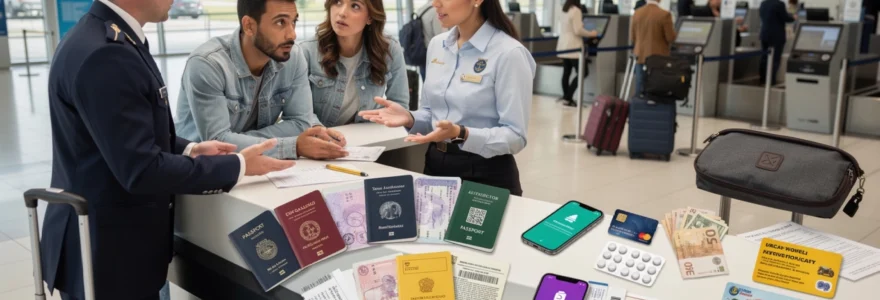
Every year, thousands of travellers arrive at airports only to discover that their carefully planned journeys have been derailed by a missing stamp, an expired page, or a forgotten certificate. These seemingly minor oversights can transform an exciting adventure into a stressful ordeal involving denied boarding, unexpected fees, or even deportation upon arrival. The complexity of international travel regulations has increased significantly in recent years, with different countries implementing varying requirements that change with surprising frequency. Understanding these requirements isn’t merely about bureaucratic compliance—it’s about protecting your investment, your time, and your peace of mind. The stakes are particularly high when you consider that most travel insurance policies won’t cover losses resulting from documentation errors that travellers could have reasonably prevented.
Passport validity requirements: Six-Month rule and Country-Specific entry regulations
The six-month passport validity rule catches more travellers off guard than perhaps any other documentation requirement. This regulation stipulates that your passport must remain valid for at least six months beyond your intended departure date from a foreign country. Many assume that as long as their passport covers the duration of their trip, they’re adequately prepared. This assumption proves costly for approximately 300,000 travellers annually who face denied boarding or entry refusal. The rationale behind this rule relates to diplomatic protocols and the possibility of unexpected travel delays—immigration authorities want assurance that you won’t become stranded with an expired travel document whilst in their jurisdiction.
Different regions interpret and apply this rule with varying degrees of strictness. Asian countries, including Thailand, Singapore, and Indonesia, enforce the six-month rule rigorously, checking validity dates at both airline check-in counters and immigration checkpoints. Latin American destinations such as Brazil, Peru, and Argentina similarly maintain strict enforcement, whilst some Caribbean nations require only three months’ validity. The consequences of non-compliance range from denied boarding—where you lose your flight and any non-refundable bookings—to deportation at your destination, which creates a permanent immigration record that may affect future travel applications.
Schengen area Six-Month validity protocol and Three-Month stay calculation
The Schengen Area, comprising 27 European nations, applies specific passport validity calculations that differ slightly from the standard six-month rule. Your passport must be issued within the past ten years and remain valid for at least three months beyond your intended departure date from the Schengen territory. Additionally, the 90/180-day rule limits stays to 90 days within any 180-day period, a rolling calculation that confuses even experienced travellers. Border officials calculate this period by looking backward from your entry date, not forward, meaning that previous Schengen visits within the past six months reduce your permitted stay duration.
Violations of these regulations carry serious consequences, including fines ranging from €500 to €1,000, immediate deportation, and potential bans on future Schengen entries lasting three to five years. In 2024, approximately 45,000 travellers were refused entry to Schengen countries due to passport validity issues, with airlines facing substantial fines for transporting inadequately documented passengers. The calculation complexity increases for those holding multiple-entry visas or residence permits, as different rules may apply depending on your specific immigration status and nationality.
United states passport validity exceptions under Six-Month club agreements
The United States maintains bilateral agreements known as the “Six-Month Club” with numerous countries, creating exceptions to the standard validity requirement. Under these agreements, travellers may enter participating nations if their passports remain valid for the duration of their intended stay, without the additional six-month buffer. Countries participating in this programme include Canada, Mexico, most European Union members, and several nations in Asia and South America. However, airline staff often apply the six-month rule universally, leading to denied boarding even when exceptions legally apply.
This discrepancy between legal requirements and airline policies creates a grey area where technically correct travellers still face obstacles. Airlines implement conservative policies to avoid substantial fines—typically €3,000 to €5,000 per inadequately documented passenger—imposed by destination countries. Therefore, even with a valid Six-Month Club exception, you may need to present printed documentation of the agreement at check-in. The US State Department website maintains updated lists of participating countries, though travellers should verify requirements directly with destination immigration authorities before departure, as agreements change periodically.
Post-brexit UK passport date stamping requirements for EU travel
Following Brexit, British travellers lost the automatic freedom of movement they once enjoyed across the European Union, and with it came new passport stamping requirements. UK passports are now treated as “third-country” documents, meaning border officers must stamp them on both entry and exit to the Schengen Area. These stamps are not just a formality; they serve as the official record used to calculate whether you have exceeded the 90/180-day rule. If a stamp is missing, authorities may presume an earlier entry date, placing the burden of proof on you to show when you actually arrived.
One of the most overlooked travel documentation issues post-Brexit is failing to check that your passport has been correctly stamped. Automated e-gates do not always issue physical stamps, and some officers—especially during busy periods—may forget. If you notice a missing stamp, you should politely request one before leaving the immigration area. Without proper stamps, UK travellers risk fines, formal warnings, or even temporary bans from the Schengen Zone if authorities believe they have overstayed, a problem that can surface months later on a subsequent trip.
Blank visa pages: minimum requirements for china, india, and middle eastern nations
Even when your passport is valid for the required period, insufficient blank visa pages can still derail your journey. Many countries insist on at least two consecutive blank pages for entry stamps and full-page visas, but enforcement levels vary. China and India are particularly strict—applications may be rejected outright if your passport lacks the required space, even if there is scattered room elsewhere. Several Middle Eastern countries, including Saudi Arabia and the United Arab Emirates, also prefer clean, adjacent pages for visas and residency permits.
Why does this matter so much? Immigration authorities must clearly place visas, endorsements, and entry/exit stamps in a way that can be easily read by officers and automated systems. Overcrowded pages can lead to confusion about previous travel history or stay durations. Before booking long-haul trips or multi-country itineraries, you should count your remaining blank pages and confirm each destination’s minimum requirements via official consular websites. If you are running low, renew your passport early rather than trying to “squeeze in one last trip” and hoping border officers will make an exception.
Visa documentation mistakes: electronic travel authorisations and pre-arrival permits
As more countries adopt electronic travel authorisations, visa documentation mistakes have become both easier to make and harder to fix at the last minute. Unlike traditional visas, which often involve in-person applications at embassies, e-visas and pre-arrival permits are processed online and linked electronically to your passport number. This convenience can create a false sense of security; travellers assume that a quick online form is foolproof. In reality, a single digit error in your passport number or an incorrect date of birth can render your authorisation invalid and result in denied boarding at the airport.
Another frequent problem is misunderstanding whether an electronic travel authorisation is required at all. Some nationalities are exempt for short tourist visits but still need an ETA for transit, work, or study. Others assume that holding a valid visa for one country grants them automatic entry to neighbouring states within a region, which is rarely the case. To avoid unpleasant surprises, you should treat ETAs with the same seriousness as traditional visas: read the conditions, double-check your entries, and always apply well before your departure date rather than relying on last-minute approvals.
ESTA application errors and 72-hour processing windows for US entry
The United States Electronic System for Travel Authorization (ESTA) is a classic example of a document travellers underestimate. Under the Visa Waiver Program, eligible visitors must obtain an approved ESTA at least 72 hours before boarding a flight or ship to the US. While some approvals are issued within minutes, delays are increasingly common, particularly when additional background checks are required. Airlines will not allow you to board without a valid ESTA linked correctly to your passport, regardless of previous approvals or past visits.
Common ESTA application errors include using an old passport number after renewal, typing a surname with an accent that does not match the machine-readable line, and misunderstanding the questions about prior visas or criminal history. Even minor inconsistencies can trigger a refusal or a request to apply for a full visa at a US consulate, which can take weeks. To reduce the risk, you should copy your passport details exactly as they appear and save a PDF confirmation of your approval. Remember that an approved ESTA does not guarantee entry; it simply allows you to travel to a US port of entry where Customs and Border Protection officers make the final decision.
Eta canada biometric data requirements and common rejection reasons
Canada’s Electronic Travel Authorization (eTA) regime mirrors the US ESTA in many ways but introduces additional complexity through biometric requirements for many applicants. While visa-exempt travellers from designated countries may only need the online eTA, others must also provide fingerprints and a digital photo at a Visa Application Centre before their application can be finalised. Failing to complete the biometric step within the specified timeframe—often 30 days—can lead to automatic cancellation of your application, forcing you to start the process again.
Frequent rejection reasons for Canadian eTA applications include incomplete travel history, discrepancies between your declared employment status and previous visa records, and unpaid immigration fees from past visits. Even minor overstay incidents can trigger closer scrutiny. If you have ever been refused entry to another country, you should be honest and provide full details; Canadian authorities cross-check databases and are likely to discover omissions. Treat the eTA as a formal visa process: prepare supporting documentation, respond promptly to any additional information requests, and avoid booking non-refundable travel until your authorisation is definitively approved.
Australia ETA subclass 601 versus evisitor subclass 651 eligibility criteria
Australia’s electronic visa landscape confuses many travellers because there are two primary options that look similar at first glance: the ETA (Subclass 601) and the eVisitor (Subclass 651). The ETA is designed mainly for certain Asian, North American, and Gulf nationalities and often requires applying through an airline, travel agent, or dedicated mobile app, sometimes with a service fee. The eVisitor, by contrast, is a no-fee online visa tailored to citizens of European Union and a few other European countries. Both allow short tourist or business stays, but eligibility depends strictly on your nationality and where you are applying from.
Mistakes occur when travellers select the wrong category or assume they can switch types after submission. For example, a European passport holder physically present outside Europe may find that the eVisitor option is not available, necessitating an ETA instead. Additionally, both visas carry strict conditions regarding work, study length, and health insurance expectations. If you breach these terms, even unintentionally, you may face cancellation of your visa and difficulty obtaining future Australian travel permissions. Always check the official Australian immigration website to confirm which subclass matches your passport and circumstances before submitting any application.
UK electronic travel authorisation rollout for european and gulf nationals
The United Kingdom is gradually introducing its own Electronic Travel Authorisation scheme, and this phased rollout is already catching some travellers off guard. Initially focused on nationals from selected Gulf countries, the system is expanding to cover more visa-exempt visitors, including many Europeans who previously entered the UK with minimal formalities. Once the programme fully applies to your nationality, you will need an approved UK ETA in addition to a valid passport before boarding a flight, ferry, or Eurostar service.
Because the rollout is staggered, confusion often arises over who needs an ETA and when. Some travellers rely on outdated guidance from airlines or blogs and arrive at departure points without the required authorisation. To avoid this, you should check the official UK government website shortly before each trip, even if you have visited recently without an ETA. As with other electronic systems, the UK ETA links directly to your passport number, so if you renew your passport you will need to apply again. Think of it as buying a digital ticket to the UK border in advance—without it, your journey will likely end at the check-in desk.
Vaccination certificates and medical documentation compliance standards
Health-related travel documents have become central to international border management, especially after the COVID-19 pandemic. Vaccination certificates, medical letters, and test results are now assessed alongside passports and visas in many jurisdictions. While some destinations have relaxed pandemic-era measures, long-standing requirements for diseases such as yellow fever remain firmly in place. Travellers frequently underestimate the specificity of these rules, assuming that any vaccine record or digital app will suffice.
In reality, many countries recognise only particular formats, validity periods, and vaccine types. A certificate that meets your home country’s healthcare standards may still be rejected at a foreign border if it lacks the proper language, official stamp, or signature. This is why it is crucial to verify health entry requirements with both your doctor and official government sources several weeks before departure. When in doubt, carrying original documents on paper in addition to digital copies provides an extra layer of security.
Yellow fever vaccination requirements for Sub-Saharan africa and south american destinations
Yellow fever vaccination rules are among the most strictly enforced health requirements in international travel. Many Sub-Saharan African countries—such as Ghana, Nigeria, and Kenya—and several South American nations including Brazil and Bolivia require proof of yellow fever vaccination for travellers arriving from or transiting through endemic areas. The requirement often applies even if you only spent a few hours in an affected country’s airport, a detail many travellers overlook when booking complex itineraries.
Failure to present a valid yellow fever certificate can lead to stark choices at the border: immediate vaccination at a designated health facility, quarantine at your own expense, or outright refusal of entry. Because the vaccine is a live attenuated virus, not everyone can safely receive it; infants, pregnant women, and some immunocompromised individuals may need medical waivers. If you fall into one of these categories, you should obtain a formal exemption letter from a travel clinic on official letterhead and confirm in advance whether your destination recognises such waivers. Assuming that “they will make an exception” at the airport is a gamble that can end your trip before it starts.
WHO international certificate of vaccination yellow card validation protocols
The World Health Organization’s International Certificate of Vaccination or Prophylaxis—commonly called the yellow card—is the globally recognised document for recording certain travel vaccines. However, simply having a yellow card is not enough; it must be completed according to specific protocols to be considered valid. The administering clinic must enter the vaccine name, manufacturer, batch number, and date, then sign and stamp the relevant section using an official stamp that includes the clinic’s details. Missing signatures, illegible stamps, or handwritten corrections can all raise red flags at border control.
Another point travellers often miss is the timing requirement. For yellow fever, the vaccine becomes valid 10 days after administration, and only then is your certificate accepted for entry to most countries. If you receive the injection too close to your departure date, you may technically be vaccinated but still non-compliant on paper. To avoid this problem, schedule your appointment at least two to three weeks before travel. Store your yellow card with your passport rather than leaving it at home; after all, it serves as your “health passport” for many high-risk regions.
Prescription medication declaration forms and controlled substances documentation
Travelling with prescription medication seems routine, yet it introduces another layer of documentation that can cause issues if overlooked. Many countries impose strict controls on certain painkillers, psychiatric medications, and stimulants, treating them as controlled substances that require supporting paperwork. Customs officers may ask you to justify the quantity you are carrying, especially if it exceeds a standard 30-day personal supply. Without adequate documentation, pills that are legal in your home country can be confiscated or, in extreme cases, lead to legal trouble.
To minimise risk, carry medicines in their original packaging with the pharmacy label clearly showing your name and dosage. You should also obtain a doctor’s letter detailing your diagnosis, prescribed medications, and the need to carry them during travel. Some destinations—particularly in the Middle East and parts of Asia—require pre-approval or specific import permits for controlled drugs, which you must secure well before departure. Treat prescription documentation as carefully as your visa paperwork; after all, running out of essential medicine abroad is not just inconvenient, it can be dangerous.
Travel insurance medical coverage proof for schengen visa applications
For travellers who require a Schengen visa, proof of adequate travel medical insurance is not optional—it is a formal prerequisite. The policy must provide at least €30,000 of medical coverage, be valid throughout the entire Schengen Area, and span the full duration of your intended stay. Consulates routinely reject applications that rely on basic domestic health policies or credit-card insurance that does not clearly meet these thresholds. The insurance certificate must explicitly state the coverage limits, geographic scope, and dates; vague or incomplete documents often trigger requests for clarification or outright refusals.
Even if you are visa-exempt, carrying proof of travel medical insurance remains a wise precaution. Border officers have the authority to ask how you plan to cover medical expenses in case of an emergency, especially if you intend to stay close to the 90-day limit. Printing a concise insurance confirmation letter and keeping a digital copy accessible on your phone ensures you can answer these questions confidently. Think of this document as your financial safety net: without it, a simple accident could escalate into a serious financial burden.
Travel insurance policy documents and emergency contact verification
Beyond satisfying visa requirements, travel insurance policy documents play a crucial role when something goes wrong abroad. In an emergency, you may have only moments to locate your insurer’s contact details, policy number, and coverage summary. Yet many travellers leave their policy buried in an email inbox or assume that a booking confirmation from a comparison website is enough. When hospitals, airlines, or local authorities ask for proof of coverage, vague screenshots or partial information often cause delays in treatment or assistance.
A simple strategy is to print a one-page summary containing your policy number, insurer’s 24/7 emergency phone line, and key coverage limits, then store it with your passport. You should also share this information with a trusted contact at home who can act on your behalf if you are incapacitated. Some insurers now provide digital membership cards or wallet passes; while convenient, they should supplement rather than replace paper copies, as battery failures and connectivity issues are common during crises. Regularly verifying that your emergency contact details are up to date with your insurer ensures that any necessary authorisations or medical evacuations can proceed without administrative delays.
Currency declaration forms and financial documentation thresholds
Moving money across borders is heavily regulated, and failing to understand currency declaration rules can result in confiscated funds or legal penalties. Contrary to popular belief, it is usually legal to carry large amounts of cash, provided you declare it correctly; the problems begin when travellers try to keep amounts “under the radar.” Different jurisdictions set their own thresholds for mandatory reporting, and the definition of “monetary instruments” often includes not only banknotes but also traveller’s cheques, bearer bonds, and certain prepaid cards. Ignorance of these rules rarely convinces customs officers once a discrepancy is discovered.
To stay compliant, you should research the inbound and outbound cash reporting limits for every country on your itinerary, not just your final destination. Declaration forms typically ask where the funds came from and how they will be used, information that must be truthful and consistent with your broader travel story. Keeping supporting documents—such as bank withdrawal slips or sale receipts—can help demonstrate legitimate origin. Remember, the goal of these laws is to combat money laundering and terrorism financing; treating declarations as routine paperwork rather than personal interrogations can make the process smoother and less stressful.
US FinCEN form 105 requirements for cross-border monetary instrument transportation
In the United States, anyone transporting more than USD $10,000 in currency or monetary instruments into or out of the country must file FinCEN Form 105. This obligation applies to individuals, families, and even courier services, and the threshold is calculated per physical crossing, not per trip. One subtle trap is that officers consider the total carried by all members of a travelling group; a family of four each carrying $4,000 would collectively exceed the threshold and be expected to declare. Failing to submit the form can lead to seizure of the funds and possible civil or criminal penalties.
The form can be completed online in advance or at the port of entry or exit, but leaving it until the last moment increases the chance of errors. You will need to provide personal identification details, the exact amount and type of monetary instruments, and the purpose of transporting them. Being honest and precise is essential; inconsistent statements between family members often trigger deeper scrutiny. Keeping a copy of the filed form with your travel documents helps resolve any questions during secondary inspections and demonstrates that you took your reporting duties seriously.
European union cash control regulation: €10,000 declaration threshold
Within the European Union, travellers entering or leaving the bloc with €10,000 or more in cash or equivalent instruments must file a declaration under the EU Cash Control Regulation. This rule applies regardless of whether you are an EU citizen and covers movements both to and from non-EU countries. Additionally, some member states apply their own reporting requirements for movements of large sums within their borders, particularly for domestic train or air travel. Travellers often misunderstand this distinction, assuming that once they clear the external EU border, they no longer need to worry about cash reporting.
When completing the declaration, you will be asked about the origin of the funds, intended use, and transport route. Authorities may cross-check your explanation against your broader travel plans—for example, a short weekend visit paired with extremely high cash amounts may raise questions. As with US rules, the threshold applies to the total amount carried by the group, not just individuals. If you routinely carry significant cash for business or investment purposes, consider using formal banking channels or trusted financial intermediaries rather than transporting large sums personally, thereby reducing both risk and administrative burden.
Australian border force reporting requirements for AUD $10,000 currency movements
Australia imposes its own cash reporting standard: anyone bringing AUD $10,000 or more (or equivalent in foreign currency) into or out of the country must declare it to the Australian Border Force. The requirement covers both residents and visitors and extends to bearer negotiable instruments in some circumstances. Officers at airports and seaports use a combination of declaration forms, questioning, and random inspections to ensure compliance. Attempts to split funds between travellers to stay just under the limit are unlikely to succeed if you are clearly part of a single group.
Declarations can be made using the cross-border movement form provided on arrival and departure cards or through specific cash reporting forms. As elsewhere, the focus is on ensuring that funds are not linked to criminal activity, so you should be prepared to explain their source and purpose calmly and consistently. Keeping printed evidence of bank withdrawals, property sales, or business transactions can help. Treat the process as a standard part of your travel documentation routine—no more unusual than presenting your boarding pass or passport—and you will find it straightforward to manage.
Onward journey proof and return ticket documentation mandates
One of the most commonly overlooked travel documents is proof of onward or return travel. Many countries, especially those offering visa-free or visa-on-arrival entry, require you to demonstrate that you do not intend to stay indefinitely. Airlines often enforce this requirement at check-in because they can be held financially responsible if you are refused entry on arrival. If you cannot show a return ticket, onward flight, or equivalent documentation, you may be forced to purchase an expensive last-minute ticket on the spot—or be denied boarding altogether.
Digital nomads and long-term travellers are particularly vulnerable to this issue, as open-ended itineraries do not always fit neatly within official expectations. Some use fully refundable tickets or legitimate onward bookings (such as bus or train reservations) to satisfy documentation checks. Whatever approach you choose, ensure that your proof of onward travel matches your stated plans on arrival forms and visa applications. Keeping confirmations easily accessible—saved offline on your phone and printed with your other travel documents—helps you answer the inevitable question at check-in and immigration: “When are you leaving?”