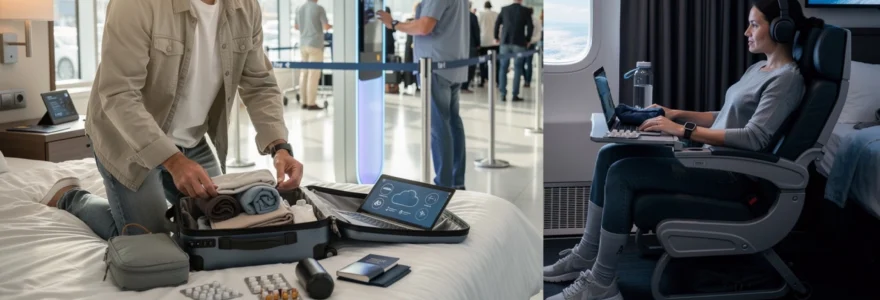
Modern travel has evolved into a sophisticated choreography of habits, technologies, and personal rituals that most travellers barely notice. These ingrained behaviours—from the way you pack your suitcase to how you navigate airport security—fundamentally shape the quality, efficiency, and enjoyment of every journey. What seems like simple habit is actually a complex interplay of physiological adaptation, technological leverage, and learned optimization. Whether you’re a seasoned business traveller crossing time zones weekly or an occasional holidaymaker planning your annual escape, the routines you’ve developed (consciously or not) determine far more than just convenience. They influence your health, productivity, stress levels, and ultimately, the memories you create. Understanding these patterns offers an opportunity to refine them, transforming travel from a draining necessity into a seamlessly orchestrated experience.
Pre-departure ritual engineering: packing systems and chronotype alignment
The hours before departure set the psychological and practical foundation for your entire trip. How you approach this critical window reveals much about your travel maturity and directly impacts your arrival state. Research suggests that pre-travel preparation accounts for approximately 40% of traveller satisfaction ratings, yet most people treat packing as an afterthought rather than a strategic exercise in resource allocation and mental preparation.
Capsule wardrobe methodology for Multi-Climate itineraries
The capsule wardrobe approach represents a fundamental shift from quantity to versatility. Rather than packing for every conceivable scenario, experienced travellers curate 15-20 interchangeable pieces that work across multiple contexts and temperature ranges. This methodology centres on a neutral colour palette—typically black, navy, grey, and white—with one or two accent colours for visual variety. The technical fabrics matter enormously: merino wool base layers regulate temperature in both warm and cold environments, while synthetic blends offer quick-drying properties essential for hand-washing in hotel sinks. A well-constructed capsule wardrobe for a two-week trip typically includes three tops, two pairs of trousers, one dress or additional trouser option, one lightweight jacket, and one versatile pair of shoes that transition from walking to dining. This system reduces decision fatigue whilst ensuring you’re appropriately dressed regardless of unexpected weather shifts or last-minute itinerary changes.
Digital nomad document architecture: passport positioning and cloud backup protocols
Document management has become increasingly complex as travel requires both physical and digital verification. The strategic placement of your passport within your carry-on might seem trivial, but accessibility during multiple security checkpoints directly affects stress levels and processing speed. Seasoned travellers position passports in dedicated external pockets with RFID protection, avoiding the fumbling that creates bottlenecks. Beyond physical location, establishing a comprehensive cloud-based backup system for all critical documents—passport biographical pages, visa copies, travel insurance certificates, accommodation confirmations, and prescription medication documentation—creates essential redundancy. Services like Dropbox, Google Drive, and specialized travel document apps should contain encrypted PDF versions accessible offline. Approximately 23% of travellers experience document loss or theft annually, making this digital architecture not merely convenient but potentially trip-saving.
Circadian rhythm Pre-Adjustment techniques for transmeridian travel
Jet lag remains one of travel’s most underestimated physiological challenges, with symptoms persisting for one day per time zone crossed. Rather than accepting this as inevitable, proactive circadian rhythm manipulation significantly reduces adjustment periods. Three to four days before eastbound travel (the more challenging direction), gradually shift your sleep schedule 30-60 minutes earlier each night whilst simultaneously adjusting meal times. Light exposure becomes your most powerful tool: seek bright morning light if travelling east, evening light if heading west. Specialized apps like Timeshifter provide personalized light exposure and melatonin timing recommendations based on your specific flight schedule and chronotype. This pre-adjustment approach can reduce post-arrival fatigue by up to 60%, allowing you to engage productively from day one rather than losing 2-3 days to grogginess and disorientation.
Medication reconciliation and prophylactic pharmaceutical protocols
Medical preparedness extends far beyond throwing a few plasters in your bag. A comprehensive travel pharmacy addresses both chronic condition management and acute illness prevention
planning. Start with a current medication list, including exact dosages, timing, and generic names, and compare it against your itinerary, time zone changes, and expected activities. This “medication reconciliation” step, ideally reviewed with a healthcare professional or travel clinic, helps identify potential interactions with common over-the-counter drugs you might take on the road—such as antihistamines, sleep aids, or altitude sickness tablets. For international travel, request prescriptions with the generic (international nonproprietary) name clearly stated, and carry a printed letter outlining any controlled substances, injectable medications, or devices like EpiPens. Building a small but targeted travel pharmacy—electrolyte powders, loperamide, oral rehydration salts, a broad-spectrum antibiotic if prescribed, and basic analgesics—creates a prophylactic buffer against common issues like traveller’s diarrhoea, dehydration, and minor injuries. The goal is not to self-treat emergencies, but to prevent predictable problems from derailing your trip and forcing you into unfamiliar healthcare systems unnecessarily.
Airport navigation biometrics: leveraging trusted traveller programmes
Once you leave home, airports become the first major test of your travel routines. For frequent flyers, the difference between a chaotic terminal sprint and a calm pre-boarding coffee often comes down to how well they leverage trusted traveller programmes and biometric systems. These tools compress time, reduce friction, and lower cognitive load by turning repeated identity checks into near-frictionless scans. With global air passenger numbers projected to reach 9.4 billion by 2040, according to IATA, queue optimisation is not a luxury—it is survival strategy. By designing a personal “airport navigation stack” that integrates pre-clearance, status benefits, and smart routing apps, you effectively treat the terminal as a predictable workflow rather than an anxiety-inducing unknown.
TSA PreCheck and global entry enrolment optimisation strategies
For travellers passing through the United States, TSA PreCheck and Global Entry function as core components of an efficient airport routine. PreCheck alone can cut security line wait times by up to 50%, while Global Entry reduces passport control clearance on arrival to just a few minutes in many cases. When deciding which to apply for, consider your travel patterns: if you primarily fly domestically, TSA PreCheck may suffice; if you cross borders several times per year, the incremental cost of Global Entry often pays for itself within a single high-traffic season. Timing enrolment is also strategic—application backlogs tend to spike before summer and major holidays, so submitting during off-peak months can reduce processing delays. Once approved, make sure your Known Traveller Number (KTN) is stored in every airline profile you use; forgetting this simple step is one of the most common reasons travellers “lose” their benefits at check-in.
Biometric facial recognition gates: SITA SmartPath and BorderXpress integration
Biometric systems like SITA SmartPath and BorderXpress kiosks are quietly redefining how identity is verified at airports worldwide. Instead of repeatedly presenting your passport and boarding pass, you step into a lane, face a camera, and allow facial recognition algorithms to match your features against encrypted government databases. For you, the traveller, this compresses multi-step checks into a single, almost ambient interaction—much like tapping a contactless card instead of manually entering payment details. Adoption is accelerating: some hubs report boarding an entire wide-body aircraft in under 20 minutes using biometric gates. To benefit, ensure your passport photo is current and that you opt in where required by your airline or airport app. While privacy concerns are valid, understanding what data is stored, how long it is retained, and your opt-out options allows you to make an informed decision rather than reacting at the gate.
Priority lane access through airline alliance status matrices
Frequent travellers often treat airline status as a mere perk, but in practice it functions as an efficiency multiplier embedded directly into airport infrastructure. Priority check-in, expedited security access, and early boarding cumulatively save not just time but mental bandwidth—you spend less time queuing and more time preparing for meetings, adjusting your itinerary, or simply decompressing. Because major carriers operate within alliances (Star Alliance, oneworld, SkyTeam), status with one airline usually unlocks benefits across partner networks, which is why aligning your flights to a single ecosystem is more strategic than endlessly shopping for the lowest fare. Think of alliance status matrices as loyalty “ladders” that reward consistent patterns of behaviour; by consciously routing your bookings to support a targeted status tier, you transform scattered trips into a coherent travel strategy. Over a year, the compound effect of shorter lines, reliable overhead bin space, and lounge access can fundamentally change how draining—or how pleasant—air travel feels.
Terminal mapping applications: GateGuru and FlightView navigation systems
Digital wayfinding inside airports has become as important as navigation between cities. Terminal mapping apps such as GateGuru and FlightView give you real-time visibility on gate changes, estimated security wait times, and even the nearest power outlets or quiet workspaces. Instead of wandering aimlessly or relying on outdated signage, you can plot a precise route from security to your gate, factoring in a coffee stop or a sit-down meal without the low-level stress of “Will I miss boarding?”. These apps become especially powerful when paired with push notifications—if your gate moves or your flight is delayed, you know instantly and can adjust. Conceptually, you are treating the terminal as a dynamic graph of nodes (gates, lounges, services) and edges (corridors, escalators, trains), and the app as your pathfinding algorithm. The more you travel, the more these micro-optimisations add up to a sense of calm control rather than reactive scrambling.
In-flight physiological maintenance protocols and cabin pressure adaptation
Once you are airborne, the routines that matter most are no longer bureaucratic but biological. Commercial cabins simulate altitudes of 6,000–8,000 feet, humidity levels often drop below 20%, and you may remain seated for 8–14 hours with limited movement. Left unmanaged, this environment can exacerbate dehydration, jet lag, and circulatory issues, turning even a business-class seat into a physiologic stress test. Yet frequent flyers who follow structured in-flight protocols—hydration schedules, movement routines, and light exposure management—often arrive astonishingly functional. The aircraft, in this sense, becomes less a passive container and more a mobile lab where you are constantly running small experiments on your own body.
Hypobaric hypoxia mitigation through hydration schedules
Cabin pressure at cruising altitude means the air you breathe contains less oxygen than at sea level, a state known as mild hypobaric hypoxia. Combined with low humidity, it contributes to headaches, fatigue, and that vague “travel hangover” many of us associate with long flights. One of the simplest yet most overlooked countermeasures is a disciplined hydration schedule. Instead of chugging a litre of water before take-off, aim for 200–250 ml every hour you are awake, spacing intake to support steady absorption and stable blood volume. Limiting alcohol and caffeinated drinks during flight—both of which act as diuretics—further reduces dehydration risk. Think of water on a flight as a slow IV drip rather than a one-time top-up; consistency, not quantity in a single burst, is what keeps your physiology closer to baseline.
Deep vein thrombosis prevention: compression garment efficacy
Extended immobility during long-haul flights increases the risk of deep vein thrombosis (DVT), particularly for travellers with predispositions such as clotting disorders, recent surgery, or pregnancy. Graduated compression socks and tights help maintain venous return from the lower legs, reducing pooling and swelling. Clinical reviews suggest that properly fitted compression garments can significantly lower the incidence of symptomless DVTs on flights longer than four hours. However, they are most effective as part of a broader movement protocol: standing or walking every 90 minutes, performing ankle circles and calf raises in your seat, and avoiding constrictive clothing around the waist. Imagine your circulatory system as a complex highway network—compression socks keep traffic flowing smoothly, but you still need to open new lanes periodically by moving. For high-risk individuals, a pre-flight consultation about low-dose anticoagulants may also be appropriate.
Melatonin dosing protocols for eastbound versus westbound flight patterns
Melatonin, the hormone that signals “night” to your body clock, can be a powerful jet-lag tool when used with precision. The key is that eastbound and westbound flights require opposite strategies. When you fly east, you effectively lose time and need to advance your circadian rhythm; low-dose melatonin (0.5–3 mg) taken 1–2 hours before your target bedtime at destination time can help shift your internal clock forward. Westbound journeys, by contrast, demand a phase delay—you are staying awake later, not sleeping earlier—so melatonin is typically taken in the late evening local time once you arrive, or skipped entirely on shorter time shifts. Overdosing often backfires, leading to grogginess and fragmented sleep, so more is rarely better. Like adjusting the hands on a mechanical watch, small, well-timed changes yield better results than drastic, irregular resets.
Noise-cancelling technology: bose QC45 and sony WH-1000XM5 comparative analysis
Acoustic environment is one of the most underrated variables in in-flight comfort. Constant engine hum averages around 75–85 dB, which is loud enough to contribute to fatigue and make concentration difficult over several hours. Active noise-cancelling (ANC) headphones such as the Bose QC45 and Sony WH-1000XM5 use microphones and inverse sound waves to neutralise much of this background roar. The Bose line is often praised for its out-of-the-box comfort and slightly more neutral sound profile, while the Sony XM series tends to win on customisation, app-based controls, and marginally stronger ANC performance in many independent tests. Which is better for you ultimately depends on fit and your ecosystem—do you value seamless multi-device pairing, or fine-grained EQ control? Regardless of brand, integrating high-quality ANC into your travel routine is akin to dimming harsh fluorescent lights in a workspace; the underlying environment has not changed, but your subjective experience improves dramatically.
Accommodation check-in routines and sleep environment optimisation
The moment you step into your accommodation, you begin shaping the quality of your nights—and, by extension, your days. Many travellers treat check-in as a simple key exchange, but those first fifteen minutes in a room are an opportunity to engineer a sleep-friendly environment tailored to your needs. Given that poor sleep can reduce cognitive performance by up to 25% the following day, according to various sleep studies, these micro-routines have outsized impact. By approaching each new room with a short audit process, targeted adjustments, and a few portable tools, you convert unfamiliar spaces into reliable recovery zones rather than gambles.
Hotel room audit procedures: blackout curtain assessment and HVAC temperature calibration
A structured hotel room audit starts with light, noise, and temperature—the three pillars of sleep environment quality. First, test the blackout curtains; even small gaps can allow intrusive street or signage light, so many experienced travellers carry simple clips or use trouser hangers to seal edges. Next, locate and, where possible, dim or cover intrusive LEDs from televisions, thermostats, or emergency indicators, using items like sticky notes or a sleep mask as a backup. HVAC calibration is equally critical: most people sleep best in a room set between 18–20°C (64–68°F), yet default hotel settings are often higher. Adjust the thermostat shortly after arrival so the room reaches an optimal temperature by bedtime, and check whether the fan has a constant-on setting to create steady airflow and white noise. This quick, repeatable procedure transforms any room into a more predictable sleep lab.
White noise generation and sleep tracking through wearable devices
Urban accommodations often come with unpredictable noise: elevators, late-night traffic, or neighbouring guests. White noise—steady, unobtrusive sound—acts like an acoustic “wallpaper”, masking sudden spikes and helping your brain stay in deeper stages of sleep. You can generate it via dedicated apps, compact sound machines, or even the continuous fan setting on the HVAC system. Pairing this with a wearable device—such as an Oura Ring, Apple Watch, or Garmin tracker—provides feedback loops on sleep duration, efficiency, and heart rate variability. While no consumer device is perfectly accurate, consistent trends help you see how different routines (late dinners, evening screen use, alcohol) impact your rest across trips. Over time, you are not just sleeping in hotel rooms; you are running small experiments, refining a personal protocol for optimal overnight recovery.
Loyalty programme automation: marriott bonvoy and hilton honours API integration
Behind the scenes, your choice of accommodation brand and loyalty programme can also influence how smooth check-in feels. Chains like Marriott Bonvoy and Hilton Honors increasingly integrate with APIs and mobile apps to enable digital key access, automatic elite benefit recognition, and pre-arrival room preferences. When your profile already contains your typical bed type, high-floor preference, or allergy notes, every stay starts one step closer to your ideal environment without manual negotiation at the desk. You can further automate value capture by linking your loyalty accounts to credit cards, expense tools, or booking platforms so points and elite nights post reliably without intervention. Think of this as building an invisible support system: the less you need to think about upgrades, late check-outs, or Wi-Fi access, the more attention you can devote to the actual purpose of your trip.
Ground transportation decision trees and modal shift efficiency
Once you exit the airport or station, your ground transportation choices quietly determine how much time, money, and energy you spend moving between points on your itinerary. Many travellers default to taxis or ride-hailing apps, but treating ground transport as a decision tree rather than a habit opens more efficient, and often more interesting, options. Factors such as time of day, luggage volume, local infrastructure, and your own energy levels should feed into a simple mental algorithm: is this leg optimised for speed, cost, or experience? In dense cities with reliable metros or trams, for example, public transport can cut travel time during rush hour while immersing you in local routines. In more sprawling destinations, renting a car, bike, or e-scooter may grant flexibility and reduce reliance on surge-priced rides. Over a multi-day trip, consciously selecting the right mode for each leg can reclaim hours that would otherwise be lost to traffic or confusion.
Developing this kind of modal agility starts before you arrive. Reviewing airport-to-city transport options, purchasing transit cards in advance where possible, and saving key routes offline in mapping apps all reduce friction when you are tired from a long flight. Some travellers create simple, tiered rules—for instance, “If the journey is under 3 km and I have light luggage, I walk; if it is 3–10 km, I default to public transport; beyond that, I compare train versus taxi based on real-time traffic.” Framing it this way turns each journey into a quick optimisation problem rather than an improvisation. The payoff is not just monetary; you also reduce decision fatigue, a hidden drain that can make travel feel more exhausting than it needs to be.
Daily micro-routines: caffeine timing and nutritional homeostasis maintenance
Once settled at your destination, the grand structures of flights and transfers give way to smaller, daily rituals that profoundly shape how you feel. Two of the most influential—yet frequently underestimated—are caffeine consumption patterns and basic nutritional balance. Because travel often disrupts meal timing and sleep, many of us lean more heavily on coffee or energy drinks and default to convenience foods. Over a few days, this can create a cycle of spikes and crashes that leaves you wired at midnight and sluggish at noon. By contrast, travellers who maintain what we might call “nutritional homeostasis”—stable blood sugar, adequate hydration, and moderated stimulant use—tend to report higher energy, better mood, and more consistent focus, even across time zones.
Strategic caffeine timing begins with aligning intake to your adapted local schedule rather than your departure time zone. As a rule of thumb, avoiding caffeine for the first 60–90 minutes after waking lets your natural cortisol peak do its work, then a moderate dose (equivalent to one espresso or small coffee) can support mid-morning alertness without driving anxiety. Cutting off stimulants 6–8 hours before your planned bedtime helps protect sleep quality, which is already under pressure from unfamiliar surroundings and possible jet lag. Nutritionally, aim to anchor your day with at least one predictable, balanced meal—something containing protein, complex carbohydrates, and some healthy fats—whether that is breakfast at a hotel buffet or a late lunch at a local café. Carrying simple “stability tools” like nuts, protein bars, or electrolyte sachets ensures you are not forced into poor choices when schedules slip. In essence, these micro-routines are your internal stabilisers, keeping your physiology steady while the external world of travel constantly shifts around you.