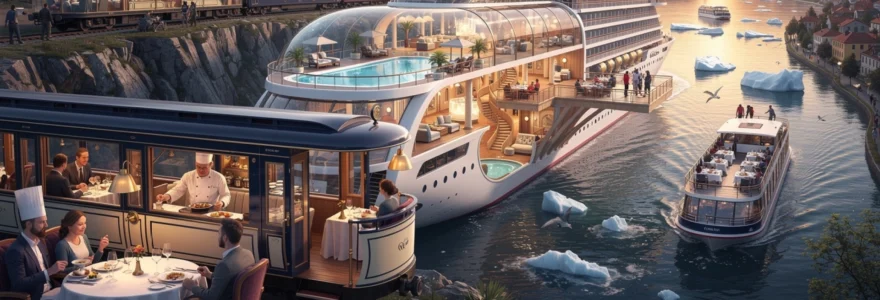
The traditional concept of transportation as merely a means to reach a destination has evolved dramatically in recent years. Today’s most innovative transport operators understand that the journey itself can become the primary attraction, transforming vehicles into floating palaces, luxury hotels on rails, and sky-high sanctuaries. This paradigm shift reflects a broader trend in experiential tourism, where travellers increasingly seek immersive experiences that begin the moment they board their chosen vessel.
From meticulously restored heritage railway carriages to architecturally stunning cruise ships that rival floating cities, the transportation industry has embraced the philosophy that getting there should be half the fun. This transformation requires sophisticated engineering, thoughtful design psychology, and substantial investment in creating experiences that justify premium pricing whilst delivering unforgettable memories.
Luxury railway journeys: engineering experiences beyond Point-to-Point transit
The renaissance of luxury rail travel demonstrates how traditional transportation modes can be reimagined as destination experiences. Modern luxury trains combine heritage craftsmanship with cutting-edge technology, creating mobile experiences that rival the world’s finest hotels and restaurants.
Venice Simplon-Orient-Express: heritage carriage restoration and culinary theatre design
The Venice Simplon-Orient-Express represents the pinnacle of heritage railway restoration, with each carriage meticulously rebuilt to 1920s specifications whilst incorporating modern safety systems and climate control. The restoration process involves craftspeople specialising in marquetry, upholstery, and brass fittings, ensuring authenticity whilst meeting contemporary comfort standards. The dining cars function as theatrical stages, where culinary performances unfold as landscapes scroll past panoramic windows.
The engineering challenge lies in balancing historical accuracy with modern passenger expectations. Weight distribution becomes critical when installing modern amenities in vintage carriages, requiring custom solutions for air conditioning, lighting, and plumbing systems. The kitchen cars operate as compact, high-efficiency culinary laboratories, designed to produce restaurant-quality meals whilst managing the unique challenges of cooking whilst in motion.
Rocky mountaineer’s panoramic Glass-Dome architecture and route optimisation
Rocky Mountaineer’s bi-level glass-dome coaches revolutionise the rail viewing experience through innovative architectural design. The curved glass construction maximises panoramic visibility whilst maintaining structural integrity against wind loads and temperature variations. Advanced UV-filtering glass protects passengers from solar gain whilst preserving unobstructed views of the Canadian Rockies.
Route optimisation involves careful consideration of scenic timing, ensuring that the most spectacular views align with optimal lighting conditions. The railway coordinates with weather services and seasonal changes to adjust schedules, maximising photographic opportunities and wildlife viewing chances. This level of choreographed precision transforms a simple journey into a curated experience where timing becomes as important as the destination.
The ghan’s desert traverse: sleeper car configuration and Off-Train excursion integration
The Ghan’s transcontinental journey across Australia requires sophisticated sleeper car engineering to ensure passenger comfort during extended travel periods. Cabin configurations maximise space efficiency whilst providing privacy and storage solutions. The carriages incorporate vibration dampening systems and advanced suspension technology to minimise the effects of track irregularities across vast desert stretches.
Off-train excursion integration represents a logistical masterpiece, with stops timed to allow passenger exploration of remote locations whilst maintaining schedule integrity. The railway partners with local operators to provide helicopter flights, camel rides, and cultural experiences, creating a multi-modal adventure that extends far beyond traditional rail travel boundaries.
Belmond royal scotsman: highland circuit planning and exclusive access partnerships
The Belmond Royal Scotsman operates as a mobile country house, with custom-built carriages designed specifically for Scottish Highland touring. The train’s circular routing eliminates the need for overnight reversals, maintaining forward motion whilst showcasing diverse Scottish landscapes. Exclusive access partnerships with Highland estates, distilleries, and castles create experiences unavailable to other tourists.
The engineering of circular routes requires sophisticated track sharing agreements and precise timing coordination with freight and passenger services. Private siding access allows the train to visit exclusive locations, requiring custom infrastructure investments and ongoing maintenance agreements with heritage properties.
<h2
Maritime transport as destination infrastructure: cruise ship design psychology
On the water, transportation as destination reaches its most literal expression. Modern cruise ships are no longer just vessels; they are carefully choreographed environments where architecture, wayfinding, and amenity planning are used to create a sense of discovery and delight. Designers talk in terms of “neighbourhoods” and “streets” rather than decks and corridors, using hospitality design psychology to encourage exploration, social interaction, and repeat spending during the voyage.
The rise of mega-ships has accelerated this shift. Vessels carrying more than 6,000 passengers present the same design challenges as a small city, from crowd management to noise control and vertical circulation. To turn this dense, complex infrastructure into a desirable tourism product, cruise lines invest heavily in spatial zoning, acoustics engineering, and visual storytelling, ensuring that guests feel both stimulated and relaxed as they move through the ship.
Symphony of the seas: vertical neighbourhood zoning and passenger flow management
Royal Caribbean’s Symphony of the Seas is a prime example of how vertical neighbourhood zoning can transform maritime transport into an immersive destination. Instead of a uniform deck plan, the ship is divided into distinct themed zones—such as Central Park, Boardwalk, and Royal Promenade—stacked and interwoven across multiple decks. This approach distributes key attractions vertically and horizontally, preventing congestion hotspots and creating a layered sense of place more akin to an urban district than a traditional liner.
Passenger flow management is treated almost like traffic engineering in a busy city centre. Simulation software models how thousands of guests move between restaurants, theatres, pools, and cabins at peak times, allowing architects to adjust stair locations, elevator banks, and corridor widths before steel is ever cut. Signage, lighting cues, and subtle design elements then guide guests intuitively, reducing wayfinding stress and helping people discover amenities without feeling herded.
Celebrity edge’s cantilevered magic carpet platform: multi-function space engineering
Celebrity Edge’s Magic Carpet platform illustrates how a single piece of engineering can become a signature tourism experience. The cantilevered deck glides up and down the ship’s exterior track, transforming from a tender platform at sea level into an open-air restaurant, bar, or event space at higher decks. Structurally, the platform must withstand dynamic loads, shifting sea conditions, and wind forces, all while providing a feeling of security and openness for guests seated metres above the water.
From a design psychology perspective, the Magic Carpet taps into the thrill of exposure without crossing into fear. Rail heights, transparent barriers, and sightlines are calibrated to offer sweeping views and a palpable sense of altitude. At the same time, warm materials, comfortable seating, and ambient lighting soften the industrial nature of the mechanism, turning a piece of heavy marine engineering into a floating terrace that feels like a boutique rooftop bar.
Hurtigruten’s hybrid propulsion systems for arctic expedition cruising
At the expedition end of the market, vessels like Hurtigruten’s hybrid-powered ships demonstrate how sustainability features can become part of the tourism narrative. These ships use a combination of conventional engines and battery packs to reduce fuel consumption and emissions in sensitive Arctic and Antarctic environments. Beyond compliance, the quiet, low-vibration electric operation during certain phases amplifies wildlife encounters and enhances the feeling of serenity in remote landscapes.
Guests are increasingly interested in how their journey impacts the destinations they visit, so technical systems are made visible through onboard science centres, real-time dashboards, and guided tours of engine-control spaces. By turning propulsion technology into an educational attraction, operators help travellers understand concepts like fuel optimisation and emissions reduction in a tangible way. In effect, the machinery below deck becomes part of the “destination infrastructure” story, not just a hidden necessity.
River cruise vessel design: AmaMagna’s twin-hull innovation for danube navigation
On rivers, space is at a premium, which is why AmaMagna’s twin-hull design on the Danube is such a notable innovation. Instead of building longer within strict lock-length constraints, designers doubled the vessel’s width, creating a catamaran-like platform that offers up to twice the living space of a standard river ship. This allows for larger suites, multiple dining venues, and expansive wellness areas, turning the vessel itself into a compelling alternative to land-based boutique hotels.
The twin-hull concept must negotiate shallow drafts, variable currents, and tight locks without compromising manoeuvrability. Advanced navigation systems, bow thrusters, and carefully calculated weight distribution ensure the ship can handle narrow passes and docking points along the river’s historic cities. As a result, passengers enjoy a remarkably stable, spacious environment while still accessing the intimate, close-to-shore experiences that define European river cruising.
Aviation experience design: airlines transforming aircraft cabins into destinations
In the air, the shift from pure transport to experiential travel is most visible in premium cabins, where airlines compete on comfort, privacy, and service rituals as much as schedule and price. Wide-body aircraft have become canvases for cabin architects, ergonomists, and hospitality specialists who collaborate to design spaces that feel less like rows of seats and more like micro-hotels and social lounges above the clouds. For long-haul routes, this “cabin as destination” approach can be the deciding factor for high-yield travellers.
Behind the scenes, every design decision is constrained by weight, safety regulations, and the economics of seat density. The challenge is similar to designing a compact luxury apartment block: how do you maximise perceived space and privacy without sacrificing too many sellable units? Leading airlines use space-saving structures, integrated storage, and multi-function furniture to deliver private suites and social zones that justify premium fares while still protecting overall aircraft revenue.
Singapore airlines A380 suite class: privacy architecture and personalised service protocols
Singapore Airlines’ A380 Suites are a benchmark for turning aircraft seating into a high-end hospitality product. Enclosed cabins with sliding doors, full-flat beds, and separate armchairs create a residential feel, using soft partitions and carefully angled walls to offer privacy without making the space feel claustrophobic. Acoustic insulation and door seals minimise corridor noise, while adjustable lighting scenes help passengers manage jet lag and create a sense of personal sanctuary.
The physical design is matched by equally sophisticated service protocols. Crew are trained to read subtle cues—eye contact, body language, work devices—to determine whether a passenger wants conversation, quiet, or proactive assistance. Meal service operates more like an à la carte restaurant than an airline galley, with flexible timing and extensive customisation. For the traveller, the aircraft becomes not just a vehicle but a private retreat where you can work, sleep, or dine at your own pace.
Emirates A380 onboard lounge and shower spa: space utilisation engineering
Emirates’ A380 lounge and shower spa show how airlines can carve out shared “destination spaces” within the strict footprint of a commercial jet. By clustering galley and crew rest areas efficiently, designers freed up room at the rear of the upper deck for a curved bar, sofa seating, and standing space where passengers can socialise. The lounge serves a dual purpose: it enhances the brand’s luxury image while also encouraging passengers to move around, reducing the physical strain of long-haul travel.
The shower spa is an even more striking example of space utilisation engineering. Integrating pressurised water systems, grey-water storage, and additional fire-safety measures into the crown area of the fuselage required close collaboration with airframe manufacturers and regulators. Time slots are managed with near-military precision, yet for the passenger, the experience feels indulgent and unhurried. Like a rooftop pool atop a skyscraper, this improbable facility becomes a talking point that elevates the entire journey.
Qatar airways qsuite: business class quad configuration and social seating design
Qatar Airways’ Qsuite rethinks business class as a configurable living space rather than a fixed row of individual seats. Movable privacy panels and sliding doors allow four adjacent seats to be combined into a “quad” layout, where families or colleagues can dine and work face-to-face. For solo travellers, the same architecture creates a cocooned private suite with direct aisle access, proving that flexibility can be a powerful differentiator in premium cabin design.
The social seating design relies on precise geometry and engineering. Seat tracks, harness points, and partition mechanisms must all meet stringent crashworthiness standards while allowing quick reconfiguration by cabin crew. Lighting, fabrics, and contrasting finishes subtly indicate shared versus private modes, helping you understand how to use the space without lengthy instructions. In effect, Qsuite turns a linear cabin into a set of adaptable rooms, blurring the line between transport and temporary residence.
Scenic transportation networks: infrastructure as tourist attraction
Beyond individual vehicles, entire transportation networks can function as tourist attractions in their own right. Scenic railways, mountain cableways, and coastal highways are planned not only for efficiency but also for spectacle, turning lines on a map into curated visual narratives. The most successful examples treat views, stops, and transfer points as if they were exhibits in an open-air museum.
Consider Switzerland’s Glacier Express, Norway’s Atlantic Ocean Road, or Japan’s Shinkansen routes with Mount Fuji vistas. In each case, alignments have been chosen or adjusted to frame landmark panoramas, with timetables calibrated so that trains and buses pass key viewpoints in daylight. Observation decks, lay-bys, and panoramic stations are added like viewing platforms in a gallery, encouraging travellers to pause, photograph, and share their experience, which in turn reinforces the network’s tourism value.
Urban transport tourism: city systems designed for experiential travel
In cities, everyday transport networks increasingly double as tourist experiences. Iconic metro maps, river ferries, bike-share schemes, and aerial trams are not just ways to get around; they form part of the urban brand, often appearing in marketing campaigns and social media feeds. When you think of London’s Tube, Hong Kong’s Star Ferry, or San Francisco’s cable cars, you are recalling transportation systems that have become destinations in themselves.
Designers and planners are beginning to lean into this potential. Wayfinding graphics are crafted with the same care as museum signage, and stations are conceived as public spaces rather than mere access points. Some cities commission public art, live performance areas, or pop-up retail within their transport hubs, recognising that the journey between attractions can be as memorable as the attractions themselves. For visitors, this means you can “see” a city simply by riding its networks, turning a practical necessity into an affordable sightseeing tour.
Adventure transport modalities: extreme environment vehicle design for tourism
At the frontier of experiential tourism, transport itself becomes the adventure. Vehicles designed for polar ice, high-altitude plateaus, desert dunes, and deep oceans must balance safety-critical engineering with the promise of thrilling, once-in-a-lifetime experiences. Whether it is an amphibious expedition vehicle in Antarctica or a pressurised 4×4 in the Atacama Desert, the hardware is part of the narrative: you are not just visiting a remote place, you are riding the specialised machines that make access possible.
Designers treat these vehicles almost like wearable technology for landscapes, tailoring suspension, tyres, hulls, and life-support systems to specific environmental challenges. Interior layouts must reconcile rugged functionality with a level of comfort that justifies high price points and long travel times. Large windows, vibration-dampening seats, and integrated camera mounts recognise that documentation—photos, video, shared stories—is integral to the tourism experience. In extreme environments, transport is no longer an invisible layer beneath the trip; it is the visible, tactile interface between traveller and terrain.