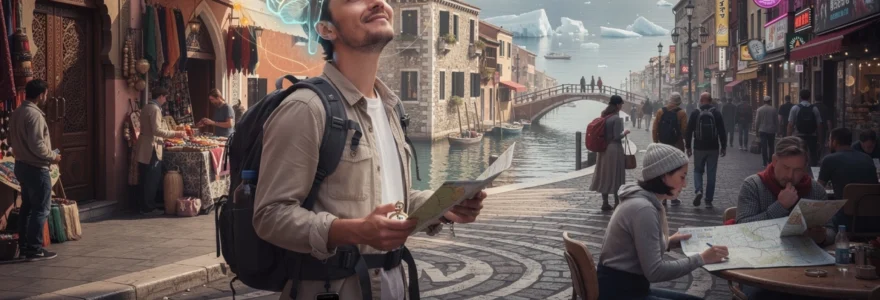
In an age where GPS navigation systems promise to guide us to within three metres of any destination on Earth, the concept of deliberately getting lost might seem counterintuitive. Yet wandering without direction has become increasingly recognised as a profound travel philosophy that transforms ordinary journeys into extraordinary adventures. The phenomenon of spontaneous exploration activates neural pathways that structured itineraries simply cannot reach, offering travellers unexpected encounters, authentic cultural immersion, and a deeper connection to the places they visit. Research in cognitive neuroscience, coupled with countless anecdotes from explorers throughout history, reveals that navigational uncertainty might actually be your greatest asset when seeking meaningful travel experiences. This approach challenges our modern obsession with optimisation and efficiency, instead embracing the unpredictable nature of genuine discovery.
Cognitive neuroscience behind spontaneous wayfinding and travel serendipity
The human brain responds remarkably to unplanned exploration in ways that rigid travel schedules cannot replicate. When you abandon predetermined routes and allow yourself to wander freely, your neurological systems engage in complex processes that enhance memory formation, creativity, and overall wellbeing. Understanding these mechanisms reveals why getting lost often creates the most vivid travel memories that persist long after carefully photographed landmarks fade from recollection.
Dopaminergic reward systems activated during unplanned discovery
Your brain’s reward circuitry releases dopamine—the neurotransmitter associated with pleasure and motivation—at significantly higher levels during unexpected discoveries compared to anticipated experiences. When you stumble upon a hidden courtyard in Barcelona’s Gothic Quarter or find an unmarked trattoria in Rome’s Trastevere neighbourhood, the surprise element triggers a dopamine surge that creates powerful positive associations with the experience. Studies from University College London indicate that unpredicted rewards generate approximately 40% more dopamine release than expected ones, explaining why serendipitous travel moments often become the stories you recount most frequently.
This neurochemical response creates what researchers call “reward prediction errors”—the difference between what you anticipated and what actually occurred. These errors are essential for learning and memory consolidation, meaning that unplanned discoveries literally rewire your brain to retain information more effectively. The spontaneous café encounter or unexpected architectural marvel embeds itself deeper into your neural networks than the fifteenth planned museum visit on your itinerary.
Hippocampal spatial memory formation in novel environments
The hippocampus, a seahorse-shaped structure deep within your brain, plays a crucial role in spatial navigation and episodic memory formation. When you navigate unfamiliar territory without digital assistance, this region becomes extraordinarily active, creating detailed cognitive maps of your surroundings. London taxi drivers, famous for their comprehensive knowledge of the city’s labyrinthine streets, have been shown to possess enlarged posterior hippocampi compared to the general population—a direct result of intensive spatial learning.
Getting lost forces your hippocampus into overdrive, strengthening spatial cognition skills that atrophy when you rely exclusively on turn-by-turn navigation. Research from McGill University demonstrates that individuals who regularly navigate without GPS assistance maintain superior spatial memory capabilities well into older age. Beyond practical wayfinding benefits, this hippocampal engagement creates richer, more textured memories of your travels, allowing you to mentally revisit locations with remarkable clarity years later.
Reduced cortisol levels when abandoning rigid itineraries
Paradoxically, while getting lost might initially trigger mild stress, travellers who embrace navigational ambiguity often experience lower overall cortisol levels throughout their journeys compared to those following strict schedules. The constant pressure to reach specific destinations at predetermined times creates chronic low-level stress that diminishes travel enjoyment. A study published in the Journal of Travel Research found that holidaymakers with highly structured itineraries reported 28% higher stress hormones than those who adopted flexible exploration approaches.
When you release attachment to rigid plans, you simultaneously release the anxiety associated with potential delays, missed connections, or deviations from schedule. This psychological shift allows you to enter what psychologists call a “flow state”—a mental condition characterised by complete immersion in the present moment. Flow states are associated with increased creativity, enhanced problem-solving abilities, and profound satisfaction,
making them particularly compatible with unscripted travel. When you stop obsessing over timetables and accept that getting lost is part of the journey, you reduce anticipatory stress and open space for genuine curiosity. Physiologically, your sympathetic nervous system downshifts, heart rate stabilises, and you become more receptive to subtle details in your environment—from the smell of street food to the cadence of a local language. Over the course of a trip, these micro-moments of calm accumulate, leaving you more restored than any checklist-driven holiday could achieve.
Default mode network activation and creative problem-solving while lost
Another key neural system activated during unstructured wandering is the default mode network (DMN)—a set of brain regions involved in introspection, imagination, and autobiographical thinking. When you walk without a fixed destination, especially in a low-pressure context, your DMN cycles through memories, future scenarios, and creative associations. This is why some of your most original ideas may surface while you are ambling through an unfamiliar district rather than sitting at a desk. Travel that invites a degree of disorientation therefore doubles as a powerful incubator for creative problem-solving.
Neuroimaging research from Harvard and the University of British Columbia suggests that mild mind-wandering, paired with gentle sensory stimulation such as walking in a city or along a coastal path, increases creative insight scores by up to 40%. Getting lost in a safe environment replicates exactly this combination: your executive control networks are partially relaxed, while your senses are alive to novel inputs. You might begin the walk thinking about how to find your guesthouse, but end it with a new business idea, fresh clarity on a relationship, or a reframed life goal. In this sense, navigational uncertainty becomes less a logistical error and more a structured opportunity for inner recalibration.
Historical examples of transformative journeys through navigational uncertainty
While modern travellers often treat getting lost as an inconvenience, history is full of examples where miscalculations, detours, and navigational ambiguity produced epoch-defining journeys. These stories illustrate how disorientation can reshape not just an individual life but entire cultures and political landscapes. They also remind us that the line between failure and breakthrough is often decided only in hindsight. By looking at how past explorers and travellers navigated uncertainty, we gain a deeper appreciation for the transformative potential of our own travel mishaps.
Christopher columbus’s miscalculated route to the caribbean islands
Christopher Columbus set sail in 1492 intending to reach Asia by crossing the Atlantic, dramatically underestimating the Earth’s circumference and the size of the American continents. His navigational errors, compounded by inaccurate maps and bold assumptions, led him instead to the Caribbean Islands. What began as a misjudged shortcut became one of the most consequential “wrong turns” in history, initiating centuries of exchange, conflict, and cultural transformation between Europe and the Americas. From a travel perspective, Columbus’s voyage exemplifies how even flawed wayfinding can open doors to entirely unimagined destinations.
Of course, the legacy of this detour is complex and often devastating for Indigenous populations, underscoring that serendipity does not automatically equal positivity. Yet as a case study in travel uncertainty, it demonstrates that explorers rarely know the full significance of their routes while they are still at sea. When you find yourself getting lost on a far smaller scale—say, missing a train and ending up in an unfamiliar town—you are participating in a long tradition of travellers whose most memorable experiences arose where their maps ended. The key difference today is that you can embrace this uncertainty ethically and responsibly, with respect for local communities and ecosystems.
Isabella bird’s uncharted exploration of the japanese interior in 1878
In 1878, British traveller and writer Isabella Bird ventured into the largely unmapped interior of Japan, far beyond the established treaty ports frequented by Westerners. Her journey through remote villages, mountain passes, and Ainu settlements in Hokkaido was characterised by incomplete information, unreliable guides, and frequent deviations from planned routes. Bird’s willingness to accept logistical confusion produced one of the most detailed early Western accounts of rural Japanese life. Her book, Unbeaten Tracks in Japan, remains a seminal text in travel literature and cultural history.
Bird’s experience shows how embracing navigational ambiguity can deepen cultural understanding. Rather than remaining in Yokohama or Tokyo, where Western infrastructure and translation services were more available, she sought out regions where her maps were little more than suggestions. This decision enabled her to document everyday practices, religious rituals, and social customs that would otherwise have remained invisible to foreign observers. For modern travellers, Bird’s story invites a simple question: what might you learn if you occasionally chose the unmarked path rather than the well-signposted attraction?
Ernest shackleton’s endurance expedition detour to south georgia island
Ernest Shackleton’s Imperial Trans-Antarctic Expedition (1914–1917) is often remembered as a story of heroic survival, but it is also a powerful example of transformative rerouting under extreme conditions. When his ship, the Endurance, became trapped and eventually crushed in Antarctic ice, Shackleton was forced to abandon his original plan of crossing the continent. Instead, he led his crew on a perilous journey by lifeboat to the uninhabited Elephant Island and then on to the whaling stations of South Georgia. This improvised route, navigated with limited instruments across some of the world’s most treacherous seas, ultimately saved every member of his crew.
Although few of us will ever face such dire circumstances, Shackleton’s response to unexpected disorientation holds valuable lessons for travellers. He treated changing conditions not as a personal failure but as a new problem to solve, continually reframing the goal from exploration to survival to safe return. In more everyday terms, when a storm cancels your ferry or a missed bus strands you overnight, adopting a Shackleton-like mindset can transform frustration into strategic adaptation. The “detour to South Georgia” becomes an analogy for any moment when your journey demands resilience, creativity, and a revised definition of success.
Che guevara’s motorcycle diaries across patagonia and the andes
In 1952, a young Ernesto “Che” Guevara embarked on a motorcycle journey across South America with his friend Alberto Granado. Their route, chronicled in The Motorcycle Diaries, was marked by mechanical breakdowns, improvised hitchhiking, and frequent geographic uncertainty. They often relied on local advice, rough sketches, and trial-and-error navigation through Patagonia and the Andes. These episodes of literal and metaphorical “lostness” exposed Guevara to the stark realities of poverty, inequality, and indigenous marginalisation, experiences that profoundly shaped his later political identity.
Guevara’s trip illustrates how getting lost can catalyse not just personal growth but ideological transformation. Without the safety net of precise mapping and digital translation, he was compelled to engage deeply with the people he met, listen to their stories, and accept their hospitality. The resulting shift in worldview demonstrates a key principle of meaningful travel: the most impactful encounters often occur far from your intended route. When you allow your itinerary to loosen, you create space for meetings and revelations that a tightly optimised schedule would systematically filter out.
Psychographic profiles of travellers who embrace navigational ambiguity
Not everyone enjoys ambiguity in the same way. Some travellers thrive on unplanned wandering, while others feel genuine distress at the thought of losing their bearings. Understanding the psychographic traits associated with those who embrace getting lost can help you assess where you sit on this spectrum and how far to stretch your comfort zone. Rather than a binary divide between “planners” and “free spirits,” research in personality psychology suggests a nuanced interplay between openness to experience, risk tolerance, and perceived control.
Individuals high in openness to experience—one of the Big Five personality dimensions—are more likely to seek out novel stimuli, whether that means new cuisines, art forms, or travel routes. These travellers often report that a flexible or even deliberately vague itinerary makes them feel more secure, because they trust their ability to adapt in real time. By contrast, those with high levels of trait anxiety or low tolerance for uncertainty may prefer detailed planning, yet can still benefit from controlled doses of navigational ambiguity. For example, you might reserve accommodation in advance but leave your daily routes open to chance, allowing yourself to get lost within a defined radius.
Psychographic segmentation in the travel industry increasingly recognises categories such as “experience seekers,” “independent explorers,” and “transformational travellers.” These groups tend to value authenticity over comfort and spontaneity over predictability. They are often willing to trade convenience for depth, consciously choosing night buses, homestays, or local markets where miscommunication and misdirection are more likely—but also more rewarding. If you identify with these profiles, intentionally incorporating “lost time” into your journey can align travel logistics with your underlying motivations, making your trips feel more congruent with who you are.
Urban exploration techniques: dérive and psychogeography methodologies
For travellers who want a more structured approach to getting lost—especially in dense cities—urban exploration methodologies like dérive and psychogeography offer practical frameworks. Originating in mid-20th-century European avant-garde movements, these techniques treat the city as a living organism whose emotional landscapes can be mapped through drifting rather than planning. Instead of asking, “What should I see?”, you begin to ask, “How does this neighbourhood make me feel, and why?” This shift in perspective transforms travel from sightseeing into a form of experiential research.
Guy debord’s situationist drifting through paris’s latin quarter
The French theorist Guy Debord and the Situationist International popularised the concept of the dérive—a “drift” through urban space guided by mood, curiosity, and the subtle “psychogeographical” pull of the environment. In practice, this meant wandering through districts like Paris’s Latin Quarter without a fixed goal, following intriguing alleyways, unexpected sounds, or sudden changes in architecture. Debord argued that modern cities, organised around efficiency and consumption, dull our senses; the dérive was his antidote, a method for reawakening emotional and sensory engagement with place.
Adapting Debord’s approach to your own city travel can be surprisingly simple. Choose a starting point, put away your map, and let yourself be drawn by whatever catches your attention—a crowded café, a quiet courtyard, or the sound of music down a side street. You might decide only on a loose rule, such as always turning left at the second intersection or following the steepest street uphill. This low-tech randomness functions like a human-scale “algorithm,” ensuring that you encounter parts of the city that typical guidebooks ignore. The result is often a deeper sense of connection, as if you and the city are co-authoring a story in real time.
Modern flaneur practices in tokyo’s shinjuku and shibuya districts
The 19th-century idea of the flâneur—the leisurely urban stroller who observes city life—has found new expression in hyper-modern districts like Shinjuku and Shibuya in Tokyo. Here, neon-lit intersections, layered pedestrian walkways, and maze-like backstreets create a rich environment for intentional disorientation. Modern flaneurs may spend hours weaving between convenience stores, izakayas, arcades, and quiet shrines tucked between office towers, using crowded crossings and station exits as starting points for unplanned loops. The goal is less about ticking off attractions and more about absorbing the micro-rhythms of everyday life.
Practically, you can adopt flaneur-like habits by slowing your pace, resisting the urge to constantly check GPS, and paying attention to details that most commuters ignore: a hand-painted sign, a vending machine cluster, a sudden shift from noise to silence. In districts as dense as Shibuya, getting lost on foot often reveals pocket-sized parks, basement jazz bars, or family-owned noodle shops that rarely appear on search results. Think of it as zooming in from satellite view to street view—with your own senses replacing the camera. Over time, these wanderings build a personal, emotionally charged map that no digital app can replicate.
Random walk algorithms applied to venice’s dorsoduro neighbourhood
Interestingly, computer science offers another lens on urban wandering through the concept of the random walk—a mathematical process where each step is determined by chance. Applied to travel, a random walk might mean flipping a coin at each intersection in Venice’s Dorsoduro neighbourhood or using dice to decide how many bridges to cross before changing direction. While this may sound whimsical, it mirrors algorithmic strategies used in network analysis and physics to explore complex systems without prior knowledge of their structure. Your body becomes the cursor, sampling the “graph” of the city one unpredictable move at a time.
In practice, a controlled random walk in Venice can be both safe and revelatory, given the city’s pedestrian-only layout and dense concentration of cultural landmarks. You may start near the Accademia Bridge intending to visit a specific gallery, only to find yourself meandering through laundry-lined alleys and quiet campos where children play football. By relinquishing control over your route, you paradoxically gain a more holistic sense of the neighbourhood’s texture and tempo. This method not only enriches your travel experience but also subtly trains your brain to tolerate uncertainty—an invaluable skill far beyond tourism.
Digital detox strategies for intentional disorientation travel
While technology can enhance travel logistics, constant reliance on GPS and real-time information can also flatten the sense of discovery that makes journeys memorable. If you want to experience why getting lost can be the best way to travel, a partial digital detox is often essential. This does not mean abandoning safety or refusing all modern tools; rather, it involves consciously limiting navigation aids so that your spatial memory, intuition, and social skills have room to operate. By designing trips with “offline windows,” you can reclaim the thrill of uncertainty without sacrificing basic security.
GPS navigation dependency and spatial cognition atrophy
Studies from the University of Tokyo and McGill University have raised concerns that heavy reliance on GPS may lead to reduced activation in brain regions responsible for spatial navigation, particularly the hippocampus and parietal cortex. In experimental settings, participants who depended on turn-by-turn directions showed weaker recall of route layouts and landmarks compared to those who navigated with minimal technological assistance. Over time, this “use it or lose it” dynamic can contribute to what some researchers term spatial cognition atrophy, where our innate wayfinding abilities become dulled.
From a travel perspective, this dependency can also impoverish experience. When you follow a blue dot along a prescribed path, your attention narrows to screen-level information instead of expanding to include smells, sounds, and peripheral sights. Have you ever arrived at a destination and realised you could hardly describe the streets you just walked through? Intentionally turning off GPS for segments of your journey—especially in compact, safe areas—reverses this pattern. You re-engage with environmental cues, ask locals for directions, and start forming mental maps that make the place feel genuinely known rather than merely passed through.
Analogue wayfinding tools: ordnance survey maps and compass navigation
One effective digital detox strategy is to reintroduce analogue wayfinding tools, such as paper maps and basic compass use. In rural contexts, detailed mapping systems like the UK’s Ordnance Survey provide rich topographical information that encourages active route planning and on-the-ground adjustment. Unlike GPS, which often reduces navigation to a single optimised path, paper maps display multiple possibilities, inviting you to choose based on curiosity rather than pure efficiency. The mere act of unfolding a map can slow you down, shifting your attention from “How quickly can I get there?” to “What interesting terrain lies between here and there?”
Urban travellers can adopt a lighter version of this approach by carrying simplified neighbourhood maps or sketching their own from hotel lobby leaflets. Combining this with a small compass, even on a smartphone set to airplane mode, helps you maintain a general sense of direction while still allowing plenty of room to wander. This hybrid method preserves safety—you know roughly where north, south, east, and west lie—while ensuring that micro-decisions at each corner remain open-ended. Over a few days, you will likely notice improved confidence in your internal compass and a richer appreciation for the subtle geography of the place.
Offline travel applications with reduced route optimization features
For those not ready to go fully analogue, a middle path involves using offline travel applications configured to minimise route optimisation. Many map apps allow you to download city or regional data for offline use; instead of following their suggested routes, you can consult them only to check broad orientation or identify major landmarks. Think of these apps as a modern equivalent of a wall map: helpful for general bearings but not dictating each turn. This “check, then pocket” rhythm keeps technology in a supporting role rather than letting it choreograph your entire movement.
You can also experiment with apps designed for serendipitous exploration—tools that highlight local points of interest without prescribing the most efficient sequence. Some platforms allow you to filter for independent cafés, street art, or small museums, then encourage you to walk between them without step-by-step guidance. In effect, you are curating a loose constellation of destinations and letting the connective tissue form spontaneously. Over time, this approach builds your tolerance for being “semi-lost”: not entirely directionless, but not over-managed either. It is often in those in-between spaces that the most surprising encounters occur.
Socio-cultural immersion metrics in unstructured travel experiences
Beyond individual neuroscience and psychology, getting lost while travelling has measurable effects on socio-cultural immersion. Tourism researchers increasingly use both qualitative and quantitative metrics to assess how deeply visitors engage with local communities, customs, and everyday life. Interestingly, several studies suggest that less structured, more exploratory travel styles correlate with higher immersion scores. When we remove rigid itineraries and allow room for chance, we are more likely to interact with residents, participate in spontaneous events, and notice subtler cultural patterns.
Ethnographic encounters in marrakech’s medina through unplanned wandering
Marrakech’s Medina, with its winding alleys, hidden courtyards, and bustling souks, practically invites travellers to get lost. While some visitors experience this maze-like layout as stressful, others treat it as an opportunity for informal ethnographic encounters. Without a strict route, you may find yourself drawn into a conversation with a carpet seller, a tea invitation from a shopkeeper, or an impromptu lesson in spice identification from a stall owner. These interactions, though brief, provide windows into social norms, economic realities, and family structures that guided tours rarely capture in full.
Fieldwork-style travel does not require academic training; it simply involves attentive observation and respectful curiosity. As you navigate the Medina, you can mentally note recurring patterns: how people greet each other, which stalls attract local customers versus tourists, or how gender roles play out in public spaces. Each wrong turn becomes a micro-study of how culture is lived, not just displayed. Over the course of a day, these chance observations accumulate into a richer, more nuanced understanding of Marrakech than any single landmark could provide.
Language acquisition acceleration in spontaneous local interactions
Unstructured wandering also accelerates language acquisition, especially when you rely on local interactions to navigate. Research on second-language learning consistently shows that contextual, real-world use—ordering food, asking for directions, clarifying bus routes—leads to faster vocabulary retention than isolated study alone. When you are slightly lost, the need to communicate becomes immediate and meaningful, turning each exchange into a high-relevance learning moment. You remember the phrase for “left” or “next street” because it directly affected whether you found your guesthouse before sunset.
Have you ever noticed how a single, emotionally charged interaction can cement a word or expression in your memory for years? Getting lost increases the probability of such interactions, especially when you deliberately resist switching to your native language too quickly. By asking simple questions in the local tongue and accepting that you will make mistakes, you transform the city into a living classroom. Over time, these incremental gains compound, leaving you with a functional set of phrases and a deeper appreciation for the rhythm and logic of the language.
Cultural anthropology insights from getting lost in rural rajasthan
In rural regions like Rajasthan in India, where village layouts may not appear on mainstream mapping platforms, getting lost can yield particularly rich anthropological insights—provided you approach with sensitivity and humility. As you wander through unmarked lanes, you might encounter water-well gatherings, temple rituals, or agricultural practices that rarely feature in standard tourist circuits. Each unexpected scene offers clues about caste dynamics, religious syncretism, resource management, and kinship networks. In effect, you are glimpsing the “everyday anthropology” of the place, the small-scale systems that sustain community life.
To translate these encounters into meaningful understanding, it helps to adopt a reflective mindset. After returning to your accommodation, you might jot down brief field notes: What surprised you? Which gestures seemed universal, and which felt culturally specific? How did people respond to your presence when you appeared clearly off the usual visitor path? This light-touch self-ethnography turns navigational uncertainty into an engine of insight rather than mere confusion. Over time, you begin to see travel not just as movement across space, but as an ongoing dialogue between your assumptions and the realities you meet when you dare to get lost.