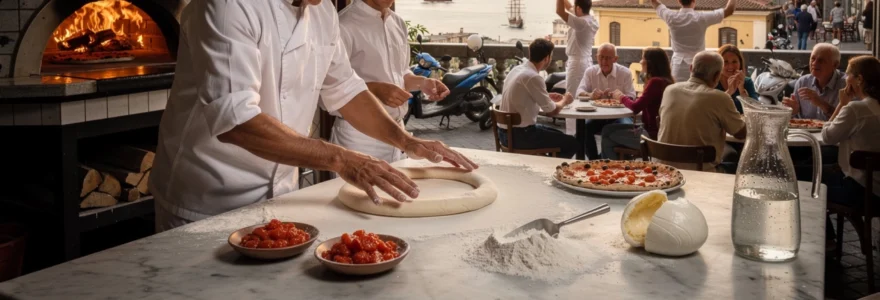
Naples pulses with a culinary energy unlike anywhere else on earth. Walk through its narrow streets at any hour, and you’ll encounter the unmistakable aroma of wood smoke mingling with baking dough, the sight of flour-dusted hands spinning circles of elastic dough, and the sound of crackling fires from centuries-old brick ovens. This southern Italian city didn’t just invent pizza as the world knows it—Naples refined, protected, and elevated it to an art form that UNESCO now recognizes as intangible cultural heritage. The story of Neapolitan pizza isn’t merely about food; it’s about volcanic soil, mineral-rich water, generational knowledge, and a fierce cultural pride that refuses to compromise on quality or tradition.
The volcanic terroir of campania: how mount vesuvius shaped neapolitan pizza dough
Mount Vesuvius looms over the Bay of Naples as both threat and benefactor. This infamous volcano that buried Pompeii in 79 AD has, over millennia, enriched the surrounding Campanian soil with minerals that profoundly influence agriculture. The volcanic terroir creates ideal growing conditions for ingredients that define authentic Neapolitan pizza—ingredients you simply cannot replicate elsewhere, no matter how sophisticated your agricultural techniques become. When pizzaioli speak reverently about their ingredients, they’re acknowledging something profound: geography is destiny in pizza-making.
San marzano tomatoes and the sarno river valley microclimate
San Marzano tomatoes grow in a specific microclimate within the Sarno River Valley, where volcanic soil composition combines with precise temperature fluctuations and humidity levels. These elongated, deep-red tomatoes possess a sweetness balanced by just enough acidity—a flavour profile that food scientists attribute to the mineral content absorbed from volcanic ash deposits. DOP (Denominazione di Origine Protetta) certification ensures authentic San Marzano tomatoes come exclusively from designated zones where soil composition meets exacting standards. The difference between these tomatoes and standard varieties becomes immediately apparent when you taste pizza prepared with each: San Marzano delivers concentrated flavour without excess moisture that would make dough soggy, a technical consideration as important as taste.
Caputo flour mills and the double zero milling technique
The Caputo family has milled flour in Naples since 1924, perfecting the “00” classification that describes the fineness of the grind rather than protein content. This doppio zero flour creates dough with exceptional elasticity and extensibility—properties essential for hand-stretching pizza to the precise thickness AVPN standards require. The milling process removes bran and germ, leaving primarily endosperm ground to powder-fine consistency. What makes Caputo and other Neapolitan mills distinctive isn’t just technique but their use of specific wheat varieties grown in particular microclimates. The protein content typically ranges between 11-13%, providing enough gluten development for structure without becoming tough or chewy when baked at extreme temperatures.
Campanian water mineral composition and gluten network formation
Water accounts for approximately 60% of pizza dough by weight, making its chemical composition critically important. Campanian water contains specific ratios of calcium, magnesium, and other minerals that affect gluten development during kneading and fermentation. Hard water with higher mineral content strengthens gluten bonds, while softer water creates more extensible dough. Naples benefits from aquifers filtered through volcanic rock, producing water with balanced mineral profiles that contribute to dough’s characteristic texture. Pizzaioli adjust hydration percentages based on flour absorption capacity and ambient humidity—knowledge developed through years of tactile experience rather than laboratory analysis. You’ll notice authentic Neapolitan dough possesses a silky, almost living quality when properly developed, a texture impossible to achieve without understanding how water chemistry interacts with flour proteins.
Fior di latte from agerola: mozzarella production in the lattari mountains
Agerola, perched in the Lattari Mountains above the Amalfi Coast, produces fior di latte—cow’s milk mozzar
ella prized for its delicate, milky flavour and exceptional melting qualities. Unlike industrial mozzarella, fior di latte from Agerola is produced in small batches from cows grazing on mountain pastures rich in wild herbs, which subtly influence the milk’s aromatic profile. Cheesemakers work at dawn, transforming still-warm milk into curds that are stretched by hand in hot water, a process that determines the final texture. The result is a cheese that blisters and softens in the fierce heat of a Neapolitan oven without releasing excess liquid, maintaining the structural integrity of the pizza. When you bite into a true Neapolitan slice in Naples, that gentle pull of molten cheese is as much a product of mountain terroir as the tomatoes are of Vesuvius.
Associazione verace pizza napoletana: codifying traditional preparation standards since 1984
By the late 20th century, Neapolitan pizza had spread far beyond Naples, but its identity risked being diluted by shortcuts and imitations. In response, local pizzaioli and millers founded the Associazione Verace Pizza Napoletana (AVPN) in 1984 to protect and define what makes an authentic Neapolitan pizza. This non-profit body drew up a detailed disciplinary code covering everything from ingredient origin to oven temperature, effectively turning centuries of unwritten craft into a documented standard. For anyone exploring food in Naples, Italy, AVPN is the reason you can still recognise a true Neapolitan pizza at a glance—and taste. Today, hundreds of pizzerias worldwide seek AVPN certification, but the benchmark remains the busy, unassuming storefronts of Naples itself.
The 90-second baking protocol at 485°c in wood-fired ovens
One of AVPN’s most famous rules is the baking protocol: a certified Neapolitan pizza must cook in a wood-fired oven at about 485°C (905°F) for 60–90 seconds. This might sound like a small technical detail, but it shapes everything from dough hydration to topping choice. At that temperature, the cornicione inflates like a balloon, creating the signature leopard-spotted char while keeping the interior soft and airy. The tomato sauce cooks just enough to concentrate without drying, and the mozzarella melts into gentle pools instead of becoming rubbery. Try slowing this process down in a cooler home oven and you quickly see why the result is different: longer baking times dehydrate the dough, toughen the gluten, and break the delicate balance that defines traditional food in Naples, Italy.
Hand-stretching methodology: the forbidden rolling pin rule
AVPN is equally strict about how the dough is shaped. Rolling pins, dough sheeters, and mechanical presses are explicitly banned for Neapolitan pizza. Instead, pizzaioli must stretch the dough entirely by hand, using a sequence of presses and rotations that redistribute gas without bursting the internal network of bubbles. Think of it like handling a soap bubble: too much pressure in one spot and it collapses, but gentle, even movements preserve its volume. This hand-stretching technique protects the light, airy rim and ensures the centre remains thin and flexible. When you see a pizzaiolo “slapping” dough from one hand to the other, they’re not just putting on a show—they’re calibrating thickness by feel in a way no machine can match.
Diameter and cornicione specifications in avpn certification
To qualify as “verace pizza napoletana,” a pizza must adhere to precise measurements once baked. AVPN specifies a diameter of about 22–35 cm (roughly 8.5–13.5 inches), with a central thickness of no more than 0.25 cm and a raised cornicione of 1–2 cm. These figures may seem obsessive, but they guarantee the characteristic contrast between a paper-thin centre and pillowy edge. Too large and the pizza becomes unwieldy and unevenly cooked; too small and the heat distribution changes, affecting texture. When you fold a slice into the classic “portafoglio” (wallet) shape on a Naples street, you’re experiencing the practical side of those rules—this is street food engineered for one hand and a quick walk through the alleyways.
Approved ingredient registry: dop requirements and regional sourcing
Beyond technique, AVPN mandates a strict ingredient registry to preserve the flavours of food in Naples, Italy. Tomatoes should be San Marzano dell’Agro Sarnese-Nocerino DOP or comparable peeled tomatoes grown in Campania, while cheese must be either mozzarella di bufala Campana DOP or high-quality fior di latte from designated areas. Olive oil must be extra virgin, and even the type of salt and yeast are regulated. Why such rigidity? Because each ingredient carries a trace of its origin—volcanic soil, coastal breezes, mountain pastures—that contributes to the final profile of a Neapolitan pizza. In a world where industrial supply chains blur geographic identities, AVPN’s DOP focus functions like a culinary passport, guaranteeing that what you taste in your slice truly comes from Campania.
Pizzaiolo apprenticeship culture at historic pizzerias: da michele and sorbillo legacy
Walk into Da Michele or one of the Sorbillo family pizzerias, and you’re not just stepping into a restaurant—you’re entering a living classroom. In Naples, becoming a pizzaiolo is rarely the result of a short cooking course; it’s a multi-year apprenticeship that blends manual skill, intuition, and local history. Young apprentices start with basic tasks like cleaning, portioning dough, or tending the fire, slowly earning the right to stretch and top pizzas under a master’s eye. At Da Michele, where the menu famously focuses on just margherita and marinara, this disciplined simplicity forces trainees to master fundamentals rather than hide behind elaborate toppings. Sorbillo, meanwhile, has turned its family name into a symbol of quality by training generations of pizzaioli who carry Neapolitan pizza techniques to other Italian cities and abroad. When we say the best food in Naples, Italy is “handed down,” we mean it literally—hand to hand, bench to bench, shift after shift.
The ancient greek plakuntos precursor and port of neapolis trade routes
Long before tomatoes arrived from the Americas, the people of Neapolis were already baking flatbreads that foreshadowed pizza. In the Greek colonies that dotted southern Italy, including early Naples, cooks prepared plakuntos: rounds of dough topped with herbs, cheese, garlic, and sometimes olives or onions. These breads were easy to transport, quick to bake, and perfect for labourers and sailors who needed sustenance without ceremony. As Naples grew into a major Mediterranean port, its markets overflowed with new ingredients arriving by ship—olive oils from other Italian regions, spices from the East, and eventually tomatoes from the New World. The city’s role as a trading crossroads meant local bakers constantly encountered new flavours to layer onto their flatbreads. When tomatoes finally shed their reputation as poisonous curiosities and joined garlic and oil on dough, the ancient idea of plakuntos evolved into something recognisably modern. In this sense, the port of Neapolis wasn’t just a commercial hub; it was the original test kitchen for what would become pizza.
Unesco intangible cultural heritage recognition: the 2017 art of neapolitan pizzaiuolo designation
In 2017, UNESCO formally recognised the “Art of Neapolitan Pizzaiuolo” as part of humanity’s intangible cultural heritage, placing it alongside traditions like flamenco and Japanese washoku cuisine. This designation doesn’t protect a recipe so much as a living practice: the gestures, stories, and social rituals that surround pizza-making in Naples. The application dossier emphasised how pizzaioli learn through observation and imitation, how pizzerias function as neighbourhood meeting points, and how songs, jokes, and Neapolitan dialect are woven into daily service. More than two million people signed a petition supporting the bid, underscoring how deeply locals identify with this craft. The recognition also brought tangible benefits, from safeguarding funds to training programmes aimed at preserving skills among younger generations in Naples’ working-class districts.
Spinning and tossing techniques as performance gastronomy
Pizza-tossing videos might fill social media feeds today, but in Naples, spinning dough in the air predates the age of the smartphone by many decades. UNESCO highlighted these movements as a kind of performance gastronomy—part technique, part theatre. When a pizzaiolo lifts a disk of dough and lets it spin, centrifugal force helps stretch it evenly while preserving internal gas pockets, much like a potter shaping clay on a wheel. The rotation also allows excess flour to fall away, preventing bitter, burnt flavours in the oven. For customers, the spectacle turns a simple order into an experience: you’re not just buying food; you’re witnessing a small piece of Neapolitan street culture. Have you ever noticed how a crowded pizzeria seems to quiet for a moment when someone starts tossing dough? That shared glance upwards is part of the magic UNESCO set out to protect.
Generational knowledge transfer in quartieri spagnoli workshops
Nowhere is the transmission of pizzaiolo knowledge more visible than in neighbourhoods like the Quartieri Spagnoli, a dense maze of streets in central Naples. Here, small workshops and family-run pizzerias train the next generation often without formal contracts or curricula. A teenager might start by stacking wood or delivering take-away boxes, but over years they absorb techniques through constant repetition and correction. An older pizzaiolo may place a hand over theirs to show the right pressure for stretching dough, or adjust their grip on the peel to slide pizzas into the hottest spot of the oven. This kind of tacit knowledge—difficult to write down but easy to recognise in practice—is why authentic food in Naples, Italy retains a distinct character even as other cities replicate the style. UNESCO’s recognition encourages these neighbourhood schools of craft to survive in the face of rising rents, global chains, and shifting job aspirations among youth.
Community identity formation through pizzeria social spaces
In Naples, a pizzeria is rarely just a place to eat; it’s a social institution woven into daily life. Families celebrate milestones at their local spot, friends meet for a quick margherita before a football match, and solo diners take a seat at the counter to chat with staff. Over time, regulars form an informal community where people from different backgrounds share the same table and the same simple meal. This is one reason UNESCO framed Neapolitan pizza-making as a social practice rather than a purely culinary one—it creates spaces where stories, jokes, and local news are exchanged along with plates. If you think about your favourite pizzeria back home, chances are what you love isn’t just the crust, but how it feels to be there. In Naples, that sense of belonging is amplified, turning pizzerias into neighbourhood living rooms that anchor community identity.
Modern innovation within tradition: franco pepe’s caserta approach and enzo coccia’s experimental methods
For all its reverence for rules, Naples and its surrounding region are not museums. Some of the most influential pizzaioli of our time—like Franco Pepe in Caiazzo (Caserta province) and Enzo Coccia in Naples—prove that innovation and tradition can coexist. Rather than abandoning the foundations of Neapolitan pizza, they interrogate each step, from fermentation times to topping combinations, asking how to enhance flavour and digestibility without losing authenticity. Franco Pepe, for instance, works with extended fermentation and carefully calibrated hydration to create doughs that are remarkably light, almost like eating a savoury cloud. His pizzeria, Pepe in Grani, has become a pilgrimage site for food lovers who want to experience a dialogue between old and new forms of food near Naples, Italy. Enzo Coccia, one of the key figures behind the UNESCO campaign, experiments with seasonal toppings, wholegrain flours, and advanced baking curves while still honouring AVPN principles.
What can we learn from these innovators as home cooks or curious travellers? First, that respecting tradition doesn’t mean freezing it in time; it means understanding why certain methods work before you adapt them. If you’re baking at home without a wood-fired oven, you might mimic the intense heat by using a pre-heated steel or stone and keeping bake times short, accepting that the result will be “Neapolitan-inspired” rather than strictly authentic. You can also borrow the Campanian emphasis on quality over quantity: choose fewer, better ingredients, handle the dough gently, and resist the urge to overload with toppings. In doing so, you’ll get a small taste of why Naples remains the birthplace of unforgettable pizza traditions—and why, despite countless variations around the world, locals still insist that the truest expression of pizza is found in the shadow of Vesuvius.