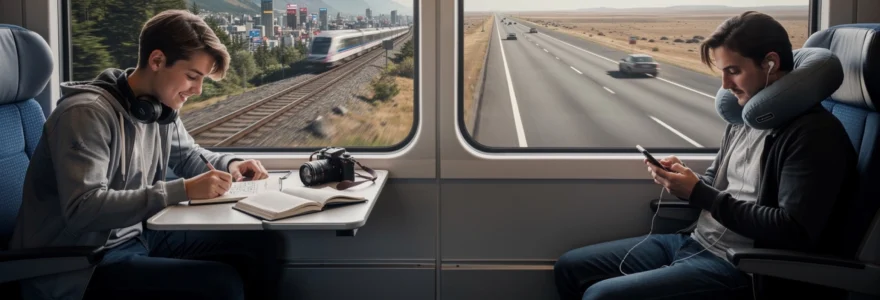
Have you ever arrived at your destination wondering where the time went, whilst on other occasions, a seemingly identical journey dragged on interminably? This peculiar distortion of temporal perception during travel isn’t merely a curious quirk of the mind—it’s a complex interplay of neurological processes, cognitive mechanisms, and environmental factors that fundamentally alter how you experience the passage of time. Understanding these phenomena reveals profound insights into human consciousness, attention, and memory formation. The phenomenon affects everything from your daily commute to transcontinental adventures, shaping how you remember and plan future journeys in ways that might surprise you.
The neuropsychological mechanisms behind temporal perception during travel
Your brain doesn’t possess an internal clock that measures time with mechanical precision. Instead, temporal perception emerges from intricate neural networks that process sensory information, emotional states, and cognitive engagement levels. This biological reality explains why subjective time can diverge dramatically from objective chronological duration during different journeys.
How the reticular activating system modulates time estimation in transit
The reticular activating system (RAS), a network of neurons located in the brainstem, functions as your brain’s alertness regulator. During travel, the RAS continuously filters incoming sensory information, determining which stimuli deserve conscious attention. When you traverse familiar routes with minimal novel features, the RAS reduces its activation level, allowing your consciousness to drift into a semi-automated state. This reduced arousal correlates directly with compressed time perception, making journeys feel shorter than their actual duration. Research indicates that arousal levels account for approximately 30-40% of variance in prospective time estimation during routine travel scenarios.
Conversely, when navigating unfamiliar territories or encountering unexpected events, the RAS heightens its activity, flooding your consciousness with sensory details. This heightened state of alertness creates more detailed memory traces, paradoxically making the journey feel longer in the moment yet richer in retrospect. Studies conducted across multiple transportation modalities demonstrate that RAS activation patterns differ significantly between first-time travellers and seasoned commuters on identical routes.
Dopaminergic pathways and their role in journey duration assessment
Dopamine, often associated with reward and motivation, plays an underappreciated role in temporal cognition during travel. The mesolimbic and mesocortical dopaminergic pathways influence how you encode temporal information throughout a journey. When you anticipate an enjoyable destination or experience pleasurable scenery during transit, dopamine release accelerates your internal time perception, creating the sensation that time passes swiftly. Neuroimaging studies reveal that dopamine receptor density in the striatum correlates with individual differences in time estimation accuracy, with variations of up to 25% between individuals.
This neurochemical mechanism explains why journeys toward anticipated events—holidays, reunions, or significant appointments—often feel briefer than return journeys from the same locations. The anticipatory dopamine surge compresses prospective time assessment, whilst the absence of such anticipation during return travel allows time to resume its more pedestrian pace. Pharmaceutical research has demonstrated that dopamine agonists can alter time perception by up to 15-20% in controlled experimental conditions.
The suprachiasmatic nucleus and circadian rhythm disruption in transit
Located in the hypothalamus, the suprachiasmatic nucleus (SCN) serves as your body’s master biological clock, orchestrating circadian rhythms across approximately 24-hour cycles. During long-distance travel, particularly across time zones, the SCN experiences desynchronization between environmental light cues and internal rhythms. This temporal disorientation affects your perception of journey duration, often making overnight flights or extended coach journeys feel temporally ambiguous—neither definitively long nor short, but rather existing in a liminal state outside normal time perception frameworks.
The SCN’s influence extends beyond jet lag to affect daytime journey perception as well. Travels undertaken during your circadian low points (typically mid-afternoon between 2-4 PM) often feel longer due to reduced cognitive processing efficiency and decreased arousal. Chronobiology research suggests that time estimation accuracy varies by approximately 18% depending on when during your circadian cycle you undertake a journey. This phenomenon has practical implications for scheduling important travels and
affective state optimization. By aligning long trips with your naturally higher alertness windows—usually mid-morning and early evening for most chronotypes—you can subtly compress your subjective journey time and reduce the sense of travel fatigue.
Airlines and long-distance rail operators are increasingly aware of these circadian influences. Some carriers now design lighting schedules and meal timings to gently nudge your SCN toward destination time zones, mitigating both jet lag and the uncomfortable temporal distortion that makes flights feel interminable. For individual travellers, using strategic light exposure, short naps timed to your usual sleep cycle, and consistent meal patterns can help stabilize your internal clock. In practice, this means that how long a journey feels can often be adjusted as much by when and how you travel as by the actual distance involved.
Memory consolidation patterns and retrospective journey duration judgement
While prospective time perception operates “in the moment”, your sense of how long a journey lasted afterwards arises from memory consolidation. The hippocampus and associated medial temporal lobe structures store episodic details of the trip, and your brain later infers duration based on the density and variety of these stored events. Paradoxically, a journey that felt fast while it was happening can be remembered as quite long if it contained many distinct, memorable segments.
This explains why a complex multi-leg journey with several transfers can seem to have taken up an entire day in hindsight, even if the clock says otherwise. Your brain uses the number of contextual “scene changes”—different stations, landscapes, interactions—as a proxy for elapsed time. In contrast, a long, uneventful motorway drive may blur into a single vague memory, leading you to underestimate its duration in retrospect. For travel planning and experience design, this distinction between prospective and retrospective timing is crucial: what feels short while you travel is not always what feels short when you later recall the trip.
Recent neuroimaging research suggests that periods of wakeful rest during travel, such as gazing out of a window without engaging with devices, may enhance memory consolidation of journey segments. Interestingly, that can make a trip feel richer and longer in memory without necessarily making it drag in real time. If you are curating travel experiences—for yourself or for others—alternating periods of stimulation with quiet reflection can balance real-time comfort with later satisfaction that the journey was “worth” the time invested.
Cognitive load theory and attentional resources in travel environments
Cognitive load theory provides a useful framework for understanding why some journeys feel shorter than others. Your working memory has limited capacity, and different travel environments place varying demands on this finite resource. When a journey absorbs your available cognitive load—through navigation tasks, environmental monitoring, or engaging stimuli—there is less capacity left to monitor the passage of time, making the trip feel shorter.
Conversely, when your working memory is underutilized, you become more aware of time itself. This is similar to watching a progress bar slowly inch across a screen: once your attention has nothing else to latch onto, every second stretches. Effective journey design, whether for a daily commute or a once-in-a-lifetime expedition, often hinges on how well the experience manages your cognitive load. The level of mental effort is not simply about difficulty; it is about providing the right kind of engagement so that your attention is externally anchored rather than internally focused on waiting.
Visual novelty processing along the Trans-Siberian railway versus daily commutes
Consider the contrast between crossing Eurasia on the Trans-Siberian Railway and taking your usual bus route to work. On the Trans-Siberian line, you encounter a constant stream of novel visual input: shifting biomes, unfamiliar stations, and evolving cultural markers across thousands of kilometres. Your visual cortex and higher-order association areas work steadily to process, categorize, and integrate these scenes, creating a persistent load on perceptual and cognitive systems.
This continuous novelty acts like an engaging story that keeps your attention tethered to the outside world rather than to the ticking of the clock. Even though the physical journey may last several days, many travellers report that time “flies” between major stops, only punctuated by meals and sleep. By contrast, your daily commute presents nearly identical visual stimuli each day. After a few repetitions, the brain compresses this information, processing it largely through predictive mechanisms that require far fewer resources. As a result, with less to occupy your perceptual systems, you may become painfully aware of every traffic light and delay.
Urban planners and transport designers can harness this effect deliberately. Small variations along routine routes—rotating public art, changing station displays, seasonal landscaping—can introduce just enough visual novelty to sustain engagement without overwhelming travellers. For individuals stuck with unchangeable routes, simple strategies such as varying your reading material, listening to different podcasts, or occasionally altering your path can mimic the Trans-Siberian effect and make familiar journeys feel shorter.
Working memory capacity depletion during monotonous motorway journeys
Long-distance motorway driving exemplifies how monotony can paradoxically both deplete and underload working memory, depending on the phase of the journey. In the early stages, you may devote significant resources to maintaining lane position, monitoring speed, and tracking other vehicles. Over time, as conditions remain stable, these tasks become semi-automatic. Your working memory begins to drift toward unrelated thoughts—plans, worries, or daydreams—creating a diffuse cognitive load that is less anchored to the external environment.
This diffuse internal load often leads to the phenomenon of “highway hypnosis”, in which you arrive at an exit with little recollection of the preceding kilometres. When your mind is absorbed in internal narratives, your explicit awareness of elapsed time can fade, making stretches of road feel surprisingly short in hindsight. However, once fatigue sets in and working memory begins to struggle with even simple tasks, the opposite occurs: every additional mile feels like an effortful extension, and time drags as you count down the remaining distance.
From a safety and time-perception standpoint, managing cognitive load during motorway journeys is critical. Taking regular breaks, varying auditory input, and using adaptive cruise control systems can reduce overload without plunging you into understimulation. You want enough external engagement to prevent rumination and drowsiness, but not so much that you are overwhelmed. Striking this balance tends to make long drives feel both safer and subjectively shorter.
The oddball paradigm effect on time perception in varied landscapes
The “oddball paradigm” in cognitive psychology shows that rare or unexpected stimuli are perceived as lasting longer than frequent, predictable ones, even when their objective duration is identical. Applied to travel, a sudden appearance of a striking landmark, a dramatic weather change, or an unusual event along the route can momentarily stretch your experience of time. These oddball moments stand out in memory and can make particular segments feel disproportionately long.
Yet across an entire journey, a sequence of modestly varied landscapes can compress overall perceived duration. Instead of a flat baseline punctuated by a few extended-feeling oddball moments, you experience a gently evolving environment that keeps your attention engaged without repeatedly shocking it. Think of driving through rolling hills where each bend offers a slightly different vista versus a dead-straight highway interrupted only by the occasional spectacular bridge or storm. In the first case, your sense of travel time may feel pleasantly continuous and fast; in the second, you might recall the trip as a series of long slogs between “time-stretched” oddball events.
For travellers, this suggests a counterintuitive strategy: a journey sprinkled with moderate variety may feel shorter overall than one engineered around a few major highlights. When planning road trips or rail itineraries, selecting routes with consistent, low-level change—rivers that weave in and out of view, villages spaced at regular intervals, subtle elevation shifts—can harness the oddball paradigm in your favour, smoothing your subjective sense of time.
Automaticity and procedural memory in familiar route navigation
Familiar routes, such as your commute or weekly trip to the supermarket, are predominantly governed by procedural memory. Over repeated exposures, your brain shifts navigation from effortful, declarative processes into automatic routines encoded in the basal ganglia and cerebellum. This automaticity dramatically reduces the cognitive load required to execute the journey, freeing up mental resources for other tasks—or for mind wandering.
Because you no longer need to consciously track each turn or landmark, the journey segments compress into a few key anchor points: leaving home, a major junction, arriving at work. The in-between sections are represented sparsely in memory and thus contribute less to your sense of elapsed time. This is why you may sometimes struggle to recall specific details of a familiar drive and yet feel that you arrived in no time. However, if something disrupts the automatic script—a closed road, an unfamiliar detour—your procedural system hands control back to conscious navigation, and time can suddenly feel slower as you re-engage with each decision point.
If you want a routine journey to feel shorter, supporting automaticity can help: minimizing unnecessary route changes, keeping departure routines consistent, and avoiding multitasking that forces you to micromanage the drive. On the other hand, if you are concerned about “losing” chunks of your day to autopilot, deliberately varying small aspects of the route can reintroduce conscious engagement and make the time feel more substantial, though not necessarily faster.
Environmental stimulus complexity and prospective time estimation
Beyond neural and cognitive factors, the physical environment through which you move exerts a powerful influence on how long a journey feels. Environmental stimulus complexity—the richness, variability, and density of sensory input—shapes your prospective estimation of time in real moments. High-complexity environments can either compress or expand time perception depending on whether the stimuli feel coherent and engaging or chaotic and overwhelming.
Travel through bustling cities, empty deserts, or scenic coastal roads each generates a distinct pattern of sensory input. Your brain continuously evaluates these patterns, grouping them into meaningful segments that inform your subjective sense of duration. When the environment offers a structured flow of changing yet comprehensible scenes, you tend to experience “time compression” during travel. When stimuli are either too sparse or too cluttered to organize easily, time can either stretch painfully or blur unmemorably.
High-density urban corridors: tokyo to osaka shinkansen time compression
The journey between Tokyo and Osaka on the Shinkansen provides a textbook example of environmental complexity leading to compressed travel time. As the train accelerates to over 250 km/h, you are exposed to a rapid-fire sequence of urban sprawl, industrial zones, agricultural fields, and distant mountain ranges. Yet this visual information is highly structured: station announcements, digital displays, and predictable stops create a clear narrative that organizes your experience.
Because the high-speed railway integrates fast-changing scenery with orderly onboard routines—ticket checks, snack trolleys, scheduled stops—your attention is continually engaged but rarely overwhelmed. Many passengers report that the two and a half hour trip feels more like a short commute than a significant intercity journey. This effect is amplified by onboard activities such as reading, working, or using digital devices, which further occupy cognitive resources and reduce awareness of elapsed time.
Transport systems around the world attempt to emulate this model of “structured richness”: offering wi-fi, clear wayfinding, and predictable service patterns to pair environmental complexity with usability. If you are planning high-speed travel, choosing services that offer both engaging views and reliable onboard structure can make substantial distances feel surprisingly brief. In contrast, fast trains that run through visually monotonous corridors without meaningful onboard cues may feel longer, despite similar timetables.
Monotonous desert highway drives across australia’s nullarbor plain
At the opposite end of the spectrum lies the Nullarbor Plain in Australia, famed for one of the world’s longest straight stretches of road. Here, environmental stimulus complexity drops dramatically: endless flat terrain, sparse vegetation, and minimal human-made structures dominate the view. While this vastness can be awe-inspiring for a time, the lack of varied visual and auditory stimuli eventually reduces engagement and highlights the raw passage of time.
On such desert highways, you may find your awareness oscillating between brief moments of absorption in the landscape and long stretches of clock-watching. With fewer external events to mark progress, kilometres merge into one another, and your brain has little material with which to segment the journey. This can produce a strong sense that the drive is dragging on, even if the actual distance is comparable to more varied routes elsewhere.
Experienced outback drivers often counter this by creating artificial structure and stimulation: scheduled rest stops, curated playlists, audio books, and planned points of interest, however minor. By introducing self-generated “chapters” into an otherwise unchanging environment, you provide your brain with reference points that break up the monotony. For anyone facing a long, featureless drive—whether across a desert, steppe, or frozen plain—pre-planned mental and sensory engagement is essential not just for comfort but for safety.
Scenic route variability through scotland’s north coast 500
Scotland’s North Coast 500 (NC500) illustrates how carefully balanced scenic variability can make a multi-day drive feel both immersive and surprisingly swift. The route weaves through rugged coastlines, fishing villages, mountain passes, and sandy beaches, presenting a steady but manageable stream of changing vistas. Each segment feels distinct enough to stand out, yet the overall narrative of circling the northern Highlands ties the journey into a coherent whole.
In this context, environmental stimulus complexity supports a state of sustained curiosity. You find yourself looking forward to the next bend or viewpoint rather than checking the clock or odometer. Interestingly, many travellers report that individual days on the NC500 feel full and rich, but the entire trip seems to pass more quickly than expected when they look back. This combination of in-the-moment engagement and retrospective compression makes scenic routes especially attractive for leisure travel.
If you have the option to choose between a fast, direct motorway and a slightly longer but more scenic path, it is often the latter that will feel shorter, particularly for non-urgent journeys. By selecting routes with varied topography, periodic landmarks, and opportunities to stop at interesting locations, you align your environment with the brain’s preference for structured, evolving stimuli—turning necessary travel time into perceived exploration time.
Flow state psychology and time dilation during active travel
Another powerful explanation for why some journeys feel shorter revolves around the concept of flow. Coined by Mihaly Csikszentmihalyi, flow describes a mental state of deep immersion where challenge and skill are well matched. In travel contexts, flow emerges when you are actively engaged in moving—cycling, hiking, kayaking—rather than passively transported. Under these conditions, your attention narrows to the immediate task, and your internal sense of time often becomes distorted.
When you experience flow during a journey, hours can pass with little conscious awareness of their progression. You may notice key milestones—reaching a mountain pass, arriving at a campsite—but the intervals between them feel compressed. This is one reason why active holidays frequently feel “shorter but richer” than sedentary ones, even if their durations are identical. The more you are involved in shaping the journey moment by moment, the less you dwell on how long it is taking.
Csikszentmihalyi’s flow theory applied to long-distance cycling journeys
Long-distance cycling offers a near-ideal laboratory for applying flow theory to travel time perception. When the terrain, weather, and your fitness level are in balance, pedalling becomes rhythmic and absorbing. You continuously adjust cadence, gear selection, and body position in response to subtle changes in gradient and wind. These micro-challenges align well with your skills, creating the conditions for sustained flow.
Cyclists on routes such as EuroVelo networks or coast-to-coast trails often report being surprised at how quickly days pass on the bike. They remember key climbs, descents, and towns but have little sense of boredom or clock-watching in between. Crucially, when the challenge level becomes too high—brutal headwinds, relentless climbs, dangerous traffic—flow dissolves into stress, and time can begin to feel painfully slow. Likewise, terrain that is too easy and unchanging may lead to understimulation and increased awareness of effort and duration.
For those planning cycling journeys that “feel” shorter and more enjoyable, aiming for a route with varied but manageable difficulty is key. Mixing rolling hills with occasional challenging climbs, ensuring regular rest stops, and riding with companions of similar ability all support flow. You are essentially engineering conditions where your brain can lose track of time in the service of a meaningful, self-propelled journey.
Engagement levels in interactive travel experiences on amtrak’s coast starlight
Flow is not limited to physically demanding travel; interactive experiences on slower modes of transport can also trigger it. Amtrak’s Coast Starlight, for example, combines panoramic observation cars, onboard commentary, and social spaces that invite conversation. Instead of simply sitting in a seat watching the countryside blur by, you can move between carriages, attend talks, photograph scenery, or meet fellow passengers.
This variety of optional activities allows passengers to modulate their own engagement levels, creating personalized flow opportunities. Someone might become absorbed in photography as the train hugs the Pacific coastline, while another becomes immersed in a book, punctuated by glances at the shifting light over the ocean. In both cases, the 30+ hour journey can feel unexpectedly short because attention is anchored in rewarding, self-chosen tasks rather than in impatiently monitoring progress.
Rail operators and cruise lines increasingly design itineraries around this principle, offering structured programs, workshops, and communal spaces. For travellers, choosing services that encourage movement and interaction—rather than confining you to a single seat—can significantly alter your subjective experience of long-distance travel time. When you turn a train or ship into a space of activities rather than a mere container for waiting, hours lose their sharp edges.
Passive versus active attention in aircraft cabin environments
Aircraft cabins provide a fascinating contrast between passive and active attention. On many flights, especially long-haul, you are a largely passive passenger: strapped into a seat, exposed to white noise, and limited in your ability to move freely. In such contexts, the default is under-stimulation, and time can stretch uncomfortably if you do not actively structure your attention. This is one reason why in-flight entertainment systems are so extensive—they provide ready-made tasks to fill cognitive space.
When you engage actively—planning your sleep, scheduling meals, working on a project, or following a curated sequence of films—the same 10-hour flight can feel markedly shorter. You are effectively creating a series of mini-journeys within the flight, each with its own goal and endpoint. Conversely, when you drift aimlessly between half-watched shows, intermittent naps, and frequent time checks, you remain acutely aware of the remaining hours, magnifying perceived duration.
If you want long flights to feel shorter, treating them as structured work or leisure retreats can help. Before boarding, decide how you will divide the flight into blocks—reading, watching, working, stretching—and prepare the necessary tools offline. By shifting from passive to active attention, you gain partial control over your temporal experience, even in a highly constrained environment.
Social context and temporal distortion in shared journey experiences
Human beings are deeply social creatures, and social context strongly modulates how time feels during travel. When you share a journey with others—friends, family, colleagues, or even strangers—you gain access to conversational, emotional, and collaborative activities that can significantly compress perceived duration. Talking, joking, planning, and reflecting together create a dense web of social events that fill cognitive space much more effectively than solitary rumination.
Have you ever noticed how a long car ride with a close friend seems to vanish into a series of conversations, while the same route alone feels much longer? Social interaction redirects attention away from internal time monitoring and toward the dynamic exchange of stories, opinions, and shared observations. Neuroimaging studies suggest that social engagement activates reward circuits and dampens regions associated with self-focused thought, both of which contribute to a feeling that “time flies” when you are with enjoyable company.
However, not all social contexts shorten perceived journey time. Crowded, stressful environments—overpacked commuter trains, tense business trips, or family journeys marked by conflict—can make minutes feel longer, not shorter. In such cases, heightened emotional arousal paired with negative affect increases both vigilance and discomfort, amplifying awareness of each passing moment. Designing social travel experiences that genuinely compress time therefore depends on the quality of interaction, not merely the presence of other people.
Practical strategies can tilt the balance toward beneficial social time distortion. On road trips, cooperative tasks—navigating, playlist curation, snack preparation—turn passengers into active contributors rather than passive riders. On group tours, guides who foster conversation and group identity often create the sense that days pass quickly yet meaningfully. Even brief, positive interactions with strangers on public transport—sharing recommendations, discussing the view—can punctuate an otherwise slow-feeling journey, making the entire trip seem shorter and more human.
Predictive coding models and expectation-reality discrepancies in travel duration
Finally, predictive coding offers a unifying framework for many of these effects on travel time perception. According to this model, your brain constantly generates predictions about incoming sensory input and timing, then updates these predictions based on actual experience. Your sense of how long a journey feels arises not only from what actually happens but from how those events compare to what you expected.
When a journey is expected to be arduous but turns out smoother and faster than anticipated, you experience a pleasant compression of time: the brain’s prior model overestimates duration, and the positive prediction error makes the trip feel “short”. Conversely, delays, diversions, and discomfort introduce negative prediction errors, making time feel elongated because reality falls short of your forecast. This is why a 30-minute delay can feel disproportionately long if you had mentally prepared for a perfectly on-time arrival.
Expectation management, then, becomes a subtle but powerful tool in shaping subjective journey length. Transport apps that provide realistic arrival windows rather than optimistic estimates, airlines that communicate honestly about potential delays, and tour operators that underpromise and overdeliver all leverage predictive coding in their favour. On a personal level, setting flexible expectations—allowing a buffer in your schedule, accepting that some uncertainty is inevitable—can reduce the sting of negative prediction errors and the associated time dilation.
Interestingly, predictive coding also explains why repeated journeys often feel shorter: as your internal model of the route becomes more accurate, there are fewer surprises, and your brain requires less active inference to update its predictions. The journey becomes increasingly “compressed” within your mental map. By understanding how expectation and reality interact in your own travel experiences, you can better predict which trips will feel long or short—and take practical steps to nudge your perception in the direction you prefer.