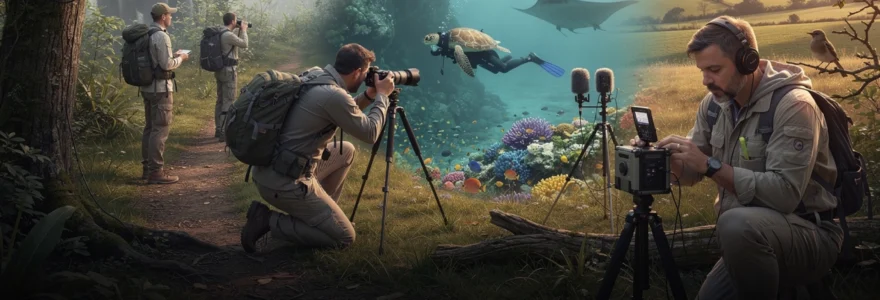
The profound connection between humans and wildlife represents one of Earth’s most transformative experiences, offering glimpses into behaviours and ecosystems that have evolved over millions of years. Modern wildlife encounters extend far beyond casual observation, encompassing rigorous scientific methodologies that allow researchers and enthusiasts to document, understand, and protect biodiversity whilst maintaining strict ethical standards. These immersive experiences range from cutting-edge technological approaches in remote wilderness areas to community-driven conservation initiatives that bridge the gap between scientific research and public engagement.
Contemporary wildlife encounters emphasise minimal human intervention whilst maximising educational and research value through innovative techniques that respect animal welfare and habitat integrity. The evolution of wildlife photography, primate research programmes, marine conservation efforts, and citizen science initiatives has created unprecedented opportunities for meaningful engagement with natural world whilst contributing to global conservation efforts.
Ethical wildlife photography techniques for Conservation-Minded encounters
Modern wildlife photography serves as both an artistic medium and a powerful conservation tool, requiring photographers to balance creative expression with ethical responsibility towards wildlife subjects. The field has evolved significantly from invasive practices of previous decades, embracing technologies and methodologies that prioritise animal welfare whilst producing scientifically valuable documentation. Professional wildlife photographers now operate under strict codes of conduct that emphasise non-interference principles, ensuring that photographic activities contribute positively to conservation outcomes rather than disrupting natural behaviours.
The integration of advanced camera technologies with conservation science has revolutionised how wildlife encounters are documented and shared. High-resolution sensors, sophisticated autofocus systems, and weather-resistant equipment enable photographers to capture detailed behavioural sequences from appropriate distances, reducing stress on wildlife subjects whilst providing researchers with valuable visual data for behavioural analysis and population monitoring studies.
Camera trap methodology for Non-Intrusive species documentation
Camera trap technology represents one of the most significant advances in wildlife documentation, providing researchers with continuous monitoring capabilities that operate independently of human presence. These automated systems utilise motion sensors, infrared triggers, and weatherproof housings to capture wildlife behaviour in completely natural settings, eliminating the observer effect that can alter animal behaviour patterns. Modern camera traps can operate for months without maintenance, generating thousands of images that provide insights into nocturnal activities, territorial behaviours, and population dynamics that would be impossible to observe through traditional methods.
Strategic placement of camera traps requires extensive knowledge of animal behaviour patterns, habitat preferences, and territorial boundaries. Research teams typically conduct preliminary surveys using tracks, scat analysis, and local knowledge to identify optimal positioning sites along animal corridors, water sources, and feeding areas. Data collection from camera traps contributes to population monitoring programmes, behavioural studies, and conservation planning initiatives across diverse ecosystems worldwide.
Long-lens photography protocols in yellowstone national park backcountry
Yellowstone National Park serves as a premier destination for ethical wildlife photography, implementing comprehensive protocols that protect both wildlife and photographers whilst facilitating meaningful encounters. The park’s backcountry areas require photographers to maintain minimum distances of 25 yards from most wildlife and 100 yards from bears and wolves, necessitating the use of telephoto lenses ranging from 400mm to 600mm for frame-filling compositions. These distance requirements ensure that animal behaviour remains unaltered whilst providing photographers with opportunities to document natural interactions.
Professional photography expeditions in Yellowstone operate under strict permit systems that limit group sizes and establish seasonal restrictions based on wildlife breeding cycles and migration patterns. The park’s diverse ecosystem supports over 60 mammal species and 150 bird species, offering photographers year-round opportunities to document everything from grizzly bear foraging behaviour to wolf pack dynamics across varied terrain ranging from thermal features to alpine meadows.
Dawn chorus recording equipment for avian behaviour analysis
Acoustic monitoring of dawn choruses provides researchers with valuable data about avian community structure, breeding behaviours, and ecosystem health indicators. Specialised recording equipment designed for field conditions includes directional microphones, windshields, and digital recorders capable of capturing high-frequency vocalizations across extended time periods. These recordings contribute to biodiversity assessments, climate change impact studies, and habitat quality evaluations that inform conservation management decisions.
Advanced analysis software enables researchers to identify individual species within complex soundscapes, measure vocalization frequencies and intensities, and track temporal changes in community composition. The
soundscape approach allows researchers to treat entire habitats as acoustic communities, rather than focusing on single species in isolation. As dawn chorus datasets accumulate over multiple seasons, conservation teams can detect subtle shifts in breeding times, species richness, and call intensity that may signal habitat degradation or climate-driven phenological changes. Increasingly, portable recorders and smartphone-compatible microphones allow citizen scientists to contribute to large-scale dawn chorus monitoring projects, creating a powerful bridge between professional ornithologists and engaged members of the public who wish to deepen their wildlife encounters through sound.
For individuals interested in ethical wildlife encounters, dawn chorus recording offers a low-impact method to engage with birdlife in both protected areas and urban greenspaces. By positioning microphones at a distance from nests and roost sites, observers avoid disturbing sensitive breeding activities whilst still capturing detailed vocalisations for avian behaviour analysis. Carefully logging metadata such as time, weather conditions, and habitat type transforms each recording session into a small but valuable research contribution. In this way, you can turn your early-morning wildlife experiences into robust data that supports long-term conservation planning.
Underwater photography ethics in great barrier reef marine sanctuaries
Underwater wildlife encounters in the Great Barrier Reef demand a heightened level of ethical awareness due to the fragility of coral ecosystems and the vulnerability of marine species to disturbance. Ethical underwater photography protocols emphasise strict buoyancy control, no-touch policies, and careful finning techniques to avoid damaging coral structures or stirring sediment that can smother reef organisms. Photographers are encouraged to maintain respectful distances from turtles, reef sharks, and other marine megafauna, using wide-angle lenses rather than approaching closely to fill the frame. This approach preserves natural behaviours whilst still enabling compelling visual documentation of reef biodiversity.
Professional dive operators within marine sanctuaries typically brief participants on best practices for responsible wildlife encounters, including prohibitions on baiting, chasing, or cornering animals for photographic purposes. Strobe use is often restricted around sensitive species such as seahorses and nesting turtles, as repeated flashes can alter behaviour and increase stress. Many conservation-minded photographers now integrate their work into reef monitoring initiatives by submitting geotagged images of coral bleaching, crown-of-thorns starfish outbreaks, and rare species sightings to collaborative databases. By aligning underwater photography with reef conservation goals, we can ensure that visual storytelling actively supports the long-term resilience of the Great Barrier Reef.
Primate habituation programmes in east african research stations
Primate habituation programmes in East Africa represent some of the most intimate and scientifically valuable wildlife encounters available to researchers and visitors alike. Unlike casual wildlife viewing, habituation is a long-term, carefully managed process in which primate groups gradually become accustomed to non-threatening human presence. This controlled familiarity allows scientists to observe natural behaviour at close range without provoking flight or aggression responses, yielding detailed insights into social structures, feeding ecology, and communication systems. Crucially, ethical habituation programmes are implemented with strict safeguards to limit disease transmission, avoid food-conditioning, and minimise disruptions to daily activity patterns.
Research stations across Uganda, Rwanda, Tanzania, and the Democratic Republic of Congo operate under national park regulations that define acceptable encounter distances, group sizes, and maximum daily contact time with primate groups. These frameworks ensure that wildlife encounters contribute directly to long-term conservation strategies, including anti-poaching surveillance, habitat protection, and community-based ecotourism. For conservation-minded travellers, participating in regulated primate tracking activities offers a rare opportunity to support research funding and local livelihoods while experiencing one of the most profound connections possible with wild animals.
Mountain gorilla tracking protocols in bwindi impenetrable national park
Mountain gorilla tracking in Bwindi Impenetrable National Park operates under some of the most stringent guidelines for ethical wildlife encounters anywhere in the world. Each habituated gorilla family can be visited by a limited number of people per day, typically in small groups accompanied by trained rangers and trackers. Visitors are required to maintain a minimum distance of 7–10 metres, wear face masks in some seasons, and adhere to strict hygiene regulations to prevent the transmission of human respiratory diseases to gorillas, whose populations remain critically endangered. These measures may appear restrictive, yet they are essential for safeguarding the health of primate communities that are highly susceptible to human pathogens.
Tracking expeditions often involve several hours of hiking through dense montane forest, following trails marked by nests, dung, and vegetation signs interpreted by experienced trackers. Once the gorilla group is located, observers are granted a tightly controlled viewing window—usually around 60 minutes—to limit cumulative disturbance across the day. During this time, photography without flash is allowed, but touching vegetation near the gorillas or imitating vocalisations is discouraged to avoid unintended communication signals. By respecting these protocols, you not only protect gorilla welfare but also contribute directly to conservation financing, as permit fees fund park management, ranger salaries, and community development projects in surrounding villages.
Chimpanzee research methodologies at gombe stream national park
Gombe Stream National Park in Tanzania, made famous by the pioneering work of Jane Goodall, remains a global reference point for long-term chimpanzee research methodologies. Habituation at Gombe has unfolded over decades, enabling researchers to construct detailed family trees, document tool use, and analyse complex social behaviours such as alliance formation and reconciliation. Data collection protocols typically combine focal animal sampling, where observers follow one individual for an extended period, with scan sampling at regular intervals to record group-wide activities. This systematic approach allows scientists to transform day-to-day chimpanzee encounters into robust behavioural datasets.
Given the close genetic relationship between humans and chimpanzees, ethical safeguards at Gombe emphasise disease prevention and minimal provisioning. While limited provisioning helped establish early research contact, modern protocols aim to reduce artificial feeding to avoid altering natural foraging patterns and social hierarchies. Researchers and authorised visitors must observe distancing guidelines, avoid entering the forest when ill, and follow strict decontamination procedures for boots and equipment. For those fortunate enough to visit, the experience is less about high-drama encounters and more about quiet observation—watching a community of chimpanzees move through the landscape like a mirror held up to human society.
Bonobo conservation projects in democratic republic of congo
Bonobo conservation projects in the Democratic Republic of Congo offer a unique perspective on primate behaviour, as bonobos exhibit matriarchal social structures and relatively low levels of overt aggression compared with other great apes. Habituation efforts in remote forest regions, such as the Salonga landscape and community-managed reserves, prioritise building trust over many years, with trackers and researchers repeatedly following the same groups from a respectful distance. Unlike tourism-heavy gorilla sites, most bonobo encounters occur in low-density research settings where data collection focuses on socio-sexual behaviour, conflict resolution, and vocal communication.
Because bonobos exist only within the Congo Basin, conservation programmes integrate habitat protection with complex socio-political realities, including logging pressures, subsistence hunting, and regional instability. Field teams collaborate closely with local communities to develop alternative livelihoods and environmental education initiatives that reduce dependence on bushmeat hunting. For external visitors and research assistants, adherence to ethical guidelines—no direct contact, disease precautions, and strict no-feeding rules—is non-negotiable. In this context, every bonobo encounter becomes part of a broader conservation narrative, linking personal experience with the survival of an entire species and its forest ecosystem.
Lemur ring-tailing studies in madagascar’s Andasibe-Mantadia national park
Andasibe-Mantadia National Park in Madagascar serves as a critical site for studying ring-tailed lemurs and other endemic species whose evolutionary histories are isolated from mainland primates. Research on ring-tailed lemurs often focuses on their conspicuous tail signals, vocalisations, and complex group dynamics, which are especially visible during early-morning foraging sessions. Habituation in this context aims to normalise researcher presence without encouraging dependency, ensuring that lemurs continue to rely on native vegetation and retain natural predator-avoidance behaviours. Observers typically maintain moderate distances, using binoculars and telephoto lenses to document interactions without crowding individuals.
Field methods in Andasibe-Mantadia combine behavioural observations with habitat assessments, such as recording tree species used for feeding and sleeping, mapping home ranges, and monitoring seasonal changes in resource availability. These studies are vital for understanding how deforestation and fragmentation affect lemur populations, many of which are now classified as threatened or endangered. Eco-guides trained in both research basics and visitor management play a pivotal role, translating scientific insights into accessible narratives for travellers. By participating in guided lemur tracking that supports park fees and local employment, you help finance the very research and protection efforts that make such intimate wildlife encounters possible.
Marine megafauna interaction protocols in protected waters
Marine megafauna encounters—whether with whales, manta rays, or whale sharks—offer some of the most awe-inspiring wildlife experiences, yet they also carry significant ethical responsibilities. In many protected waters, interaction protocols serve as a protective buffer between curious humans and vulnerable species that depend on predictable behaviour patterns for feeding, breeding, and migration. Regulations typically define minimum approach distances for vessels, maximum numbers of swimmers in the water, and time limits for each encounter. These guidelines function like invisible safety rails, ensuring that your once-in-a-lifetime marine wildlife encounter does not translate into long-term stress for the animals involved.
Responsible operators adhere to speed limits in known congregation areas, cutting engines or using low-impact propulsion systems to reduce collision risks and underwater noise pollution. For in-water encounters, such as swimming with whale sharks or snorkelling with manta rays, participants are briefed to enter the water calmly, avoid diving directly above or below animals, and never touch or ride marine wildlife. Wide-angle lenses, natural light photography, and patient observation replace intrusive behaviours like chasing or crowding, allowing natural curiosity to dictate the proximity of the animals. When we respect these interaction protocols, we create conditions in which marine megafauna may choose to approach us, transforming the encounter into a genuinely reciprocal experience rather than a one-sided pursuit.
Several protected areas now integrate citizen-generated photographs and videos into identification catalogues, using unique patterns on manta ray bellies or whale shark flanks as natural “fingerprints.” This marriage of wildlife tourism and applied science allows travellers to contribute encounter data—dates, locations, images—to long-term monitoring projects tracking migration routes and population trends. Of course, data value never justifies unethical practice: operators who bait, crowd, or repeatedly intersect an animal’s path to secure dramatic footage ultimately undermine both animal welfare and research quality. By choosing certified eco-tourism providers and asking direct questions about interaction rules before booking, you can help shift market demand toward genuinely conservation-aligned marine wildlife encounters.
Citizen science wildlife monitoring programmes across british isles
Across the British Isles, citizen science initiatives have transformed everyday wildlife encounters into powerful tools for biodiversity monitoring and conservation planning. From garden bird counts to hedgehog mapping and bat box surveys, these programmes leverage the collective power of thousands of volunteers recording observations in their local landscapes. What might seem like a casual sighting of a migrating bird or a hedgehog crossing a lawn becomes, when systematically logged, a data point in a continent-scale picture of species distribution and abundance. This democratisation of wildlife monitoring not only strengthens ecological datasets but also deepens public engagement with the natural world.
Digital platforms and mobile apps have made participation more accessible than ever, guiding users through standardised recording protocols that ensure data quality. Training resources, online workshops, and local field events help new volunteers learn identification skills and ethical observation techniques—such as avoiding disturbance at nesting sites or handling rules for distressed animals. By contributing observations over months and years, you can witness first-hand how your local wildlife community responds to changes in land use, climate patterns, and conservation interventions. In effect, your regular walks, garden watches, and weekend explorations become part of a long-term ecological research project spanning the British Isles.
Ebird data collection techniques for migratory species tracking
eBird, managed by the Cornell Lab of Ornithology, has become a cornerstone platform for tracking migratory bird species across the British Isles and beyond. Contributors log bird sightings through structured checklists that record species, counts, location accuracy, timing, and observation effort. This emphasis on effort—such as duration and distance covered—allows analysts to distinguish between genuine absences of a species and simple lack of observation. When thousands of birdwatchers follow the same data collection framework, individual encounters coalesce into high-resolution migration maps and abundance models that inform conservation policy.
To maximise the scientific value of your eBird checklists, it is essential to report all species detected during a defined time period rather than selectively listing only rare or charismatic birds. Consistent use of precise locations, ideally via GPS-enabled devices, helps refine habitat associations and stopover site importance for migratory species. Ethical guidelines advise observers to avoid sharing exact coordinates of sensitive breeding sites for vulnerable species, instead using coarse location data to prevent disturbance or persecution. In this way, careful data entry becomes as crucial as field identification skills, ensuring that your enjoyment of migratory bird encounters directly supports evidence-based conservation.
Butterfly conservation transect surveys in dorset countryside
In the Dorset countryside, structured butterfly transect surveys have become a model for how volunteers can generate robust long-term data on insect populations. Participants walk the same fixed routes—known as transects—on a weekly basis during the flight season, counting all butterflies seen within a defined distance band. This standardised approach allows researchers to detect subtle population changes over time, distinguishing between natural year-to-year variation and sustained declines that may signal habitat loss or climate stress. Walking a butterfly transect transforms a simple countryside stroll into a repeatable scientific measurement.
Training provided by organisations such as Butterfly Conservation teaches volunteers to identify common species, record weather conditions, and follow ethical protocols, including avoiding trampling sensitive vegetation and not capturing butterflies unless specifically authorised for research. Data from Dorset and other counties feed into national indices used by governments and NGOs to assess ecosystem health and evaluate the success of agri-environment schemes. For many participants, the discipline of visiting the same sites week after week deepens their connection with local landscapes, revealing seasonal patterns and species turnover that might otherwise go unnoticed. You begin to see the countryside not just as scenery, but as a living dataset unfolding in real time.
Hedgehog mapping projects through garden wildlife networks
Hedgehog mapping projects across the British Isles harness the power of garden wildlife networks to monitor one of the nation’s most beloved yet declining mammals. Volunteers report sightings of live hedgehogs, road casualties, and signs such as droppings or tracks through online portals or dedicated apps. When aggregated, these records help conservationists identify strongholds, movement corridors, and urban barriers that affect hedgehog survival, such as impermeable garden fencing or heavily trafficked roads. Mapping efforts play a role similar to a medical scan, revealing the “circulatory system” that allows hedgehogs to move through suburban and rural landscapes.
Participating households are often encouraged to make simple habitat modifications—creating “hedgehog highways” by cutting small holes in fences, providing log piles for shelter, and avoiding slug pellets that can poison both hedgehogs and their prey. Ethical guidance also stresses letting hedgehogs remain wild: supplementary feeding should be occasional and carefully managed, and handling is discouraged unless directed by wildlife rehabilitators. By combining passive observation with thoughtful habitat enhancement, garden-based networks transform private spaces into a patchwork of safe zones that support hedgehog conservation at a national scale. Your back garden, alleyway, or shared courtyard can become a meaningful node in this wildlife connectivity network.
Bat box installation programmes in national trust properties
National Trust properties across the British Isles increasingly function as living laboratories for bat conservation, integrating bat box installation programmes into broader estate management plans. Artificial roosts—ranging from simple wooden boxes to advanced, thermally stable designs—provide critical shelter for bat species facing the loss of natural tree cavities and old buildings. Installation projects often follow detailed habitat assessments that consider flight corridors, foraging areas, and microclimate conditions, ensuring that bat boxes are placed where they are most likely to be used. Volunteers and staff then monitor occupancy through emergence counts and acoustic surveys using bat detectors.
These programmes exemplify how heritage conservation and wildlife protection can converge, turning historic houses, gardens, and parklands into refuges for nocturnal biodiversity. Public engagement events, such as evening bat walks, introduce visitors to echolocation, bat behaviour, and the ecological role of bats in controlling insect populations. Ethical codes emphasise avoiding disturbance of roosts during sensitive periods like maternity season and hibernation; access to internal spaces is strictly controlled and often limited to licensed bat workers. Through these initiatives, everyday wildlife encounters—watching bats skim over a lake at dusk, for instance—become gateways to understanding broader conservation challenges and successes.
Indigenous-led wildlife tracking expeditions in remote ecosystems
Indigenous-led wildlife tracking expeditions offer a profoundly different model of wildlife encounter, one rooted in long-standing relationships with land and species rather than short-term visitation. In regions ranging from the Arctic tundra to Australian deserts and Amazonian forests, Indigenous guides draw on intergenerational ecological knowledge to interpret tracks, calls, seasonal movements, and subtle landscape cues that many outsiders would overlook. What appears to a visitor as an empty stretch of ground becomes, under expert guidance, a densely written text of footprints, broken twigs, and scent marks that tell stories of recent animal passage. This knowledge functions like a living library, continually updated through daily interactions with the environment.
Ethical participation in such expeditions requires acknowledging and respecting intellectual sovereignty: wildlife tracking techniques and place-based knowledge are not simply resources to be extracted, but cultural inheritances that belong to the communities who maintain them. Many Indigenous-led initiatives explicitly link wildlife encounters with language preservation, land rights advocacy, and community-based conservation projects. Guests are often invited to walk at a contemplative pace, listening to explanations of how hunting taboos, seasonal restrictions, and sacred sites contribute to sustainable wildlife management. By joining these expeditions on the communities’ terms, you engage in a form of wildlife tourism that reinforces, rather than erodes, local governance over ecosystems.
In practical terms, Indigenous trackers often use a hybrid toolkit that combines traditional skills with modern conservation technologies. GPS units, camera traps, and drones may be integrated into tracking routines to document species presence, map critical habitats, or support anti-poaching patrols. Analogies with Western science are sometimes drawn—track patterns likened to data points, or seasonal calendars compared to long-term ecological datasets—yet the guiding framework remains firmly grounded in Indigenous worldviews. This synthesis of knowledge systems demonstrates that the most meaningful wildlife encounters are not only about seeing animals, but about learning to inhabit a landscape through the perspectives of those who know it most intimately.
Bioacoustic research participation in rainforest canopy studies
Bioacoustic research in rainforest canopies represents one of the most innovative frontiers in non-invasive wildlife monitoring, and an emerging avenue for hands-on participation by conservation-minded travellers and students. In these projects, autonomous recording units are hoisted into the upper forest layers to capture the continuous soundscape of birds, insects, frogs, and mammals over weeks or months. Because many rainforest species are more often heard than seen, especially in dense foliage, audio datasets provide a remarkably rich record of biodiversity and activity patterns. Participating in canopy-based bioacoustic studies allows you to experience wildlife encounters through sound as much as sight, often from vantage points rarely accessed by conventional tourism.
Field teams typically combine rope-climbing or canopy walkway infrastructure with rigorous safety protocols to deploy and retrieve recording equipment. Once collected, audio files are analysed using specialised software that transforms calls into visual spectrograms, enabling rapid scanning for target species or acoustic events. Machine learning algorithms increasingly assist in recognising call signatures across massive datasets, much like a search engine for animal sounds. Volunteers may contribute by annotating recordings, flagging unusual vocalisations, or helping build training datasets for automated detection systems. This collaborative process turns the overwhelming complexity of rainforest soundscapes into manageable streams of conservation-relevant information.
As with other forms of ethical wildlife encounter, bioacoustic studies aim to minimise disturbance: recorders operate silently, without lights, and can be left in place for long periods without repeated human visits. The analogy to a “listening observatory” is apt—rather than bringing animals to us or venturing constantly into their space, we set up instruments that quietly eavesdrop on daily life in the canopy. Insights from these projects inform everything from protected area design to assessments of logging impacts and climate-driven shifts in species distributions. For participants, the most memorable moments often come when they first hear a playback of dawn or dusk in the canopy, realising that behind the apparent stillness of the forest, an intricate acoustic drama is unfolding every minute of the day.