
Tuscany holds 7 of Italy’s UNESCO Cultural Heritage Sites within a compact geographic zone — from Florence‘s Renaissance masterpieces to Pisa‘s iconic leaning campanile and Siena’s medieval piazzas. For American travelers, the question isn’t whether to visit these landmarks, but how to connect them efficiently without the headache of navigating Italian driving laws, restricted traffic zones, and the infamous ZTL fines that plague rental car users.
The Tootbus intercity bus pass system addresses this exact friction point. Instead of coordinating train schedules or risking automated traffic violations in historic city centers, you gain unlimited hop-on hop-off access across two dedicated routes covering Florence, Pisa, Siena, Lucca, and San Gimignano. Pass options range from 1 to 5 days with pricing starting at 46.55 €, and the entire experience runs through a mobile app that tracks buses in real time while an AI travel guide named Tootie delivers personalized recommendations as you move between destinations.
What follows is a practical breakdown of how the system works, how to activate your pass digitally, which routes connect which cities, and how to structure your itinerary based on the pass duration you choose. The goal is simple: turn Tuscany’s geographic spread from a logistical puzzle into a flexible exploration advantage.
Tuscany’s geographic concentration creates both opportunity and challenge for first-time visitors. Florence sits approximately 50 miles (80km) west of Pisa and 40 miles (65km) north of Siena, distances that seem manageable on a map. Yet regional train connections between secondary cities like Lucca and San Gimignano remain infrequent, with schedules that rarely align with tourist sightseeing patterns. Direct routes often don’t exist, requiring transfers through Florence that add 90 minutes to journeys that should take 30 minutes by road.
The intercity bus pass model solves this coordination problem by eliminating individual ticket purchases and schedule hunting. A single digital pass covers unlimited travel across five cities, with hop-on hop-off flexibility that lets you adjust your itinerary in real time based on weather, crowds, or spontaneous discoveries. The system was designed specifically for tourists rather than commuters, which means routes prioritize landmark drop-offs over residential neighborhoods and departure times cluster around typical sightseeing hours rather than rush-hour commutes.
What this guide covers for your Tuscany transport planning:
- Multi-day pass options (1, 2, 3, or 5 days) with pricing from €46.55 and up to 15% online discount
- Complete route coverage across 5 iconic cities: Florence, Pisa, Siena, Lucca, and San Gimignano
- Step-by-step digital activation via mobile app with GPS tracking and AI travel assistant
- Sample itineraries matched to your trip length, from quick Florence-Pisa loops to comprehensive 5-day circuits
- Honest comparison against car rental costs (including hidden ZTL fines and parking fees)
Why choosing a bus pass beats renting a car in Tuscany
First-time visitors to Italy often assume renting a car offers maximum freedom. The reality in Tuscany’s historic centers tells a different story. Florence, Pisa, Siena, and Lucca all enforce ZTL zones — Zona Traffico Limitato — where only authorized vehicles can enter. These restricted areas cover the exact medieval quarters tourists want to explore, and the enforcement system is fully automated. Drive into a ZTL zone without proper credentials and you’ll receive a mailed fine weeks after returning home, typically ranging from €100 to €200 per violation.
The prevalence of this problem is documented by travel behavior data:
62 %
Proportion of first-time Tuscany visitors who underestimate driving challenges based on travel forum analysis
This underestimation stems from a disconnect between Italy’s romantic image and its strict urban traffic enforcement reality. Many travelers assume that booking a rental car guarantees access to city centers, only to discover that historic districts are off-limits to non-residents. The resulting fines, combined with parking scarcity and navigation stress, transform what should be leisurely cultural exploration into a logistical burden.
Beyond ZTL complications, parking in Tuscan city centers is scarce and expensive. A single day of parking near Florence’s Duomo can cost €30-€40, assuming you find a spot. Add fuel costs (approximately €1.80 per liter in 2026), highway tolls on the A11 and A1 routes, mandatory insurance upgrades, and the base rental rate, and a 3-day car rental easily exceeds €250-€300 for the vehicle alone — before factoring in potential fines or the stress of navigating unfamiliar traffic patterns.
- Zero risk of ZTL fines or parking violations
- Fixed upfront cost with no hidden fees (from €46.55 for full day unlimited travel)
- Included walking tours and audio guides via app
- Direct drop-off at major landmarks (Pisa’s Piazza dei Miracoli, Florence’s Piazzale Michelangelo)
- Routes limited to two fixed loops (Green and Terracotta), not fully customizable
- Dependent on bus schedules rather than spontaneous departure timing
The IRPET regional tourism report confirms that North American overnight stays surged 20.2% compared to pre-pandemic 2019 levels, driven partly by travelers seeking car-free alternatives that eliminate driving stress while maximizing cultural immersion time.
Getting started: How to purchase and activate your Tootbus Tuscany pass
The activation process runs entirely through digital channels, which means you can complete the setup before ever setting foot in Italy. The system is designed to work on standard smartphones (iOS and Android) with minimal data requirements, though downloading the full app and pass materials over WiFi before departure is recommended to avoid roaming charges.
Passes purchased through the official booking platform before arrival qualify for up to 15% off the walk-up rate. For a 3-day pass, that discount translates to roughly €12-€18 in savings, enough to cover a museum entrance fee or a quality lunch in Lucca. The online system accepts major credit cards (Visa, Mastercard, American Express) and processes in euros, though most US cards handle the currency conversion automatically. During checkout, you’ll select your pass duration (1, 2, 3, or 5 consecutive days) and the number of travelers. The system doesn’t require you to choose a specific start date at purchase — instead, your pass validity begins the moment you activate it on your first ride, which provides flexibility if your travel plans shift. You’ll receive a confirmation email with a QR code and booking reference number. Keep this email accessible, as the QR code serves as your digital ticket.
The companion app (search “Tootbus” in the App Store or Google Play) centralizes pass activation, real-time bus tracking via GPS, and access to audio guides. Once installed, create an account using your email address — the same email used during pass purchase — which automatically syncs your booking. The app displays a map view showing your current location and the positions of active buses on both routes, with the AI travel guide Tootie providing location-aware suggestions.
Physical activation happens the first time you board any Tootbus vehicle. As you enter, you’ll see a QR code scanner near the driver’s station. Open your confirmation email (or the app’s “My Passes” section), display your QR code to the scanner, and you’ll hear a confirmation beep. That scan triggers your pass countdown: if you purchased a 3-day pass and activate it at 10:00 AM on Monday, your unlimited travel window runs until 11:59 PM on Wednesday. Subsequent rides require no re-scanning — simply board any bus on either route.
- Confirm your confirmation email with QR code is accessible offline (screenshot it or save PDF to phone)
- Download the Tootbus app and verify your booking appears under “My Passes” section
- Identify your starting bus stop location in Florence (Santa Maria Novella station area is the main hub)
- Check live bus schedules the morning of your first ride to confirm no service disruptions
- Plan your activation timing to maximize pass value (activate on first full sightseeing day, not arrival day)
Exploring Tuscany with Tootbus: Routes, cities, and unlimited travel
The service operates two distinct intercity loops designed to cover Tuscany’s most visited cultural landmarks without overlap. Think of them as complementary circuits rather than competing options — most multi-day pass holders end up using both routes to create a complete regional tour.
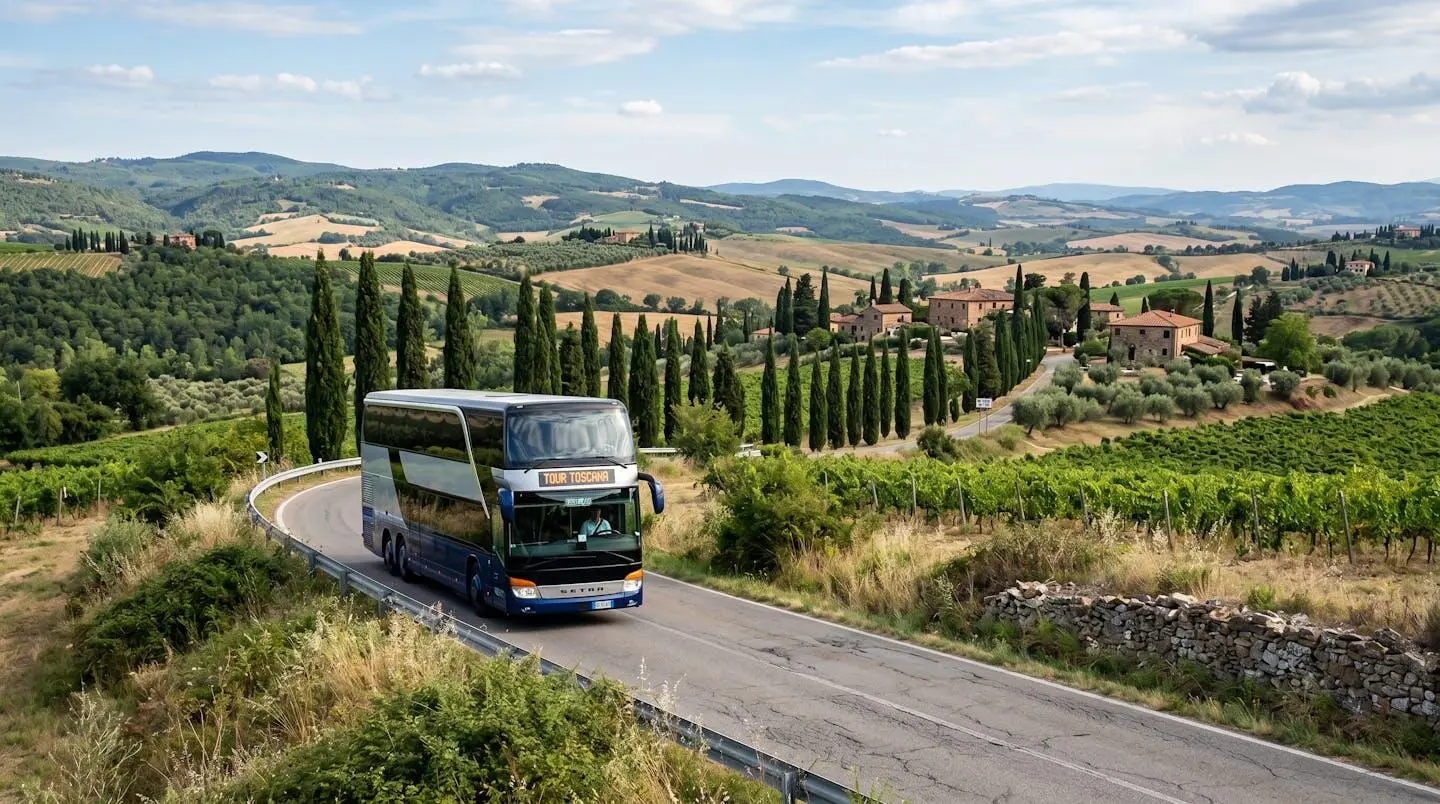
The Green Route forms the northern arc, connecting Florence with Pisa and Lucca through the Arno River valley. Buses depart from Florence’s Santa Maria Novella train station area with multiple daily frequencies, stopping at Pisa’s Piazza dei Miracoli (a UNESCO World Heritage Site recognized since 1987, as the City of Pisa’s official World Heritage documentation notes) before continuing to Lucca’s intact medieval walls. The full loop takes approximately 2.5 hours if you stay onboard without hopping off. The Terracotta Route covers the southern cultural zone, linking Florence with Siena and the medieval towers of San Gimignano through Chianti wine country, delivering access to Siena’s Gothic Piazza del Campo and the remarkably preserved hilltop town of San Gimignano, both part of Tuscany’s collection of 7 UNESCO Cultural Heritage Sites as documented by Toscana Promozione Turistica’s UNESCO heritage inventory. The Terracotta circuit runs slightly longer at roughly 3 hours for the complete loop.
Real-time GPS tracking solves the uncertainty problem that plagues hop-on hop-off systems in unfamiliar cities. Instead of wondering whether you just missed a bus or need to wait 90 minutes for the next one, the app displays live positions and arrival countdowns for every vehicle on both routes. If you’re finishing lunch in Lucca and see the next Green Route bus arriving in 8 minutes, you have enough time to walk to the nearest stop. If the wait is 45 minutes, you might choose to visit one more church or shop before boarding.
Route coverage summary: The two Tootbus routes collectively serve Florence (hub for both routes), Pisa, Lucca, Siena, and San Gimignano. No other intercity bus pass system in Tuscany covers all five cities under a single multi-day ticket with included walking tours and mobile app integration. Regional trains connect these cities but require separate ticket purchases for each segment and don’t include guided experiences or real-time tracking.
Planning your itinerary: Sample routes by pass duration
The decision between a 1-day, 3-day, or 5-day pass hinges on two factors: how many cities you want to visit deeply versus superficially, and whether you’re optimizing for cost-per-city efficiency or maximum geographic coverage. What follows are three itinerary templates matched to each pass duration, built around realistic timing that accounts for travel, sightseeing, and meal breaks.

The 1-2 day pass suits travelers with limited time or those treating Tuscany as a short extension of a longer Italy trip. The single-day pass works best when you’re already based in Florence and want to add Pisa as a half-day excursion. A realistic timeline: depart Florence at 9:00 AM via Green Route, arrive Pisa by 10:30 AM, explore Piazza dei Miracoli until 1:00 PM, grab lunch, then either return to Florence by 3:00 PM or continue to Lucca for a quick 90-minute walk before catching the final evening bus back. The 2-day pass adds breathing room with a more relaxed Pisa visit (including potential tower climb) and a full afternoon in Lucca on Day 1, then switches to the Terracotta Route for Siena on Day 2, where the steep medieval streets and the Duomo can easily consume 4-5 hours.
The 3-day option represents the sweet spot for most first-time Tuscany visitors. It provides enough time to cover all five cities without feeling rushed, and the per-city cost drops to roughly €15-€18 (compared to €25-€30 for individual regional train tickets per segment). A balanced structure: Day 1 covers the Green Route (Florence to Pisa to Lucca), Day 2 tackles the Terracotta Route (Florence to Siena to San Gimignano), and Day 3 serves as a flexible replay day to revisit a favorite city for deeper exploration or stay in Florence for Uffizi Gallery and Accademia museum visits.
The 5-day pass makes sense only if you’re spending a full week in Tuscany and want the freedom to revisit cities or explore at a very slow pace. From a pure cost-efficiency standpoint, the 5-day pass offers diminishing returns unless you’re taking at least 8-10 bus rides across the validity period. This duration allows you to spend full days in single cities (particularly Siena and Lucca, which reward slow immersion) and add secondary destinations or repeat visits to whichever city captured your interest most strongly.
- If you have 2-3 total days in Tuscany and want to see the highlights:
Choose the 1-day or 2-day pass. Focus on the Green Route (Florence, Pisa, Lucca) for maximum iconic landmarks per hour. Accept that Siena and San Gimignano will need to wait for a future trip.
- If you have 4-5 days and want comprehensive coverage without rush:
The 3-day pass delivers the best cost-per-city value and covers all five destinations with realistic sightseeing time. This is the most popular choice among first-time Tuscany visitors.
- If you have 6+ days and prioritize deep exploration over breadth:
The 5-day pass allows you to spend full days in single cities (particularly Siena and Lucca, which reward slow immersion) and revisit favorites. Calculate whether 8+ rides justify the price versus buying a 3-day pass plus individual train tickets for extra trips.
For comprehensive trip planning beyond transportation logistics, this guide on efficient holiday preparation covers accommodation booking, museum reservations, and packing for Italy’s variable spring and fall weather patterns. The Tootbus pass solves your intercity movement, but pre-departure planning around peak museum times and restaurant reservations in high-demand cities like Siena can make the difference between a smooth trip and a frustrating one.
Your questions about using the Tuscany bus pass
How frequently do buses run on each route?
During peak season (April through October), buses on both the Green and Terracotta routes typically run every 60-90 minutes from early morning (first departure around 8:00-8:30 AM) until early evening (final departure around 6:00-7:00 PM). Off-season frequency drops to every 2-3 hours with reduced weekend service. The app displays live schedules that adjust for seasonal changes, holidays, and occasional service disruptions, so always check the real-time timetable rather than relying on printed schedules from previous trips.
Is there luggage space if I’m traveling between accommodations?
Buses include undercarriage storage compartments similar to coach buses used for airport transfers, with capacity for standard rolling suitcases (up to approximately 30 inches / 75cm tall). Small carry-on bags and backpacks fit in overhead racks inside the bus. If you’re relocating from a Florence hotel to a Siena accommodation, bringing one suitcase per person is perfectly feasible. Avoid oversized luggage (surf boards, bike boxes, multiple large cases per traveler), as compartment space is first-come, first-served and fills quickly during summer peak hours.
Are the buses wheelchair accessible?
Most vehicles in the fleet are equipped with wheelchair lifts and designated accessibility seating areas, complying with EU accessibility standards for public transport. However, not every single bus on every single departure guarantees accessibility features, particularly during off-season when older backup vehicles sometimes enter rotation. If you require wheelchair access, contact customer support at least 48 hours before your planned travel date to confirm accessible vehicle availability on your specific route and departure time. The app indicates which scheduled buses have confirmed accessibility features.
Do children require their own pass or can they travel free?
Children under age 5 typically travel free when accompanied by a paying adult, without requiring a separate pass or ticket. Children ages 5-15 qualify for discounted youth passes (usually 20-30% off the adult rate, depending on pass duration). Anyone 16 and older pays the full adult price. During booking, you’ll specify the number of adults and children, and the system automatically applies the appropriate pricing structure. Keep proof of age (passport or ID) accessible, as drivers occasionally verify ages for children who appear close to the 5-year or 16-year thresholds.
Tuscany’s geographic concentration of UNESCO World Heritage Sites creates both opportunity and logistical challenge. The opportunity: you can experience Renaissance Florence, the Leaning Tower, Siena’s Gothic treasures, and medieval hill towns within a compact travel radius. The challenge: coordinating movement between these destinations without wasting time, money, or mental energy on driving complications. The intercity bus pass model solves that specific friction point, turning what could be a stressful rental car experience into a flexible, digitally-guided exploration system that gets you to the landmarks while leaving the navigation and ZTL anxiety to someone else.