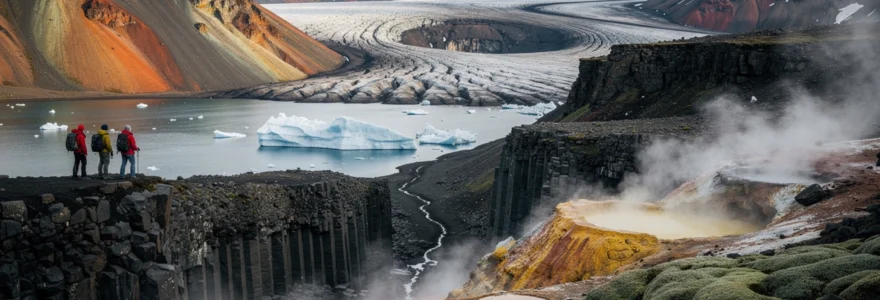
Iceland occupies a unique position in the global imagination, functioning as Earth’s most accessible alien world. The Nordic island nation presents landscapes so extraordinary and otherworldly that they routinely serve as backdrops for science fiction films and training grounds for space exploration missions. From crystalline glacial formations to bubbling geothermal fields, Iceland’s terrain defies conventional expectations of terrestrial beauty, creating an environment that feels fundamentally detached from familiar earthly experiences.
The psychological impact of Iceland’s landscapes extends far beyond mere aesthetic appreciation. Visitors frequently describe profound sensations of displacement, as though they have stepped onto another planet entirely. This phenomenon stems from a remarkable convergence of geological forces, atmospheric conditions, and chromatic displays that combine to create one of Earth’s most alien-feeling environments. The country’s position straddling the Mid-Atlantic Ridge, combined with its Arctic location and unique geological history, has produced terrain features that mirror those found on Mars, the Moon, and other planetary bodies throughout our solar system.
Geological phenomena creating iceland’s otherworldly terrain
Mid-atlantic ridge volcanism and basalt column formations
The fundamental driver of Iceland’s extraordinary landscape lies in its position directly atop the Mid-Atlantic Ridge, where the Eurasian and North American tectonic plates diverge at approximately 2.5 centimetres annually. This geological setting creates a volcanic hotspot of unparalleled intensity, generating the raw materials for Iceland’s most spectacular formations. The island experiences volcanic eruptions roughly every three to four years, with over 30 active volcanic systems continuously reshaping the terrain.
Basalt column formations represent perhaps the most visually striking manifestation of this volcanic activity. Svartifoss waterfall exemplifies this phenomenon perfectly, where hexagonal basalt columns create natural cathedral-like structures that appear almost engineered in their geometric precision. These formations result from the slow cooling of basaltic lava flows, which contract and fracture in predictable hexagonal patterns due to thermal stress distribution principles. The resulting columns can reach heights of over 20 metres, creating walls that resemble enormous organ pipes or alien architecture.
The regularity and mathematical precision of these basalt formations contribute significantly to their otherworldly appearance. Unlike the organic, irregular shapes typically associated with natural rock formations, basalt columns display an almost crystalline perfection that suggests artificial construction. This geometric regularity, combined with the dark, charcoal-coloured basalt rock, creates visual environments that feel distinctly non-terrestrial, particularly when shrouded in Iceland’s frequent atmospheric mists and unusual lighting conditions.
Geothermal activity shaping hverir and námafjall landscapes
Iceland’s extensive geothermal systems create some of the planet’s most Mars-like terrestrial environments. The Hverir and Námafjall geothermal areas exemplify this phenomenon, presenting landscapes dominated by sulfurous steam vents, bubbling mud pots, and mineral-stained earth that ranges from vivid yellow to deep red. These areas maintain surface temperatures often exceeding 100 degrees Celsius, creating localized atmospheric conditions that distort vision through heat haze effects.
The chemical composition of these geothermal zones produces colour palettes virtually unknown elsewhere on Earth. Sulfur deposits create brilliant yellow patches across the landscape, while iron oxide formations generate rust-red staining that extends across entire hillsides. Hydrogen sulfide emissions contribute to the otherworldly sensory experience, producing the characteristic « rotten egg » smell that further reinforces the alien nature of these environments. The combination of unusual colours, acrid odours, and otherworldly sounds creates a complete sensory experience that feels fundamentally non-terrestrial.
Glacial erosion patterns at vatnajökull and langjökull ice caps
Iceland’s glacial systems, particularly the massive Vatnajökull ice cap covering approximately 8% of the country’s total area, create landscape features that mirror those observed on other planets with significant ice formation history. These glacial systems generate unique erosional patterns through processes that operate over millennia, carving valleys, fjords, and mountain formations with distinctly alien characteristics.
The interaction between glacial ice and underlying volcanic
bedrock produces dramatic contrasts: deep, U-shaped valleys with polished basalt walls, over-deepened fjords that plunge beneath sea level, and isolated nunatak peaks protruding through the ice like dark islands in a frozen sea. At Vatnajökull, outlet glaciers such as Skaftafellsjökull and Svínafellsjökull exhibit crevasse patterns and seracs that resemble frozen waves, frozen mid-motion as if time itself had stalled. Langjökull, Iceland’s second-largest ice cap, reveals extensive networks of subglacial channels and moulins where meltwater disappears into the blue heart of the ice, evoking images of cryovolcanic terrains on icy moons like Europa.
These glacial erosion patterns generate landforms that look strangely familiar to planetary scientists studying other worlds. The striated bedrock, drumlin fields, and moraines surrounding Icelandic ice caps mimic the glacial scars identified on Mars and the remnants of ancient ice sheets on Earth. For the casual visitor, walking across these sculpted valleys can feel like traversing the remnants of a vanished ice age on another planet, where gravity, temperature, and time have worked differently. For you as a traveller, understanding that these shapes arise from slow, relentless grinding of rock beneath kilometres of ice can deepen the sense of awe—much like learning how a sculptor laboriously carves smooth marble from a rough block.
Tectonic plate boundaries creating thingvellir rift valley
Nowhere is Iceland’s role as a living tectonic laboratory more evident than at Þingvellir (Thingvellir) National Park. Here, the separation of the Eurasian and North American plates is visible at the surface, expressed as a broad rift valley cut by numerous fissures and faults. The Almannagjá fault wall, rising starkly from the valley floor, marks the edge of the North American Plate, while parallel fractures step away toward the Eurasian side, creating a zone several kilometres wide where the crust is being pulled apart.
This rifting process, measured at a few millimetres per year, creates an environment that feels inherently unstable and dynamic, as though the ground itself is in motion beneath your feet. Clear water fills many of the fissures, most famously Silfra, where visibility can exceed 100 metres, allowing divers to literally swim between the continents. Standing on viewing platforms above the valley, you can see how the land has fractured and sunk, forming terraces and collapsed blocks that resemble computer-generated landscapes from a science fiction film. The physical sensation of straddling two major tectonic plates reinforces the impression that Iceland occupies a liminal space, not just between continents, but between worlds.
Chromatic palettes and light phenomena amplifying alien aesthetics
Rhyolite mountains’ mineral oxidation at landmannalaugar
If the geology supplies Iceland’s sculptural forms, colour chemistry provides its surreal palette, nowhere more so than in the rhyolite mountains of Landmannalaugar. Unlike the dark basalt dominating much of the country, rhyolite is rich in silica and various minerals that oxidize into a spectrum of colours under Iceland’s harsh weathering conditions. As iron-bearing minerals rust and other elements transform, slopes develop bands of orange, yellow, cream, green, and blue-grey, creating the effect of a watercolor painting poured over mountains.
Hiking through Landmannalaugar, you encounter hillsides striped with pastel tones that shift with moisture and light, almost like mood rings reacting to the sky. Patches of obsidian and black lava fields interrupt the softness of the rhyolite, producing stark contrasts that feel digitally enhanced, even when you see them with your own eyes. Have you ever looked at a travel photo and assumed it was heavily edited? Here, the reality outpaces most filters, which is why both photographers and geologists treat Landmannalaugar as a natural laboratory for studying how mineral oxidation can transform volcanic landscapes into dreamlike scenes.
Aurora borealis magnetospheric interactions over jökulsárlón
Iceland’s skies contribute as much to its alien atmosphere as its landforms, particularly when the aurora borealis dances above Jökulsárlón glacial lagoon. This phenomenon occurs when charged particles from the solar wind are funnelled by Earth’s magnetic field toward the poles, where they collide with atoms and molecules in the upper atmosphere. These interactions excite oxygen and nitrogen, producing shimmering curtains of green, violet, and occasionally red light that ripple across the sky.
Over Jökulsárlón, the spectacle gains an extra dimension because the lagoon’s floating icebergs and mirror-like waters amplify and distort the aurora’s glow. The ice refracts and scatters the light, creating subtle internal glows and reflections that turn the lagoon into a luminous stage set. It can feel as though you are watching energy storms on a gas giant rather than a familiar earthly sky. For visitors hoping to photograph the aurora borealis in Iceland, timing your trip for clear, cold nights between September and April and monitoring both cloud cover and geomagnetic activity can dramatically increase your chances of witnessing this cosmic display.
Midnight sun solar elevation effects on westman islands
In summer, Iceland’s alien character emerges through an almost opposite phenomenon: the midnight sun. Near the June solstice, the sun barely dips below the horizon, instead tracing a low, golden arc that bathes the landscape in prolonged twilight. On the Westman Islands (Vestmannaeyjar), this low solar elevation casts exceptionally long shadows across volcanic craters and basalt sea stacks, exaggerating textures and features that might be subdued under a midday sun.
The result is a kind of time dilation; at midnight, the sky can still be suffused with soft orange and pink light, confusing your internal clock and sense of place. Bird cliffs teem with puffins and other seabirds that continue their activity in this extended dusk, contributing to the impression of living in a parallel version of Earth where day and night follow unfamiliar rules. For travellers, the midnight sun provides both an opportunity and a challenge: while you can explore longer and see the islands in extraordinary light, maintaining regular sleep patterns can require deliberate discipline, such as using blackout curtains or eye masks to counteract the relentless glow.
Geothermal steam refractions creating atmospheric distortions
Across much of Iceland, geothermal steam rising from vents, fumaroles, and hot springs adds a final, almost cinematic layer to the landscape. As hot steam meets cold air, it condenses into dense plumes that twist and dissipate in unpredictable ways, acting like transient sculptures in the air. When sunlight passes through these vapour clouds, refraction and scattering produce subtle halos, glows, and shifts in colour temperature, making nearby rocks, moss, and snow appear to shimmer or blur.
Walking through geothermal fields such as those near Krafla or Gunnuhver, you may notice heat haze distortions similar to those seen above desert roads, only here they carry the faint smell of sulfur and the constant hiss of escaping gas. These atmospheric distortions can make it feel as though the boundaries of objects are dissolving, as if the landscape itself is slightly out of focus or digitally rendered. In a sense, geothermal regions function like natural special effects studios, demonstrating how light, temperature gradients, and moisture can collaborate to produce environments that appear only half tethered to reality.
Extraterrestrial analogues in icelandic topography
Eldhraun lava fields resembling martian terrain
The Eldhraun lava field, created by the catastrophic Laki eruption of 1783–1784, offers one of Iceland’s clearest visual parallels to Martian terrain. Spanning roughly 565 square kilometres, this vast expanse of solidified lava has been softened over centuries by thick carpets of moss, yet it still retains the flow structures, pressure ridges, and collapsed lava tubes characteristic of basaltic eruptions. From a distance, the undulating surface, pockmarked with small craters and depressions, looks remarkably similar to satellite images of volcanic plains on Mars.
For planetary scientists, Eldhraun serves as a natural analogue site for studying how basaltic lava behaves under different climatic conditions, particularly as it weathers and interacts with water and biological life. For you as a visitor driving the ring road in South Iceland, the sensation can be disorienting: kilometre after kilometre of moss-draped rock creates the impression of travelling through a single, continuous lava ocean frozen in time. The muted greens and grays, combined with minimal vegetation and sparse human structures, evoke the kind of barren, ancient surface we associate with other planets rather than a modern, inhabited Earth.
Askja caldera’s lunar landscape training ground for apollo missions
Askja, a remote volcanic caldera in the central highlands, has long been recognised as one of Earth’s best analogues for the Moon’s surface. In the 1960s, NASA used this area as a training ground for Apollo astronauts, who practised geological observations and sampling among the ash, pumice, and lava formations. The caldera floor, dominated by light-coloured tephra and fragmented rock, bears a striking resemblance to lunar regolith, particularly in its lack of vegetation and its fine, dusty texture.
Surrounding peaks and crater rims rise like the edges of immense impact structures, while nearby lava flows and maars add complexity to the otherwise austere landscape. Standing on the rim of Víti, a small explosion crater filled with turquoise geothermal water, you are confronted with a visual paradox: a crater-lake combination that feels at once completely foreign and scientifically familiar, echoing images from both lunar and Martian missions. The knowledge that human astronauts once walked these slopes in preparation for walking on another world only deepens the sense that Askja occupies a strange threshold between Earth and space.
Dimmuborgir pseudo-crater formations mimicking planetary surfaces
Dimmuborgir, near Lake Mývatn, is a labyrinthine field of unusual lava formations often described as “lava castles” or “dark cities.” These structures formed when lava flowed over a wet, marshy area, causing steam explosions that created hollow pillars and bizarre, contorted shapes. Unlike standard volcanic cones, many of these features are classified as pseudo-craters or lava pillars—features that resemble impact or volcanic craters but form through different, often more chaotic processes.
Wandering through Dimmuborgir’s narrow passages and arches, you might feel as though you are exploring the ruins of an alien civilisation rather than a natural landscape. The dark basalt, combined with irregular cavities and overhangs, casts deep shadows that accentuate the terrain’s three-dimensional complexity. In planetary geology, similar chaotic terrains and pseudo-crater fields have been identified on Mars and other bodies, making Dimmuborgir an invaluable site for comparing terrestrial and extraterrestrial processes. For science-fiction filmmakers, this ready-made set requires minimal modification to pass as an otherworldly outpost or ancient alien stronghold.
Dettifoss waterfall’s erosional patterns similar to martian outflow channels
Dettifoss, often cited as Europe’s most powerful waterfall, offers a dynamic counterpart to Iceland’s static lava and ice analogues. Fed by glacial meltwater from Vatnajökull, the Jökulsá á Fjöllum river plunges 44 metres into a deep, basalt-lined gorge, transporting hundreds of cubic metres of sediment-laden water every second. Over thousands of years, this torrent has carved a canyon system marked by steep walls, plunge pools, and abandoned river channels that strongly resemble the catastrophic outflow features observed on Mars.
High-resolution imagery from Martian orbiters has revealed valley networks and scoured channels that many researchers attribute to short-lived, high-volume floods, perhaps triggered by melting ice or subsurface reservoirs. Dettifoss and its surrounding canyon provide a real-world laboratory for studying how such high-energy flows sculpt rock, redistribute sediments, and leave behind distinct erosional fingerprints. Standing at one of the viewing platforms, feeling the ground tremble beneath your feet and the mist coat your skin, you gain an intuitive sense of the raw hydraulic power that could, on another world, transform a frozen plain into a network of deep, branching canyons in geologically brief episodes.
Psychological and sensory isolation effects in remote highlands
Beyond its physical resemblance to alien worlds, Iceland’s highlands exert a profound psychological effect rooted in isolation and sensory minimalism. Much of the interior remains uninhabited, accessible only during summer months via gravel F-roads that cross black sand deserts, glacial rivers, and wind-scoured plateaus. Once you leave the ring road and enter this sparse interior, human-made structures become rare, mobile phone coverage often disappears, and horizons stretch uninterrupted in every direction.
This reduction of familiar sensory input—no urban noise, minimal vegetation, few signs of daily human life—can heighten your awareness of subtle details: the crunch of pumice underfoot, the distant rumble of a glacier-fed river, the way clouds cast slow-moving shadows over volcanic ridges. For some travellers, this sensory stripping-down feels meditative, offering a rare opportunity to recalibrate their relationship with silence and space. For others, the immense emptiness can be mildly unsettling, inducing a sense of exposure similar to what astronauts describe when looking back at Earth from orbit: beautiful, but undeniably apart from the comforting clutter of everyday environments.
From a psychological standpoint, the highlands function almost like a deprivation tank in open air. With fewer colours, sounds, and smells than most ecosystems, your brain has less data to process, which can intensify emotional responses to whatever stimuli remain. A lone patch of bright green moss on black volcanic sand might feel strangely poignant; a single distant cabin light can seem like a beacon in a universe of darkness. If you plan to travel in these regions, it helps to prepare not just in terms of equipment—sturdy vehicles, layered clothing, emergency supplies—but also mentally, acknowledging that the emotional impact of such isolation can be as powerful as the visual spectacle.
Cultural mythology reinforcing otherworldly perceptions of icelandic nature
Icelanders have long responded to their unusual environment by weaving it into a rich tapestry of myths and folklore. Instead of treating lava fields, hot springs, and eerie rock formations as inert backdrops, traditional stories populate them with elves (álfar), hidden people (huldufólk), trolls, and land spirits. In many communities, certain boulders or groves are still considered the dwellings of such beings, and construction projects have occasionally been altered to avoid disturbing them, reflecting a cultural willingness to grant agency and personality to the landscape.
This mythological framing influences how both locals and visitors experience Iceland’s terrain. A solitary rock outcrop in an otherwise flat lava field might be interpreted as a petrified troll caught by the sunrise, while a mist-shrouded ravine becomes a plausible gateway to the realm of hidden people. Such narratives operate almost like augmented reality overlays, adding layers of meaning that transform natural features into characters and stories. For travellers, engaging with these tales—whether through guided tours, local museums, or casual conversations—can make Iceland feel even more like a borderland between worlds, where the line between geology and mythology blurs.
Modern Icelandic culture continues to draw on this sense of otherworldliness in literature, music, and visual arts, creating a feedback loop between perception and place. Contemporary authors and filmmakers often situate supernatural or speculative events in real Icelandic locations, reinforcing the idea that this landscape is a plausible stage for encounters with the uncanny or extraterrestrial. You might find yourself standing at a windswept cliff or beside a steaming vent that you recognise from a novel or series, experiencing a strange déjà vu that further distances you from your usual sense of Earthly normalcy. In this way, Iceland’s alien-feeling nature is not just a product of rocks and light, but also of stories—stories that encourage us to see the island as a threshold where the familiar world gives way to something profoundly, enticingly other.