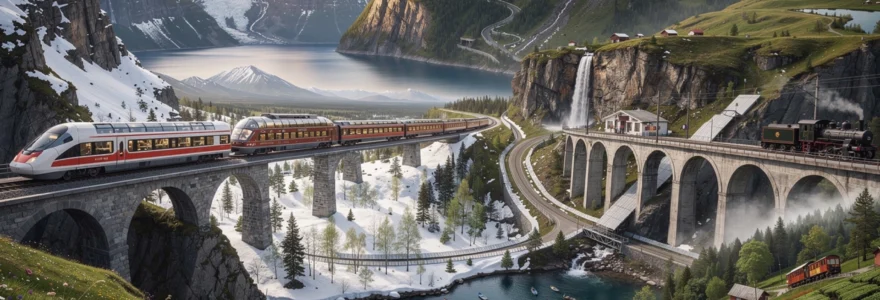
The romance of rail travel transcends mere transportation. As landscapes unfurl beyond panoramic windows and the rhythmic clatter of wheels on tracks becomes a meditative soundtrack, you experience destinations in ways impossible from highways or airports. Scenic train journeys represent some of humanity’s most ambitious engineering achievements, carved through mountain passes, suspended above gorges, and threaded through wilderness corridors that remain otherwise inaccessible. From the snow-draped peaks of the Swiss Alps to the vast taiga forests of Siberia, these railway routes showcase natural wonders whilst offering comfort and perspective unavailable to those rushing past in vehicles or overhead in aircraft. The world’s most celebrated rail journeys combine technical innovation with geographical splendour, creating experiences that linger in memory long after the final station.
Alpine railway networks: the glacier express and bernina express through swiss mountain passes
Switzerland’s reputation as the zenith of scenic rail travel stems from an intricate network of mountain railways engineered with precision and operated with legendary Swiss efficiency. The Glacier Express, often marketed as the world’s slowest express train, traverses 291 kilometres between Zermatt and St. Moritz over approximately eight hours, crossing 291 bridges and passing through 91 tunnels. This deliberately unhurried pace allows passengers to absorb the dramatic transitions between linguistic regions, climatic zones, and architectural styles that define Switzerland’s cultural geography. The journey epitomises slow travel philosophy, where arrival matters less than the journey itself.
Traversing the oberalp pass and landwasser viaduct engineering marvels
The Oberalp Pass represents the highest point on the Glacier Express route, reaching 2,033 metres above sea level. During winter months, this section becomes particularly dramatic as the train navigates through corridors carved from snow walls that tower several metres above the carriages. The engineering challenges of maintaining year-round rail service at such altitudes demanded innovative solutions, including sophisticated snow management systems and track heating mechanisms that prevent ice accumulation. The Landwasser Viaduct, meanwhile, stands as an architectural icon of alpine railway construction, its six limestone arches spanning 65 metres in height and 136 metres in length before the track plunges directly into a tunnel carved into the rock face.
Panoramic carriage design and High-Altitude rolling stock specifications
The panoramic carriages employed on premier Swiss scenic routes feature curved glass panels extending from floor to ceiling, maximising visibility whilst maintaining structural integrity against alpine weather extremes. These specially designed coaches incorporate climate control systems that compensate for the temperature variations encountered during mountain ascents and descents, which can exceed 20 degrees Celsius within a single journey. The rolling stock specifications account for steep gradients, with rack-and-pinion systems engaging on sections where conventional adhesion traction proves insufficient. Modern carriages include multi-language audio commentary systems synchronised with GPS positioning, delivering contextual information precisely as notable landmarks appear.
Seasonal variations: winter snow corridors versus summer alpine meadow vistas
The seasonal transformation of alpine landscapes creates entirely different visual experiences for passengers travelling the same routes in different months. Winter journeys reveal a monochromatic world of snow-laden forests and frozen waterfalls, where avalanche protection galleries frame views like enormous picture windows. Summer brings technicolour alpine meadows carpeted with wildflowers, grazing cattle adorned with ceremonial bells, and glacial streams swollen with meltwater. Autumn presents golden larch forests against early snow on high peaks, whilst spring offers the dramatic spectacle of avalanche debris being cleared from tracks and meltwater cascading down every rock face. Each season demands different operational protocols, from snow clearance in winter to vegetation management in summer.
UNESCO world heritage albula and bernina railway line recognition
The Rhaetian Railway’s Albula and Bernina lines received UNESCO World Heritage status in 2008, acknowledging their exceptional engineering significance and harmonious integration with alpine landscapes. The Bernina Line crosses the Alps without employing tunnels at the highest sections, instead following the terrain’s natural contours through meticulously engineered curves and gradients. This 61-kilometre section includes the remarkable Brusio circular viaduct, where the track loops through 360 degrees to manage altitude change within limited horizontal space. The UNESCO
status also highlights the innovative use of stone galleries, spiral tunnels and carefully sited bridges that minimise visual intrusion whilst maximising operational reliability. For travellers, this recognition reassures you that views from the train are protected by strict planning regulations, preventing inappropriate development along the corridor. Interpretive signage at key stations and onboard commentary explain how early 20th-century engineers balanced function and aesthetics, often choosing longer, more complex alignments to preserve village vistas and historic structures. When you ride these UNESCO-listed scenic train journeys, you participate in living industrial heritage, where every viaduct, retaining wall and tunnel portal has been documented, preserved and, where necessary, sensitively upgraded for 21st-century standards.
Rocky mountaineer routes across canadian wilderness corridors
Across the Atlantic, Canada’s Rocky Mountaineer operates some of the world’s most celebrated scenic train routes through the Canadian Rockies and along the Pacific coast. Unlike regular intercity trains, these seasonal services run exclusively in daylight, ensuring that passengers never miss dramatic mountain passes, glacial valleys or winding river canyons. The routes connect cities such as Vancouver, Kamloops, Banff and Jasper, following historic transcontinental railway alignments that opened Western Canada to settlement and trade. Today, those same tracks provide a slower, more contemplative way to experience vast wilderness corridors that you would otherwise only glimpse from a highway.
Fraser canyon and hell’s gate gorge topographical features
One of the most dramatic sections on these Canadian scenic train journeys is the passage through the Fraser Canyon and Hell’s Gate. Here, the Fraser River narrows to only about 35 metres across, forcing enormous volumes of snowmelt through a steep-sided gorge that feels almost cavernous from the train. The railway clings to cliff faces, often sharing the canyon walls with parallel lines and historic telegraph infrastructure, a reminder of fierce competition between rival rail companies in the late 19th century. From your panoramic seat, you watch turbulent rapids, avalanche chutes and rockfall protection structures that speak to the constant battle between civil engineering and powerful natural forces. It is a textbook example of topography dictating route design, where every curve, siding and tunnel has been shaped by geology.
Goldleaf service bi-level dome coach configuration
Rocky Mountaineer’s flagship GoldLeaf Service elevates the scenic rail experience through bi-level dome coaches designed specifically for sightseeing. The upper level features full-length, glass-dome windows that curve overhead, creating a near-360-degree field of view akin to sitting inside a conservatory on wheels. Below, a dedicated dining area serves multi-course meals prepared onboard, allowing you to enjoy regional cuisine while mountains and lakes glide past at a leisurely pace. These carriages ride on upgraded bogies for enhanced stability and employ advanced suspension systems to reduce vibration, so photography through the glass remains crisp even at higher speeds. Staffed by hosts trained in both hospitality and local interpretation, GoldLeaf coaches transform the journey into a rolling classroom, where geology, wildlife behaviour and railway history are explained in real time.
Spiral tunnels and kicking horse pass railway engineering
Approaching Kicking Horse Pass, one of the steepest sections of the original Canadian Pacific Railway mainline, you encounter the famous Spiral Tunnels. Constructed between 1907 and 1909 to replace an alarmingly steep “Big Hill,” these tunnels loop the track inside the mountainside, significantly reducing the gradient and improving safety. From the train, the engineering feat can be hard to visualise, but if you watch carefully at certain viewpoints, you may see the locomotive exiting a tunnel while the rear of the train is still entering it far below. This ingenious design is comparable to coiling a long ribbon inside a box so it fits neatly without increasing the box’s footprint. For rail enthusiasts and casual travellers alike, traversing the Spiral Tunnels is a reminder of how design creativity can overcome extreme terrain without resorting to rack systems or cable haulage.
Kamloops to jasper: wildlife observation zones and glacial lake systems
The leg between Kamloops and Jasper passes through a mosaic of wildlife habitats and glacially carved landscapes that often leave passengers glued to the windows. Rail staff encourage you to watch for black bears, elk, bighorn sheep and, more occasionally, moose along riverbanks and clearings, particularly during spring and early summer. The line skirts turquoise lakes such as Moose Lake and follows sections of the North Thompson and Fraser Rivers, where alluvial fans, braided channels and moraines reveal the handiwork of retreating ice sheets. Because the Rocky Mountaineer operates at modest speeds with frequent commentary, you have time to absorb how these interconnected lake systems act like a chain of mirrors reflecting snow-capped peaks. It is also one of the best stretches to appreciate how Canada’s national parks use rail-friendly viewing zones and wildlife corridors to balance visitor access with conservation.
Trans-siberian railway: moscow to vladivostok continental traverse
The Trans-Siberian Railway, stretching roughly 9,289 kilometres between Moscow and Vladivostok, remains the ultimate overland epic for travellers seeking long-distance scenic train journeys. Completed in the early 20th century and continually upgraded since, this route crosses eight time zones and bridges the cultural, climatic and geographic divide between European Russia and the Pacific coast. Unlike shorter tourist lines, the Trans-Siberian functions as a vital artery for freight and passengers, threading through industrial cities, remote villages and untouched wilderness. For you as a traveller, the appeal lies in the slow, steady transition of landscapes—from birch forests and rolling plains to the vast taiga and rugged mountain ranges—viewed from the comfort of a moving microcosm of Russian society.
Lake baikal circumbaikal railway historic branch line
Arguably the most scenic segment of the broader Trans-Siberian system is the historic Circumbaikal Railway that skirts the southern shore of Lake Baikal. Once part of the mainline before later bypasses were built, this 89-kilometre route is now primarily used for heritage and excursion services. The line incorporates dozens of tunnels and stone viaducts built into steep cliffs, offering constant views of Baikal’s deep-blue waters, which contain roughly 20 percent of the world’s unfrozen fresh surface water. In winter, the lake freezes into a vast white expanse, and trains often stop for guided walks on the ice, while in summer you see wooden villages, pebble beaches and forested headlands. Riding the Circumbaikal is like leafing through a pictorial history book, where each bridge and portal reflects pre-revolutionary engineering aesthetics painstakingly preserved for modern visitors.
Taiga forest ecosystems and ural mountains crossing points
For much of its length, the Trans-Siberian passes through the taiga, the world’s largest terrestrial biome, dominated by coniferous forests of larch, spruce and pine. From your compartment window, the scenery can seem endlessly repetitive at first, yet subtle shifts in tree species, river patterns and settlement density reveal underlying ecological gradients. Crossing the low but symbolically significant Ural Mountains near Yekaterinburg marks the boundary between Europe and Asia, often commemorated onboard with announcements or informal toasts among passengers. These crossing points were historically crucial for trade, and today they serve as mental milestones during the multi-day journey, breaking the vast distance into psychologically manageable segments. Observing how small logging towns, industrial hubs and agricultural areas appear and fade again is a reminder that the Trans-Siberian is not just a scenic route but also a lifeline for millions of people.
Russian railways rzd rolling stock and luxury private carriage options
Russian Railways (RZD) deploys a mix of modern and refurbished rolling stock on Trans-Siberian services, ranging from standard long-distance sleepers to premium tourist-oriented trains. Typical configuration includes second-class four-berth compartments and first-class two-berth cabins, with shared washrooms at each end of the carriage and a samovar providing constant hot water for tea or instant meals. In parallel, private operators run luxury trains with en-suite cabins, fine dining cars and curated excursion programmes, essentially moving boutique hotels on rails. These premium services often appeal to travellers who want the romance of a continental traverse without sacrificing high-end comfort, much like choosing a cruise ship over a cargo vessel. Whether you opt for regular RZD carriages or luxury private cars, it is wise to research timetables, carriage types and seasonal variations well in advance, as travel times, onboard services and pricing can differ significantly.
Norwegian fjord railway lines: bergen line and flåm railway gradient systems
Norway’s fjord country is synonymous with dramatic scenery, and its railway lines are engineered to bring you as close as possible to waterfalls, glaciers and steep-sided valleys. The Bergen Line (Bergensbanen) connects Oslo with the coastal city of Bergen, crossing the Hardangervidda plateau at elevations exceeding 1,200 metres, while the Flåm Railway (Flåmsbana) branches off at Myrdal and plunges down to the Aurlandsfjord. These routes illustrate how careful gradient management, tunnels and protective structures can make some of Europe’s harshest environments accessible year-round. For travellers combining rail and cruise holidays, the Bergen and Flåm lines often form the terrestrial backbone of a broader fjord exploration.
Myrdal to flåm: 863-metre descent and horseshoe curve configurations
The Flåm Railway is renowned for its steep gradients, descending approximately 863 metres over just 20 kilometres between Myrdal and Flåm. To manage this drop without resorting to rack-and-pinion systems, engineers designed a series of horseshoe curves, tunnels and S-bends that lengthen the route and smooth out the gradient. From the carriage, you feel the train weaving in and out of mountain walls, sometimes emerging from a tunnel high above a valley that you will later traverse at river level. This layout is analogous to gently unwinding a coiled spring, extending its length so that the overall slope becomes manageable for conventional adhesion traction. With a maximum gradient of about 5.5 percent, the Flåm Railway is one of the steepest standard-gauge passenger lines in the world, proving that meticulous alignment planning can overcome formidable vertical challenges.
Kjosfossen waterfall viewing platform and aurlandsdalen valley geography
Midway along the Flåm line, trains make a scheduled stop at Kjosfossen, a powerful waterfall that cascades beside the tracks and has become an iconic photo opportunity. A dedicated viewing platform allows you to step off the train, feel the spray and hear the roar of water harnessed partially for hydroelectric power. Continuing the descent, the line threads into the Aurlandsdalen valley, carved by glacial and fluvial processes into a classic U-shaped profile with steep walls and a relatively flat valley floor. You watch as high pastures, remote farms and seasonal waterfalls give way to more cultivated landscapes closer to sea level, where orchards and small villages cluster near the fjord. This journey makes it easy to visualise how ice, water and human settlement have interacted over millennia to shape one of Norway’s most picturesque valleys.
Winter avalanche protection infrastructure and snow shed architecture
Operating high-altitude and steep-gradient lines in Norway’s snowy climate requires extensive avalanche protection infrastructure. Along both the Bergen Line and the Flåm Railway, you see robust snow sheds—tunnel-like structures built over the tracks—to deflect falling snow and rocks, as well as avalanche fences and controlled release systems on surrounding slopes. These sheds are often constructed from concrete and steel but designed with angled roofs and drainage channels that guide snowmelt away from the railway bed. From inside the train, passing through a succession of snow sheds can feel like intermittent blinks, where the world alternates between enclosed darkness and luminous winter landscapes. This combination of protective architecture and active monitoring systems ensures that scenic train journeys in Norway maintain high safety standards even in conditions that would ground many other forms of transport.
Highland railway experiences: west highland line and jacobite steam train through scottish glens
In Scotland, the West Highland Line and the Jacobite Steam Train offer some of Europe’s most atmospheric scenic rail experiences, weaving through glens, skirting lochs and crossing remote moorlands. Running from Glasgow to Oban and Mallaig, the West Highland Line has repeatedly been voted one of the world’s greatest rail journeys, thanks to its combination of rugged highland scenery and historic railway infrastructure. The Jacobite, a seasonal steam service between Fort William and Mallaig, covers part of the same route but adds vintage rolling stock and steam-era charm. For travellers, these lines provide an evocative way to explore the Scottish Highlands without the stress of driving narrow, winding roads.
Glenfinnan viaduct: 21-arch concrete structure and loch shiel panoramas
The Glenfinnan Viaduct is perhaps the most recognisable structure on the West Highland Line, thanks in part to its appearance in popular films. Completed in 1901, this 21-arch concrete viaduct was a pioneering use of mass concrete, with each span stretching 15 metres and the structure curving gracefully above the valley. From the train, you enjoy sweeping views over Loch Shiel and the Glenfinnan Monument, which commemorates the Jacobite uprising of 1745, linking the railway to broader Scottish history. The curvature of the viaduct allows you to see the locomotive and much of the train ahead, creating an iconic photo opportunity that encapsulates the romance of classic rail travel. Standing on the nearby viewpoints, you can watch as steam or diesel trains trace this elegant arc, seemingly floating above the glen.
Rannoch moor peat bog railway foundation and engineering challenges
Further along the West Highland Line, the crossing of Rannoch Moor showcases a different kind of engineering challenge. This vast expanse of peat bog and lochan-studded wilderness offered little solid foundation for traditional track construction, forcing engineers in the late 19th century to develop innovative solutions. They essentially “floated” the railway on a mattress of brushwood, earth and stone laid over the peat, distributing the load and preventing the track from sinking. Travelling across Rannoch Moor today, you see almost no signs of human habitation, only an open, windswept landscape where weather changes can be dramatic and fast-moving. The sense of isolation is profound; it feels as though the train is a slender thread connecting two distant civilisations across an ancient, waterlogged plateau.
Fort william to mallaig: coastal atlantic seascapes and island visibility
The section between Fort William and Mallaig, served by both regular ScotRail services and the Jacobite Steam Train, combines highland scenery with Atlantic coastal vistas. As the line approaches the sea, you gain views over lochs, sandy bays and, on clear days, distant islands such as Skye, Eigg and Rum rising from the horizon. The railway often runs close to the shoreline, giving the impression that the carriages are skimming the edge of the water while fishing boats and ferries traverse the same channels. For many travellers, this part of the journey feels like a cinematic sequence, with shifting light, sea mist and cloud formations painting an ever-changing backdrop. It also underlines how scenic train journeys can knit together inland mountain landscapes and maritime environments within a single, seamless experience.
Asia-pacific heritage rail routes: darjeeling himalayan railway and kuranda scenic railway
The Asia-Pacific region hosts several heritage railways where dramatic scenery is matched by historic engineering and cultural significance. Two standout examples are the Darjeeling Himalayan Railway in India and the Kuranda Scenic Railway in Australia’s tropical north. Both lines climb from lowland areas into mountainous or plateau regions, using tight curves, viaducts and tunnels to negotiate challenging topography. Yet they differ markedly in climate and visual character: one winds through tea plantations and misty Himalayan foothills, the other through rainforest-clad ravines and waterfalls near the Great Barrier Reef. Together, they showcase how heritage railways can preserve colonial-era infrastructure while offering immersive scenic journeys to contemporary travellers.
Toy train narrow-gauge track systems and z-reverse engineering
The Darjeeling Himalayan Railway, often affectionately called the “Toy Train,” operates on a narrow gauge of 610 millimetres, allowing exceptionally tight curves as it climbs from New Jalpaiguri to Darjeeling. To handle steep gradients without rack systems, the line employs a series of “Z-reverses” and loops, where the train shunts back and forth on switchbacks, effectively zigzagging up the hillside. Watching this manoeuvre from onboard is a bit like observing a mountain climber carefully zigzag across a steep slope to conserve energy rather than attacking it head-on. The narrow-gauge track hugs roadside markets, village streets and tea estate boundaries, bringing you within arm’s length of daily life in the hills. This intimate proximity turns the journey into both a scenic train ride and a moving street-level documentary of the region’s culture.
Tea plantation landscapes and tropical rainforest canopy perspectives
One of the Darjeeling line’s greatest visual pleasures is the succession of tea gardens, where immaculate rows of tea bushes contour the slopes like contour lines on a map. Early morning departures often reveal slopes wrapped in mist, through which sunbeams gradually reveal pickers at work and distant peaks of the eastern Himalaya. In contrast, the Kuranda Scenic Railway in Queensland climbs from Cairns to the Atherton Tablelands through dense tropical rainforest, offering elevated perspectives on the forest canopy. Viaducts such as the classic curve at Stoney Creek Falls provide views of waterfalls plunging beside the train, while lookouts and commentary explain how the line was carved by hand in the late 19th century. Experiencing both routes, you appreciate how different climatic regimes—cool, misty uplands versus humid rainforest—shape not only the scenery but also the engineering solutions and maintenance challenges.
Colonial-era steam locomotives and unesco mountain railway status
The Darjeeling Himalayan Railway forms part of the UNESCO-listed “Mountain Railways of India,” recognised for its outstanding example of hill passenger railways constructed during the British colonial period. Heritage steam locomotives, particularly the B-class 0-4-0 saddle tank engines, still haul some services, their whistles echoing off the hillsides as they negotiate sharp curves and roadside alignments. The combination of steam-era technology, narrow streets and close-knit communities creates an atmosphere that feels almost theatrical, as though the train and town are actors in a long-running play. In Australia, Kuranda’s heritage is preserved through restored stations, timber structures and historical displays that interpret the hardships endured by the workers who blasted tunnels and built bridges in harsh, tropical conditions. For travellers seeking scenic train journeys that combine landscape, engineering and living history, these Asia-Pacific routes offer layered experiences where every gradient, locomotive and station building tells part of a larger story.