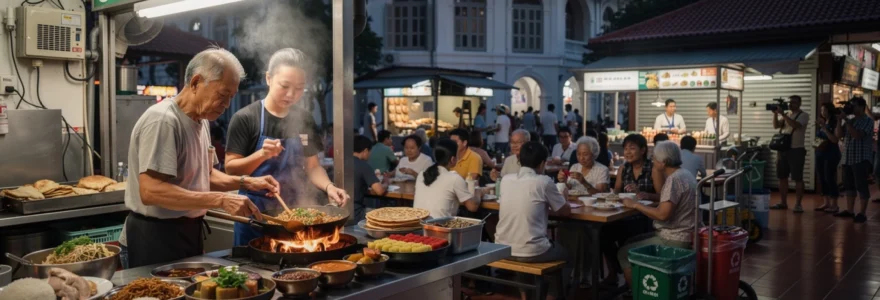
In the heart of Singapore’s urban landscape, hawker centres stand as living monuments to the nation’s multicultural identity. These unpretentious open-air food complexes represent far more than convenient dining spaces—they embody decades of cultural evolution, social integration, and culinary innovation that have shaped the city-state’s distinctive character. From the sizzle of wok-fried noodles at dawn to the evening aroma of grilled satay, these communal dining rooms serve as democratic spaces where corporate executives share tables with construction workers, united by their appreciation for authentic, affordable cuisine. Understanding the cultural significance of Singapore’s food stalls requires exploring their transformation from makeshift street operations to internationally recognised heritage sites, and examining how they continue to forge community bonds in an increasingly modernised urban environment.
Hawker centre heritage: UNESCO recognition and national identity formation
The 2020 UNESCO intangible cultural heritage inscription process
The successful inscription of « Hawker Culture in Singapore: Community Dining and Culinary Practices in a Multicultural Urban Context » onto UNESCO’s Representative List in December 2020 marked a watershed moment for the nation’s cultural preservation efforts. This recognition came after extensive public engagement initiatives, beginning with a 2017 poll conducted by the National Heritage Board that attracted over 3,000 respondents, with food heritage emerging as the most cherished aspect of Singapore’s intangible cultural legacy. The nomination process itself reflected the democratic nature of hawker culture—focus group discussions involved academics, heritage experts, youths, cultural practitioners, and everyday Singaporeans, all emphasising how these communal dining spaces have become inseparable from daily life.
What distinguished Singapore’s nomination was its emphasis on hawker culture as a living practice rather than a static tradition. The UNESCO committee recognised how hawkers continuously adapt dishes to evolving tastes whilst maintaining core culinary techniques passed through generations. This inscription places Singapore’s food stalls alongside other globally significant cultural practices like Argentine tango and Chinese shadow puppetry, validating their role as custodians of multicultural heritage. The recognition arrived at a critical juncture, with the average hawker age reaching 59 years, underscoring urgent succession challenges facing this culinary tradition.
Maxwell food centre and lau pa sat as architectural preservation models
Maxwell Food Centre exemplifies how architectural heritage intertwines with culinary tradition in Singapore’s hawker landscape. Originally constructed in 1928 on former burial grounds, the site evolved from Maxwell Market into today’s beloved food centre following redevelopment in 1987. The building’s history mirrors Singapore’s broader transformation—during the Japanese Occupation, it provided controlled-price meals to residents, whilst post-war years saw it house Singapore’s first « Family Restaurant » offering affordable eight-cent meals to vulnerable families. This historical continuity demonstrates how physical spaces accumulate layers of social memory, with each generation adding new chapters to shared community narratives.
Similarly, Lau Pa Sat represents architectural adaptation serving cultural preservation. Housed within a Victorian-era building featuring an ornate clocktower, the centre showcases how colonial-era structures can be repurposed to serve contemporary community needs whilst maintaining historical character. The juxtaposition of Victorian ironwork with hawker stalls selling char kway teow creates a uniquely Singaporean aesthetic—neither purely Eastern nor Western, but a synthesis reflecting the nation’s hybrid identity. These architectural landmarks function as anchors for neighbourhood identity, with their distinctive facades becoming recognisable symbols that orient residents and visitors alike.
Hawker culture as Post-Independence Nation-Building mechanism
Following independence in 1965, Singapore’s government faced the monumental challenge of forging national unity amongst diverse immigrant populations with distinct languages, religions, and culinary traditions. Hawker centres emerged as crucial instruments in this nation-building project, creating shared spaces where ethnic boundaries dissolved over common meals. The deliberate policy of ensuring each hawker centre included Chinese, Malay, and Indian stall owners promoted everyday multiculturalism—not through official rhetoric but through the practical act of neighbours trying one another’s cuisines. This exposure fostered mutual understanding and appreciation that abstract integration policies could never achieve.
The social levelling effect of hawker centres proved equally significant. Unlike restaurants with dress codes and price points that signal class distinctions, hawker centres
The social levelling effect of hawker centres proved equally significant. Unlike restaurants with dress codes and price points that signal class distinctions, hawker centres create environments where a plate of rice costs the same whether you are a CEO or a delivery rider. Subsidised stall rentals in many centres also help to keep prices affordable, reinforcing the idea that communal dining is a right rather than a luxury. In this sense, hawker culture became part of Singapore’s soft infrastructure for nation-building—quietly normalising shared spaces, shared queues and shared tables as everyday expressions of a common identity. Over time, the familiar routines of ordering kopi at the same stall or queuing for favourite noodles turned these spaces into informal civic arenas where the notion of being “Singaporean” was tasted as much as it was taught.
Government resettlement schemes from street vendors to regulated centres
The emergence of regulated hawker centres in the 1970s and 1980s was not accidental; it was the outcome of large-scale resettlement schemes that transformed Singapore’s street food landscape. In the early decades of the 20th century, itinerant hawkers operated from pushcarts and makeshift stalls, clustering along roadsides and five-foot-ways near the Singapore River and Raffles Place. While these vendors provided essential, low-cost meals for labourers, their proliferation contributed to congestion, sanitation issues and public health risks in an already dense colonial port city. Post-independence, the government viewed organised resettlement as a way to address these challenges without erasing a vital livelihood sector.
Between 1971 and 1986, more than 18,000 street hawkers were registered, licensed and relocated into over 100 purpose-built hawker centres and markets across the island. This ambitious programme, led by municipal authorities and later the National Environment Agency (NEA), combined urban planning with social policy: hawker centres were deliberately sited within new Housing and Development Board (HDB) towns, near industrial estates and transport nodes to ensure accessibility. Standardised stall sizes, built-in water and waste facilities, and hygiene regulations professionalised what had been an informal trade, while licensing regimes helped weed out unsafe practices. Crucially, the state chose integration rather than eradication—retaining hawker food as a core feature of daily life while elevating standards of cleanliness and order.
Resettlement also had deeper cultural implications. When former roadside satay men and noodle sellers moved into permanent stalls, they carried with them techniques, family recipes and micro-regional specialities that might otherwise have disappeared in the push for modernisation. The concentration of multiple ethnic cuisines under one roof accelerated cross-cultural food exchange, as customers ventured beyond familiar dishes to sample new flavours. From a policy perspective, hawker centres became testing grounds for Singapore’s broader approach to multiracial coexistence: regulate the physical environment, but allow organic social and culinary interactions to flourish. This calibrated balance continues to shape how food stalls in Singapore mediate between tradition, regulation and everyday urban life.
Culinary diversity mapping: ethnic enclaves and cross-cultural food exchange
Hainanese chicken rice at tian tian and cultural adaptation patterns
Few dishes illustrate Singapore’s culinary adaptation patterns as clearly as Hainanese chicken rice, especially in its iconic form at Tian Tian Hainanese Chicken Rice in Maxwell Food Centre. Originating from Wenchang chicken rice in Hainan, early migrants brought a simple home-style dish of poached chicken and plain rice. In Singapore’s hawker context, this modest staple evolved: the rice became fragranced with chicken fat, garlic and ginger; chilli sauce was sharpened with lime; and dark soy sauce was added as a standard accompaniment. What began as an immigrant comfort food turned into a national dish through decades of incremental tweaks responding to local palates and competitive hawker innovation.
Tian Tian’s popularity—cemented by television features, guidebook recommendations and even a Michelin Bib Gourmand listing for its offshoots—shows how a humble stall can become a cultural reference point. Diners do not simply queue for chicken rice; they participate in a shared narrative of “authentic” Singaporean taste, even though the dish itself is a hybrid of Hainanese technique and local flavour preferences. This process of continual refinement exemplifies how hawker food stalls in Singapore function as laboratories of cultural adaptation. Recipes are rarely frozen in time; instead, they evolve in response to changing health concerns, ingredient availability and customer feedback, much like a language absorbing new words while retaining its core grammar.
From a broader mapping perspective, the chicken rice phenomenon demonstrates how specific stalls anchor culinary micro-enclaves within larger hawker centres. Around Tian Tian, complementary stalls selling traditional desserts, Teochew porridge or Cantonese roast meats create a loosely Chinese gastronomic corridor, yet Malay nasi padang or Indian rojak are often just a few steps away. For visitors and locals alike, this spatial arrangement invites culinary “code-switching”—you might have Hainanese chicken rice for lunch, then return another day for ayam penyet or murtabak in the same space. Over time, such habits blur rigid ethnic boundaries and encourage a more fluid understanding of what constitutes “our food”.
Peranakan cuisine at east coast lagoon food village
East Coast Lagoon Food Village, set against the backdrop of the beach, offers a vivid example of how Peranakan cuisine occupies a bridge position between Chinese and Malay food traditions. Dishes like laksa, ayam buah keluak and kueh lapis reflect the long-standing intermarriage and cultural fusion between Straits-born Chinese and local Malay communities. At hawker stalls here, coconut-rich gravies, aromatic rempah (spice pastes) and rice-based kueh are prepared using techniques that marry Chinese wok skills with Malay and Indonesian spice philosophies. The result is a flavour profile that feels both familiar and distinct, embodying the “third space” of Peranakan identity.
Peranakan stalls in this seaside hawker centre often sit alongside barbecue seafood outlets, satay grills and Western-style food stalls, creating a layered gastronomic landscape. When you slurp a bowl of laksa while watching families of different backgrounds share sambal stingray and Hokkien mee at adjacent tables, you are witnessing culinary hybridity in action. Peranakan food, once associated with domestic kitchens and special occasions, has become everyday fare accessible through hawker culture, yet it still carries stories of interwoven lineages and cross-cultural households. This transition from private heritage to public consumption is a key feature of how food stalls in Singapore democratise complex cultural histories.
Importantly, Peranakan cuisine at places like East Coast Lagoon also illustrates how taste can be an archive. Recipes often rely on tactile knowledge—how the rempah should feel under the pestle, or when the coconut milk has reached the right consistency—that is difficult to codify in written form. As younger hawkers experiment with leaner versions of traditional curries or introduce plant-based alternatives, we see an ongoing negotiation between preservation and reinvention. Yet the core principle remains: Peranakan food at hawker centres acts as an edible map of Singapore’s centuries-long cultural entanglements along the Straits of Malacca.
Indian muslim food traditions in tekka centre
In Little India, Tekka Centre stands as a powerful node for Indian Muslim culinary traditions, which have played a crucial role in Singapore’s hawker ecosystem. Stalls selling biryani, murtabak, mee goreng and teh tarik trace their roots to traders and labourers from South India and the Malay Peninsula, many of whom adapted their recipes to suit a multi-ethnic clientele. Biryani rice was adjusted to be less oily, mee goreng took on a reddish hue with tomato sauce and chilli, and roti evolved into massive, sharing-friendly murtabak stuffed with eggs, onions and minced meat. Within Tekka Centre, these dishes coexist with South Indian vegetarian fare and North Indian tandoori specialities, creating a dense tapestry of regional sub-cuisines.
What makes Tekka particularly significant is its role as a cultural hinge between Indian and Malay gastronomic worlds. Indian Muslim stalls often offer halal Chinese-style dishes like mee hoon goreng or even chicken chop, reflecting decades of cross-ethnic demand. At the same time, Malay customers frequent biryani stalls for festive meals, especially around Hari Raya, while non-Muslim Chinese and Eurasian patrons line up for supper favourites like maggi goreng and prata. This constant circulation of diners across cultural lines turns Tekka Centre into a site of lived pluralism, where dietary laws and taste preferences are navigated through everyday negotiation rather than rigid separation.
From a diversity mapping standpoint, Indian Muslim food in Tekka also demonstrates how hawker centres accommodate religious requirements without limiting culinary experimentation. Halal certification, separate utensils and clear signage reassure Muslim diners, while non-Muslims benefit from the same high standards of cleanliness and quality. The result is an inclusive environment where spicy, robust dishes once confined to specific ethnic enclaves now form part of the wider Singaporean comfort food repertoire. In this way, Tekka’s Indian Muslim stalls underscore how food stalls in Singapore serve as crucial interfaces between faith, identity and shared public space.
Malay culinary preservation in geylang serai market
Geylang Serai Market and Food Centre functions as a cultural heartland for Malay culinary heritage in Singapore. Originally established in the 1960s and rebuilt in 2009 with a design inspired by traditional kampung houses, the complex houses numerous stalls specialising in nasi padang, nasi lemak, lontong and a dazzling array of kueh. Here, dishes are more than sustenance; they are carriers of ritual and memory, closely tied to Ramadan bazaars, Hari Raya gatherings and everyday breakfast routines. Many stallholders can trace their lineage back several generations, with recipes learned in family kitchens before being adapted for hawker-scale production.
The architecture of Geylang Serai—tiered roofs, woven basket motifs and open, breezy corridors—complements its role as a keeper of Malay food traditions. The layout allows patrons to see long rows of stalls at a glance, encouraging comparison and, inevitably, friendly competition that keeps standards high. At the same time, the market’s wet section offers essential ingredients like fresh coconut, pandan leaves and spices, reinforcing the link between raw produce and finished dishes. This integration of market and food centre helps preserve traditional cooking practices, as hawkers often source ingredients directly downstairs, maintaining familiarity with seasonal variations and quality.
Yet preservation here does not mean stasis. Younger Malay hawkers are introducing grilled fusion platters, artisanal sambal brands and social media marketing alongside time-honoured dishes. The challenge lies in balancing commercial pressures with cultural responsibility: how do you shorten queues without compromising on slow-cooked rendang, or modernise packaging without losing the charm of banana leaf and waxed paper? Geylang Serai’s evolving food landscape suggests a possible answer—by rooting innovation in respect for ingredients, techniques and religious norms, Malay hawker cuisine can remain both recognisably traditional and dynamically contemporary, ensuring its relevance for future generations.
Economic democratisation through accessible street food gastronomy
Michelin bib gourmand hawker stalls: hill street tai hwa pork noodle case study
The global spotlight on Singapore’s hawker culture intensified when stalls like Hill Street Tai Hwa Pork Noodle received Michelin recognition, challenging conventional hierarchies in the culinary world. Awarded a Michelin star, Tai Hwa operates from a modest shop in Crawford Lane, epitomising how world-class food can be served in everyday surroundings at relatively accessible prices. Customers—office workers, retirees, tourists and students—queue together in the humid corridor, united by a shared willingness to wait for a bowl of springy noodles tossed in vinegar, chilli and umami-rich sauce. In this context, “fine dining” is defined less by white tablecloths and more by generational expertise and painstaking attention to detail.
The Tai Hwa story highlights how hawker stalls in Singapore function as vehicles for economic mobility. Originally started as a small street operation, the business evolved through multiple relocations, resilience during resettlement, and disciplined adherence to quality. Recognition from prestigious guides has increased demand, but prices remain a fraction of what one might pay for a comparable dish in an upscale restaurant abroad. This dynamic—global acclaim coupled with local affordability—demonstrates how accessible street food gastronomy can democratise culinary excellence. It allows residents from diverse income brackets to participate in what might elsewhere be an exclusive gastronomic experience.
At the same time, Michelin recognition raises complex questions. Does fame risk driving up rents or altering the nature of a stall that was once a neighbourhood secret? Can a hawker operation scale while retaining artisanal control? In Tai Hwa’s case, carefully managed capacity and limited outlets have helped preserve standards, but not all stalls navigate this transition smoothly. The broader lesson is that economic democratisation through hawker culture requires not only low prices, but also policy frameworks and community norms that protect these micro-enterprises from over-commercialisation and speculative pressures.
Social levelling mechanisms in mixed-income dining spaces
Beyond individual success stories, hawker centres operate as powerful social levellers in Singapore’s urban fabric. Because seating is communal and unreserved, diners from different socioeconomic backgrounds routinely share tables, sometimes even sharing recommendations or small talk about their favourite stalls. A domestic helper and a senior civil servant may both join the same queue for laksa, differentiated only by what they order, not by where they are allowed to sit. This everyday spatial mixing is rare in many global cities, where dining venues are tightly segmented by price, postcode and dress code.
Hawker food’s affordability underpins this levelling function. Government policies, including the provision of subsidised stall rentals at selected centres and efforts to moderate food prices, ensure that a basic meal remains within reach for most residents. When 9 in 10 survey respondents affirm that hawker centres are central to national identity, they are also acknowledging that these spaces cushion the impact of income inequality by providing shared, low-cost amenities. In effect, hawker centres act like public libraries of taste—open to all, regardless of what you earn or where you live.
Social levelling is also reinforced by the norms and rituals of hawker etiquette. Practices like self-service tray return, tissue “chope-ing” of seats and shared condiment stations foster a sense of collective responsibility and mutual respect. You quickly learn that being courteous in a crowded environment—returning trays, clearing space, offering a seat—is part of the unwritten social contract. Over time, these micro-interactions contribute to social cohesion, reminding us that public civility is built not just in parliament or policy papers, but over kopi and kaya toast at the neighbourhood food court.
Micro-entrepreneurship pathways for immigrant communities
For many immigrant and lower-income communities, hawker stalls provide crucial micro-entrepreneurship pathways that might otherwise be out of reach. Starting a restaurant typically requires significant capital investment, but a hawker stall—while still demanding—offers a relatively lower barrier to entry. Newcomers can begin with a compact menu based on family recipes, test market response in a high-footfall environment and refine their offering without the overheads of full-service establishments. In this way, hawker culture functions as an incubator for culinary start-ups, long before the term “hawkerpreneur” entered public discourse.
Historically, this entrepreneurial route has been especially important for Chinese, Indian and Malay migrants who lacked formal qualifications but possessed strong culinary skills. Today, similar patterns can be seen among newer communities, including foreign spouses or second-generation immigrants who infuse traditional dishes with contemporary twists. We see fusion stalls run by younger owners pairing Thai flavours with local noodle styles, or Indonesian families specialising in regional dishes like ayam penyet and bakso adapted for Singaporean tastes. These ventures create livelihoods, but they also broaden the city’s gastronomic repertoire, enriching the cultural significance of food stalls in Singapore.
However, micro-entrepreneurship via hawker stalls is not without its challenges. Long hours, rising labour costs and intense competition can quickly erode slim profit margins. Language barriers and unfamiliarity with local regulations may also disadvantage new migrant operators. This is where training schemes, mentorship programmes and simplified licensing processes become vital. By lowering administrative hurdles and providing business support, policymakers can ensure that hawker centres remain accessible launchpads for diverse entrepreneurs, rather than exclusive domains of established players.
Generational knowledge transfer and artisanal cooking techniques
Master-apprentice systems in traditional char kway teow preparation
Char kway teow, with its smoky “wok hei” and rich layers of flavour, offers a compelling window into artisanal cooking techniques preserved through master-apprentice systems. In many heritage stalls, recipes are not simply written down; they are embodied in the rhythm of a wrist, the timing of a sauce addition, the precise moment noodles should leave the pan. Senior hawkers often train apprentices—whether younger family members or committed outsiders—by having them observe, assist and gradually replicate each step under close supervision. It can take years before an apprentice is allowed to handle peak-hour frying on their own.
This transmission model mirrors traditional craft guilds more than modern culinary schools. Techniques like controlling charcoal fire intensity, gauging when cockles are just cooked, or balancing lard, sweet dark soy and chilli are refined through continuous practice and feedback. For the master, passing on these skills is both a practical necessity and a form of legacy-building; for the apprentice, it is an initiation into a lineage of taste. In a world of automated kitchens and standardised sauces, such intimate, hands-on pedagogy keeps alive the sense that each plate of char kway teow is a unique performance rather than a generic product.
Yet master-apprentice systems face mounting pressures. Younger Singaporeans may be deterred by the physical demands and perceived social status of hawker work, and insurance or regulatory frameworks can complicate informal training. Some veterans hesitate to teach non-family members for fear of competition or dilution of their brand. Addressing these concerns requires recognising hawkers as cultural practitioners, not just small business owners, and supporting structured apprenticeship schemes that acknowledge both economic and heritage dimensions of their craft.
Recipe preservation challenges at heritage stalls like ah tai hainanese chicken rice
Heritage stalls such as Ah Tai Hainanese Chicken Rice at Maxwell Food Centre illustrate the delicate balance between recipe preservation and adaptation. Founded by a former chef from another famous chicken rice stall, Ah Tai carries forward a lineage of poaching techniques, rice preparation methods and chilli sauce formulas that were honed over decades. Yet, like many heritage operations, it faces the risk that these recipes may vanish if not carefully documented and transmitted. Often, the “secret” lies not in a single ingredient, but in cumulative tacit knowledge: how long to rest the chicken, the exact ratio of stock to rice, the order in which aromatics are fried.
One of the key challenges is that many older hawkers learned entirely by feel and sight, without written measurements. When younger successors seek to scale up production, centralise kitchens or franchise the brand, inconsistencies can creep in. Another issue is that health regulations and changing consumer preferences—such as demands for less salt or less chicken fat—may require adjustments that subtly shift the dish’s character. The question then arises: at what point does a “healthier” or “modernised” version cease to be the heritage dish it claims to represent?
To mitigate these risks, some hawkers are working with food writers, researchers and heritage boards to record their processes in detail, sometimes through video documentation or recipe codification. Others involve apprentices early, encouraging them to internalise both the “why” and the “how” of each step. Still, the emotional component should not be underestimated: letting go of control over a cherished recipe can feel akin to sharing a family heirloom with strangers. Supporting heritage stalls therefore involves not only technical assistance, but also trust-building and recognition that these recipes are part of Singapore’s collective cultural capital.
Hawker succession schemes and NEA incubation programmes
Recognising the urgency of generational renewal, Singapore’s authorities have introduced succession schemes and incubation programmes to sustain hawker culture. The National Environment Agency’s Hawkers’ Development Programme, for instance, pairs aspiring hawkers with veteran mentors, combining classroom-based training on food safety and business skills with on-the-job learning at actual stalls. New entrants can access subsidised rentals under incubation stall schemes, reducing financial risk during their first years of operation. These measures are designed to make hawker entrepreneurship a viable career path rather than a last resort.
Such programmes also play a strategic role in knowledge transfer. By formalising mentorship arrangements, they help capture and transmit techniques that might otherwise be lost when older hawkers retire. Trainees are encouraged to respect tradition while also innovating—whether through digital marketing, menu design or supply chain improvements. In some cases, second-generation hawkers returning from corporate careers bring fresh perspectives on branding and customer engagement, merging inherited recipes with contemporary business acumen.
Still, challenges remain. Not all veteran hawkers have the time or inclination to mentor; not all apprentices are prepared for the physical and emotional demands of long hours behind the wok. Moreover, incubation schemes must balance support with market realism: stalls ultimately need sufficient footfall and product-market fit to survive beyond subsidised phases. The success of these initiatives will depend on sustained public appreciation of hawker culture, continued patronage of new stalls and ongoing policy refinement to keep entry pathways open without compromising quality.
Community cohesion spaces: social infrastructure beyond nourishment
Kopitiam culture and daily ritual formation at hong lim food centre
Hong Lim Market and Food Centre in Chinatown exemplifies how kopitiam (coffee shop) culture underpins daily rituals and community cohesion. Early each morning, regulars occupy familiar tables, ordering kopi-O, kaya toast or soft-boiled eggs from long-established beverage stalls. For many retirees and freelance workers, this routine provides structure to the day—a reliable meeting point to read newspapers, discuss current affairs or simply exchange greetings with stallholders who know their usual orders by heart. In this sense, Hong Lim functions as a social club without membership fees.
The architectural design of Hong Lim, with its central voids and upgraded ventilation, supports this communal rhythm. Open sightlines make it easy to spot friends across the floor, while added seating and disability-friendly access ensure that elderly patrons can continue to gather comfortably. Over the years, these everyday encounters have woven dense social networks that extend beyond the food centre, fostering informal support systems where neighbours look out for one another. When a regular fails to appear for several mornings, someone is likely to notice and check in—a small but meaningful form of social safety net.
Kopitiam culture here also serves as a living archive of linguistic and cultural practices. Orders are placed in a mix of Hokkien, Cantonese, Malay and English, with local shorthand like “kopi-C siew dai” flowing effortlessly across generations. Such exchanges normalise multilingualism and cultural hybridity, reinforcing the idea that being Singaporean involves an ease with switching codes—linguistic, culinary and social—throughout the day. For visitors, observing these rituals at Hong Lim offers a deeper understanding of how food stalls in Singapore double as community institutions.
Multilingual interaction patterns in shared dining environments
Shared dining environments in hawker centres naturally generate multilingual interaction patterns that are both pragmatic and symbolic. A single stall may display menus in English, Chinese and sometimes Tamil or Malay, while staff switch languages depending on who is standing in front of them. You might hear a hawker take an order in Mandarin, call out to a colleague in Hokkien, reply to a query in English, then thank a Malay customer with a warm “terima kasih”. This linguistic fluidity reflects the city-state’s layered demographics and education policies, but it is in hawker centres that it becomes most visible and audible.
These interactions do more than facilitate transactions; they build comfort with difference. Children learn early that it is normal to hear unfamiliar languages at the next table, and that understanding can often be achieved through a combination of words, gestures and shared food vocabularies—terms like “nasi lemak”, “roti prata” or “laksa” that transcend linguistic boundaries. For newcomers and tourists, the friendly chaos of multiple tongues can be disorienting at first, but most quickly discover that pointing, smiling and attempting a few local phrases go a long way.
From a sociolinguistic perspective, hawker centres act as informal classrooms for “Singlish” and local slang, where phrases like “shiok”, “makan” and “dabao” are routinely used by people of all backgrounds. This shared lexicon underpins a sense of collective belonging that cuts across ethnic categories. When we describe a dish as “very shiok” or ask a friend to “go makan at the hawker downstairs”, we are participating in a speech community shaped as much by food stalls as by formal schooling.
Neighbourhood identity construction through local food court patronage
On a neighbourhood scale, specific hawker centres and food courts contribute significantly to local identity construction. Residents of Tampines, for instance, often refer to the Round Market and Food Centre as a landmark shorthand in directions and memories—“near Round Market” becoming as meaningful a locator as a street name. Similarly, Tiong Bahru Market, Changi Village Hawker Centre or Adam Road Food Centre anchor mental maps of their respective districts, each associated with particular specialities, weekend routines or late-night suppers.
Regular patronage turns these venues into extensions of home. Families might have a “usual” nasi lemak stall for Sunday breakfast, office workers may gather at a favourite yong tau foo stall after work, and joggers could end their runs at a trusted juice stall in the neighbourhood centre. Over time, these repeated choices create a sense of shared ownership—this is “our” hawker centre, “our” char kway teow uncle, “our” kopi auntie. Such attachments help residents feel rooted in otherwise rapidly changing urban environments, especially in newer estates where physical infrastructure may evolve faster than social ties.
Neighbourhood identity is also reinforced during festive occasions and community events, when hawker centres become stages for performances, grassroots dialogues or cultural exhibitions. A Mid-Autumn celebration might see lantern displays near stalls, while National Day could bring bunting, flags and special set meals. In these moments, the everyday act of eating intersects with formal expressions of citizenship, further deepening the role of food stalls in Singapore as sites where locality, memory and nationhood intersect.
Contemporary challenges: gentrification, authenticity debates and sustainability
Artisanal hawker movement versus traditional stall operations
In recent years, an “artisanal hawker” movement has emerged, led by younger entrants who bring specialty coffee, fusion rice bowls or gourmet burgers into the hawker landscape. These stalls often feature sleek branding, Instagram-ready plating and higher price points, targeting a demographic accustomed to café culture. On one hand, this trend injects fresh energy into older centres, drawing new crowds and demonstrating that hawker spaces can accommodate evolving tastes. On the other, it raises concerns about gentrification and the potential marginalisation of traditional stalls selling low-margin, labour-intensive dishes.
The tension is not simply about old versus new, but about the underlying economics and values that each model represents. Traditional hawkers prioritise volume and affordability, often relying on decades-long relationships with suppliers and customers to sustain thin profit margins. Artisanal operators may focus on smaller batches, premium ingredients and social media marketing, positioning their offerings as lifestyle choices. When these two logics coexist under the same roof, questions arise: will rising expectations for ambience and “concept” drive up rentals? Will younger diners gradually shift away from humble noodle or rice dishes towards trendier options, altering the centre’s overall price profile?
Finding equilibrium requires clear policy signals and community dialogue. Some newer hawker centres experiment with curated mixes of traditional and contemporary stalls, while rental frameworks and design guidelines aim to keep basic food options available. For consumers, conscious patronage plays a role too: choosing to alternate between a hip bao stall and an elderly couple’s fishball noodles, for instance, can help support diversity and continuity. Ultimately, the cultural significance of food stalls in Singapore hinges on their ability to remain inclusive—in flavour, price and participation—even as they evolve.
Food waste management systems in modern hawker centre infrastructure
Sustainability has become an increasingly pressing concern, and hawker centres are no exception. With thousands of meals served daily, the potential for food waste—from preparation offcuts to unfinished portions—is substantial. Modern centres and upgraded facilities are incorporating food waste management systems, such as centralised dishwashing, segregated recycling points and, in some cases, on-site food waste digesters that convert leftovers into water or fertiliser. These infrastructural innovations aim to reduce the environmental footprint of Singapore’s beloved eating spaces without disrupting the diner experience.
Behavioural change is equally important. Campaigns encouraging diners to order only what they can finish, return trays and sort disposables correctly have become familiar sight across many centres. Some stalls offer smaller portion options or provide discounts for bringing reusable containers, aligning individual choices with broader sustainability goals. For hawkers, optimising procurement—ordering just enough produce, repurposing trimmings into stocks, and monitoring sales data to adjust cooking quantities—can also minimise waste and improve margins.
The challenge lies in integrating these systems seamlessly into an environment prized for convenience and speed. Long queues and crowded peak periods can make careful sorting or reusable container use feel cumbersome. Yet, as climate concerns grow, hawker centres have a unique opportunity to serve as everyday laboratories for sustainable urban dining. If we can successfully embed waste-conscious practices in such high-traffic, informal settings, the lessons learned could inspire similar shifts in restaurants, hotels and household kitchens.
Tourism commodification at chinatown complex and cultural dilution concerns
Chinatown Complex Food Centre illustrates both the opportunities and pitfalls of tourism-driven attention. As one of Singapore’s largest hawker centres, it has attracted international acclaim for stalls ranging from soya sauce chicken rice to traditional desserts. Increased tourist footfall has brought economic benefits and heightened global appreciation for hawker fare. At the same time, critics worry that heavy reliance on visitors may nudge some stalls towards “staged authenticity”—simplifying menus, adjusting flavours or altering presentation to cater to perceived foreign tastes rather than local preferences.
This tension is not unique to Chinatown, but it is especially visible there due to the district’s broader positioning as a heritage tourism hub. When food becomes a spectacle for cameras more than a staple for residents, subtle shifts can occur: prices may creep up, queues lengthen beyond what locals are willing to tolerate, and newer stalls might prioritise visual novelty over culinary depth. Over time, such trends risk diluting the lived, everyday character that made these spaces attractive in the first place.
Managing commodification requires a careful balance between promotion and protection. Heritage bodies, tour operators and local associations can collaborate to highlight lesser-known stalls, encourage respectful visitor behaviour and ensure that information about hawker culture emphasises its community roots, not just its Instagram appeal. For their part, hawkers and regular patrons play a crucial role in maintaining standards and norms—from insisting on robust flavours to preserving queue etiquette and table-sharing habits. If tourism is approached as an invitation into an existing culture rather than a reason to reinvent it, centres like Chinatown Complex can continue to thrive as genuine community dining rooms that welcome the world without losing their soul.