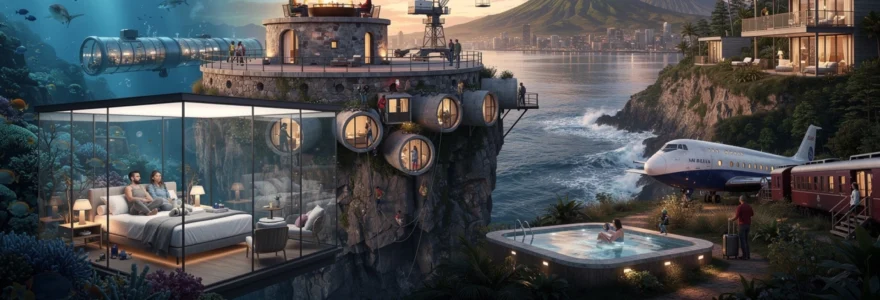
The evolution of hospitality has transcended traditional hotel rooms and standardized accommodation offerings. Today’s discerning travellers seek experiences that blur the boundaries between shelter and spectacle, transforming the simple act of sleeping into an unforgettable adventure. From transparent capsules suspended on sheer cliff faces to repurposed industrial relics reimagined as boutique sanctuaries, the global accommodation landscape now offers truly extraordinary options that challenge conventional notions of where—and how—we rest our heads during our journeys.
This transformation reflects a broader shift in travel psychology. Modern adventurers increasingly prioritize immersive experiences over passive observation, seeking accommodations that serve as destinations in themselves rather than merely functional spaces between attractions. The rise of social media has certainly amplified this trend, yet the appeal runs deeper than photogenic backdrops—it speaks to a fundamental human desire for novelty, wonder, and meaningful connection with extraordinary environments.
Underwater accommodation: submerged suites and marine observatory hotels
The realm of underwater hospitality represents perhaps the most technically ambitious frontier in unusual accommodation design. These engineering marvels allow guests to inhabit an environment fundamentally hostile to human life, creating an intimate theatre where marine ecosystems unfold mere inches beyond reinforced glass walls. The psychological impact of sleeping beneath the ocean’s surface proves profound—a reversal of our terrestrial perspective that repositions humans as temporary visitors within an alien aquatic realm.
The muraka at conrad maldives rangali island: Two-Level undersea architecture
Positioned sixteen feet below the Indian Ocean’s surface, The Muraka exemplifies the apex of submerged luxury accommodation. This architectural achievement comprises a two-level residential suite where the lower chamber exists entirely underwater, featuring floor-to-ceiling acrylic walls that provide 180-degree views into the surrounding coral reef ecosystem. The suite’s name, derived from the Dhivehi word for coral, acknowledges the delicate marine environment it inhabits.
The technical specifications reveal the complexity involved in creating this underwater sanctuary. The submerged bedroom component required specialized marine construction techniques, with acrylic panels manufactured to withstand immense hydrostatic pressure while maintaining optical clarity. Above the waterline, the suite continues across an upper level housing living spaces, bathrooms, and a private infinity pool—a study in contrasts between terrestrial luxury and submarine observation. Nightly rates approaching $50,000 reflect both the extraordinary engineering investment and the exclusivity of the experience.
Atlantis the palm dubai: neptune and poseidon suites with aquarium integration
Dubai’s Atlantis resort pioneered accessible underwater accommodation through its Neptune and Poseidon suites, which incorporate massive aquarium walls as architectural features. Unlike purpose-built ocean-floor structures, these suites exist within the resort’s Ambassador Lagoon—a 65,000-marine-animal aquarium housing over 250 species. Floor-to-ceiling windows transform bedroom and bathroom walls into living marine galleries, where eagle rays glide past and reef sharks patrol during evening hours.
The integration of accommodation within an existing aquarium infrastructure provides several advantages over ocean-floor alternatives. Environmental conditions remain controlled and predictable, eliminating concerns about tidal variations, storm impacts, or seasonal visibility changes. The proximity to resort amenities and the absence of complex submersion logistics make these suites more accessible to families and less adventurous travellers. However, critics note that the curated aquarium environment, while spectacular, lacks the authentic unpredictability of genuine ocean habitats.
Utter inn lake mälaren sweden: DIY floating submersible concept
Artist Mikael Genberg’s Utter Inn presents a radically different approach to underwater accommodation—one prioritizing conceptual art over luxury amenities. This deliberately modest structure floats on Sweden’s Lake Mälaren, appearing from the surface as a simple red cottage. Beneath the waterline, however, lies a spartan chamber with twin beds and panoramic windows offering views into the lake’s freshwater ecosystem.
The Utter Inn experience emphasizes solitude and contemplation rather than comfort. Guests must arrange their own boat transport, bring their own provisions, and accept the absence of running water or electricity. This stripped-back approach creates
an intentional sense of disconnection from everyday conveniences, inviting guests to engage more directly with their surroundings. In many ways, Utter Inn functions as a meditative retreat disguised as an unusual place to stay, highlighting how minimalism and isolation can redefine what meaningful travel feels like. For travellers accustomed to resort-style underwater hotels, this DIY submersible concept offers a thought-provoking counterpoint: a reminder that unforgettable accommodation does not always equate to high-end luxury.
Lover’s deep submarine: mobile luxury submersible hospitality
At the opposite end of the spectrum from artistic minimalism lies Lover’s Deep, a concept that reimagines a private submarine as a fully serviced luxury suite. Instead of being tethered to a fixed location, this mobile vessel can, in theory, position itself in various Caribbean locations, providing ultra-exclusive underwater views tailored to guest preferences. Interiors mirror those of high-end boutique hotels, with bespoke furnishings, fine linens, and private dining crafted by onboard chefs.
The technical challenges of submarine-based hospitality are considerable. Maintaining strict safety protocols, pressurization, and life-support systems while simultaneously delivering gourmet cuisine and hotel-level service requires a multidisciplinary operational team. For travellers, the experience raises interesting questions about sustainability, accessibility, and cost: such extreme exclusivity inevitably comes with a premium price tag, often placing it firmly in the aspirational category rather than the mainstream. Still, as proof-of-concept, Lover’s Deep illustrates how the boundaries of where we can reasonably “check in” are expanding into realms once reserved for scientific expeditions.
Converted industrial heritage structures as boutique lodging
As travellers become more attuned to sustainability and cultural context, adaptive reuse of industrial heritage buildings has emerged as one of the most compelling trends in unusual accommodation. Rather than demolishing obsolete infrastructure, architects and hoteliers are transforming forts, factories, cranes, and even drainage pipes into striking boutique stays. This approach not only preserves layers of local history, it also offers guests a tangible connection to past eras—like sleeping inside a living museum where the exhibits surround you in steel, stone, and riveted beams.
Staying in a converted industrial structure often feels like reading a place’s biography through architecture. Original machinery, weathered brickwork, shipyard gantries, and concrete shells become storytelling devices that frame your experience of a destination. For travellers seeking unique places to stay that also carry a sense of authenticity, this genre of accommodation delivers something increasingly rare: a narrative-rich environment where heritage, design, and comfort intersect.
Spitbank fort solent UK: victorian military fortification transformation
Spitbank Fort, one of several sea forts in the Solent off England’s south coast, exemplifies the dramatic reinvention of military infrastructure as luxury accommodation. Originally constructed in the 19th century to protect Portsmouth from naval threats, the circular granite and iron fortress once housed soldiers, artillery, and munitions. Today, it functions as an intimate island hotel, complete with suites, spa facilities, rooftop hot tubs, and fire pits overlooking the English Channel.
Part of the fort’s appeal lies in its inherent isolation: guests arrive by boat, stepping into a self-contained micro-world where weather, tides, and history set the rhythm of each day. Many original details—arched brick ceilings, gun ports, and narrow passageways—have been preserved and integrated into the design, maintaining a powerful sense of place. For those interested in unusual places to stay in the UK, Spitbank Fort offers a rare combination: military heritage, maritime drama, and boutique hospitality all rolled into one.
Das park hotel austria: repurposed concrete drainage pipe micro-hotels
On the banks of the Danube in Austria, Das Park Hotel demonstrates how industrial detritus can be reimagined as minimalist micro-lodging. Here, standard concrete drainage pipes—each weighing several tons—have been cleaned, insulated, and fitted with doors, beds, and electricity to create compact sleeping pods. Exteriors retain their raw, industrial character, while interiors are surprisingly cozy, with custom artwork and simple furnishings.
The hotel operates on a “pay as you wish” model, making this one of the more budget-friendly unusual places to stay in Europe. Shared facilities such as bathrooms and showers are located nearby, reinforcing the concept’s hybrid identity between art installation, hostel, and social experiment. For travellers, staying in a concrete pipe raises questions about space, comfort, and what we really need from a room—an architectural analogy to travelling with only essential items in your carry-on.
Crane hotel faralda amsterdam: industrial harbour crane adaptive reuse
Hovering above Amsterdam’s IJ waterfront, Crane Hotel Faralda transforms a disused shipyard crane into a high-drama, three-suite boutique stay. Each suite is perched at varying heights within the crane’s steel framework, accessible via industrial lifts and staircases that preserve the gritty character of the former docklands. Inside, however, the experience contrasts sharply with the exterior: lavish interiors, freestanding bathtubs, and panoramic windows create a sense of indulgent seclusion high above the city.
The crane’s rotating mechanism has been partially retained, allowing for subtle orientation changes that alter the view—a reminder of its working past. For adrenaline seekers, a bungee-jump platform adds an extra layer of thrill, turning the hotel itself into an activity hub. As an example of how industrial reuse can redefine urban accommodation, Crane Hotel Faralda encapsulates the idea that unusual places to stay can be both daringly vertical and deeply rooted in a city’s maritime identity.
Propeller island city lodge berlin: former factory artistic metamorphosis
Berlin’s Propeller Island City Lodge (now closed but long cited as a cult classic) showed how a nondescript building—reportedly part of a former industrial complex—could be transformed into an immersive art project masquerading as a hotel. Conceptual artist Lars Stroschen designed each room as a unique installation: beds suspended from ceilings, skewed perspectives, mirrored surfaces, and surreal themes like padded cells or coffin-style sleeping arrangements. Staying there was less about conventional comfort and more about inhabiting an artwork.
While Propeller Island was deliberately provocative, it helped establish a template for experiential hotels that challenge guests’ perceptions. In a city already known for its avant-garde creative scene, it underscored Berlin’s willingness to push the boundaries of what accommodation can be. For travellers today, similarly experimental hotels—often housed in repurposed factories or warehouses—continue this legacy, proving that unusual places to stay can double as interactive galleries where guests temporarily become part of the exhibit.
Extreme altitude and cliffside suspended accommodation
From a psychological standpoint, few travel experiences are as visceral as sleeping high above the ground. Extreme altitude and cliffside hotels leverage our innate mix of fear and fascination with heights, turning gravity into both a design constraint and a key part of the appeal. These unusual places to stay often require an adventurous spirit simply to access them—via cable cars, mountain trails, or even climbing equipment—ensuring that the journey is as memorable as the destination.
Architecturally, building at altitude or on sheer rock faces demands meticulous engineering and environmental sensitivity. Structures must withstand high winds, temperature extremes, and sometimes seismic activity, all while minimizing impact on fragile ecosystems. For travellers willing to trade easy access for extraordinary views, these properties provide a unique form of immersion: waking up literally in the landscape, rather than merely looking at it through a distant hotel window.
Skylodge adventure suites sacred valley peru: transparent capsule cliff hanging
Perhaps the most cinematic expression of cliffside hospitality is Skylodge Adventure Suites in Peru’s Sacred Valley. Here, transparent polycarbonate capsules cling to a vertical rock face some 400 meters above the valley floor, accessed by a combination of via ferrata climbing routes and zip lines. Each capsule contains beds, a small dining area, and basic bathroom facilities, with 300-degree views of Andean peaks and the Urubamba River below.
Staying at Skylodge feels like camping in a high-tech insect cocoon attached to a mountain. The ascent becomes part of the narrative—by the time you clip into the final safety line and crawl into your pod, you’ve already achieved something many travellers would find daunting. For those with a fear of heights, the experience can be transformative, offering a controlled way to confront that anxiety. It’s an archetypal example of how an unusual place to stay can double as a personal challenge and a bucket-list travel moment.
Fogo island inn newfoundland: cantilever architecture on north atlantic coastline
On Canada’s remote Fogo Island, a starkly modern inn stands on stilts and steel supports, cantilevering out above North Atlantic rock and surf. Fogo Island Inn is renowned not only for its striking architecture—white geometric volumes perched on the rugged coastline—but also for its community-focused philosophy. Built as a social enterprise, the inn channels profits back into local cultural and economic initiatives, helping sustain traditional fishing communities.
The building’s design responds directly to the climatic extremes of the region: brutal winter storms, heavy winds, and salty air. Floor-to-ceiling windows frame the ever-changing sea, while elevated supports reduce impact on the delicate coastal ecosystem and echo the stilts of local fishing stages. Guests can expect a refined, contemplative experience: wood-fired saunas, locally sourced cuisine, and artist-in-residence programs that invite deeper engagement with the island’s culture. Here, altitude is modest compared with cliff capsules, but the sensation of being on the very edge of the continent is profound.
Ladera resort st lucia: open-wall design overlooking pitons UNESCO site
In St Lucia, Ladera Resort takes a different approach to boundary-blurring architecture. Rather than suspending rooms off a cliff face, it removes one entire wall of each suite, opening them directly to the elements. Perched on a volcanic ridgeline at approximately 1,000 feet above the Caribbean Sea, the resort overlooks the iconic twin peaks of the Pitons, a UNESCO World Heritage Site. Private plunge pools, wooden decks, and lush vegetation blend into the natural surroundings, creating the sensation of living in a high-altitude treehouse.
The open-wall concept demands careful orientation and design to ensure guests remain comfortable despite humidity, wind, and tropical rain. Mosquito nets, strategically placed planting, and overhanging roofs work together to manage exposure while preserving uninterrupted views. For travellers drawn to unusual places to stay that still feel indulgent, Ladera offers a compelling synthesis: the raw drama of an exposed cliffside combined with the soft edges of Caribbean hospitality.
Aviation and transportation vessel conversions
The romance of travel is often tied as much to the journey as to the destination, so it’s little wonder that retired aircraft, trains, and other vehicles are being repurposed as unforgettable places to stay. These conversions tap into a deep nostalgia for the golden age of aviation and rail, while also satisfying a modern appetite for quirky, story-rich accommodation. Sleeping in a Boeing 747 or a vintage train carriage lets you occupy a piece of transport history—without the turbulence or timetables.
From a sustainability perspective, converting decommissioned vehicles into static hotels or suites extends their useful life and reduces waste. Interiors are typically stripped back and rebuilt to meet contemporary comfort and safety standards, but designers often retain cockpit controls, original signage, or cabin layouts as subtle reminders of each vessel’s former function. For travellers, the result is a playful juxtaposition: familiar forms used in entirely unfamiliar ways.
Jumbo stay stockholm arlanda: boeing 747-200 static aircraft hotel
Parked just outside Stockholm Arlanda Airport, Jumbo Stay turns a retired Boeing 747-200 into a full-service hostel and hotel. Guests can choose from dorm-style cabins, compact private rooms, or the star attraction: a cockpit suite with panoramic windows overlooking the runway. Original elements—overhead compartments, curvature of the fuselage, and even some cockpit controls—have been preserved, reinforcing the aviation theme.
For aviation enthusiasts and budget-conscious travellers alike, Jumbo Stay offers a convenient and distinctly memorable alternative to standard airport hotels. Imagine sipping a coffee on the wing terrace or falling asleep beneath the gentle hum of passing aircraft overhead. While the rooms are necessarily compact, the novelty factor is high, turning a usually forgettable pre-flight night into part of the trip’s narrative. It’s also a useful reminder that unusual places to stay don’t have to be remote; they can sit right at the junctions where we’re already travelling.
Costa verde boeing 727 fuselage suite manuel antonio costa rica
In Costa Rica’s Manuel Antonio region, Hotel Costa Verde takes an abandoned Boeing 727 airframe and gives it a second life in the jungle canopy. Perched on a custom-built platform 15 meters above the ground, the fuselage has been transformed into a two-bedroom luxury suite with teak interiors, balconies, and sweeping views over the Pacific Ocean. The distinctive silhouette of the aircraft remains instantly recognizable, but the context—enshrouded in rainforest, visited by monkeys and toucans—could not be more different from a typical runway.
The design cleverly uses the plane’s narrow body to create a linear sequence of spaces: bedrooms at the tail and nose, central lounge and kitchenette in the middle, and outdoor decks where the wings once were. For guests seeking unusual places to stay in Costa Rica, the 727 suite provides a cinematic, almost surreal experience—like stepping into an aviation-themed treehouse. It also illustrates how creative reuse can merge industrial relics with natural landscapes in ways that feel whimsical rather than intrusive.
Woodlyn park waitomo: bristol freighter and railway carriage accommodations
New Zealand’s Woodlyn Park, near the Waitomo Glowworm Caves, has quietly amassed one of the world’s most eclectic collections of transport-based accommodation. Among its offerings are a Bristol Freighter aircraft converted into self-contained suites, as well as vintage railway carriages and even a boat repurposed as land-based lodgings. Each unit capitalizes on the inherent charm of its original form, with layout quirks and period details preserved where possible.
Staying in these converted vessels feels akin to sleeping in a film set: playful, slightly surreal, and deeply memorable, especially for families and rail or aviation enthusiasts. The Bristol Freighter’s cockpit and cargo hold have been transformed into bedrooms and living spaces, while train carriages retain their elongated form and window rhythms. Set against rolling green hills, Woodlyn Park’s accommodations highlight how unusual places to stay can also be disarmingly down-to-earth—less about polished luxury and more about imaginative storytelling.
Winvian farm connecticut: helicopter and stable themed cottage collection
In rural Connecticut, Winvian Farm offers a different take on transport-inspired stays through an ensemble of individually themed luxury cottages. Among the most famous is the Helicopter cottage, built around a fully restored 1968 Sikorsky Sea King that still sits at the heart of the suite. The helicopter’s interior has been refitted as a lounge area, while the surrounding cottage includes a bedroom, fireplace, and bathroom, blending aviation memorabilia with upscale country style.
Other cottages on the property interpret themes like a stable, a library, or a treehouse, making Winvian Farm a curated gallery of architectural fantasies rather than a conventional resort. The overall effect is one of playful escapism: you might spend your days exploring New England countryside and your evenings sipping wine in a decommissioned helicopter. For travellers who enjoy narrative-driven stays without sacrificing comfort, this kind of property shows how unusual places to stay can be both whimsical and deeply relaxing.
Arctic and desert extreme climate transparent dome structures
Transparent domes and igloo-style structures have become emblematic of high-impact experiential travel, particularly in Arctic and desert regions. These innovative accommodations leverage advanced materials and thermal engineering to make some of the world’s harshest environments not just survivable, but genuinely comfortable. The core idea is simple yet powerful: you stay warm and protected while feeling visually immersed in the surrounding wilderness, whether that’s a polar night sky or a Martian-like sandstone valley.
From a design perspective, these domes function like wearable technology scaled up to the size of a room—thin, high-performance shells that mediate between human comfort and extreme climate. For travellers, the appeal is obvious. Who wouldn’t want to watch the Northern Lights dance overhead from the comfort of a heated bed, or fall asleep under a canopy of desert stars? As climate-conscious travellers increasingly seek nature-based experiences, transparent dome resorts offer a compelling way to connect with remote landscapes while minimizing permanent impact.
Kakslauttanen arctic resort finland: thermal glass igloo technology for aurora viewing
In Finnish Lapland, Kakslauttanen Arctic Resort popularized the glass igloo as a bucket-list accommodation type. Each igloo features a domed, thermal-glass roof engineered to remain clear of snow and frost, providing unobstructed views of the Arctic sky. Inside, insulated structures and efficient heating systems keep temperatures comfortable even when the outside air dips well below freezing. During peak aurora season, this design turns ordinary nights into potential spectacles.
From a guest’s perspective, the experience is part stargazing observatory, part cozy cabin. You might step out for a husky safari or snowmobile excursion by day, then return to your transparent dome to watch the sky for signs of green and violet ribbons. Because the resort operates in a fragile subarctic ecosystem, it has also invested in renewable energy use and careful waste management—an increasingly important consideration for travellers seeking unusual places to stay in environmentally sensitive regions.
Whitepod Eco-Luxury hotel swiss alps: geodesic pod sustainable design
Whitepod, nestled in the Swiss Alps, combines geodesic dome architecture with a strong sustainability ethos. The resort’s individual pods are anchored to wooden platforms on a mountainside, each outfitted with wood-burning stoves, minimalist Scandinavian-inspired interiors, and panoramic views over snow-covered valleys. The geodesic design optimizes structural strength and energy efficiency, distributing stress evenly across the shell while reducing the surface area exposed to cold.
To minimize its environmental footprint, Whitepod limits vehicle access, encourages guests to hike or snowshoe between facilities, and uses renewable energy where possible. Staying there feels a bit like inhabiting a futuristic mountain base—think sci-fi expedition rather than traditional chalet. For travellers interested in eco-luxury and unusual places to stay in the Alps, the resort offers a compelling alternative to conventional ski hotels, emphasizing quiet, low-impact immersion in the landscape over nightlife and crowds.
Wadi rum night luxury camp jordan: martian landscape bubble tent experience
In Jordan’s Wadi Rum desert, bubble tents have become an iconic way to experience a landscape so otherworldly that it has doubled as Mars in several films. Wadi Rum Night Luxury Camp and similar properties position transparent or semi-transparent domes amid sandstone cliffs and red sand dunes, allowing guests to stargaze from bed and watch the desert change hues at sunrise and sunset. Climate control systems and insulated bases help manage temperature swings that can range from scorching daytime heat to chilly nights.
The bubble tents strike a delicate balance between exposure and privacy, often using partially opaque materials or strategic positioning to shield interiors from neighbouring domes. Activities such as 4×4 desert safaris, camel treks, and Bedouin-style dinners around the fire round out the experience, grounding high-concept design in local culture. For travellers chasing unusual places to stay that feel like a journey to another planet—without leaving Earth—Wadi Rum’s bubble camps deliver a powerful sense of cinematic escapism.
Biomorphic and treehouse elevated canopy dwellings
Biomorphic and treehouse accommodations tap into a deep-seated human fascination with nests, cocoons, and elevated refuges. By mimicking organic forms—spheres, bird’s nests, pods—or integrating directly with forest canopies, these unusual places to stay offer both playful fantasy and a heightened sense of connection to nature. They appeal to our inner child as much as our adult appreciation for good design: who hasn’t dreamed of living in a treehouse at some point?
Architecturally, these projects often prioritize lightweight materials, minimal ground disturbance, and careful integration with existing trees. Suspension systems, elevated walkways, and modular construction techniques allow structures to hover among branches rather than displacing them. For travellers, the result is an immersive experience of the forest as a three-dimensional space—where you share vertical territory with birds, insects, and rustling leaves instead of merely walking beneath the canopy.
Treehotel harads sweden: mirror cube and UFO architectural innovations
Treehotel in Harads, northern Sweden, has become a benchmark for avant-garde treehouse design. Scattered among pine trees high above the forest floor, each suite is a distinct architectural experiment. The Mirrorcube is clad in reflective glass that camouflages the structure by mirroring the surrounding forest, while the UFO resembles a hovering spacecraft, accessed via a retractable staircase. Other rooms take forms such as a bird’s nest or a minimalist cabin, turning the hotel into an open-air gallery of architectural ideas.
Despite their whimsical exteriors, the interiors are warm, functional, and thoughtfully finished, demonstrating that unusual places to stay can still meet the practical needs of travellers. Insulation, efficient heating, and triple-glazed windows ensure comfort in harsh Scandinavian winters, while suspension systems distribute loads to avoid damaging trees. Guests can spend their days hiking, dog sledding, or simply listening to the forest, then retreat at night to sleep inside what feels like a design museum suspended in the canopy.
Free spirit spheres vancouver island: suspended spherical wooden pods
On Canada’s Vancouver Island, Free Spirit Spheres takes the treehouse concept into fully biomorphic territory with spherical wooden pods suspended by cables among coastal rainforest trees. Each sphere—constructed from wood laminates and marine-grade materials—sways gently with the wind, creating a subtle, cradle-like motion that many guests find deeply calming. Accessed via spiral staircases and short suspension bridges, the pods contain compact sleeping and sitting areas, with shared facilities on the forest floor.
The experience is more akin to staying in an oversized hanging ornament than a conventional room. By day, dappled sunlight filters through the canopy; by night, rain drums on the curved shell while the forest hums around you. For travellers attracted to unusual places to stay that emphasize introspection and nature connection, Free Spirit Spheres provides a unique form of forest bathing, where the boundary between you and the ecosystem feels porous in the best possible way.
Keemala phuket thailand: clay cottage bird’s nest indigenous design interpretation
In Phuket’s lush hills above Kamala Beach, Keemala resort weaves indigenous mythologies and organic forms into a collection of highly distinctive villas. Four main “clans” of accommodation interpret imagined local tribes, with design languages that include earth-and-clay cottages, tent-like structures, and elevated bird’s nest villas. The latter, wrapped in woven rattan-like exteriors, appear to perch among the treetops, many with private pools cantilevered over the forest below.
Interiors combine natural materials—bamboo, stone, thatch—with contemporary comforts, creating a cocoon-like atmosphere that feels both earthy and luxurious. Keemala’s design philosophy emphasizes holistic wellbeing and a gentle connection to the surrounding ecosystem, incorporating spa rituals, plant-based cuisine, and on-site gardens. For travellers seeking unusual places to stay in Thailand that go beyond the typical beach resort, Keemala offers a compelling narrative-driven alternative rooted in place-inspired storytelling and biomorphic architecture.
Hapuku lodge kaikoura new zealand: standalone tree tower suites
Near Kaikoura on New Zealand’s South Island, Hapuku Lodge elevates guests—literally—into a grove of native manuka trees with a series of sleek treehouse “towers.” Each structure rises several meters above the ground, with large windows framing views of the Kaikoura mountain range on one side and the Pacific Ocean on the other. Built from sustainably sourced timber and clad in understated materials, the treehouses blend contemporary design with the rugged coastal landscape.
Inside, fireplaces, deep soaking tubs, and handcrafted furniture create an atmosphere of understated luxury. The elevated position not only enhances privacy but also offers front-row seats to Kaikoura’s celebrated wildlife, from seabirds to occasional whales offshore. For travellers drawn to unusual places to stay in New Zealand that celebrate both marine and alpine environments, Hapuku Lodge’s treehouses encapsulate the region’s dual identity: where forests meet sea and design meets wilderness in quietly spectacular fashion.