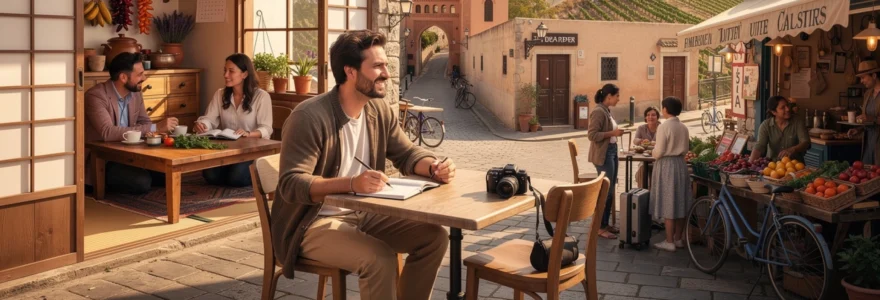
The modern travel landscape has become a race against time, with itineraries packed so tightly that genuine connection to place feels increasingly elusive. As travel becomes more accessible and social media amplifies the pressure to maximise experiences, many travellers find themselves exhausted rather than enriched by their journeys. Yet a counter-movement is gaining momentum—one that challenges the assumption that more destinations automatically translate to more meaningful experiences. This shift towards deliberately paced exploration reveals something neuroscience and psychology have long understood: depth of experience, not breadth of coverage, creates lasting memory and genuine transformation. When you slow down, travel stops being a performance and becomes an immersive education in how other people live, think, and find meaning in their daily existence.
The neuroscience behind slow travel: how reduced pace enhances memory consolidation
Your brain processes travel experiences fundamentally differently depending on the pace at which you encounter them. Neuroscientific research demonstrates that memory consolidation—the process by which short-term experiences become long-term memories—requires time and repetition. When you rush through multiple destinations, your hippocampus struggles to encode discrete experiences, resulting in what researchers call « boundary blurring, » where individual memories fade into an undifferentiated blur of sensory impressions.
Slower travel patterns activate different neural pathways entirely. Extended exposure to a single environment allows your brain to move beyond novelty processing into pattern recognition and contextual understanding. This shift from the amygdala’s rapid threat-and-novelty assessment to the prefrontal cortex’s deeper analytical processing creates richer, more nuanced memories. Studies of long-term travellers show significantly enhanced episodic memory formation compared to rapid tourists visiting the same locations.
The chronobiological dimension matters as well. Jet lag and constant timezone shifts disrupt circadian rhythms, impairing both cognitive function and emotional regulation. When you remain in one geographic region, your body achieves chronobiological alignment, resulting in better sleep quality, improved mood stability, and enhanced capacity for new learning. This physiological settling creates optimal conditions for the kind of deep attention that transforms ordinary moments into memorable experiences.
Furthermore, reduced decision fatigue plays a crucial role. The constant micro-decisions required by rapid travel—where to go next, how to get there, where to stay—deplete cognitive resources. By eliminating these exhausting choices, slower travel preserves mental energy for what matters: observing, connecting, and reflecting. Your prefrontal cortex can focus on making sense of cultural patterns rather than logistics, leading to more sophisticated understanding and retention.
Immersive cultural integration through extended stays in single destinations
True cultural understanding emerges not from observing but from participating in the daily rhythms that structure local life. Extended stays transform you from spectator to provisional resident, granting access to patterns and meanings invisible to brief visitors. This shift fundamentally changes what you notice and how communities respond to your presence.
Language acquisition advantages: conversational fluency in kyoto’s machiya guesthouses
Language learning accelerates dramatically when immersion becomes daily necessity rather than tourist novelty. In Kyoto’s traditional machiya guesthouses, where owners often speak limited English, extended stays create natural language acquisition environments. You’re not simply memorising phrases from a guidebook; you’re negotiating real needs, expressing genuine preferences, and gradually internalising grammatical structures through repeated functional use.
The social dynamics shift as well. When guesthouse owners recognise you as a longer-term resident rather than transient visitor, conversations deepen beyond surface pleasantries. They correct your pronunciation, teach you local dialect variations, and explain cultural context behind linguistic choices. This mentorship relationship—impossible to establish during brief stays—accelerates learning whilst simultaneously building meaningful human connections that enrich your entire experience.
Culinary depth through Multi-Week cooking workshops in oaxaca and provence
Food tourism often reduces cuisine to consumable spectacle, but extended culinary engagement reveals the cultural logic embedded in regional foodways. Multi-week cooking workshops in places like Oaxaca or Provence allow you to progress from basic technique observation to understanding ingredient seasonality, historical evolution, and the social meanings of
meals. Over time, you learn why certain chillies appear only in specific months in Oaxaca’s mercados, or how mistral winds influence herb growth in Provence. Recipes stop being one-off performances and become living documents of geography, climate, and history.
Slow culinary travel also changes your relationship with eating itself. Instead of chasing the “top ten restaurants,” you shop repeatedly at the same stalls, talk with producers, and see how menus shift week by week. You begin to recognise bakers by the crack of their loaves, or cheese-makers by the slight variations in rind and aroma. These sensory details anchor stronger travel memories than a single, hurried dinner at a famous spot ever could.
Multi-week workshops further create a peer community that mirrors local social structures. You cook alongside neighbours, seasonal workers, or fellow long-stay travellers, sharing stories while chopping vegetables or kneading dough. In this way, slow travel uses food as a gateway to shared human experience, revealing how a region nourishes both body and culture over time.
Building meaningful local relationships beyond transactional tourism encounters
Slow travel is uniquely positioned to turn fleeting interactions into enduring relationships. When you appear in the same café every morning, or attend the same yoga class three times a week, locals stop seeing you as a passing customer and start recognising you as a temporary neighbour. The dynamic shifts from “service provider and client” to “two people inhabiting the same space,” which opens the door to authenticity.
These relationships rarely arise on a four-day whirlwind itinerary, where staff know that you will disappear as soon as your checklist is complete. Stay for three weeks, however, and the barista remembers your order, asks about your day, and eventually shares their own stories of the city. Over months, these exchanges may evolve into invitations to family gatherings, language practice sessions, or collaborative projects such as helping at a local event.
From a psychological perspective, repeated low-stakes encounters are the raw material of trust. Social scientists call this “weak tie strengthening”: the gradual deepening of casual relationships that often leads to the most surprising opportunities. By slowing down, you give these ties the continuity they need to transform your trip from a series of purchases into a network of human connections.
Participating in community rhythms: market days and regional festivals
Every destination has its own pulse, defined by recurring events that are invisible to short-term visitors. Weekly market days, monthly craft fairs, and annual religious or cultural festivals create a calendar that structures local life. Slow travel allows you to tune into this rhythm rather than skimming its surface. You begin to anticipate Wednesday’s fish market in a coastal town or the Friday-night food trucks in a suburban square.
Participation, not just observation, is what deepens your understanding. Instead of photographing a festival from the sidelines, you might help set up chairs, carry offerings, or rehearse with a community choir. Over multiple weeks, locals stop explaining everything in “tourist mode” and start speaking to you as someone who already understands the context. This subtle shift is where genuine cultural immersion begins.
There is also an anthropological benefit. By seeing how spaces transform over time—a quiet plaza on Monday, a bustling farmers’ market on Saturday—you understand that places are not static backdrops but dynamic stages. Each recurring event layers meaning onto streets and squares, and as you witness those cycles, your sense of place grows richer and more textured.
The economics of slow travel: cost efficiency through long-term accommodation
At first glance, slow travel can seem like a luxury reserved for those with time and money. Yet when we examine the economics carefully, a different picture emerges. Concentrating your stay in one destination often reduces overall costs, particularly in accommodation and transportation. The daily rate of living tends to decrease the longer you remain in place, much like buying in bulk at a market rather than purchasing individual items each day.
In 2025, several digital nomad reports highlighted that travellers who stayed at least 28 days in one location saved between 20% and 40% on accommodation compared with those who moved weekly. Similar trends appear across continents: landlords and hosts reward stability, while short stays carry premiums to offset higher turnover and cleaning. When you add reduced transport, fewer restaurant meals, and access to local pricing, slow travel often becomes the more economical choice over a month or more.
This cost efficiency also creates psychological breathing room. When your budget is not under constant pressure from last-minute bookings and high-speed transfers, you are freer to spend on meaningful experiences—workshops, museum passes, or local performances—rather than on logistics. Put simply, the less money you spend moving between places, the more you can invest in actually being there.
Monthly rental savings: comparing airbnb rates in lisbon versus nightly bookings
Lisbon offers a clear illustration of how slow travel creates tangible savings. A centrally located studio on a nightly rate might cost €90 to €120 per night in high season. Over a week, that adds up quickly, especially once cleaning fees and platform charges are included. However, many listings in the same neighbourhood drop their effective nightly rate by 30% to 50% when you book for 28 days or more.
For example, a studio in Graça or Intendente might list at €95 per night for short stays, yet offer a monthly rate of €1,500. Spread across 30 days, that’s just €50 per night—nearly half the price. Some landlords offer even deeper discounts for two- or three-month commitments, particularly outside peak tourist months. Slow travellers who can align their schedules with shoulder seasons often benefit from both better prices and calmer city life.
Why does this matter for the richness of your travel experience? Lower accommodation costs free budget for language classes, day trips to Sintra or Setúbal, or frequenting local tascas instead of grabbing takeaway. Instead of racing through Lisbon in four days, trying to “get your money’s worth,” you live there at a sustainable pace, with financial room to follow your curiosity rather than your booking confirmation.
Access to local pricing structures in vietnamese markets and portuguese tascas
Short-stay tourism tends to trap visitors in high-price ecosystems: central restaurants with English menus, souvenir-heavy markets, and taxi-dependent transport. Slow travel, by contrast, gradually unlocks access to local pricing structures. In Vietnamese wet markets, for instance, your first day’s visit might involve paying a visible “foreigner premium.” But return several times, build rapport, and learn basic numbers in Vietnamese, and prices often move closer to what residents pay.
The same pattern appears in Portuguese tascas—small, family-run eateries where menus can be astonishingly affordable if you know where to look. Frequenting the same tasca for a month does more than save money; it creates a relationship. Owners may quietly recommend the off-menu dish, pour you a complimentary ginjinha, or point you towards lesser-known neighbourhoods worth exploring. The more you are recognised, the less you are treated as a passing revenue source and the more you are welcomed as part of the community fabric.
From an economic standpoint, this matters because the bulk of your daily travel budget is often spent on food. By shifting from tourist-facing venues to local infrastructure, you not only lower your expenses but also eat more seasonally, more traditionally, and more sustainably. Slow travel thus aligns financial efficiency with cultural authenticity.
Reduced transportation expenditure: the financial case for geographic containment
Rapid travel has a hidden cost that adds up quickly: constant movement. Trains, flights, ride-shares, luggage storage, and airport transfers all nibble away at your budget. When you adopt a slow travel mindset and practise geographic containment—choosing one base and exploring nearby areas—those costs drop dramatically.
Consider the difference between visiting five European capitals in ten days versus settling in one region for the same period. The multi-city itinerary might involve four flights or high-speed trains, each with additional accommodation taxes and city premiums. In contrast, basing yourself in a smaller hub, such as Bologna or Girona, allows for inexpensive regional trains and buses, or even free walking and cycling. You still experience variety—medieval towns, coastal villages, agricultural landscapes—but without constantly paying to relocate your luggage and your body.
Geographic containment also has a cognitive bonus. When you are not constantly calculating routes, departure times, and check-in procedures, your mental bandwidth returns to noticing details. You might discover a side street café simply because you are not racing to the next station. In this way, financial savings and experiential depth become two sides of the same slow travel coin.
Ecological footprint reduction: carbon impact of overland travel versus flight-intensive itineraries
The environmental argument for slow travel is increasingly difficult to ignore. Aviation accounts for an estimated 2.5% of global CO₂ emissions, yet its impact is amplified at high altitudes, making frequent short-haul flights disproportionately harmful. When your itinerary involves hopping between cities or countries every few days, your personal carbon footprint can grow faster than your experience actually deepens.
Overland travel—trains, coaches, shared vans, and cycling—typically emits far less carbon per kilometre. The European Environment Agency, for instance, reports that train travel can produce up to 90% fewer emissions than equivalent flights on certain routes. If you choose to spend three weeks exploring a single region by rail rather than flying to three different countries, the carbon savings are substantial. You are, in effect, trading altitude for attitude: staying grounded, literally, in order to engage more thoughtfully with place.
There is also a qualitative dimension to ecological responsibility. When we move slowly through landscapes, we become more aware of what is at stake—disappearing glaciers, drought-stricken fields, or healthy wetlands teeming with life. This awareness often leads to more ethical choices: refilling a water bottle instead of buying plastic, supporting conservation-minded guesthouses, or choosing locally produced food. By aligning your travel pace with ecological limits, you demonstrate that “seeing the world” need not mean consuming it.
Deep place attachment: phenomenological experience of the amalfi coast versus rapid circuit tours
Place attachment—the emotional bond we form with specific locations—develops through repeated, meaningful encounters rather than brief visual contact. Nowhere is this contrast clearer than on Italy’s Amalfi Coast. Coach tours and cruise excursions often promise to show you multiple towns in a single day: Positano at 10:00, Amalfi at noon, Ravello in the afternoon. You technically “see” them all, yet your memories may blur into a collage of similar viewpoints and crowded piazzas.
Slow travellers who rent a small apartment in, say, Minori or Praiano for two or three weeks report a different kind of relationship. Over time, you learn the morning rhythm of fishing boats, the exact hour when the sun slips behind a particular cliff, and which bakery sells out of sfogliatelle by 9 a.m. These details form what phenomenologists call the “lived experience” of place—how a location feels from the inside, as part of your daily life, rather than how it looks from an external vantage point.
This deepening attachment has a feedback effect. The more familiar a place becomes, the more subtle qualities you notice. You may begin by appreciating the dramatic coastline, but end by feeling a quiet fondness for the grocer who always rounds down your bill, or the particular way laundry flaps against pastel walls on windy days. Meaning migrates from spectacle to intimacy, and that transition is one of the most rewarding outcomes of slow travel.
Microclimate awareness and seasonal variation in burgundy wine country
Wine regions are laboratories for understanding how time and place intertwine. Burgundy, with its patchwork of vineyards and centuries-old classification of climats, offers a compelling illustration. A quick weekend of tastings might leave you with vague impressions—“this Pinot Noir is lighter,” “that Chardonnay is more oaked.” Stay for several weeks, however, and a more intricate picture emerges.
You begin to notice how morning fog lingers longer in certain valleys, or how a slope facing southeast warms faster, affecting grape ripening. Locals talk about vintages not only in terms of rainfall, but also of subtle temperature swings during flowering or harvest. By walking through the same vineyards in different weather—misty, sun-drenched, after rain—you feel in your body what “terroir” truly means.
This microclimate awareness alters your travel narrative. Instead of simply saying, “We visited Burgundy and tasted wine,” you might describe how the character of a particular village wine mirrored the cool, late spring that year. Your memories become anchored not just in place names but in environmental nuances, evidence that slow travel has deepened both your palate and your perception.
Discovering hidden enclaves: unmarked trattorias and neighbourhood artisan workshops
Hidden gems are often hidden not because they are secret, but because they require time and attention to find. In Italian cities and small towns alike, some of the most memorable experiences unfold in unmarked trattorias tucked down residential alleys or in modest workshops where artisans mend shoes, bind books, or restore furniture. You rarely stumble upon these places during a hurried march between must-see attractions.
Slow travel gives you “wandering credit”—the spare hours and mental openness needed to take that side street, follow the sound of clinking glasses, or investigate the smell of fresh leather or sawdust. The more you walk the same neighbourhood, the more its non-obvious layers reveal themselves: a door that is inexplicably open every Thursday afternoon, a courtyard where neighbours gather at dusk, a window display that changes with local festivals rather than tourist seasons.
Finding these enclaves is not about bragging rights; it is about recalibrating your definition of value. Instead of rating experiences by how “Instagrammable” they are, you start valuing them for the stories they carry and the people they connect you with. That unmarked trattoria where the owner insists you try their grandmother’s recipe may never appear in a guidebook, yet it can anchor your entire memory of a city.
Understanding regional identity: historical layering in andalusian pueblos blancos
The white villages of Andalusia—the pueblos blancos—are often marketed as a picturesque day trip from Seville or Málaga. Tour buses roll in, passengers photograph the whitewashed houses and dramatic vistas, and then depart before sunset. From this perspective, the villages can appear almost interchangeable, as if they were merely variations on the same postcard image.
Spend weeks in one or two of these villages, however, and regional identity unfolds in layers. You notice subtle architectural traces of Moorish rule, baroque churches adapted from earlier structures, and modern interventions such as solar panels discretely integrated into tiled roofs. Conversations with older residents may reveal memories of the civil war or stories of migration that are not immediately visible in the scenery.
This historical layering gives the present a different texture. When you join a procession during a local fiesta, you are not just witnessing a colourful spectacle; you are participating in a tradition shaped by centuries of religious, political, and economic change. Slow travel invites you to hold these layers in mind simultaneously, enriching your understanding of how regional identity is continuously negotiated rather than fixed.
Developing spatial literacy through pedestrian navigation in marrakech’s medina
Marrakech’s medina is often described as a labyrinth, a place where visitors become disoriented within minutes. On a short visit, many travellers rely heavily on GPS or guides, darting from one landmark to the next without ever building an internal map. The experience can feel chaotic, even overwhelming, especially when combined with the sensory intensity of markets, motorbikes, and calls to prayer.
Slow travel offers a different approach: instead of fighting the maze, you learn to read it. Walking the same alleys at different times of day, you start using spatial cues that no digital map can capture—the smell of baking bread from a community oven, the echo pattern in a narrow passage, the way light falls through wooden latticework near a particular square. Gradually, you develop what geographers call “spatial literacy”: an embodied understanding of how a place fits together.
This literacy transforms anxiety into confidence. You move from thinking, “I’m lost again,” to, “If I follow the sound of the main street, I’ll reach the spice square, then turn left towards my riad.” Your relationship with the medina shifts from adversarial to collaborative; it becomes a partner in your learning rather than an obstacle to overcome. That sense of orientation—both literal and metaphorical—is one of slow travel’s most underrated rewards.
Countering travel fatigue: physiological recovery and chronobiological adaptation
Travel fatigue is often framed as an unavoidable side effect of seeing the world, but much of it stems from pace rather than distance. Constantly changing beds, time zones, diets, and social expectations taxes your nervous system. Symptoms such as irritability, poor sleep, digestive issues, and difficulty concentrating are signs that your body is struggling to adapt quickly enough to your itinerary.
By slowing down, you allow your physiology to catch up with your ambitions. Chronobiologists note that it can take roughly one day per time zone crossed for circadian rhythms to stabilise; remaining in a single region reduces this constant re-synchronisation. Once your internal clock aligns with local light patterns, hormones that regulate sleep, appetite, and mood rebalance, creating a baseline of wellbeing from which you can explore more fully.
There is also the matter of rest built into your schedule. Rapid itineraries often treat downtime as wasted time, yet recovery days are where your nervous system integrates stimuli and your mind processes experiences. Scheduling regular “nothing days” during a long stay—days with no major sightseeing plans, just reading in a park or strolling a familiar street—can significantly reduce burnout. Have you ever returned from a trip feeling like you needed another holiday to recover? Slow travel is designed to prevent exactly that.
Finally, slower, more stable routines support healthier habits on the road. When you know you will be in the same place for weeks, it is easier to cook some of your meals, maintain an exercise practice, or keep consistent sleep hours. These small anchors create a sense of home, even far from it. By respecting your body’s need for rhythm and recovery, you make space for the richer, more attentive encounters that are the hallmark of truly meaningful travel.