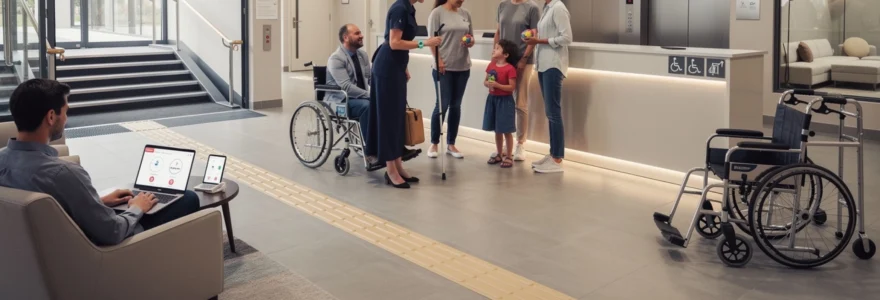
Travel should be an enriching experience accessible to everyone, regardless of physical abilities, sensory requirements, or neurological differences. Yet selecting suitable accommodation remains one of the most significant barriers for travellers with disabilities and specific needs. With approximately 14 million disabled people in the UK alone—representing over 20% of the population—the demand for genuinely accessible lodging continues to grow exponentially. Understanding how to evaluate accommodation providers effectively transforms potentially stressful holiday planning into confident decision-making. From wheelchair-accessible infrastructure to neurodivergent-friendly environments, the spectrum of accessibility requirements is vast and nuanced, demanding thorough assessment beyond simple « accessible room » designations.
Understanding the legal framework: ADA, equality act 2010, and EN 17210 accessibility standards
Navigating the legal landscape of accessibility standards provides essential context for evaluating accommodation providers. In the UK, the Equality Act 2010 mandates that service providers, including hotels and holiday rentals, make reasonable adjustments to ensure disabled guests aren’t substantially disadvantaged. This legislation covers physical features, policies, practices, and auxiliary aids, creating enforceable expectations for accommodation providers. The Act defines disability broadly, encompassing physical impairments, sensory conditions, learning difficulties, and mental health conditions, ensuring comprehensive protection across the disability spectrum.
The European standard EN 17210, established in 2021, represents a significant advancement in harmonising accessibility requirements across the continent. This standard provides detailed specifications for accessible accommodation services, covering everything from booking processes to physical infrastructure requirements. Unlike previous frameworks that offered general guidance, EN 17210 establishes measurable criteria for accessibility features, enabling properties to demonstrate compliance through objective assessment. For travellers, properties certified under EN 17210 offer standardised accessibility levels, reducing uncertainty when booking accommodation abroad.
The Americans with Disabilities Act (ADA) influences global accessibility standards despite its US-centric application. Many international hotel chains adopt ADA compliance as their baseline, creating consistency across their worldwide properties. The ADA Standards for Accessible Design specify precise measurements for doorways, bathroom fixtures, and circulation spaces, offering technical benchmarks that travellers can reference when evaluating accommodation descriptions. Understanding these measurements—such as the minimum 32-inch clear door width or the required 60-inch wheelchair turning diameter—empowers you to assess whether advertised « accessible » rooms truly meet your mobility requirements.
Recent legal developments continue shaping accessibility provisions. The 2022 UK government consultation on accessibility regulations for short-term holiday lets highlighted persistent gaps in enforcement for non-traditional accommodation types. As platforms like Airbnb and Vrbo expand, regulatory frameworks struggle to ensure equivalent accessibility standards across diverse property types. This regulatory evolution means that scrutinising individual properties becomes increasingly important, as legal compliance varies significantly between traditional hotels and alternative accommodation providers.
Evaluating physical infrastructure: wheelchairs, mobility aids, and Barrier-Free navigation
The physical infrastructure of accommodation forms the foundation of genuine accessibility. When evaluating properties, you must consider the complete journey from arrival to departure, identifying potential barriers at every stage. This comprehensive assessment prevents unexpected obstacles that could significantly impact your travel experience. Properties claiming accessibility without addressing these fundamental elements often fall short of practical usability, leaving guests frustrated and underserved.
Accessible room features: Roll-In showers, grab bars, and adjustable furniture requirements
Accessible rooms require specific features extending far beyond basic space considerations. Roll-in showers represent the gold standard for wheelchair users, featuring level thresholds, non-slip flooring, and adequate manoeuvring space—typically a minimum of 60 inches by 30 inches. These showers should include strategically positioned grab bars, preferably L-shaped configurations that provide support from multiple angles. Wall-mounted shower seats with fold-down capabilities offer flexibility, though fixed seats positioned at 17-19 inches height provide more stability for transfers.
Grab bar placement requires precision to deliver meaningful support. Bathrooms should feature bed grab rails and home adaptations beside toilets—one on the side wall at 33-36 inches high and another behind at similar height—supporting secure daily transfers. Additional grab bars near bathtubs or showers, positioned at 33-36 inches above the floor, enable safe entry and exit. The diameter of grab bars matters considerably; 1.25
to 1.5 inches allows a comfortable grip, while non-slip textures and secure wall fixings help prevent accidents. Adjustable-height beds and desks enable wheelchair users and people of shorter stature to customise the environment to their needs, rather than compromising on comfort. Clear space of at least 30 inches by 48 inches beside the bed is essential for side transfers and hoist use. When you contact an accommodation provider, ask for detailed measurements of bed height, under-bed clearance for hoists, and the exact layout of furniture to ensure your mobility aids can be used safely.
Storage and controls are often overlooked but can determine whether a room is genuinely usable. Wardrobes should include low-level hanging rails, ideally between 36 and 48 inches from the floor, and shelves that do not require overhead reaching. Light switches, thermostats, and power sockets should be positioned within accessible reach ranges—usually 15 to 48 inches above the floor—enabling guests to control their environment independently. Where possible, prioritise accommodation that offers flexible furniture arrangements, so items like desks, chairs, or bedside tables can be moved to create personalised transfer routes and clear turning circles.
Entrance and corridor specifications: ramp gradients, door widths, and turning radii
Accessible accommodation starts before you even reach your room, with entrances and corridors designed to support barrier-free navigation. Step-free access from the street, car park, or drop-off point is crucial, as a single unexpected step can render an otherwise accessible property unusable. Ramps should follow recognised guidance such as a maximum gradient of 1:12 for short rises, with handrails on both sides where the rise exceeds 6 inches. Surfaces must be firm, stable, and slip-resistant, avoiding loose gravel or uneven cobblestones that make wheelchair propulsion and walking with mobility aids difficult.
Door widths represent a common pinch point for wheelchair users and travellers with walkers. While the ADA sets a minimum clear opening width of 32 inches (about 815 mm), many modern accessibility standards, including EN 17210, recommend at least 850 mm to accommodate larger power wheelchairs and scooters. Automatic doors or low-resistance manual doors with lever handles improve usability for guests with limited upper body strength or dexterity. Corridors should provide a minimum clear width of 1200 mm where possible, with passing places or wider sections every 10 metres in narrower passages to allow two wheelchairs or mobility scooters to pass safely.
Turning radii are another technical detail that has a significant practical impact. Wheelchair users typically need a clear turning circle of at least 1500 mm diameter in corridors, lift lobbies, and room entrances to change direction comfortably. Tight corners, protruding radiators, and decorative furniture can all reduce effective circulation space, even when theoretical measurements look adequate on paper. When reviewing floor plans or photos, imagine tracing the path from the entrance to the room and then into the bathroom—could you rotate a wheelchair or walker at each junction without reversing multiple times?
Lift and elevator accessibility: visual-audio systems and platform dimensions
In multi-storey buildings, lift accessibility can make or break your stay. A property may offer beautiful accessible rooms on higher floors, but without a compliant lift, those spaces effectively become off-limits. Look for lifts with internal dimensions of at least 1100 mm by 1400 mm as recommended in many European standards, or larger where possible, to comfortably accommodate a wheelchair user plus a companion. Door widths should be a minimum of 800 mm, and doors that remain open long enough to allow safe entry and exit are especially important for guests with slower mobility.
Effective lifts also integrate both visual and audio systems so different sensory needs are supported. Floor announcements via clear, audible speech help blind or visually impaired travellers know when they have reached the correct level, while illuminated floor indicators and direction arrows assist deaf or hard of hearing guests. Tactile and Braille markings on control panels, placed at accessible heights, enable independent navigation rather than relying on staff or companions. Emergency communication systems should include visual indicators as well as two-way voice connections, ensuring that guests with hearing impairments can confirm that help has been summoned if the lift fails.
The approach to the lift is as important as the interior itself. Adequate manoeuvring space in front of lift doors—ideally 1500 mm by 1500 mm—allows wheelchairs to approach, turn, and reverse safely. Handrails within the lift car provide stabilisation for guests who stand but need support, such as older travellers or those with balance difficulties. When assessing a property, do not hesitate to ask for photos or videos of the lift lobby, control panel, and interior; think of this as checking the “engine room” of vertical accessibility, just as you would check a car’s engine before a long journey.
Car park provisions: designated bays, drop-off zones, and surface materials
For many travellers, the accessibility journey begins in the car park. Designated accessible bays should be clearly marked, located close to the main entrance, and aligned with recognised standards such as the UK’s Blue Badge guidance. These bays are typically wider than standard spaces—often at least 3.6 metres—to accommodate side or rear ramp deployment from adapted vehicles. Ideally, there should be a level or gently sloped route from the parking bay to the entrance, with dropped kerbs and tactile paving to signal transitions for visually impaired guests.
Drop-off zones are especially valuable for travellers who cannot walk long distances or who use heavy equipment that needs unloading. A covered loading area protects guests and their equipment from bad weather and provides time to organise wheelchairs, scooters, or luggage without pressure. Surface materials in parking areas and approach routes should be smooth, non-slip, and free from large cracks or gaps; loose gravel or cobbles can feel like walking across a beach in office shoes for someone using a cane or frame. If you are unsure, ask the provider what the ground is like from the car to reception and whether they offer porter assistance or mobility scooters on arrival.
Lighting and wayfinding in car parks play a crucial role too. Well-lit spaces reduce trip hazards and support guests who rely on visual cues or lip reading when communicating with drivers and staff. Clear signage for accessible entrances, lift lobbies, and reception avoids the frustrating “treasure hunt” that often greets disabled travellers in poorly designed resorts. By treating the car park and arrival zone as integral parts of accessible travel, rather than an afterthought, you significantly reduce the risk of stressful or unsafe first impressions.
Sensory accommodation provisions for visual and hearing impairments
While mobility access often receives the most attention, sensory accessibility is just as important for inclusive travel. Around 2 million people in the UK live with significant sight loss, and an estimated 12 million have some degree of hearing loss—yet many hotels still focus solely on ramps and lifts. For travellers with visual or hearing impairments, the wrong environment can feel like navigating a busy city without road signs or traffic lights. To choose truly accessible accommodation, you need to examine how properties support independent orientation, safe communication, and rapid alerts in an emergency.
Forward-thinking accommodation providers now integrate sensory adaptations into the entire guest journey, from check-in to bedroom design. This might include staff trained in basic sighted guiding techniques, clear written information in large print, and hearing assistance technology at reception. When you research properties, look for explicit references to visual and hearing accessibility—vague mentions of being “disability friendly” are rarely enough. You can think of sensory accessibility as the “language” a building speaks to its guests; the more formats it uses (visual, audio, tactile), the more people can understand and navigate it confidently.
Visual impairment adaptations: braille signage, tactile pathways, and audio description systems
For guests with visual impairments, consistent orientation and clear information are essential. Braille and raised-letter signage on room doors, lifts, and key facilities such as restaurants and toilets enables independent navigation without relying on staff at every step. Signage should be placed at a consistent height, typically between 1400 and 1700 mm, and positioned on the latch side of doors to build predictable patterns. High-quality tactile signs feel more like embossed letters on a bank card than faint imprints, so do not hesitate to ask hotels how their signage is produced and positioned.
Tactile pathways—sometimes called guidance paths or tactile walking surface indicators—act like a “tactile map” underfoot or via a cane. These pathways may use ribbed or dotted textures to guide guests from reception to lifts, restaurants, or accessible toilets, with distinct patterns marking decision points such as junctions or doorways. In larger complexes, these tactile routes can be as helpful as painted lines in a car park, giving a clear sense of direction. When combined with clear audio cues, such as spoken lift announcements or beacons that emit a gentle sound near key facilities, they transform an unfamiliar building into a legible space.
Audio description systems extend accessibility to visual media within the accommodation, particularly in-room televisions and on-site attractions like theatres or guided tours. Many modern smart TVs now include audio-described channels and menu narration, but properties must ensure these features are activated and staff understand how to switch them on. Some hotels also offer handheld audio guides for on-site exhibitions or gardens, mirroring the approach used in museums. If you rely on audio description at home, ask in advance whether the accommodation supports it; this is especially important for theme parks, heritage hotels, and resorts that offer visual shows or displays as part of the experience.
Hearing assistance technology: induction loops, visual alarm systems, and vibrating alert devices
For deaf and hard of hearing travellers, clear communication and reliable alerts are non-negotiable. Induction loop systems at reception desks, conference rooms, and entertainment venues help guests who use hearing aids by transmitting sound directly to their devices and reducing background noise. These loops should be clearly signposted with the standard hearing loop symbol and tested regularly to avoid the common scenario where equipment exists but does not work. If you use a hearing aid, you may want to ask: is there a portable loop available for use in smaller meeting rooms or at the bar?
Emergency alarms represent a critical safety issue. Traditional audible fire alarms can leave deaf guests completely unaware of danger, which is why visual alarm systems and vibrating alert devices are so important. Strobe lights in bedrooms, corridors, and bathrooms provide immediate visual cues, while vibrating alarm pads placed under pillows wake guests during night-time evacuations. Many hotels now provide “deaf guards” or similar devices on request, but this is rarely mentioned in standard room descriptions, so direct enquiries are essential. You might think of these devices as the equivalent of seat belts in cars: you hope never to need them, but you would not feel safe without them.
Day-to-day communication support also shapes the overall travel experience. Subtitled televisions, captioned video content, and staff who understand basic deaf awareness—such as facing the guest when speaking and not covering their mouth—can dramatically reduce fatigue and frustration. Some properties are experimenting with video relay services at reception, enabling sign language users to communicate via remote interpreters on tablets. Even simple measures, like providing written confirmation of key information given verbally at check-in, demonstrate a commitment to inclusive communication rather than relying on a single sensory channel.
Colour contrast standards and wayfinding solutions for low vision guests
Many travellers fall into the category of low vision rather than total blindness, where colour contrast and visual clarity are vital. Good colour contrast between walls, floors, and doors helps guests distinguish boundaries and spot hazards; for example, a dark handrail against a light wall is much easier to locate. International guidelines often recommend a Light Reflectance Value (LRV) contrast of at least 30 points between adjacent surfaces, such as door frames and surrounding walls. In practical terms, this means avoiding fashionably “washed-out” interiors where everything is painted in similar shades of grey or beige.
Wayfinding solutions combine signage, lighting, and environmental cues to create a coherent mental map of the building. Large, high-contrast signage with clear sans-serif fonts, minimal text, and simple icons supports both low vision guests and those with cognitive impairments. Consistent layout—such as placing room numbers on the same side of every door or positioning toilet signs at eye level—reduces the effort required to interpret each new area. You can think of good wayfinding like a satnav for buildings: it gently guides you where you need to go without demanding constant problem-solving.
Lighting quality is another crucial factor. Uniform, glare-free lighting in corridors and public areas helps prevent disorientation and falls, especially for older travellers with age-related vision changes. Adjustable task lighting in rooms allows guests to increase brightness for reading or medication management, while blackout curtains prevent excessive light for those with photophobia. When comparing properties, look at photos carefully: are stairs, ramps, and changes in level clearly lit and marked? If every image appears dim or heavily filtered, it may be worth asking for unedited photos that better represent the real environment.
Digital accessibility: WCAG 2.1 compliance in booking platforms and communication tools
Digital accessibility is now as important as physical design when choosing accessible accommodation. If a hotel’s website or booking platform is difficult to navigate with a screen reader or keyboard, that is often a red flag for how seriously the provider takes accessibility overall. The Web Content Accessibility Guidelines (WCAG) 2.1, widely recognised across Europe and beyond, outline how websites and apps should be designed so people with disabilities can use them. They cover everything from text alternatives for images to keyboard navigation and captioned videos, setting a clear benchmark for inclusive online experiences.
How can you tell whether a booking platform is accessible? Look for features such as the ability to navigate via keyboard alone, clear focus indicators around links and buttons, and descriptive labels on form fields and images. Screen reader users should be able to jump between headings and landmarks to find sections such as “accessible rooms” or “special requests” quickly. If you rely on assistive technology, try a test search on the site: can you filter for accessible accommodation features, read room descriptions, and complete payment without resorting to workarounds?
Communication tools also need to support different access needs throughout the booking process. Live chat functions should be compatible with screen readers and allow enough time for users to respond without the session timing out. Email confirmation should be in clear, plain language with key details—such as room type, step-free access, and accessibility equipment—highlighted logically. Some providers offer video calls with sign language interpreters or typed chat for guests who cannot use the telephone, while others accept detailed accessibility questionnaires via email. Prioritising accommodation that offers multiple communication channels can make planning feel more like a partnership and less like a barrier course.
Transparency about digital accessibility is becoming more common, especially among larger chains and specialist accessible travel providers. Some websites display an accessibility statement outlining the steps taken to meet WCAG 2.1 criteria, known limitations, and contact details for reporting issues. This level of openness suggests a willingness to improve rather than a box-ticking exercise. When you encounter a site that feels like a locked door—tiny text, images with no descriptions, inaccessible date pickers—it may be a sign to look elsewhere for providers who understand that accessible travel begins online.
Neurodivergent-friendly environments: sensory rooms, quiet spaces, and autism accommodation programmes
Neurodivergent travellers—including autistic people, those with ADHD, Tourette’s, or sensory processing differences—often face invisible barriers that traditional accessibility standards overlook. Busy lobbies, unpredictable noise, strong cleaning product smells, and constant schedule changes can be overwhelming, turning what should be a break into a source of anxiety. In the UK alone, there are estimated to be over 700,000 autistic people, and many more with other forms of neurodivergence, yet dedicated provision remains patchy. Choosing accommodation that recognises these needs can feel like the difference between walking into a calm library and a chaotic nightclub.
More hotels, theme parks, and resorts are introducing sensory rooms, quiet spaces, and autism-friendly programmes to address these challenges. These initiatives often go beyond physical design to include staff training, tailored communication, and flexible procedures. When researching properties, look for explicit references to being “autism-friendly,” “neurodivergent-inclusive,” or part of recognised programmes run by charities or specialist organisations. Because terminology is still evolving, it can help to ask directly about noise levels, flexibility with check-in, and options for avoiding crowded areas rather than relying solely on marketing labels.
Reducing sensory overload: lighting controls, noise reduction, and predictable layouts
Reducing sensory overload begins with the environment itself. Adjustable lighting in bedrooms—such as dimmer switches, bedside lamps, and blackout curtains—allows guests to create a comfortable sensory level rather than being forced to endure harsh overhead lights. Soft, indirect lighting in corridors and common areas can be less triggering for people sensitive to brightness, while avoiding rapidly changing coloured lights or flashing effects is important for both autistic guests and those with epilepsy. Asking whether a room faces a quiet courtyard or a busy street can also make a big difference to sleep quality.
Noise reduction strategies are another cornerstone of neurodivergent-friendly accommodation. Thick walls, good door seals, and carpets rather than hard flooring help absorb sound, while rooms located away from lifts, bars, and conference spaces tend to be quieter. Some properties now offer “quiet floors” or specify rooms that are less exposed to late-night activity—ideal for travellers who are sensitive to sudden noises. Ear defenders, white noise machines, or simple fans can also help mask unpredictable sounds; a growing number of autism-friendly hotels list these among their available amenities.
Predictable layouts and routines can reduce anxiety significantly. Clear, uncluttered room layouts with logical placement of furniture and facilities help guests form a mental map quickly, rather like knowing where everything is in your own kitchen. Signage that uses simple icons, consistent colours, and minimal text supports both neurodivergent and non-native-speaking guests. When you book, consider asking for floor plans or photos: is the route from reception to the room straightforward, or does it involve multiple turns, lifts, or changes in lighting? The more predictable the environment, the easier it is to conserve energy for enjoying the trip itself.
Communication support: visual schedules, social stories, and staff training protocols
For many neurodivergent travellers, how information is presented can be just as important as the information itself. Visual schedules—simple pictorial or written timelines of the day’s activities—help clarify what will happen and when, reducing the stress of unknowns. Some autism-friendly accommodations provide downloadable visual timetables before arrival, which families can adapt to their own routines. Social stories or visual guides that show photos of the reception, restaurant, pool, and rooms can prepare guests ahead of time, much like a trailer prepares you for a film.
Staff training is a crucial, often underappreciated, part of creating neurodivergent-friendly environments. Training programmes typically cover recognising signs of sensory overload, offering quiet alternatives without drawing attention, and communicating in clear, concrete language. For example, saying “Breakfast is served from 7 to 10 am in this room” is more helpful than “Breakfast is sometime in the morning over there.” Many autistic guests value being asked how they prefer to communicate—whether verbally, in writing, or with support from a companion—rather than staff making assumptions.
Flexible policies can also support neurodivergent travellers. Earlier check-in or later check-out reduces the pressure of strict timings, while the option to pre-order meals or dine in quieter areas can make restaurant experiences more manageable. Some properties allow guests to tour key spaces briefly on arrival, so they can understand noise levels and escape routes before committing to activities. When enquiring, you might ask: “How do you support autistic or neurodivergent guests who become overwhelmed?” The quality of the answer will often reveal more than any brochure.
Examples from leading providers: center parcs UK, legoland windsor, and caudwell children certified hotels
Several high-profile providers in the UK offer useful examples of how neurodivergent-friendly and accessible travel can work in practice. Center Parcs UK, for instance, has introduced a range of measures across its villages, including detailed pre-arrival information, quieter activities, and accommodation options in less busy areas of the site. Many families appreciate the ability to stay in woodland lodges where they can manage noise and sensory input more easily, while still accessing accessible swimming pools and step-free routes. Center Parcs also works with disability organisations to refine its accessibility and staff training.
Legoland Windsor has developed autism-friendly initiatives that illustrate how theme parks can support neurodivergent visitors. These include ride access passes that reduce queuing times—a notorious trigger for sensory overload—and designated quiet rooms where guests can retreat from the crowds. Clear maps, visual guides, and staff trained to recognise signs of distress help families feel more confident tackling a busy environment. Accommodation options associated with the park are increasingly aligning with these principles, offering themed rooms with adjustable lighting and quieter locations away from late-night entertainment.
Caudwell Children Certified Hotels represent a more formal approach to inclusive accommodation. This UK charity audits and supports hotels in implementing comprehensive accessibility and autism-friendly measures, covering everything from sensory design to staff training and emergency planning. Certification gives families and disabled travellers an additional layer of assurance that a property has been independently reviewed, not just self-declared as “accessible.” By studying how these leading providers operate, you gain a checklist of features and questions you can apply to any accommodation, even those outside established programmes.
Vetting accommodation providers: accessibility certifications, guest reviews, and on-site audits
Even with legal frameworks and best-practice examples, the reality is that accessibility claims vary widely in quality and accuracy. How can you tell whether a property’s “fully accessible” label reflects lived experience or just marketing? Vetting accommodation providers involves combining objective indicators—such as certifications and detailed access guides—with subjective insights from guest reviews and, where possible, your own pre-arrival checks. Think of this stage as conducting a mini access audit: you are gathering evidence to see whether the property fits your specific needs.
Accessibility in travel is rarely one-size-fits-all, so the goal is not perfection but informed decision-making. For some travellers, a portable ramp and clear communication may be enough; for others, ceiling track hoists, hoist-friendly beds, and sensory-friendly spaces are essential. By learning how to interpret accreditation schemes, ask targeted questions, and analyse online reviews through an accessibility lens, you can significantly reduce the risk of unpleasant surprises on arrival. This process takes time but often saves far more time, money, and energy than a last-minute scramble to fix avoidable problems.
Recognised accreditation schemes: AccessAble, DisabledGo, and tourism for all UK
Independent accessibility accreditation schemes provide a valuable starting point when vetting accommodation. In the UK, organisations such as AccessAble (formerly DisabledGo) compile detailed access guides based on on-site assessments, covering everything from ramp gradients to toilet layouts. Rather than simply labelling a property as “accessible,” these guides present objective measurements and photos, allowing you to compare them directly with your own requirements. Tourism for All UK, meanwhile, offers advice and signposting to accessible tourism businesses that have demonstrated a genuine commitment to inclusion.
These schemes act a bit like food hygiene ratings for accessibility: they do not replace your judgement, but they provide a helpful baseline. Properties that invest in independent assessments signal that they take accessibility seriously and are willing to be transparent about their facilities. When you see references to AccessAble guides or Tourism for All partnerships on a hotel’s website, take the time to follow the links and read the full reports rather than relying on summary icons. The detail—door widths, step heights, availability of hearing loops—will tell you far more than a generic wheelchair symbol.
Outside the UK, similar schemes exist under different names, and some international hotel chains run their own internal accessibility audit programmes. While standards vary, any form of structured, externally reviewed accessibility information is generally preferable to vague claims. If a property in your chosen destination lacks formal accreditation, you can still use the criteria from recognised schemes as a checklist when asking questions or reviewing photos, effectively applying professional audit principles to your own research.
Essential questions for direct property enquiries and pre-arrival assessments
Even the best online information cannot replace direct communication with accommodation providers, especially for complex or multiple access needs. Preparing a concise but detailed list of questions helps you obtain the specific information you require without overwhelming staff. Focus on your non-negotiables: step-free access from arrival to room, bathroom layout and equipment, availability of hoists or shower chairs, sensory environment, and emergency procedures. Asking for measurements in centimetres or inches, rather than yes/no answers, reduces misunderstandings; for example, “What is the clear width of the bathroom door?” is more informative than “Is the bathroom accessible?”
Consider structuring your enquiry around the stages of your stay: arrival, check-in, movement around the building, room features, bathroom, dining, and evacuation. You might ask whether staff are trained in assisting wheelchair users or autistic guests, whether printed information is available in large print, or whether visual fire alarms are installed in accessible rooms. Photos or short videos can be particularly valuable, providing a reality check against written descriptions; many smaller providers are happy to take a quick video on a smartphone if asked politely. If something feels unclear or inconsistent, trust your instincts and ask for clarification—this is your opportunity to assess both facilities and attitudes.
Some travellers also perform informal pre-arrival assessments via local contacts, disability organisations, or even virtual tours on platforms like Google Street View. Checking the route from the nearest bus stop or station to the accommodation can reveal unexpected steps or steep hills, while satellite views help you gauge the distance from accessible parking to the entrance. This may sound meticulous, but for many disabled travellers it simply replaces the casual assumptions non-disabled people can afford to make.
Utilising specialist booking platforms: accomable, handiscover, and enabled holidays
Specialist booking platforms focused on accessible travel can significantly streamline the process of finding suitable accommodation. Services such as Accomable (now integrated into a major global platform), Handiscover, and Enabled Holidays were created specifically to address the gaps left by mainstream sites. They typically offer more granular filters—such as roll-in showers, hoist availability, step-free entrances, or autism-friendly features—and rely on detailed property questionnaires or on-site audits. For many travellers, these platforms feel more like working with a knowledgeable travel agent than battling through generic search results.
Using these services does not mean abandoning mainstream platforms altogether. Instead, you can treat them as specialist tools in your accessibility toolkit, particularly for complex needs or unfamiliar destinations. For example, you might use a specialist platform to shortlist properties with verified accessible bathrooms, then cross-check those options on larger booking sites for additional photos, reviews, and pricing. This layered approach helps protect you from overly optimistic descriptions while still benefiting from broader market competition.
Moreover, specialist providers often offer personalised support via phone or email. Staff members may have lived experience of disability or close connections to disabled communities, giving them a nuanced understanding of what “accessible accommodation” really entails. Do not hesitate to share detailed information about your needs and preferences—they are accustomed to complex requirements and can often suggest creative solutions that general sites overlook, from equipment hire to accessible transport links.
Interpreting guest feedback: TripAdvisor accessibility filters and booking.com facilities tags
User reviews are a powerful, if sometimes messy, source of information about real-world accessibility. Platforms like TripAdvisor now include accessibility filters and review categories, while Booking.com lists specific facilities tags such as “toilet with grab rails,” “roll-in shower,” or “visual aids: tactile signs.” However, these tags are usually self-reported by properties, so cross-checking with guest comments is essential. When scrolling through reviews, pay attention to mentions of lifts, bathrooms, noise levels, staff attitudes, and how issues were handled, rather than just overall star ratings.
Keywords can help you find relevant insights quickly. Searching within reviews for terms like “wheelchair,” “disabled,” “autism,” “deaf,” “sight,” or “accessible room” often reveals detailed experiences, both positive and negative. Some reviewers provide measurements, photos, or videos of problem areas, effectively conducting an informal access audit for future guests. Of course, individual needs differ—what works for one wheelchair user may not work for another—but patterns across multiple reviews can indicate recurring strengths or weaknesses.
It is also worth noting how management responds to accessibility-related feedback. Do they acknowledge problems and describe concrete improvements, or do they brush off concerns as isolated incidents? A thoughtful response to a negative review can sometimes be more reassuring than a generic “thank you” under a positive one. By combining formal standards, specialist resources, direct enquiries, and lived-experience reviews, you equip yourself to choose accommodation that genuinely supports accessible travel for everyone in your group.