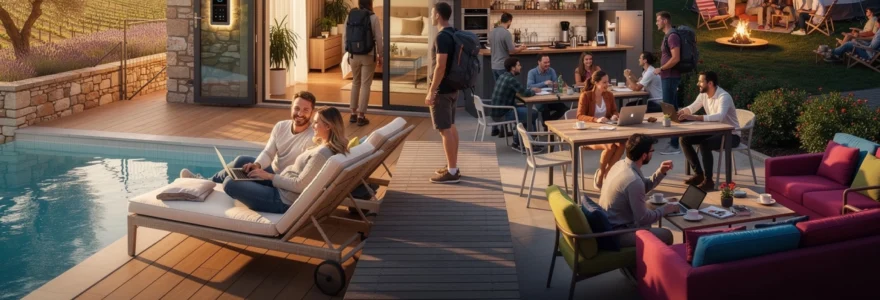
The accommodation you choose fundamentally shapes your travel experience, influencing everything from your daily routines to the memories you create. In today’s diverse hospitality landscape, travellers face an increasingly complex decision between privacy-focused options that offer solitude and personal space, versus socially-oriented accommodations that prioritise community interaction and shared experiences. This choice extends far beyond simple preference, affecting your budget, security, networking opportunities, and overall satisfaction with your journey. Understanding the nuances between these accommodation types enables you to make informed decisions that align with your travel goals, whether you’re seeking peaceful retreat or vibrant social connections.
Private accommodation types: villas, serviced apartments, and boutique properties
Private accommodation options represent the pinnacle of personal space and autonomy during travel. These properties cater to guests who prioritise exclusivity, customised experiences, and complete control over their environment. The private accommodation sector has evolved significantly, offering everything from luxury estates to intimate boutique properties that combine privacy with personalised service.
The appeal of private accommodations lies in their ability to provide sanctuary-like environments where guests can maintain their personal routines without compromise. Unlike shared spaces where you must consider others’ schedules and preferences, private properties allow you to dictate meal times, entertainment choices, and social interactions entirely on your own terms. This autonomy becomes particularly valuable during extended stays or when travelling for business purposes.
Luxury villa rentals in tuscany and provence: complete isolation benefits
Luxury villa rentals in iconic destinations like Tuscany and Provence represent the ultimate expression of private accommodation. These properties typically feature expansive grounds, private pools, and comprehensive amenities that eliminate the need to venture beyond the property boundaries. The isolation these villas provide isn’t merely physical but psychological, creating an environment where guests can completely disconnect from external pressures and distractions.
The benefits of complete isolation extend beyond simple privacy. Tuscany villas, often converted from historic farmhouses or estates, offer guests the opportunity to experience authentic local culture without the mediation of hotel staff or other tourists. You control every aspect of your experience, from selecting local ingredients at nearby markets to hosting intimate dinner parties in centuries-old dining rooms. This level of autonomy allows for deeper cultural immersion paradoxically through isolation.
Serviced apartment complexes: marriott executive apartments and fraser suites privacy features
Serviced apartment complexes like Marriott Executive Apartments and Fraser Suites bridge the gap between hotel services and residential privacy. These properties understand that modern travellers often require extended stays without sacrificing the convenience of hotel amenities. The privacy features integrated into these complexes reflect sophisticated understanding of guest needs, incorporating elements like separate entrances, soundproofed walls, and private balconies or terraces.
Fraser Suites, for instance, implements privacy-by-design principles throughout their properties. Guests enjoy keycard access that bypasses communal areas, in-apartment laundry facilities that eliminate shared spaces, and kitchenettes that reduce reliance on public dining areas. These features collectively create a residential atmosphere within a professionally managed environment, appealing particularly to business travellers and digital nomads who require both privacy and reliability.
Boutique hotel suites: aman resorts and four seasons private residence clubs
Boutique hotel suites from prestigious brands like Aman Resorts and Four Seasons Private Residence Clubs redefine luxury accommodation by emphasising intimate, personalised experiences over large-scale hospitality. These properties typically limit their room inventory to ensure exclusivity while providing extensive private spaces within each suite. The design philosophy centres on creating environments that feel like private residences rather than traditional hotel rooms.
Aman Resorts, renowned for their privacy-focused approach, often feature suites with private gardens, infinity pools, and dedicated butler services. The staff-to-guest ratio at these properties frequently exceeds 3:1, ensuring that personalised service never feels intrusive. This balance between luxury service and privacy represents a sophisticated understanding of high-end travellers’ expectations, where discretion becomes as important as opulence.
Self-catering cottages in lake district and scottish highlands: rural privacy analysis
Self-catering cottages in remote locations like the Lake
District and Scottish Highlands extend this privacy-focused model into rural settings, where low population density and natural barriers enhance seclusion. Many of these cottages are positioned on large plots of land, often with no immediate neighbours in sight, allowing guests to enjoy unobstructed views and minimal external noise. For travellers who find urban environments overstimulating, this rural privacy can be deeply restorative, supporting digital detox, reflective retreats, or focused creative work.
Rural self-catering also shifts control of your daily rhythm entirely into your hands. You decide when to cook, when to hike, and when to simply sit in silence listening to the wind across the fells. The trade-off is that services are limited; you are responsible for supplies, transport, and sometimes even heating systems or wood-burning stoves. For some, this added responsibility enhances the sense of independence; for others, it may feel like too much effort compared with serviced accommodation.
Social accommodation models: hostels, co-living spaces, and community-centric properties
On the opposite side of the spectrum from private villas and cottages are social accommodation models that prioritise interaction, collaboration, and community. These properties are designed for travellers who value connection as much as, or even more than, solitude. Instead of maximising distance between guests, they intentionally create points of contact where conversations, friendships, and sometimes professional networks can form.
Hostels, co-living spaces, and community-centric hotels respond to a clear trend: a growing number of travellers—especially under 40—report that meeting new people is one of their primary reasons for choosing a particular type of accommodation. Here, shared dormitories, communal kitchens, and co-working lounges replace private pools and gated driveways. The question becomes less “How far can I be from others?” and more “How easily can I meet like-minded people while still maintaining basic privacy?”
Generator hostels and YHA network: shared dormitory social dynamics
Brands such as Generator Hostels and the YHA network have refined the art of shared dormitory living, balancing affordability with a vibrant social scene. Dorms with 4–12 beds encourage interaction by design: bunk layouts, shared bathrooms, and communal storage areas create natural opportunities for conversation. For solo travellers, this can be the fastest route to building a temporary social circle, especially in major cities where hostels often organise free walking tours, bar nights, and cultural events.
However, shared dormitories also come with clear privacy trade-offs. Noise, differing sleep schedules, and limited personal storage can challenge even seasoned travellers. To mitigate this, newer properties deploy privacy-focused design features such as bunk curtains, individual reading lights, power outlets, and lockable under-bed drawers. These small interventions can make the difference between feeling like you are sleeping in a crowded train carriage and feeling as though you have a small, semi-private nook within a social environment.
Co-living platforms: the collective and roam network community integration
Co-living platforms like The Collective and Roam target a slightly different audience: remote workers, digital nomads, and professionals seeking medium- to long-term stays. Instead of nightly dorm beds, they offer private rooms or micro-apartments combined with extensive shared amenities: co-working spaces, event kitchens, gyms, and rooftop terraces. The goal is not just to provide accommodation but to curate an ongoing community where residents can collaborate, network, and form deeper relationships.
Community integration is engineered through programming as much as architecture. Weekly events—from skill-share workshops to film nights and yoga classes—give residents structured ways to meet without the awkwardness of cold introductions. At the same time, private rooms with robust soundproofing and secure access respect residents’ need to disconnect after a long workday. This hybrid model can be ideal if you want consistent social contact without giving up the ability to close a door and enjoy true privacy when you choose.
Backpacker hostels in bangkok’s khao san road and berlin’s kreuzberg district
Backpacker hostels in nightlife-heavy districts like Bangkok’s Khao San Road or Berlin’s Kreuzberg push the social model even further. These properties often market themselves on their party atmosphere, proximity to bars and clubs, and round-the-clock energy. For some travellers, particularly younger backpackers on gap years, this high-intensity social vibe is the main attraction: new friends every night, shared stories over cheap street food, and impromptu plans to move on to the next destination together.
Yet this level of social intensity can come at the cost of rest and routine. Noise levels are typically high, quiet hours may be loosely enforced, and privacy is minimal even in smaller dorms. If you’re working remotely, recovering from jet lag, or simply prefer earlier nights, these districts might feel more exhausting than energising. It helps to think of them like staying above a lively bar—you gain immediate access to a nightlife hub, but you sacrifice tranquillity and control over your environment.
Social hotels: citizenm and moxy by marriott community-focused design principles
Social hotels such as citizenM and Moxy by Marriott apply hostel-style sociability to a more polished, hotel-level environment. Rooms are compact and tech-enabled, often with self-check-in kiosks, mood lighting, and app-based controls. The real focus, however, is on expansive, carefully designed lobbies that function as living rooms, co-working hubs, and social spaces all in one. Instead of a formal reception desk, you’ll often find communal tables, bar counters, and comfortable seating that invite guests to linger.
These brands recognise that many modern travellers don’t want to be confined to their room for work or relaxation. By investing heavily in shared spaces and keeping private rooms efficient rather than expansive, they create a cost-effective way to experience a community-driven environment without sacrificing the security and comfort standards of a traditional hotel. For business travellers or digital nomads who enjoy casual networking but still expect a quiet, private room at the end of the day, social hotels can be an ideal middle ground.
Glamping sites and festival accommodation: shared experience environments
Glamping sites and festival accommodation represent another form of social living, where the primary draw is a shared experience rather than a specific building type. Safari tents, yurts, and eco-pods at music festivals or wellness retreats are often arranged in clusters, with shared fire pits, communal dining tents, and central gathering spaces. The result is a temporary village where interaction feels almost inevitable.
Privacy in these environments is typically functional rather than absolute—you have your own tent or pod, but thin walls and close proximity mean you will hear neighbours and share facilities. For many, the trade-off is worthwhile: the sense of belonging to a temporary community can be powerful, and the shared experience becomes a core memory of the trip. If you thrive on collective energy and don’t mind reduced personal space for a few days, these environments can be uniquely rewarding.
Location-specific privacy considerations: urban density vs rural seclusion
Regardless of the accommodation category you choose, location exerts a powerful influence on how much privacy or social interaction you actually experience. Urban density naturally compresses personal space: even in a private apartment, you may share thin walls with neighbours, navigate busy lobbies, and hear street noise late into the night. In contrast, rural seclusion stretches distance between people, allowing even modest properties to feel more private simply because of their setting.
When evaluating urban accommodation, it helps to look beyond the building and consider the micro-neighbourhood. Is the property on a busy nightlife street, next to a train line, or facing a quiet residential courtyard? Two apartments in the same city can offer radically different privacy levels depending on their orientation and surrounding land use. Conversely, rural stays demand attention to practicalities: how far are you from essential services, public transport, or emergency assistance? Extreme seclusion can feel liberating, but it may introduce risk or inconvenience if you are travelling without a car or have health considerations.
Budget allocation strategies: privacy premium vs social accommodation cost efficiency
Privacy almost always carries a premium. A private villa, serviced apartment, or boutique suite typically costs significantly more per night than a bed in a shared dormitory or a co-living room, sometimes by a factor of five or more in popular destinations. The key question is not simply “Can I afford this?” but “Is the added privacy worth the additional cost for this particular trip?” For a short, rest-focused getaway or an important work project, paying extra for quiet and control may be money well spent.
On the other hand, social accommodation can dramatically increase your budget efficiency, freeing funds for experiences, dining, and transport. If your primary goal is to explore and meet people, a well-reviewed hostel or social hotel might deliver higher overall satisfaction than a more expensive but isolating apartment. One practical strategy is to mix models within a single journey: perhaps start with a few nights in a lively co-living space to build connections and get oriented, then shift to a more private rental for deep work or recovery before flying home.
Demographic-based accommodation matching: solo travellers, couples, and group dynamics
Different demographics tend to favour different positions on the privacy–social spectrum, though there is plenty of overlap. Solo travellers often gravitate toward hostels, co-living spaces, or social hotels because these environments make it easier to meet people and avoid loneliness. That said, introverted solo travellers or those on work assignments may feel safer and more productive in studio apartments or serviced residences where they can control social exposure more carefully. Asking yourself whether you want company built into your environment is a useful starting point.
Couples and small groups frequently prioritise a mix of privacy and shared space. A private apartment, cottage, or villa gives them room to relax together without constant exposure to other guests, while proximity to cafes, bars, or co-working hubs still allows for optional social time. Larger groups—friends travelling together, extended families, or retreat participants—can benefit from renting entire properties, which combine intra-group social interaction with a strong boundary from the outside world. In these scenarios, the “social vibe” comes from within the group, while the accommodation itself functions as a private bubble.
Technology integration: keyless entry systems, smart home features, and digital privacy controls
Technology increasingly shapes both privacy and social dynamics in accommodation. Keyless entry systems and smart locks, now common in serviced apartments, co-living properties, and even hostels, streamline access while enhancing security. You no longer need to worry about lost keys or unauthorised copies; digital credentials can be revoked instantly, and access can be limited to specific areas. For privacy-conscious travellers, this means fewer interactions at reception desks and more control over who enters shared or private spaces.
Smart home features—such as app-controlled lighting, climate, and blinds—also contribute to a sense of personal control, especially in compact hotel rooms and serviced apartments. At the same time, digital platforms used by co-living operators and social hotels can foster community: in-house apps might list events, allow residents to book shared spaces, or facilitate messaging between neighbours. The flip side is digital privacy: whenever data is collected, from access logs to in-room device usage, you should understand how it is stored and used. Reading privacy policies may not be exciting, but for many modern travellers it is an essential step in choosing accommodation that feels not only comfortable, but also secure in both physical and digital terms.