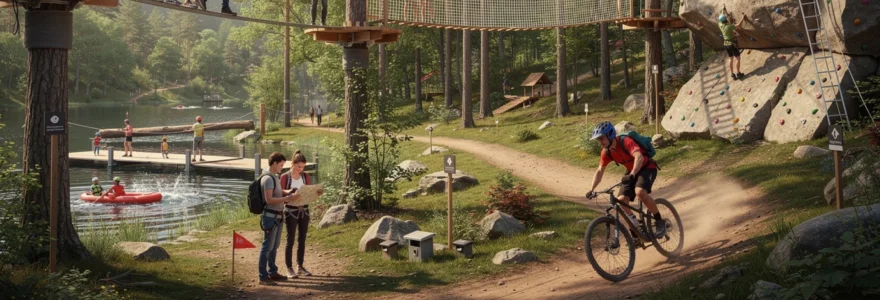
Adventure parks represent a revolutionary approach to outdoor recreation, seamlessly blending heart-pounding excitement with environmental consciousness. These innovative destinations offer visitors an opportunity to experience nature from entirely new perspectives while challenging their physical and mental boundaries. From soaring through forest canopies on zip lines to navigating intricate rope courses suspended high above the ground, adventure parks have transformed how people interact with natural landscapes.
The growing popularity of adventure parks reflects a broader cultural shift towards experiential tourism and sustainable outdoor activities. These facilities cater to diverse age groups and skill levels, making adrenaline-fueled adventures accessible to families, thrill-seekers, and nature enthusiasts alike. What sets modern adventure parks apart is their commitment to environmental stewardship whilst delivering unforgettable experiences that reconnect visitors with the natural world.
Canopy-based adventure infrastructure and elevated course design
The foundation of any successful adventure park lies in its canopy-based infrastructure, which requires sophisticated engineering solutions that work harmoniously with existing forest ecosystems. Modern elevated course design prioritises both safety and environmental impact, utilising advanced materials and construction techniques that minimise disruption to natural habitats. The structural integrity of these installations must withstand varying weather conditions whilst accommodating thousands of visitors annually.
Tree selection plays a crucial role in canopy course development, as engineers must identify specimens with sufficient trunk diameter, robust root systems, and healthy growth patterns. Mature hardwood trees typically serve as primary anchor points, with oak, beech, and maple species proving particularly suitable for supporting adventure infrastructure. Professional arborists conduct comprehensive health assessments before any construction begins, ensuring long-term viability of both the course and the supporting trees.
Zip line engineering and cable tensioning systems for forest environments
Zip line systems represent some of the most technically demanding elements within adventure parks, requiring precise calculations for cable tensioning, load distribution, and environmental factors. Modern zip line engineering employs high-grade steel cables with breaking strengths exceeding 50,000 pounds, providing substantial safety margins even under maximum loading conditions. The tensioning systems must account for temperature fluctuations, which can cause cable expansion and contraction throughout different seasons.
Professional installers utilise specialised equipment to achieve optimal cable tension, typically maintaining forces between 2,000 and 4,000 pounds depending on span length and expected loads. The angle of descent is carefully calculated to ensure riders achieve appropriate speeds whilst maintaining control throughout the journey. Brake systems at landing platforms automatically regulate approach speeds, preventing excessive force transfer to both riders and infrastructure components.
Treetop walking platforms and suspension bridge construction techniques
Treetop walking platforms create stable observation points and rest areas within the canopy environment, requiring robust construction techniques that accommodate natural tree movement. These platforms typically employ flexible mounting systems that allow for seasonal growth and wind sway whilst maintaining structural integrity. The decking materials must provide excellent grip in all weather conditions whilst resisting decay from constant exposure to moisture and temperature variations.
Suspension bridges connecting platforms present unique engineering challenges, as they must remain stable under varying load conditions whilst preserving the natural movement characteristics that make them exciting to traverse. Advanced cable-stay designs distribute loads effectively across multiple anchor points, reducing stress on individual trees. The integration of shock-absorbing elements helps minimise the transmission of dynamic forces from user movement to the supporting vegetation.
High ropes course safety protocols and harness integration methods
Safety protocols for high ropes courses encompass comprehensive training programmes, regular equipment inspections, and redundant safety systems that protect participants throughout their adventure experience. Modern harness integration methods employ continuous belay systems that eliminate the possibility of user disconnection during course navigation. These systems utilise specially designed trolleys that cannot be removed from safety cables without deliberate action by trained staff members.
Participant safety briefings cover proper harness adjustment, movement techniques, and emergency procedures, ensuring visitors understand their responsibilities throughout the experience. Weight restrictions and health considerations are carefully assessed before allowing access to elevated courses. Qualified instructors monitor participants continuously, providing assistance and encouragement whilst maintaining strict adherence to safety protocols established by industry governing bodies.
Aerial adventure park load distribution and tree health preservation
Engineers use non-invasive attachment systems, such as adjustable girdle braces and friction collars, to spread loads around the tree circumference rather than concentrating pressure on a single point. Dynamic load calculations consider simultaneous users, wind loading, and rescue scenarios, ensuring that no individual tree is pushed beyond conservative safety thresholds. Regular tree health inspections, including resistograph testing and sonic tomography, detect internal decay or stress fractures long before they become critical. Where possible, freestanding towers, rock anchors, or ground-based pylons supplement tree supports, creating a hybrid structure that balances adventure park load distribution with long-term tree health preservation.
To further protect forest ecosystems, many adventure parks implement designated no-traffic zones around sensitive root systems, using raised walkways and mulch paths to reduce soil compaction. Drip-line protection strategies ensure that construction does not interfere with water and nutrient uptake, while specialised bark pads prevent abrasion at contact points. You will often find that leading operators collaborate closely with local ecologists to map wildlife corridors and nesting areas, adjusting course layouts accordingly. This holistic approach ensures that aerial adventure elements enhance, rather than compromise, the resilience of the surrounding woodland.
Ground-level adrenaline activities and natural terrain utilisation
While canopy courses capture the imagination, ground-level adventure activities provide equally compelling ways to harness natural terrain for outdoor recreation. Thoughtfully designed trails, climbing areas, and obstacle zones can turn hillsides, riverbanks, and open meadows into dynamic playgrounds that challenge strength, balance, and navigation skills. The key is to work with the existing topography rather than against it, using slopes, rock formations, and forest clearings as integral components of the experience. This philosophy of natural terrain utilisation not only reduces construction costs but also maintains the authenticity of the landscape.
Ground-based adventures often serve as entry-level or family-friendly options, offering accessible thrills for visitors who may not be ready for high ropes or long zip lines. By providing a spectrum of difficulties—from gentle walking loops to technical downhill tracks—parks can create an inclusive environment that encourages skill progression over multiple visits. In addition, these activities spread visitor traffic over a wider area, helping to relieve congestion on popular canopy routes and supporting better environmental carrying capacity management. For operators, the combination of elevated and terrestrial attractions delivers a more resilient and diversified adventure park model.
Mountain biking trail design and flow track construction
Mountain biking trails form one of the most popular components of ground-level adventure parks, blending speed, skill, and terrain reading into a single exhilarating activity. Professional trail builders focus on creating flow tracks that guide riders through a natural rhythm of berms, rollers, and small jumps, allowing momentum to carry them smoothly from one feature to the next. Just as a well-composed song rises and falls in intensity, a well-designed trail alternates between fast, open sections and tighter technical segments to keep riders engaged without overwhelming them. Soil type, drainage patterns, and erosion risk all influence line choice and construction methods.
Sustainable trail design follows the principle of “grade reversals” and outslope shaping to manage water runoff, reducing rutting and maintenance needs. Builders often cap heavily used corners with rock armouring or imported crushed aggregate to preserve trail integrity in wet conditions. To cater for different skill levels, many parks implement a stacked loop system, where beginner green routes branch near the base area and progressively more advanced blue, red, and black trails extend deeper into the terrain. Clear signage, one-way flow, and well-marked crossing points minimise collision risk and create a safer environment for both riders and walkers.
Via ferrata route planning and rock face integration
Via Ferrata routes—protected climbing paths equipped with steel rungs, cables, and ladders—offer a unique way to open steep rock faces to a broader audience. Effective route planning starts with a detailed geological survey, identifying stable rock strata, natural ledges, and existing weaknesses such as fracture lines or loose blocks. Designers aim to follow the “logic” of the cliff, weaving the route through natural features rather than forcing artificial lines of ascent. This not only enhances the sense of immersion but also reduces the need for heavy drilling and anchoring, preserving the character of the rock.
Safety is central to Via Ferrata integration, with continuous lifeline cables and certified anchor points placed at regular intervals. Much like a guardrail on a mountain road, these systems provide a constant reference and backup for users navigating exposed sections. To limit visual and ecological impact, installers select low-profile hardware and avoid sensitive habitats such as nesting ledges or rare plant communities. Difficulty grading, escape routes, and weather exposure are all factored into the planning process, ensuring that participants can choose an appropriate challenge and descend safely if conditions deteriorate.
Natural climbing wall development and boulder problem setting
Natural rock outcrops and boulder fields can be transformed into world-class climbing venues with careful preparation and route setting. Unlike artificial climbing walls, which are designed from the ground up, natural climbing areas require subtle interventions that enhance usability without compromising the rock. Loose blocks are removed, landing zones are cleared and levelled, and access paths are established to minimise trampling of surrounding vegetation. Route setters then identify lines that flow logically between holds, considering body movement, balance, and the intended difficulty grade.
Developing engaging boulder problems is as much an art as a science, akin to composing a short but intense puzzle that climbers must solve using strength and technique. Problems are often grouped by difficulty and style—overhangs, slabs, aretes—to help visitors find climbs that suit their preferences and abilities. To keep areas sustainable, many parks introduce seasonal closures during wildlife breeding periods and encourage the use of crash pads, spotters, and soft-soled shoes that minimise rock polishing. Clear ethical guidelines, including brushing holds and staying on marked access trails, help preserve the experience for future generations of climbers.
Orienteering course layout and geocaching technology implementation
Orienteering courses and geocaching trails add a cerebral dimension to adventure park offerings, inviting visitors to engage with navigation, map reading, and problem-solving. Course planners strategically position control points in varied terrain—open fields, dense woodland, water features—to create route choices that reward both speed and smart decision-making. In family-focused parks, shorter loops with larger, more visible markers introduce newcomers to the basics of compass use and topographic map interpretation. More advanced circuits may incorporate micro-navigation challenges that require precise bearings and careful attention to contour lines.
Integrating geocaching technology allows operators to layer digital storytelling onto the physical landscape. GPS-enabled apps guide users to hidden caches containing clues, historical facts, or small rewards, turning the park into an interactive treasure hunt. This blend of technology and nature can be particularly effective for engaging younger visitors who are accustomed to screens, demonstrating that digital tools can enhance rather than replace outdoor experiences. By updating cache locations and storylines periodically, parks keep the activity fresh and encourage repeat visits.
Water-based adventure elements and aquatic challenge integration
Water-based adventures bring a refreshing dimension to multi-activity parks, harnessing lakes, rivers, and coastal environments for both high-adrenaline and reflective experiences. Floating obstacle courses, white-water channels, and paddle sports areas can be designed to work in harmony with natural hydrology and aquatic ecosystems. As with canopy and ground-level elements, the emphasis is on integrating structures with existing features—such as eddies, inlets, and shoreline vegetation—rather than imposing rigid geometries onto fluid landscapes. This preserves the character of the water body while maximising its recreational potential.
Designers of aquatic challenge zones must account for variables that change far more rapidly than in terrestrial settings, including seasonal water levels, flow rates, and temperature fluctuations. Safety considerations extend beyond life jackets and helmets to encompass water quality monitoring, rescue access, and clear route demarcation for mixed-use areas shared by kayakers, swimmers, and stand-up paddleboarders. Many parks now incorporate inflatable aqua parks anchored to the lakebed, offering slides, balance beams, and climbing towers that can be removed during off-season periods to minimise environmental impact. By combining instruction, guided tours, and self-led play areas, operators can make water-based adventure accessible to a wide range of visitors.
Leading adventure park destinations and benchmark facilities
Certain adventure parks have emerged as industry benchmarks, demonstrating how to combine fun, adrenaline, and nature in ways that are both commercially successful and environmentally responsible. These facilities often function as living laboratories for new technologies, safety systems, and ecological integration strategies. By studying their design choices and operational practices, we gain insight into what works at scale—and where future innovation is heading. The following examples highlight different approaches to forest-based and natural terrain adventure programming across the UK.
Although each destination is shaped by its local landscape and community, they share several common principles: robust safety cultures, long-term partnerships with landowners and conservation groups, and a commitment to continuous improvement. Many are also active members of national or international trade associations, helping to set industry standards that smaller operators can adopt. For visitors, these parks offer more than just a day out; they provide models of how outdoor recreation and environmental stewardship can reinforce each other.
Go ape UK network and forest-based adventure programming
The Go Ape network is perhaps the most recognisable name in UK forest adventure, with over 30 locations spread across England, Scotland, and Wales. Its core offering centres on treetop canopy courses, zip lines, and ground-based Segway or bike trails, all situated within publicly owned forests such as those managed by Forestry England. Go Ape’s design philosophy emphasises minimal forest disturbance, using non-invasive tree attachments and carefully routed access paths to protect root systems and understorey habitats. Courses are periodically reconfigured or relocated to allow recovery in high-traffic areas.
From a programming perspective, Go Ape has diversified its portfolio to include family-friendly “Treetop Adventure” routes, more demanding “Treetop Challenge” circuits, and seasonal night-time events that offer a different perspective on the forest. Staff training is heavily standardised across the network, ensuring consistent safety practices and customer service regardless of location. The company also collaborates with local schools and community groups, using its courses as outdoor classrooms for topics ranging from ecology to teamwork and leadership. For many visitors, Go Ape serves as an accessible gateway into the wider world of adventure sports.
Tree top adventure parks wales and ecological integration models
In Wales, Tree Top Adventure-style parks have capitalised on dramatic valley landscapes and dense woodlands to create visually striking canopy routes and zip lines. These facilities often operate in partnership with national parks or private estates, aligning their development plans with broader conservation and tourism strategies. Ecological integration models typically begin with comprehensive biodiversity surveys, identifying sensitive species, habitats, and seasonal patterns that must be protected. Course routes are then adjusted to avoid disturbance hotspots, with designated buffer zones around nesting sites and rare plant communities.
Many Welsh adventure parks also invest in habitat enhancement projects, such as installing bat boxes, creating deadwood piles for invertebrates, or restoring native ground flora along decommissioned paths. Interpretive signage and guided walks help visitors understand the ecological context of their activities, transforming a day of adrenaline into an educational experience. By linking ticket revenue to ongoing conservation work, operators can demonstrate tangible benefits for the landscape that hosts their attractions. This integrated approach reinforces the idea that adventure tourism and biodiversity protection are not mutually exclusive goals.
Sherwood pines adventure course and multi-activity hub design
Sherwood Pines in Nottinghamshire has evolved into a prominent example of a multi-activity adventure hub set within a working forest. Alongside treetop courses and zip lines, visitors can access extensive mountain biking networks, running trails, play areas, and picnic zones, all served by a central visitor facility with cafes, bike hire, and information points. The layout is carefully planned to separate high-speed activities from quieter recreation spaces, using natural screening and staggered access routes to minimise conflicts. This hub-and-spoke model allows different user groups to coexist without compromising each other’s experience.
From an operational standpoint, Sherwood Pines showcases how shared infrastructure—parking, toilets, first aid facilities—can support multiple adventure providers and independent concessions. This creates a more resilient economic model, as the site is not reliant on a single attraction or seasonal product. The forest’s long-term management plan includes thinning, replanting, and habitat diversification, ensuring that the adventure infrastructure can adapt as the woodland structure changes over decades. For planners seeking to develop new sites, Sherwood Pines offers a compelling blueprint for integrating recreation, forestry, and visitor services.
Crocky trail cheshire and natural obstacle course innovation
The Crocky Trail in Cheshire takes a different approach, focusing on ground-level natural obstacle courses that weave through fields, streams, and woodland margins. Rather than relying heavily on steel cables and formal platforms, it uses a mixture of timber structures, earthworks, and simple mechanical devices—swings, wobble bridges, and rotating barrels—to create a sense of playful unpredictability. The design ethos is deliberately rustic, encouraging visitors to embrace mud, splashes, and minor knocks as part of the adventure. This low-tech aesthetic can be as compelling for children as more polished installations found elsewhere.
Innovation at Crocky Trail lies in its constant evolution, with new obstacles introduced and old ones modified or retired based on user feedback and wear patterns. Because many features are close to the ground, risk can be managed through surface treatments—such as bark mulch, sand, or shallow water—rather than complex harness systems. This keeps inspection and maintenance regimes focused on structural integrity and environmental impact, rather than personal protective equipment. The result is a highly interactive environment that demonstrates how creativity and natural materials can generate powerful experiences without extensive engineering.
Environmental impact assessment and sustainable adventure tourism
As adventure parks expand in number and scale, rigorous environmental impact assessment (EIA) has become a cornerstone of responsible development. A thorough EIA process examines how proposed infrastructure might affect soil stability, hydrology, flora and fauna, landscape character, and local communities. Baseline surveys establish existing conditions against which future changes can be measured, providing an evidence base for design decisions and mitigation strategies. Just as a detailed medical history informs a treatment plan, this environmental “profile” guides where, how, and even whether certain adventure elements should be built.
Sustainable adventure tourism also looks beyond the initial construction phase to consider long-term operational impacts, including energy use, waste generation, and visitor transport patterns. Many leading parks adopt circular economy principles, prioritising durable materials, modular components that can be reused, and on-site recycling or composting facilities. Partnerships with public transport providers and incentives for car-sharing can reduce the carbon footprint associated with visitor travel, which often represents a significant share of total emissions. Transparent communication of sustainability efforts helps build trust with local stakeholders and increasingly eco-conscious visitors.
Adaptive management is vital, as even well-planned interventions can have unforeseen consequences once thousands of people begin using a site. Regular monitoring of trail erosion, vegetation recovery, wildlife behaviour, and visitor satisfaction allows operators to tweak layouts, introduce rest periods for overused areas, or trial alternative materials. Some parks implement carrying capacity limits, using booking systems to regulate daily visitor numbers and avoid overcrowding. By treating environmental stewardship as an ongoing process rather than a one-off approval hurdle, adventure parks can remain thriving, low-impact attractions for decades.
Adventure park safety certification and risk management frameworks
Underpinning every successful adventure park is a robust safety certification regime and a comprehensive risk management framework. In Europe, standards such as EN 15567 for ropes courses and EN 13814 for amusement rides provide detailed guidance on design, inspection, and operation. Independent audits by accredited bodies verify that installations meet or exceed these benchmarks before opening to the public, and periodic re-certification ensures continued compliance. This formal process is complemented by internal safety cultures that encourage staff to report hazards, share best practices, and engage proactively with risk.
Effective risk management acknowledges that adventure inherently involves controlled exposure to challenge, height, speed, or water. The goal is not to eliminate all risk, but to manage it to an acceptable level through layered controls. These include engineering measures—such as redundancy in cables and anchors—administrative procedures like operating manuals and emergency plans, and personal protective equipment for participants. Many operators employ a “dynamic risk assessment” approach, training staff to continually evaluate conditions such as weather, crowding, and user behaviour and to adjust operations accordingly.
For visitors, clear communication is one of the most powerful safety tools. Pre-visit information sets expectations about fitness requirements, clothing, and medical considerations; on-site briefings explain equipment use, course rules, and what to do in an emergency. Signage reinforces key messages at critical points, while staff remain visible and approachable throughout the experience. Post-incident reviews and near-miss reporting feed into continuous improvement cycles, ensuring that lessons are captured and acted upon rather than repeated. By embedding these practices into everyday operations, adventure parks can offer high-adrenaline experiences that remain as safe, reliable, and environmentally responsible as possible.