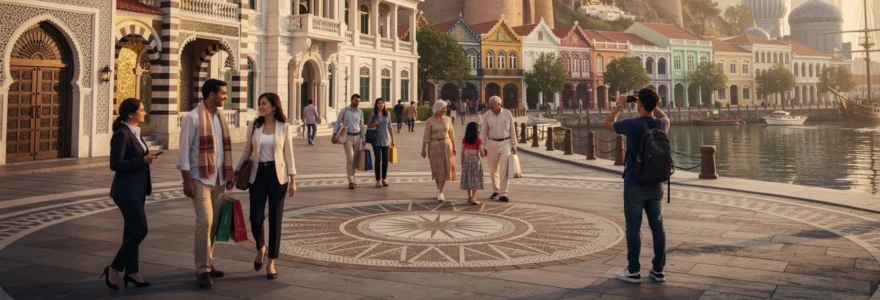
Throughout history, certain cities have served as remarkable melting pots where diverse civilisations converge, creating unique cultural landscapes that transcend traditional boundaries. These urban centres, positioned at strategic geographical junctures or significant trade routes, have witnessed the extraordinary phenomenon of cultural amalgamation—where different traditions, architectural styles, religious practices, and social customs blend to form entirely new identities. From ancient Constantinople’s role as the bridge between East and West to modern Singapore’s multicultural harmony, these cities demonstrate how human societies naturally adapt and evolve through cross-cultural exchange. The resulting hybrid cultures often exhibit greater resilience and innovation than their constituent parts, proving that diversity serves as a catalyst for human advancement.
The process of cultural synthesis in these crossroads cities rarely occurs without tension or challenge. Power imbalances, colonial influences, and economic pressures have shaped how different traditions interact and merge. Yet despite these complexities, the enduring legacy of such cultural fusion continues to influence global architecture, cuisine, art, and social practices. Understanding these urban environments provides crucial insights into how contemporary multicultural societies can navigate diversity whilst preserving authentic heritage.
Mediterranean confluence cities: architectural syncretism and urban heritage
The Mediterranean basin has long served as a crossroads for European, African, and Middle Eastern civilisations, creating cities where architectural traditions merge in spectacular fashion. These urban centres showcase how different building techniques, decorative motifs, and spatial concepts can harmoniously coexist within single structures. The resulting architectural syncretism represents centuries of cultural dialogue, where conquerors and conquered alike contributed to evolving urban landscapes.
Mediterranean confluence cities demonstrate remarkable adaptability in their built environments, where successive rulers and immigrant communities added layers of cultural expression without completely erasing previous traditions. This architectural palimpsest approach created urban spaces that simultaneously honour multiple heritage streams whilst establishing distinct local identities.
Venetian byzantine integration in ravenna’s basilica san vitale
Ravenna’s Basilica San Vitale exemplifies the sophisticated merger of Byzantine theological concepts with local Italian construction techniques. Built during the 6th century under Emperor Justinian’s patronage, this octagonal masterpiece demonstrates how Eastern Orthodox spiritual symbolism could adapt to Western architectural sensibilities. The basilica’s innovative use of brick and marble, combined with extraordinary mosaic programmes depicting both imperial and religious themes, created a template for cross-cultural architectural expression.
The building’s structural innovations, including its distinctive dome-on-pendentives system and complex geometric floor plan, influenced subsequent ecclesiastical architecture throughout the Mediterranean. Local craftsmen incorporated Venetian marble-working techniques with Byzantine mosaic artistry, producing decorative schemes that remained unparalleled in their complexity and artistic achievement. This synthesis established architectural precedents that would resonate throughout medieval Europe.
Moorish gothic synthesis in córdoba’s Mezquita-Catedral
Perhaps no building better illustrates architectural cultural fusion than Córdoba’s Great Mosque-Cathedral, where Islamic and Christian traditions intersect within a single sacred space. Originally constructed as a mosque during the 8th century, the building underwent continuous expansion under successive Umayyad rulers, incorporating Visigothic and Roman architectural elements already present on the site. The famous horseshoe arches, supported by recycled classical columns, created an entirely new aesthetic vocabulary that influenced Islamic architecture across Spain and North Africa.
Following the Christian Reconquista in 1236, rather than demolishing the mosque, church authorities chose to insert a Gothic cathedral nave within the existing Islamic structure. This unprecedented architectural decision created a unique spatial experience where worshippers encounter both mihrab and altar, witnessing centuries of religious and cultural evolution within a single building. The Mezquita-Catedral represents successful architectural diplomacy, demonstrating how sacred spaces can accommodate multiple traditions without losing their essential character.
Ottoman neoclassical fusion in istanbul’s dolmabahçe palace
Istanbul’s Dolmabahçe Palace, completed in 1856, represents the Ottoman Empire’s ambitious attempt to synthesise traditional Islamic palace architecture with contemporary European neoclassical styles. Sultan Abdülmecid I commissioned Armenian architects Garabet Balyan and his son Nigoğos Balyan to create a palace that would rival Versailles whilst maintaining distinctly Ottoman characteristics. The resulting structure
combines baroque ornamentation, neoclassical symmetry, and traditional Ottoman spatial organisation overlooking the Bosphorus. Inside, crystal chandeliers from Bohemia hang above ceilings painted in the European academic style, while the layout still reflects the sequential reception halls and private apartments characteristic of earlier Ottoman palaces. Even the use of materials is hybrid: Western-inspired grand staircases coexist with intricate Ottoman kündekari woodwork and calligraphic panels.
This deliberate fusion signalled the empire’s desire to participate in European modernity without abandoning its Islamic and Anatolian roots. As a built manifesto of reform-era politics, Dolmabahçe illustrates how architecture can become a language of cultural negotiation, encoding geopolitical aspirations in stone, glass, and silk. For contemporary visitors, the palace offers a vivid lesson in how cities at the crossroads of cultures visually communicate shifts in identity, power, and global belonging.
Mudéjar architectural elements in seville’s alcázar complex
Seville’s Real Alcázar is one of the clearest expressions of Mudéjar architecture—an Iberian style in which Muslim artisans adapted Islamic decorative forms to serve Christian patrons. After the Christian reconquest, Castilian rulers chose not to demolish the existing Islamic palace structures but to expand and remodel them using local Muslim craftsmen. The result is a complex where Arabic inscriptions, muqarnas vaulting, and intricate tilework coexist with heraldic symbols of Christian monarchy.
The Patio de las Doncellas, with its horseshoe arches, stucco lacework, and patterned azulejos, reads almost like a continuation of Nasrid Granada, yet its programme celebrates Castilian royal power. This layered environment shows how political change does not always equate to cultural rupture; instead, artistic knowledge often survives across religious and dynastic transitions. In Seville’s case, the Alcázar became a long-term laboratory for cultural coexistence, shaping Andalusian identity as an enduring blend of Islamic, Christian, and later Renaissance influences.
Colonial port cities: mercantile networks and cultural exchange mechanisms
While Mediterranean cities reveal ancient patterns of cultural convergence, colonial port cities highlight how early modern trade networks accelerated cross-cultural exchange. Situated along vital sea routes, these ports became nodal points where merchants, missionaries, soldiers, and migrants negotiated new social and spatial practices. Their streets and waterfronts, often planned under European rule, were nonetheless shaped by local climates, materials, and indigenous traditions.
In these urban laboratories, colonial powers imposed civic grids, fortifications, and administrative quarters, but could not fully control how communities occupied and transformed the built environment. Hybrid neighbourhoods emerged around docks and markets, where architectural details, religious buildings, and everyday customs mixed in unexpected ways. By looking closely at architecture and urban form in colonial port cities, we gain insight into how power, commerce, and culture intersected to create enduring multicultural landscapes.
Dutch east india company influence on malacca’s peranakan architecture
Malacca, strategically located on the Strait of Malacca, passed through Portuguese, Dutch, and British control, yet it is most famously associated with the rich Peranakan, or Straits Chinese, culture. The Dutch East India Company introduced gabled townhouses, narrow-fronted plots, and masonry construction to the old town, reshaping its waterfront façade. Over time, local Chinese merchant families adapted these European forms, infusing them with Southern Chinese courtyard typologies and Malay decorative motifs.
The resulting Peranakan townhouses feature Dutch-influenced façades with shuttered windows and fanlights, while their interiors open into tiled courtyards framed by carved timber screens. Colourful ceramic tiles from Europe sit alongside ancestral altars and Malay-inspired ventilation features designed for the humid climate. This architectural amalgamation mirrors broader cultural fusion in Malacca’s food, language, and rituals, showing how merchant elites creatively appropriated colonial forms to express hybrid identities rather than simply mimicking European models.
Portuguese colonial adaptation in macau’s historic centre
Macau’s historic centre offers another striking example of a colonial port city forged through centuries of cultural contact, this time between Portugal and China. Portuguese planners introduced baroque churches, civic squares, and pastel-coloured townhouses, yet they had to adapt to local topography, monsoon weather, and existing Chinese settlement patterns. The famous Largo do Senado, with its wave-patterned pavement, captures this dialogue by evoking Lisbon’s plazas while responding to the scale and rhythms of Chinese street life.
Religious and civic buildings in Macau frequently mix European structural systems with Chinese materials and decorative schemes. Roofs may follow Chinese profiles with ceramic tiles, while façades display niches for Catholic saints framed by local stone and motifs. This hybrid urban fabric reflects not only missionary ambitions but also the practical realities of building with local craftsmen and resources. As a result, Macau illustrates how colonial cities often became shared creations, negotiated between imperial visions and indigenous knowledge.
British colonial infrastructure in singapore’s civic district
Singapore’s Civic District, laid out by Sir Stamford Raffles and later British administrators, demonstrates how colonial infrastructure could both structure and stimulate multicultural encounters. Neoclassical government buildings, law courts, and museums were strategically placed along the Singapore River, asserting British authority through symmetry, columns, and grand porticoes. Yet these monuments were embedded within a wider urban mosaic of Chinese shophouses, Malay kampongs, and Indian temples, all drawn together by trade.
Over time, many colonial-era structures have been repurposed into cultural institutions such as the National Gallery Singapore, which now curates narratives of regional and global art. This adaptive reuse transforms former symbols of empire into platforms for pluralistic storytelling, illustrating how cities can revisit and reinterpret their colonial heritage. For visitors and residents alike, walking through the Civic District becomes a way of tracing shifting power relations, from mercantile outpost to sovereign, multicultural metropolis.
French colonial urban planning in pondicherry’s white town
Pondicherry, on India’s southeastern coast, reveals how French colonial planning principles met South Indian social and climatic realities. The so-called White Town was laid out on a rectilinear grid facing the Bay of Bengal, with tree-lined boulevards, villas, and churches evoking a small-scale Mediterranean town. Thick masonry walls, high ceilings, and shaded verandas, however, responded directly to the tropical climate and local construction techniques.
Behind the formal symmetry of façades, many houses incorporate internal courtyards reminiscent of Tamil domestic architecture, demonstrating a quiet but significant transfer of knowledge. The adjacent Tamil Quarter, with its own dense network of streets and mixed-use buildings, created a parallel yet interdependent urban system. Together, these overlapping fabrics show how colonial cities were never monolithic; instead, they were negotiated environments where different communities shaped space according to their own cultural logics.
Silk road trading hubs: commercial diplomacy and religious pluralism
Long before modern globalisation, the Silk Road fostered a web of overland routes that connected China, Central Asia, the Middle East, and the Mediterranean. Cities along these paths flourished as centres of commerce and diplomacy, but also as arenas of intense religious and cultural interaction. Merchants did not simply exchange silk, spices, or precious metals; they carried ideas, rituals, languages, and artistic motifs across deserts and mountain passes.
Silk Road hubs became laboratories of religious pluralism, where Zoroastrian fire temples, Buddhist monasteries, Islamic madrasas, and Christian churches could coexist within the same urban perimeter. Rather than rigid frontiers, these cities functioned as semi-permeable membranes through which beliefs and aesthetics filtered and transformed. By examining their surviving architecture and archaeological remains, we can better understand how spiritual and commercial networks intertwined to generate enduring cross-cultural cities.
Zoroastrian fire temple preservation in yazd’s historic quarter
Yazd, located on the Iranian plateau, developed as a key caravan stop between Central Asia and the Persian Gulf. Its historic quarter, now a UNESCO World Heritage Site, preserves one of the most important Zoroastrian communities in the world, complete with functioning fire temples and dakhmeh (towers of silence) on the surrounding hills. These religious sites coexist with traditional mud-brick houses, windcatchers, and Islamic mosques, illustrating centuries of negotiated coexistence.
The Ateshkadeh, or Fire Temple of Yazd, contains a sacred flame said to have burned for more than 1,500 years, tended continuously by Zoroastrian priests. Architecturally, its relatively modest façade blends neoclassical columns with symbols of Ahura Mazda, while the urban setting reflects broader Persian courtyard traditions. Yazd shows how minority religious heritage can survive within larger Islamic urban frameworks, provided there are mechanisms—both political and social—for tolerance and protection.
Buddhist monastery networks in kashgar’s old city
Kashgar, at the western edge of China’s Xinjiang region, once stood as a vital junction where multiple Silk Road branches converged. While today it is best known for its Uyghur Islamic heritage, earlier periods saw an extensive Buddhist presence linked to monastic networks stretching into the Tarim Basin. Archaeological evidence from surrounding sites reveals cave temples, stucco sculptures, and manuscript fragments that attest to a once-flourishing Buddhist landscape.
Although many Buddhist structures in the immediate urban core have not survived intact, their historical imprint remains crucial for understanding Kashgar as a multilayered cultural crossroads. The city functioned like a relay station where religious ideas were translated—both literally and figuratively—before moving onward to Central Asia and China. This reminds us that present-day religious geographies often obscure older strata, and that cities can carry “ghost layers” of past traditions beneath their current skylines.
Islamic caravanserai architecture in bukhara’s trading districts
Bukhara, in present-day Uzbekistan, epitomises the Islamic urbanism that flourished along the Silk Road from the 9th century onwards. Its trading districts were anchored by caravanserais—fortified inns that offered merchants secure lodging, warehousing, and negotiation spaces. Architecturally, these complexes typically organised rooms around central courtyards, with heavy entrance portals and minimal exterior openings to protect goods and travellers.
Decorative brickwork, glazed tiles, and monumental pishtaq façades signalled prosperity while also conveying religious and political messages through inscriptions. The spatial logic of caravanserais, blending commercial pragmatism with hospitality and piety, reveals how Islamic law and mercantile ethics shaped built form. For modern observers, Bukhara’s preserved trading architecture provides a tangible analogue to today’s logistics hubs—structured yet porous spaces where cultures, commodities, and contracts intersect.
Nestorian christian communities in samarkand’s archaeological sites
Samarkand, famed for its Timurid monuments, also hosted one of the most easterly branches of early Christianity: the Church of the East, often called Nestorian. Archaeological excavations in and around the city have uncovered cross-marked tombstones, fragments of Syriac inscriptions, and traces of church structures. These remains testify to communities of merchants and clergy who operated alongside Muslims, Buddhists, and others, contributing to Samarkand’s diverse religious ecology.
The relative scarcity of monumental Christian architecture, compared with mosques and madrasas, should not obscure the significance of these communities. Like fine threads woven into a dense textile, Nestorian networks linked Central Asian nodes to Mesopotamia and even China. Recognising their presence challenges simplified narratives of religious homogeneity and underscores how Silk Road cities were shaped by overlapping, and sometimes fragile, minorities.
Contemporary multicultural metropolises: diaspora communities and urban sociology
In the 21st century, air travel, digital communication, and global labour markets have transformed certain cities into dense constellations of diaspora communities. Places like London, Toronto, Dubai, and Sydney function as hubs where people maintain simultaneous ties to multiple homelands. These metropolises are not just “containers” of diversity; they actively shape how new hybrid identities, cultural practices, and social movements emerge.
Urban sociologists describe such cities as “super-diverse,” meaning that differences of language, religion, legal status, and migration history intersect in complex ways. For you as a resident or visitor, this might be most visible in everyday spaces: a street where a West African hair salon sits next to a Polish grocery and a Bangladeshi café, or a school where dozens of home languages echo in the playground. These micro-interactions constantly renegotiate what it means to belong in the city.
At the same time, contemporary multicultural metropolises face acute challenges. Housing affordability, unequal access to services, and racialised policing can reinforce spatial segregation and social exclusion. Policies that celebrate diversity at the level of branding—through festivals or tourism campaigns—do not always address deeper structural inequalities. When we ask whether a global city truly functions as a crossroads of cultures, we must therefore look beyond its cosmopolitan image to examine who has the power to shape its spaces and narratives.
Cultural preservation methodologies: UNESCO world heritage site management
As cross-cultural cities grapple with rapid development and mass tourism, questions of heritage preservation become increasingly urgent. UNESCO World Heritage designation is one of the most visible tools used to safeguard sites that embody “outstanding universal value,” many of which are located in the very crossroads cities we have discussed. Yet inscription on this prestigious list is only the beginning; effective management requires delicate balancing acts between conservation, local livelihoods, and urban growth.
Heritage professionals now emphasise community participation and “living heritage” approaches rather than treating historic districts as frozen museum pieces. In practice, this means involving residents in decision-making, supporting traditional crafts and businesses, and allowing for sensitive adaptations that keep buildings functional. A historic bazaar that still serves local shoppers, for example, is often a stronger carrier of cultural memory than one converted entirely into souvenir stalls.
UNESCO guidelines also encourage integrated management plans that coordinate transport, tourism, risk preparedness, and environmental factors. For port cities and Silk Road hubs alike, this may involve regulating building heights around key monuments, controlling vehicle access, or setting visitor caps during peak seasons. Such measures can seem restrictive, but without them the very qualities that attract people to these places risk being eroded by congestion, pollution, and speculative development.
Gastronomy as cultural indicator: culinary fusion patterns in global cities
Perhaps nowhere is cultural blending more tangible—and more enjoyable—than in the kitchens and dining rooms of crossroads cities. Gastronomy offers a daily, intimate record of how traditions meet, mix, and evolve. Fusion is not just a trend in upscale restaurants; it is a long-standing reality of port towns, migrant neighbourhoods, and border markets, where cooks have always experimented with whatever ingredients and techniques were at hand.
In Mediterranean confluence cities, we see this in dishes that combine Arab spices, Italian pasta-making, and Ottoman grilling methods. Colonial ports like Malacca or Macau showcase Peranakan and Macanese cuisines, where soy sauce mingles with olive oil, and coconut milk enriches European-style stews. Modern metropolises extend this pattern: think of Korean tacos in Los Angeles, sushi burritos in London, or Turkish-German döner adapted into Berlin street food. Each plate tells a story of migration, adaptation, and sometimes resistance.
Food culture also reveals power dynamics and questions of authenticity. When does creative borrowing become exploitative appropriation? Who profits when a traditional recipe is repackaged for global audiences, and who gets left out of the narrative? By paying attention to where ingredients come from, how dishes are marketed, and which communities are visible in the restaurant landscape, we can read the city’s social hierarchies as clearly as its menus. In this sense, treating gastronomy as a cultural indicator helps us understand not only how cities are influenced by multiple traditions, but also how they continue to negotiate the terms of that influence every single day.