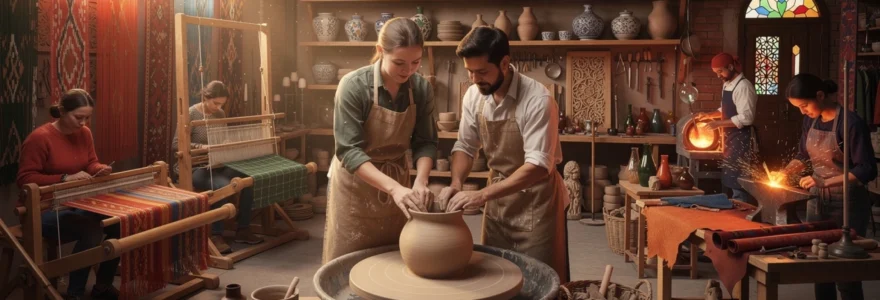
The gentle rhythm of a potter’s wheel spinning in a centuries-old Japanese studio, the satisfying click of shuttle against loom in a Highland cottage, or the ancient dance of hammer on anvil in a Mediterranean forge – these sounds represent something far more profound than mere craft instruction. Cultural workshops that focus on traditional artisanship offer travellers an opportunity to step beyond the surface of tourism and into the very heart of human creativity and cultural expression.
These immersive experiences transform participants from passive observers into active creators, forging connections between past and present through the universal language of skilled handiwork. Whether you’re learning the delicate art of Japanese raku pottery in Kyoto’s historic districts or mastering the intricate resist-dyeing techniques of Indian ikat in remote village cooperatives, each workshop becomes a bridge between cultures, generations, and ways of understanding the world through making.
The appeal of these workshops extends far beyond the creation of beautiful objects. They represent a form of cultural exchange that honours traditional knowledge whilst providing sustainable income for artisan communities. In an era where mass production dominates, these hands-on experiences offer both makers and participants a chance to reconnect with the essential human need to create something beautiful, functional, and meaningful with one’s own hands.
Traditional pottery and ceramics workshops across global artisan hubs
Pottery workshops represent perhaps the most accessible entry point into traditional craftsmanship, offering participants the opportunity to work with one of humanity’s most ancient materials. The tactile experience of shaping clay connects makers directly to thousands of years of human innovation, whilst each regional tradition brings its own unique techniques, cultural significance, and aesthetic philosophy.
Contemporary pottery tourism has evolved significantly beyond simple tourist demonstrations. Modern workshops emphasise authentic technique transmission, often taking place within working pottery communities where traditional methods remain central to daily life. Participants frequently spend several days or weeks learning not just the mechanical aspects of clay work, but understanding the cultural context that shapes each tradition’s distinctive approach to form, decoration, and firing.
Japanese raku firing techniques in kyoto’s gion district studios
Kyoto’s pottery workshops offer participants an immersion into the philosophical dimensions of ceramic art that extend far beyond technique. The traditional raku process, developed in 16th-century Japan, combines rapid firing with dramatic temperature changes to create unique glazed surfaces that embody the Japanese aesthetic principle of wabi-sabi – finding beauty in imperfection and impermanence.
Workshop participants begin their journey by hand-forming vessels using traditional pinch and coil techniques, learning to appreciate the meditative aspects of clay preparation and shaping. The firing process itself becomes a ceremonial experience, with participants removing glowing pottery from kilns at temperatures exceeding 1000 degrees Celsius, then plunging pieces into combustible materials to create the characteristic blackened and crackled surfaces that make each raku piece utterly unique.
Moroccan zellige tile crafting methods in fez medina workshops
The ancient art of zellige tile making in Fez represents one of the world’s most demanding ceramic traditions, requiring years of apprenticeship to master the precise hand-cutting techniques that create these intricate geometric mosaics. Workshop participants gain appreciation for this complexity through hands-on experience with the traditional tools and methods that have remained virtually unchanged for over a millennium.
Students begin by learning to shape and fire the basic clay tiles, understanding how the particular clay of the Salé region contributes to zellige’s distinctive character. The cutting process, performed with traditional menqach tools, demands extraordinary precision as artisans shape each small tile by hand to fit into complex geometric patterns. Even brief workshop experiences provide profound insight into the mathematical sophistication and aesthetic vision underlying Islamic decorative arts.
Greek amphora recreation using ancient corinthian clay preparation
Greek pottery workshops offer participants the chance to connect with Classical antiquity through recreation of ancient vessel forms using traditional materials and techniques. The experience begins with understanding how ancient potters prepared their clay, mixing local earth with specific tempers to achieve the plasticity and strength required for large storage and transport vessels.
Participants learn the distinctive throwing techniques used to create the characteristic shapes of amphorae, kraters, and other classical forms. The decoration
Participants learn the distinctive throwing techniques used to create the characteristic shapes of amphorae, kraters, and other classical forms. The decoration phase often introduces slip-painting and basic incision methods inspired by black-figure and red-figure pottery, giving you a tangible sense of how myths and daily scenes were once recorded in clay. Many Greek pottery workshops also incorporate simple archaeological context sessions, helping you understand how these vessels travelled throughout the Mediterranean as containers of wine, oil, and grain. The result is not just a handmade piece but a deeper appreciation of how ceramics underpinned trade, ritual, and storytelling in the ancient world.
Mexican talavera pottery glazing processes in puebla artisan collectives
In Puebla, talavera ceramics epitomise the fusion of indigenous Mexican and Spanish colonial influences, making talavera workshops ideal cultural immersion experiences. Participants usually begin with pre-thrown bisque pieces, allowing them to focus on the meticulous glazing and painting processes that define this UNESCO-recognised tradition. Using mineral-based pigments and tin-glazed earthenware, you learn how each brushstroke contributes to the dense floral, geometric, and religious motifs associated with authentic talavera pottery.
Workshop leaders typically explain the rigorous certification system that distinguishes genuine talavera from mass-produced imitations, highlighting why buying directly from artisan collectives supports the survival of local craftsmanship. As you paint, you gain insight into the strict firing temperatures and multi-stage glazing cycles that give talavera its distinctive glossy, slightly raised surface. For travellers seeking cultural workshops that immerse you in local craftsmanship, Puebla’s studios provide an accessible way to create meaningful souvenirs while engaging with a centuries-old ceramic heritage.
Italian majolica hand-painting traditions in deruta master classes
Deruta, in Italy’s Umbria region, has been synonymous with majolica since the Renaissance, and its studios offer structured master classes for both beginners and experienced makers. These pottery workshops often start with a tour of historic kilns and archives, where students see how designs have evolved from heraldic crests and religious motifs to contemporary interpretations. Under the guidance of master artisans, you learn to transfer intricate patterns onto tin-glazed surfaces using charcoal pouncing or freehand drawing, before carefully layering coloured oxides that will transform in the kiln.
The slow, deliberate pace of majolica painting can feel almost like calligraphy, training your hand and eye to work together in harmony. As you progress from simple borders to more complex central medallions and figurative scenes, you begin to understand why apprenticeship in Deruta has traditionally lasted years, not weeks. Many workshops offer the option to ship finished pieces after firing, allowing you to return home with functional tableware that encapsulates your time in one of Europe’s most enduring ceramic centres.
Textile weaving and fabric creation immersion programmes
Textile-based cultural workshops provide a deeply tactile way to understand how communities clothe themselves, express identity, and encode stories into pattern and colour. Unlike passive shopping in markets, hands-on textile weaving experiences reveal the extraordinary labour behind each scarf, blanket, or garment. From fibre preparation to dyeing, warping, and weaving, every stage offers insight into local ecosystems, gender roles, and trade histories.
Across the globe, textile immersion programmes are increasingly structured as community-based tourism initiatives, often led by women’s cooperatives seeking fair income and cultural preservation. These weaving workshops typically combine technical instruction with shared meals, language exchange, and opportunities to purchase directly from makers. As you work alongside artisans, you begin to see how fabric is not merely a commodity but a living archive of motifs, symbols, and techniques passed down through generations.
Peruvian alpaca wool processing in sacred valley communities
In Peru’s Sacred Valley, alpaca wool workshops allow travellers to trace the journey from animal to finished textile in remarkable detail. Programmes typically begin in highland communities where herders introduce you to alpacas and llamas, explaining breeding practices and the importance of these animals within Andean cosmology. You then learn traditional shearing, hand-spinning with drop spindles, and the use of native plants and minerals to achieve an astonishing palette of natural colours.
Many community-run centres emphasise the symbolic meaning of Andean weaving patterns, showing how diamonds, stepped motifs, and animal figures reference mountains, water, and protective spirits. As you attempt basic backstrap or pedal-loom weaving, you quickly realise that even a simple band requires patience and precision, much like learning the chords of a new musical instrument. These textile travel experiences not only support rural economies but also challenge our assumptions about the “true cost” of handmade garments in a world of fast fashion.
Scottish harris tweed hand-loom operations on outer hebrides
On Scotland’s Outer Hebrides, Harris Tweed remains one of the world’s most tightly protected textile traditions, legally required to be woven by islanders in their homes. Visiting these remote workshops, you’ll hear the distinctive clatter of pedal-powered looms that have hardly changed in decades. Artisans explain how locally spun wool is carded, dyed, and blended to create the tweed’s characteristic complex colour mixtures—subtle heathered tones that mirror the island landscape of moor, sea, and sky.
Hands-on sessions may include warping a loom, threading heddles, and trying a few cautious passes of the shuttle under expert supervision. While operating a full-sized loom can be physically demanding, you gain an appreciation of how rhythm and muscle memory define the weaver’s day, a bit like playing a large, mechanical piano. Many Harris Tweed artisans also discuss the industry’s revival through contemporary fashion and interior design, illustrating how heritage crafts can adapt to global markets without losing their soul.
For visitors seeking cultural workshops that immerse you in local craftsmanship, the Outer Hebrides offer a rare glimpse into a protected textile ecosystem where every yard of cloth is traceable to place and person. You leave not only with a deeper understanding of wool and weave but also with a renewed respect for small-scale, place-based production systems.
Indian ikat dyeing resistance techniques in pochampally villages
In India’s Pochampally region, ikat workshops introduce you to one of the most intellectually demanding textile arts: resist dyeing the yarns themselves before weaving. Unlike printed fabrics, ikat patterns emerge from careful planning and pre-dyeing, requiring artisans to visualise complex motifs in reverse, often across hundreds or thousands of warp and weft threads. During a typical workshop, you might begin by tying simple resist patterns onto skeins of cotton or silk, learning how different bindings and dips result in blurred or crisp edges.
As you progress, instructors demonstrate how master artisans map out intricate geometric or figurative designs, often using nothing more than mental arithmetic and experience rather than written patterns. Watching dyed threads transform into coherent motifs on the loom can feel as magical as seeing a photograph appear in a darkroom tray. These cultural workshops highlight both the mathematical brilliance and the deep patience required for ikat, offering a humbling counterpoint to the speed of digital printing.
Pochampally cooperatives often combine these craft lessons with tours of village dye centres and communal wells, underscoring environmental challenges such as water use and chemical run-off. By choosing certified, community-run ikat workshops, you help support efforts to maintain natural dye traditions and more sustainable practices in an industry under pressure from low-cost synthetics.
Guatemalan backstrap loom weaving in lake atitlán cooperatives
Around Guatemala’s Lake Atitlán, Mayan women’s weaving cooperatives invite visitors to learn backstrap loom techniques that have survived centuries of upheaval. Unlike large floor looms, the backstrap loom is portable and anchored to the weaver’s body, with one end tied to a post or tree and the other belt strapped around the waist. As you sit on the floor and lean back to tension the warp threads, you begin to understand how weaving is literally and figuratively tied to the daily rhythm of home and community.
Workshops usually start with simple stripes before introducing traditional huipil blouse motifs, each design linked to a specific village or lineage. Artisans explain how colour choices and symbols communicate marital status, social role, and spiritual beliefs, turning each garment into a woven identity card. Attempting even a small sample band can be challenging, but the process is meditative, like counting breaths in yoga or following steps in a dance.
Many Atitlán cooperatives emerged as responses to conflict and economic hardship, and they now function as vital spaces for women’s empowerment and language preservation. By joining these textile weaving experiences and purchasing directly from weavers, you contribute to more equitable, community-led tourism that values culture as much as scenery. The piece you take home is more than fabric—it is a fragment of an ongoing story of resilience and renewal.
Metalworking and blacksmithing apprenticeship experiences
Metalworking workshops tap into one of humanity’s oldest transformational arts: turning raw ore into tools, jewellery, and architectural details. The sound of hammer on anvil has echoed across cultures for millennia, and modern blacksmithing experiences invite you into that elemental dialogue between fire, metal, and human intention. Whether you are drawing out a simple hook, forging a knife blade, or shaping a decorative grille, the process demands focus, timing, and a respect for heat that can feel almost ritualistic.
Across Europe, North America, and parts of the Middle East, short-term blacksmithing apprenticeships and metal art workshops have proliferated in recent years as part of the wider “maker movement”. Many of these programmes are based in historic forges or heritage villages, where traditional coal or charcoal fires are still used alongside gas furnaces. Instructors typically balance safety with creative exploration, teaching you how to control temperature by colour, use basic forging techniques like tapering and scrolling, and finish pieces through quenching and brushing.
For travellers drawn to cultural workshops that immerse you in local craftsmanship, metalworking offers a visceral reminder that many of the world’s most iconic cultural objects—swords, gates, bells, and jewellery—began as unremarkable lumps of ore. Some courses also incorporate basic metallurgy, explaining how different alloys such as bronze, steel, or damascus are created and why they behave differently under the hammer. While you may not leave as a master smith, you do leave with a heightened awareness of the metalwork surrounding you in historic cities, from wrought-iron balconies to centuries-old church bells.
One practical consideration when planning metalworking experiences is physical demand: blacksmithing can be strenuous, with extended periods of standing and repetitive hammering. Many studios, however, now adapt projects and tools for different ability levels, proving that you do not need great strength to participate meaningfully. As with any fire-based craft, robust safety protocols are essential, so it is worth seeking out ateliers and heritage centres with well-reviewed teaching programmes and clear guidelines.
Woodcarving and carpentry masterclasses in heritage regions
Woodworking workshops offer a quieter but equally profound path into local craftsmanship, connecting you with forest ecologies, architectural traditions, and domestic life. From alpine carving schools in Austria to temple carpentry guilds in Japan, these masterclasses reveal how different cultures read and respond to wood grain, species, and structure. Working with hand tools—chisels, gouges, planes—slows you down, encouraging an intimacy with material that many of us have lost in an age of flat-pack furniture.
In heritage regions where wooden architecture remains prominent, such as Norway’s stave church landscapes or Romania’s Maramureș villages, carpentry workshops often integrate site visits with studio practice. You might spend the morning examining centuries-old joinery techniques that use complex mortise-and-tenon joints instead of metal screws, then return to the workshop to try simplified versions yourself. Much like learning a new language by copying sentences, repeating these joints trains your hands to think in three dimensions.
Carving masterclasses, on the other hand, focus on surface and storytelling—transforming plain boards into ornate panels, masks, or figurines. In Bali, for example, students learn how mythological characters are brought to life through stylised line and volume, while in Switzerland, folk carving workshops introduce alpine motifs of edelweiss, cows, and village scenes. The process can be surprisingly meditative: each cut must be deliberate, yet you also learn to respond flexibly to knots and grain, a bit like navigating a winding path rather than marching down a straight road.
From an eco-cultural perspective, responsible woodworking experiences today often emphasise sustainably sourced timber and reforestation initiatives. Ethical workshops may use reclaimed wood, local storm-felled trees, or certified forests, helping you understand the full lifecycle of the materials in your hands. When choosing woodcarving or carpentry masterclasses, it is worth asking how studios source their wood and whether they support local forest conservation—in this way, your cultural tourism can also contribute to environmental stewardship.
Leatherworking and hide processing traditional methods
Leatherworking workshops sit at the intersection of craft, agriculture, and sometimes uncomfortable ethical questions, making them uniquely rich spaces for reflection as well as skill-building. Historically, leather has been indispensable for clothing, footwear, saddlery, bookbinding, and armour, and many cultural identities are closely tied to specific leather goods. By participating in leather craft workshops, you not only learn techniques like cutting, stitching, and embossing but also confront the realities of animal use, tanning chemistry, and long-term durability.
Today’s cultural workshops that immerse you in local craftsmanship often strive to be transparent about tanning methods and sourcing, whether they focus on luxurious calfskin accessories in Italy or rugged outdoor gear in the American West. As you handle different hides—cow, goat, sheep, or deer—you begin to see how thickness, grain, and flexibility influence design choices. You may also discover the stark contrast between vegetable-tanned leathers, which age and patinate gracefully, and chrome-tanned skins, which dominate mass production but raise environmental concerns.
Cordovan leather tanning processes in spanish andalusian workshops
In Andalusia, traditional cordovan leather workshops preserve a labour-intensive process once prized across Europe for fine footwear, bookbindings, and harnesses. Despite the modern association of “shell cordovan” with horsehide, historic Spanish cordovan techniques also involved goat and other small ruminants, processed through extended vegetable tanning and hand finishing. Visiting these ateliers, you may witness the long tanning pits, natural oils, and burnishing tools that transform raw hides into dense, glossy leather with remarkable longevity.
Hands-on leatherworking sessions in the region often focus on small projects like card holders, belts, or watch straps, allowing you to experience cutting patterns, beveling edges, and saddle-stitching by hand. As you slowly pull waxed thread through pre-pricked holes, you realise that fine leatherwork is as much about rhythm and consistency as it is about strength, akin to embroidery executed with heavier materials. Many Andalusian workshops also discuss how global demand and synthetic substitutes have impacted traditional tanneries, giving you insight into the pressures facing heritage leather industries.
Moroccan leather dyeing techniques using traditional tannins in marrakech souks
In Marrakech, the sensory intensity of the tanneries—colour, smell, texture—can be overwhelming at first encounter, but guided workshops help you interpret what you are seeing. Traditional Moroccan tanning relies on a mix of natural materials, including pigeon droppings, lime, and plant-based tannins, followed by vivid dye baths using pigments such as saffron, poppy, and indigo. While full participation in tanning is rare for visitors due to health and safety considerations, many cultural workshops focus on later stages: cutting, pattern-making, stitching, and finishing.
In small studio spaces away from the main souk, artisans teach you how to work supple lamb or goat leather into babouche slippers, pouches, or journals. The emphasis is often on simple, robust construction without excessive hardware, echoing the practical elegance of traditional Moroccan design. Through conversation, you also learn how leather guilds, known as sherkat, have historically regulated quality and apprenticeship in the medina, ensuring that knowledge passed from masters to apprentices in structured ways.
For travellers wary of the environmental and ethical dimensions of leather, these workshops can provide valuable context about ongoing reforms and the shift towards less toxic tanning agents. Asking careful questions and choosing cooperatives that prioritise worker safety and wastewater treatment is one way you can align immersive craft tourism with more responsible travel values.
Italian florentine leather tooling and embossing artisan studios
Florence has been synonymous with fine leather goods since the Renaissance, and its artisan studios offer some of the most refined leatherworking workshops in Europe. Here, the focus often shifts from tanning to surface decoration and precision construction, drawing on centuries-old techniques used for luxury bags, belts, and bookbindings. In a typical class, you might practice embossing patterns with heated brass tools, applying gold leaf, or carving delicate relief designs into vegetable-tanned hides.
The atmosphere in these Florentine ateliers can feel almost like a jewellery workshop, where millimetre-level accuracy and a steady hand are paramount. As you align templates, cut with head knives, and edge-paint using fine brushes, you gain an appreciation for why genuine Florentine leather goods command premium prices. Instructors frequently discuss brand protection and the challenges posed by counterfeit products, highlighting the importance of buying directly from recognised workshops when seeking authentic pieces.
Many studios also integrate design thinking into their courses, encouraging you to sketch your own wallet or clutch layout rather than simply copying a standard pattern. This blend of traditional technique and contemporary style demonstrates how heritage crafts can remain vibrant by evolving with new generations of makers and travellers.
Native american brain-tanning methods for buckskin production
In parts of North America, especially within Indigenous-led cultural centres and survival schools, workshops on brain-tanning offer a radically different perspective on leather production. Brain-tanning transforms raw deer, elk, or moose hides into soft, breathable buckskin using natural oils from the animal’s own brain—a method that predates industrial tanning by thousands of years. Participants typically begin by learning respectful hide preparation, including fleshing, dehairing, and stretching on frames, all of which are physically demanding but illuminating steps.
The brain-tanning process itself involves repeated working of the hide—soaking, wringing, stretching—until fibres are saturated and loosened, followed by careful smoking over a low fire to stabilise the result. Many instructors frame this as a relational practice rather than a mere technique, emphasising gratitude, waste minimisation, and full use of the animal. For travellers used to buying anonymous leather goods, handling a single hide from start to finish can be a profound ethical and emotional experience, similar to growing and harvesting your own food for the first time.
These workshops are often embedded within broader cultural education about hunting, land stewardship, and community history, and they may be offered only periodically in small groups. If you are interested in such immersive experiences, it is important to seek out Native-led programmes and approach them with humility and readiness to learn, recognising that you are entering not just a craft class but a living cultural tradition.
Glass blowing and stained glass creation intensive courses
Glass arts offer some of the most visually dramatic cultural workshops, immersing you in the alchemical transformation of sand, heat, and colour. Whether you are gathering molten glass from a furnace in a Venetian hot shop or assembling luminous stained glass panels in a Gothic cathedral town, these experiences place you at the intersection of science, art, and architecture. Working with glass is exhilarating but demanding: temperatures exceed 1,000°C, and timing is everything, much like dancing with a partner who never stops moving.
In glass blowing studios, introductory courses often focus on small objects such as paperweights, ornaments, or simple drinking vessels. Under close supervision, you learn to gather molten glass onto a blowpipe, add colour frits, and shape the glowing mass using wooden blocks, wet newspapers, and metal tools. The process is surprisingly collaborative—you and the instructor must move in synchrony, rotating, blowing, and reheating at just the right moments. Even if your first pieces are irregular, the thrill of seeing your own glass cool from orange to transparent is unforgettable.
Stained glass workshops, by contrast, emphasise design, cutting, and assembly rather than high-heat manipulation. In heritage centres from Chartres to Prague, instructors guide you through drawing a cartoon (full-size pattern), selecting glass colours and textures, and cutting pieces with precision. You then learn either the copper-foil method popularised by Tiffany or traditional lead came construction, soldering joints and cementing panels for strength. This meticulous process is akin to assembling a luminous jigsaw puzzle where each piece slightly changes the quality of light in a room.
For travellers interested in cultural workshops that immerse you in local craftsmanship, glass arts also offer insight into urban and religious history. In many European cities, the development of stained glass is inseparable from the rise of Gothic cathedrals, while glass blowing traditions in places like Murano are tied to trade routes, guild politics, and technological secrecy. Modern studios increasingly address sustainability as well, experimenting with recycled glass and more efficient furnaces to reduce environmental impact.
When planning glass-focused creative travel, it is wise to consider safety gear, insurance, and the logistics of transporting fragile works home. Many studios provide shipping services and protective packaging, allowing you to enjoy the creative process without worrying about breakage in your luggage. Ultimately, whether you choose to forge iron, carve wood, tan hides, or shape glowing glass, these intensive craft courses remind us that culture is not just something we observe—it is something we can touch, shape, and carry forward with our own hands.