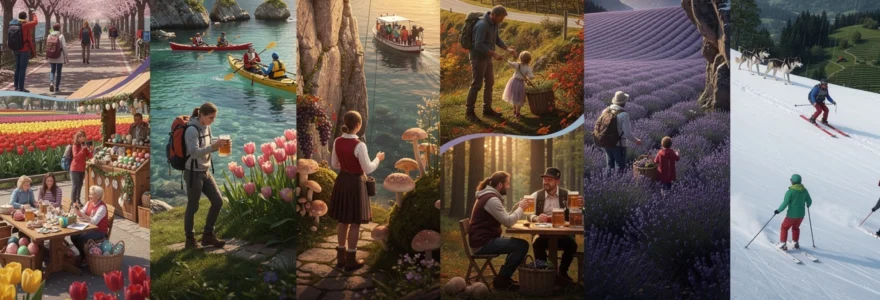
Travel transcends mere movement from one destination to another; it becomes a transformative experience when aligned with nature’s rhythms and cultural celebrations. Each season unveils distinctive opportunities that transform ordinary destinations into extraordinary experiences, offering travellers the chance to witness landscapes in their prime glory and participate in traditions that have shaped communities for generations. Whether it’s witnessing cherry blossoms paint European streets in delicate pink hues during spring or participating in authentic harvest festivals when autumn arrives, seasonal travel creates memories that resonate far beyond typical sightseeing adventures.
The art of seasonal travel lies in understanding how different times of year unlock unique doors to cultural immersion and natural wonder. Spring awakens destinations with fresh energy and vibrant celebrations, whilst summer opens up adventure tourism opportunities impossible during colder months. Autumn brings harvest festivals and spectacular foliage displays, and winter transforms landscapes into wonderlands of snow-sports and arctic adventures.
Spring seasonal tourism activities across european destinations
Spring across Europe represents a renaissance of colour, culture, and outdoor possibilities after months of winter dormancy. This shoulder season offers travellers exceptional value whilst providing access to some of the continent’s most photographed natural phenomena and deeply-rooted cultural traditions. The mild temperatures and longer daylight hours create perfect conditions for exploring both urban centres and countryside attractions without the overwhelming crowds of peak summer tourism.
Cherry blossom festival participation in bonn’s heerstrasse district
Bonn’s Heerstrasse transforms into Germany’s answer to Japan’s famous cherry blossom celebrations each April, when over 1,000 ornamental cherry trees create a stunning pink canopy above this residential street. This spectacular display attracts photographers and nature enthusiasts from across Europe, who gather to witness what locals affectionately call « Kirschblütenfest. » The phenomenon typically lasts just two weeks, making timing crucial for visitors seeking to experience this natural spectacle.
Beyond the visual feast, local cafes and restaurants embrace the celebration with special seasonal menus featuring cherry-themed delicacies and traditional German spring fare. Walking tours during peak bloom period offer insights into the trees’ history, planted in the 1980s as a symbol of Japanese-German friendship. The neighbourhood becomes particularly enchanting during early morning hours and golden hour, when soft lighting enhances the ethereal quality of the blossoms.
Tulip field photography tours through keukenhof gardens netherlands
The Netherlands’ Keukenhof Gardens represents the pinnacle of spring flower displays, with over seven million tulips, daffodils, and hyacinths creating intricate patterns across 79 acres of meticulously designed landscapes. Operating for just eight weeks annually from mid-March to mid-May, this horticultural wonderland offers visitors the chance to witness Dutch flower cultivation at its finest. Professional photography workshops during peak bloom provide technical guidance for capturing the perfect shot whilst educational tours explain the complex logistics behind creating such massive floral displays.
Cycling tours through the surrounding Bollenstreek region extend the experience beyond the gardens themselves, allowing visitors to pedal through endless fields of commercial flower cultivation. The contrast between organised garden displays and working agricultural landscapes provides fascinating insights into Dutch horticultural expertise. Local farmers often welcome visitors to their fields, sharing stories about family traditions spanning multiple generations of flower farming.
Alpine hiking trail accessibility in swiss canton graubünden
Spring in Swiss Canton Graubünden marks the gradual reopening of alpine hiking trails as snow melts reveal pristine mountain landscapes dotted with wildflowers and cascading waterfalls.
The transition from winter to spring in the Alps creates some of the most dramatic scenery in Europe, with snow-capped peaks contrasting against valleys bursting with new life.
Trail accessibility varies significantly with elevation, requiring careful planning and local consultation to ensure safe hiking conditions.
Lower elevation trails around Chur and the Rhine Valley become accessible as early as March, whilst higher altitude routes may remain snow-covered until late May or early June. Spring hiking offers unique advantages, including dramatically reduced crowds, crisp air quality, and the spectacular sight of mountain streams swollen with snowmelt. Wildlife watching opportunities peak during this season, as animals emerge from winter shelters and begin their mating rituals.
<h3
Easter market immersion experiences in prague’s old town square
As spring progresses, Prague’s Old Town Square becomes the atmospheric stage for one of Central Europe’s most charming Easter markets. Wooden stalls decorated with hand-painted eggs, birch branches, and colourful ribbons fill the square, while the Gothic spires of Týn Church and the Astronomical Clock provide a dramatic backdrop. Visitors can browse artisanal crafts, from traditional kraslice (decorated eggs) to lacework and carved wooden toys, making this an ideal place to find meaningful souvenirs that reflect local heritage.
Culinary experiences play a central role in these Easter market immersion activities. Seasonal specialities such as trdelník (a spit-roasted pastry), smoked sausages, and honey wine are prepared fresh at street-side stands, allowing you to taste Czech Easter traditions as you wander. Live folk performances, children’s workshops, and Easter-themed parades create a family-friendly atmosphere that feels both festive and authentic, especially in the late afternoon when the square glows with warm light.
To deepen your cultural experience, consider joining a guided Easter walking tour that combines market time with visits to nearby churches and historic lanes. You will gain insight into how centuries-old Christian rituals blend with older pagan spring customs across the Czech Republic. Crowds are heaviest over Easter weekend itself, so we recommend visiting on weekday mornings for a more relaxed pace and better photography opportunities during this seasonal travel highlight.
Summer adventure tourism programming in mediterranean coastal regions
Summer along the Mediterranean coastline opens a world of adventure tourism programming that simply doesn’t exist in colder months. Consistently warm water temperatures, reliable sunshine, and extended daylight hours make it possible to combine cultural sightseeing with sea-based exploration and high-altitude thrills. From sea kayaking around island archipelagos to climbing limestone peaks that rise straight from the sea, summer in this region invites you to treat the landscape as an outdoor playground rather than a distant backdrop.
Many coastal destinations now design integrated summer adventure packages that bundle accommodation, equipment rental, and guided excursions into one seamless experience. This makes it easier for travellers to try new sports without needing to travel with bulky gear or advanced technical skills. While peak months like July and August can be busy, careful planning around early summer or late September still offers excellent conditions with slightly fewer crowds, creating a more relaxed environment for your adventure-focused Mediterranean holiday.
Sea kayaking expeditions around croatia’s kornati archipelago
The Kornati archipelago off Croatia’s Dalmatian coast is often described as a “nautical paradise,” with more than 80 largely uninhabited islands forming a maze of coves and inlets ideal for sea kayaking expeditions. Summer conditions between June and September typically bring calm seas and visibility exceeding 20 metres, allowing paddlers to peer down into clear turquoise waters as they glide between stark limestone islets. Multi-day guided tours offer a balance between daily physical challenge and tranquil evenings camping or staying in simple stone cottages known as konobe.
Sea kayaking in this region provides a low-impact way to explore fragile marine environments compared with larger motorised boats. Professional outfitters usually include safety briefings, navigation support, and weather monitoring, which is crucial given that sudden bura or jugo winds can quickly change sea conditions. For travellers new to adventure tourism, shorter half-day or full-day routes around the outer islands offer a manageable introduction without committing to an extended expedition.
Planning ahead is essential, as national park permits, camping spots, and guided tours often sell out in high season. We recommend choosing smaller group tours of 6–8 participants, which tend to offer a more personalised experience and easier access to narrow coves. Think of a Kornati sea kayaking trip as the marine equivalent of a mountain trek: the pace may be meditative, but the sense of journey and immersion in nature is just as profound.
Via ferrata climbing routes in italy’s dolomites tre cime circuit
The Dolomites’ Tre Cime di Lavaredo massif is a bucket-list destination for via ferrata enthusiasts seeking dramatic exposure without the need for advanced rock-climbing skills. These “iron paths,” originally constructed during World War I, now form part of a well-regulated adventure tourism network that sees its peak usage in summer when snow-free conditions and stable weather make the routes safer and more accessible. Around the Tre Cime circuit, you will find graded routes suitable for confident beginners as well as highly exposed itineraries that attract seasoned mountaineers.
Via ferrata climbing combines hiking with protected scrambling, using fixed cables, ladders, and iron rungs anchored into the rock. With the correct harness, helmet, and lanyard system, you clip in as you ascend, somewhat like using a continuous handrail on a steep staircase carved into the mountain. This system reduces the risk of serious falls while still delivering the adrenaline rush and panoramic views that define Dolomite adventures. Many guiding companies offer introductory courses that teach equipment use and basic movement techniques before taking you onto easier routes.
Because these circuits are highly popular between late June and early September, early starts are vital to avoid afternoon thunderstorms and congested sections. Staying in rifugi (mountain huts) along the route allows you to experience sunrise and sunset over the Tre Cime, moments that many hikers miss on day trips. If you have ever wondered what it feels like to traverse a vertical playground with the security of a safety line, the via ferrata network here provides an accessible yet unforgettable answer.
Scuba diving certification programmes in malta’s blue lagoon waters
Malta and its sister islands Gozo and Comino have become a premier destination for summer scuba diving certification programmes in Europe. Warm waters, excellent visibility often exceeding 30 metres, and a combination of wrecks, caves, and reef systems create ideal training conditions for both beginners and advanced divers. The famous Blue Lagoon off Comino, with its shallow, crystal-clear waters, offers a particularly welcoming environment for first-timers completing introductory dives or confined-water sessions.
Most dive centres operate from April through November, but July to September remains the prime window for visitors who want predictable sea conditions and comfortable water temperatures without thick wetsuits. Internationally recognised courses such as PADI Open Water or Advanced Open Water can often be completed in three to five days, making them easy to integrate into a week-long Mediterranean holiday. Many travellers choose to combine morning dives with afternoon cultural excursions to Valletta’s UNESCO-listed fortifications or the prehistoric temples of Ħaġar Qim.
Safety and sustainability are increasingly central to Malta’s dive tourism. Reputable operators emphasise buoyancy control to avoid damaging sensitive corals and seagrass meadows, and several have adopted voluntary codes limiting group sizes at popular sites. If you have ever compared learning to dive with learning a new language, Malta’s coastal waters function like an immersive classroom: you are surrounded by a rich “vocabulary” of marine life and underwater landscapes from your very first lesson.
Lavender harvest participation in provence’s valensole plateau
Not all summer adventures revolve around adrenaline; some focus on sensory immersion and slower rhythms tied to agricultural cycles. Provence’s Valensole Plateau in southern France is one of Europe’s most iconic locations for seasonal lavender harvest experiences, typically running from late June through mid-July depending on weather. Rolling fields of purple stretch towards distant mountains, and the air becomes saturated with the herb’s distinctive fragrance, creating a landscape that feels almost surreal.
Many small-scale producers now open their farms to visitors for hands-on harvest activities. You might help cut lavender with traditional sickles, bundle stems for drying, or observe distillation processes that transform flowers into essential oil. These participatory experiences provide insight into the labour and craftsmanship behind the region’s globally recognised lavender products, from soaps to culinary infusions. For photographers, early morning and late evening sessions offer the best light and fewer crowds, especially when combined with guided field-access permits.
Because the bloom and harvest window is brief, flexibility is essential when planning your travel dates for this seasonal activity. We suggest staying in or near Valensole village for at least two or three nights to allow for weather variations and to join multiple workshops. Like attending a vintage wine harvest, taking part in lavender gathering connects you directly with the land’s annual cycle, turning a simple summer holiday into a multi-sensory memory that lingers long after you return home.
Midnight sun photography workshops in norwegian lofoten islands
Further north, the Norwegian Lofoten Islands offer a very different kind of summer spectacle: the midnight sun. Between late May and mid-July, the sun dips towards the horizon but never fully sets, bathing jagged peaks, fishing villages, and white-sand beaches in a continuous golden glow. Photography workshops timed to this phenomenon have surged in popularity over the past decade, attracting travellers who want to refine their skills while exploring one of Europe’s most dramatic coastal landscapes.
These workshops typically focus on mastering low-angle, soft lighting conditions that last for hours rather than minutes, a dream scenario for landscape photographers used to racing against fleeting sunset windows. Instructors guide participants through techniques such as long-exposure photography of glassy fjords, composition strategies for capturing red-painted rorbuer (fishermen’s cabins), and the technical challenges of shooting in consistent brightness when your body expects darkness. Midnight sun photography can feel a bit like visual jazz: the light keeps playing variations on the same theme, and you have time to experiment with different interpretations.
Extended daylight also allows for flexible daily schedules. Many workshops shift primary shooting sessions to late-night and early-morning hours when popular viewpoints are quieter, leaving daytime free for hiking, kayaking, or simply resting. To cope with disrupted sleep patterns, you may want to pack an eye mask and be prepared for unconventional meal times. Embracing this altered rhythm is part of the experience; after all, how often do you have the chance to photograph golden-hour light at 2 a.m. without a hint of darkness?
Autumn foliage tourism and cultural heritage experiences
As summer heat recedes, autumn ushers in cooler temperatures, softer light, and landscapes transformed by rich red, orange, and gold foliage. For many travellers, this is the ideal season to combine outdoor exploration with cultural and culinary experiences tied to harvest cycles. Accommodation prices often drop compared with peak summer, and crowds thin at major landmarks, providing a more contemplative atmosphere for photography, road trips, and village festivals.
Autumn tourism is increasingly structured around specific seasonal activities: leaf-peeping routes, grape and olive harvests, mushroom foraging, and beer or wine festivals rooted in centuries-old traditions. Because these events depend on weather and crop conditions, timing can vary from year to year, making flexibility and up-to-date local information essential. By aligning your itinerary with these short-lived windows, you transform a standard trip into a unique snapshot of a destination at its most atmospheric.
New england leaf-peeping routes through vermont’s green mountains
New England, and especially the state of Vermont, remains synonymous with autumn foliage tourism. From late September to mid-October, the Green Mountains live up to their name in reverse, as dense maple, birch, and beech forests blaze into multi-coloured panoramas that attract millions of visitors each year. Scenic byways such as Route 100 and the Green Mountain Byway between Waterbury and Stowe offer classic leaf-peeping routes that can be explored by car, motorcycle, or bicycle.
To make the most of your leaf-peeping experience, consider basing yourself in a small town like Stowe, Woodstock, or Manchester and planning day trips into surrounding valleys. Many local tourism boards publish up-to-date foliage reports and predictive peak-colour maps, helping you adjust routes on the fly. Hiking trails such as Camel’s Hump or Mount Mansfield reward those willing to climb with sweeping vistas over patchwork forests, especially in early morning when mist rises from the valleys.
Leaf-peeping in Vermont is not solely a visual experience; it is also a gateway into regional food culture and artisanal production. Farm stands brim with apples, pumpkins, and fresh cider, while sugarhouses demonstrate maple syrup production and offer tastings of syrups graded from golden delicate to dark robust. Think of an autumn drive here as blending a moving art exhibition with a progressive tasting menu, where every bend in the road reveals a new composition of colour and flavour.
Wine harvest participation in tuscany’s chianti classico region
In Italy’s Chianti Classico region, autumn marks the climax of the wine calendar as vineyards prepare for and undertake the grape harvest, or vendemmia. From mid-September to early October, depending on altitude and weather, visitors can join harvest-themed experiences that range from guided vineyard walks to hands-on grape picking followed by cellar tours. For wine enthusiasts, this is the most immersive way to understand how weather patterns across the growing season shape the character of each vintage.
Some family-run wineries open their doors to small groups who help gather grapes in the morning before sharing a communal lunch paired with estate wines. These participatory harvest days provide candid insight into the realities of agricultural work, from the importance of sorting grapes for quality to the logistics of moving tonnes of fruit in a short time window. Afternoons often include barrel-room visits where winemakers explain fermentation processes and ageing decisions that distinguish Chianti Classico from neighbouring appellations.
Because spots on authentic harvest programmes are limited and highly sought after, you should reserve months in advance and be prepared for early starts and variable weather. We recommend combining one or two intensive harvest days with slower-paced explorations of hilltop villages like Radda, Gaiole, or Castellina in Chianti. Much like participating in a theatre production instead of simply watching from the audience, joining the vendemmia makes every future glass of Chianti feel like a personal story rather than an anonymous label.
Mushroom foraging excursions in germany’s black forest reserves
The Black Forest in southwestern Germany offers a more subdued but equally rewarding form of autumn seasonal tourism: mushroom foraging. From late August through October, depending on rainfall and temperature, forest floors come alive with edible fungi such as chanterelles, porcini, and parasol mushrooms. Guided foraging excursions led by certified experts have grown in popularity as travellers seek hands-on nature experiences that combine education, gastronomy, and outdoor exercise.
Joining a professional guide is essential, as many mushroom species look similar, and misidentification can have serious consequences. On a typical half-day outing, you will learn how to recognise safe species, understand ideal habitats, and follow sustainable harvesting practices that protect the forest ecosystem. The experience often ends with a cooking demonstration or meal in a local guesthouse, where your carefully gathered mushrooms are transformed into hearty autumn dishes paired with regional wines or beers.
Mushroom foraging appeals especially to travellers who enjoy slower, meditative activities; scanning the forest floor trains you to notice small details, from subtle colour shifts to distinctive cap shapes. It is a bit like a real-world treasure hunt governed by natural rhythms rather than digital clues. When planning your trip, pack waterproof footwear and layers, as autumn weather can change quickly, and damp conditions often make for the most productive mushroom days.
Oktoberfest cultural immersion beyond munich’s traditional venues
Oktoberfest is globally associated with Munich’s vast beer tents and carnival rides, but deeper cultural immersion often lies beyond the city’s most crowded venues. Across Bavaria and the wider German-speaking world, smaller-scale harvest and beer festivals retain a more local feel while still celebrating the same brewing traditions. Towns like Regensburg, Augsburg, and Rosenheim host autumn beer festivals where traditional music, regional dishes, and community customs play a more prominent role than mass tourism.
Even within Munich, you can experience alternative facets of Oktoberfest culture by exploring historical breweries, visiting beer museums, or attending events focused on craft and heritage rather than sheer capacity. Many locals now prefer “Wirtshaus-Wiesn,” a movement encouraging celebrations within traditional taverns where seasonal beers and dishes are served without the intense crowds of the main Theresienwiese grounds. This approach allows you to converse with residents, learn about regional brewing styles, and appreciate how beer has long served as both nourishment and social glue in Bavarian life.
When planning autumn travel for Oktoberfest-related experiences, remember that accommodation prices in Munich climb sharply during the official festival dates. Considering nearby cities connected by efficient train links can significantly reduce costs and broaden your cultural perspective. Instead of treating Oktoberfest as a single mega-event, think of it as a constellation of seasonal gatherings scattered across the region, each offering its own blend of tradition, music, and culinary comfort.
Winter sports tourism and arctic adventure activities
Winter transforms many destinations into entirely different worlds, opening up sports and Arctic adventure activities that are impossible at other times of year. Snow and ice create natural infrastructure for skiing, snowboarding, dog sledding, and ice-climbing, while polar regions attract those eager to experience the Northern Lights or even the polar night. For travellers willing to embrace the cold, winter tourism can feel like stepping into a parallel universe where everyday routines are replaced by crisp air, quiet landscapes, and star-filled skies.
Modern winter sports destinations increasingly blend adrenaline pursuits with wellness and cultural programming. You might spend your mornings on the slopes, afternoons in geothermal spas, and evenings learning about Indigenous Arctic cultures or sampling hearty regional cuisine. As climate patterns shift, many resorts invest heavily in snowmaking and season planning, so checking recent snowfall data and historical trends becomes as important as choosing your accommodation. With the right gear and preparation, you can turn winter from a season to endure into a highlight of your travel calendar.
Monsoon season travel opportunities in southeast asian destinations
In Southeast Asia, the monsoon season is often misunderstood as a period to avoid, yet it can offer distinct travel opportunities for those willing to adapt their expectations. Rather than continuous downpours, many regions experience intense but predictable showers followed by clear skies, especially in shoulder months at the start or end of the rainy season. These patterns create lush landscapes, dramatic cloud formations, and fewer crowds at popular temples, islands, and cultural sites.
Monsoon travel often means lower accommodation prices and a slower, more introspective pace. Rice paddies in countries like Vietnam, Thailand, and Indonesia turn vibrant green, waterfalls swell to full power, and local life shifts to accommodate agricultural cycles. Adventure activities adjust too: river rafting conditions can become more exciting with higher water levels, while photography enthusiasts flock to capture atmospheric scenes of mist-covered mountains and reflective wet streets. As with any weather-dependent travel, flexibility in your day-to-day plans is key.
Shoulder season strategic planning for unique cultural encounters
Across many destinations, the most rewarding seasonal activities happen not at the height of peak crowds but in the shoulder seasons that bridge them. Strategic planning for spring and autumn travel allows you to access festivals, harvests, and natural phenomena with fewer visitors and often lower prices. You gain more time and space to engage with local residents, ask questions, and adapt your itinerary to unexpected invitations, whether that means joining a village celebration or lingering longer at a scenic overlook.
When we view the travel year as a circle rather than a straight line from summer to summer, each season becomes an opportunity to experience places in a new light. By aligning your trips with cherry blossoms, lavender harvests, wine vendemmias, or even monsoon rains, you shift from being a passive observer to an active participant in a destination’s annual story. The more deliberately you choose your timing, the more each journey feels truly unique—anchored not just in where you go, but in when you choose to be there.