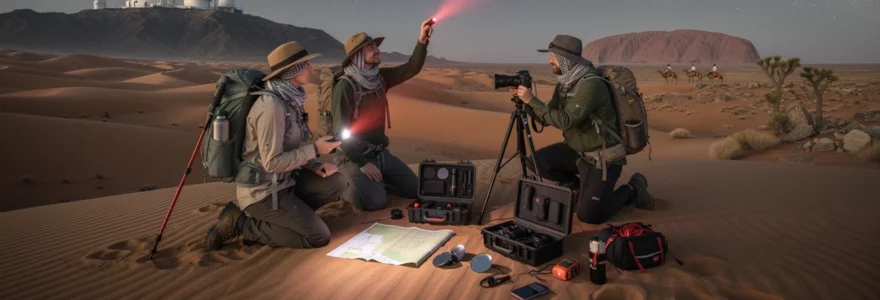
Desert landscapes offer some of the most profound and transformative experiences available to modern travellers seeking genuine connection with nature’s raw beauty. These vast expanses of sand, stone, and sky create environments where the noise of contemporary life fades away, replaced by the profound stillness that has drawn explorers, contemplatives, and adventurers for millennia. The combination of infinite horizons, crystalline night skies unmarred by light pollution, and the deep silence found only in remote wilderness areas creates opportunities for both personal reflection and extraordinary natural encounters.
From the rolling dunes of the Sahara to the stark beauty of the Atacama, desert environments present unique challenges and rewards that distinguish them from any other type of wilderness expedition. The interplay between extreme temperatures, limited water resources, and navigation complexities requires specialised knowledge and preparation, yet rewards participants with some of the most spectacular astronomical viewing conditions on Earth and landscapes that seem to exist outside the boundaries of ordinary time.
Essential desert navigation techniques for remote wilderness excursions
Navigation in desert environments presents unique challenges that differentiate it significantly from woodland or mountain terrain. The absence of prominent landmarks, shifting sand patterns, and extreme temperature variations can quickly disorient even experienced outdoors enthusiasts. Understanding multiple navigation techniques becomes essential for both safety and successful expedition completion in these demanding environments.
Traditional navigation methods complement modern technology to create redundant systems that ensure reliable wayfinding. The combination of celestial navigation, GPS technology, indigenous knowledge, and emergency protocols provides comprehensive coverage for various scenarios that might arise during extended desert expeditions. Preparation and skill development in multiple navigation approaches significantly enhances both safety margins and confidence levels when venturing into remote arid regions.
Celestial navigation using polaris and southern cross constellations
Celestial navigation remains one of the most reliable backup systems for desert travel, particularly in areas where GPS signals may be compromised or technology failures occur. The North Star, or Polaris, provides consistent directional reference in the Northern Hemisphere, while the Southern Cross constellation serves the same function below the equator. These stellar landmarks have guided travellers across desert routes for thousands of years and continue to offer dependable navigation assistance today.
Understanding the relationship between star positions and cardinal directions requires basic knowledge of astronomy and timing. Polaris sits nearly stationary relative to Earth’s rotation, making it an excellent fixed reference point for determining true north. The Southern Cross, combined with the pointer stars Alpha and Beta Centauri, allows for accurate south identification. Practice sessions before expedition departure help develop the visual recognition skills necessary for confident celestial navigation under actual field conditions.
GPS coordinate systems and datum selection in arid environments
Modern GPS technology provides unprecedented accuracy for desert navigation, yet understanding coordinate systems and datum selection proves crucial for reliable positioning. Different GPS units may use varying datum references, potentially creating position errors of several hundred metres if not properly configured. The World Geodetic System 1984 (WGS84) serves as the standard datum for most contemporary GPS devices and mapping applications.
Desert environments can create unique challenges for GPS reception due to temperature extremes affecting battery performance and occasional satellite signal interference from atmospheric conditions. Carrying multiple GPS units with spare batteries, combined with regular waypoint recording, creates robust positioning systems. Understanding how to input coordinates manually and convert between different coordinate formats enables effective communication with rescue services and expedition support teams when necessary.
Traditional bedouin wayfinding methods and landmark recognition
Indigenous navigation techniques developed by nomadic peoples over centuries provide invaluable insights for modern desert travellers. Bedouin navigation relies on subtle environmental cues including wind patterns, sand formations, vegetation distribution, and seasonal changes that may not be immediately apparent to inexperienced observers. Learning to recognise these natural indicators enhances overall situational awareness and provides backup navigation methods when technology fails.
Wind-carved rock formations, dried riverbed patterns, and specific plant communities create navigation references that remain consistent across multiple seasons. Traditional methods also incorporate time-of-day observations, including shadow patterns and temperature variations that indicate direction and approximate position. Combining traditional knowledge with modern techniques creates comprehensive navigation systems that function reliably across diverse desert conditions and scenarios.
Emergency signalling protocols for search and rescue operations
<p
Effective emergency signalling in the desert combines low-tech and high-tech methods to maximise your visibility and chances of a timely rescue. Standard international distress signals such as three blasts on a whistle, three flashes with a mirror, or three fires in a straight line remain widely recognised by professional search and rescue teams. In arid regions, where sound can carry far but terrain can obscure visibility, combining audible signals with high-contrast visual markers dramatically improves detection.
Modern devices like Personal Locator Beacons (PLBs) and satellite messengers using networks such as Iridium or Globalstar now represent best practice for remote desert excursions. These compact units send your GPS coordinates to emergency services when activated, even beyond mobile coverage, and many allow two-way text communication to clarify your situation. To support electronic systems, practice basic mirror signalling and ground-to-air symbols using rocks, clothing, or equipment, ensuring any signal pattern is clear, sustained, and placed in an open area where aircraft or ground teams can easily spot it.
Prime desert destinations for astronomical photography and stargazing
Remote desert regions rank among the world’s premier locations for stargazing and astronomical photography thanks to minimal light pollution, low humidity, and stable atmospheric conditions. For travellers seeking desert excursions filled with silence, stars, and vast horizons, selecting the right destination can make the difference between a memorable night sky and a truly world-class astronomical experience. Several deserts have gained international recognition for their dark skies, observatories, and astro-tourism infrastructure that supports both casual observers and serious astrophotographers.
When planning a stargazing-focused desert trip, you should consider not only darkness levels but also accessibility, seasonal weather patterns, and available guiding services. High-altitude deserts often provide exceptional clarity but can involve colder temperatures and more challenging logistics. Lower-altitude regions may offer easier access and rich cultural experiences alongside night-sky observation. The following destinations illustrate how diverse desert environments can all deliver outstanding astronomical opportunities while maintaining their own unique character.
Atacama desert’s paranal observatory and ALMA telescope complex
Chile’s Atacama Desert is widely regarded as one of the best places on Earth for astronomical research and night photography. With some areas receiving less than 15 millimetres of rain per year and humidity levels often below 10%, the atmosphere above the Atacama remains remarkably dry and transparent. This combination of altitude, aridity, and minimal light pollution has attracted major facilities such as the Paranal Observatory, home to the Very Large Telescope (VLT), and the Atacama Large Millimeter/submillimeter Array (ALMA) on the Chajnantor Plateau.
For visitors, guided tours of these observatories offer a rare chance to see cutting-edge astronomy in action while gaining deeper understanding of the night sky they photograph after dark. Around towns like San Pedro de Atacama, specialist astro-lodges and tour operators provide telescopes, tracking mounts, and expert instruction on capturing the Milky Way and southern sky constellations. Long-exposure astrophotography in the Atacama benefits from the region’s exceptionally dark skies, where the galactic core can cast faint shadows and airglow becomes a visible element in wide-angle desert sky compositions.
Sahara’s merzouga dunes and erg chebbi dark sky reserves
The Moroccan Sahara, particularly around Merzouga and the Erg Chebbi dune system, offers an accessible yet profoundly atmospheric stargazing environment. Once you travel beyond village lights and into the dunes by camel or 4×4, light pollution drops dramatically, revealing a striking canopy of stars stretching from horizon to horizon. Clear nights are common from autumn through spring, making this region ideal for night-sky excursions combined with cultural immersion in Berber and nomadic traditions.
Many desert camps near Erg Chebbi now cater specifically to travellers seeking dark sky experiences, offering rooftop terraces, open-sky sleeping platforms, or duneside bivouacs for uninterrupted views of the Milky Way. The soft, rolling sandscapes create compelling foregrounds for astronomical photography, from minimalist silhouettes of camels and tents to intricate dune patterns illuminated by moonlight or low-level artificial lighting. If you have already visited more touristic desert areas, arranging a private desert excursion farther from established camps can reveal even deeper levels of silence and darkness for serious astrophotography.
Australian outback’s Uluru-Kata tjuta national park astronomy programs
Central Australia’s desert interior combines strong Aboriginal cultural connections to the night sky with vast, open horizons perfect for stargazing. Uluru-Kata Tjuta National Park, while carefully managed for conservation and cultural protection, supports a range of astronomy experiences led by accredited guides who interpret both Western constellations and Indigenous sky stories. Away from the major resort lights, dark-sky conditions allow crystal-clear views of the Southern Cross, Magellanic Clouds, and the luminous band of the Milky Way arching above the red desert landscape.
Structured astronomy programs often integrate laser-guided sky tours, telescope observation sessions, and storytelling that links celestial objects to Dreaming narratives and seasonal cycles. For photographers, the juxtaposition of Uluru’s monolithic form or Kata Tjuta’s domes against star-filled skies creates iconic compositions. Because this is a sensitive cultural and environmental area, working with licensed guides ensures your night photography adheres to park regulations and respects local traditions while still allowing you to capture spectacular images.
Mojave desert’s joshua tree national park international dark sky status
In the United States, Joshua Tree National Park stands out as one of the most accessible dark-sky desert destinations, especially for travellers combining wilderness experiences with a road trip through the American Southwest. Recognised as an International Dark Sky Park, Joshua Tree actively manages lighting and visitor education to preserve night-sky quality. Despite its proximity to major urban centres like Los Angeles, the park still offers impressive views of the Milky Way, especially during new moon periods outside of peak summer haze.
Joshua Tree’s unique Joshua trees, boulder formations, and desert flora provide distinctive foreground elements for night photography. Many visitors experiment with light painting, star trails, and timelapse sequences that showcase both the motion of the heavens and subtle movements in the desert environment. Because temperatures can drop rapidly after sunset and park regulations restrict camping locations and artificial lighting, careful planning of your stargazing itinerary helps you balance comfort, safety, and photographic ambitions during your desert night excursions.
Specialised equipment for extended desert wilderness expeditions
Extended desert wilderness expeditions require more than standard hiking gear; they demand equipment specifically chosen to cope with extreme heat, intense solar radiation, abrasive sand, and wide diurnal temperature swings. Treat your kit list as a risk management tool rather than a simple packing exercise. Every item should either protect your physiology, support navigation and communication, or enhance your ability to remain self-sufficient for longer periods in remote terrain.
Water management lies at the heart of desert equipment planning. As a rule of thumb, many expedition guides recommend a minimum of 4 to 6 litres of water per person per day for active desert trekking, with additional reserves for emergencies. Robust water containers, insulated bottles to slow heating, and reliable purification methods for oases or wells (such as filters or chemical treatments) all contribute to safe hydration. Complement these with high-electrolyte rehydration salts to counteract mineral loss through sweat during intense heat exposure.
Sun and heat protection form the second pillar of your gear strategy. Wide-brimmed hats, UV-rated sunglasses, lightweight long-sleeve clothing, and high-factor broad-spectrum sunscreen reduce the cumulative impact of solar radiation on skin and eyes. Many seasoned desert travellers adopt a layering system similar to cold-climate expeditions, simply in reverse: light, loose outer layers for daytime and compact insulated layers for night, when temperatures can drop sharply. A reflective emergency bivvy or lightweight tarp can double as both shade shelter during midday rest breaks and additional insulation at night.
Navigation and communication tools should always include redundancy. Alongside your primary GPS device, carry a backup unit, printed topographic maps, and a reliable magnetic compass stored away from metallic gear. A satellite messenger or PLB substantially increases safety margins when travelling beyond cellular coverage, especially if your route includes remote dunes or plateaus where rescue may be delayed. Protect all electronics in dustproof, waterproof cases, and consider power banks or small solar chargers calibrated to desert sunlight conditions to keep devices operational throughout multi-day journeys.
Finally, think of your footwear and sleep system as two critical contact points with the environment. Desert-appropriate boots or trail shoes should offer good ventilation, sand-resistant gaiters, and adequate sole protection against hot ground and sharp rocks. For sleep, a closed-cell foam or high-density inflatable mat insulates you from radiant ground heat by day and conductive cooling by night. Pair this with a three-season sleeping bag rated to expected nighttime lows, accepting that temperatures in some high-elevation deserts can approach freezing even after very hot days.
Physiological adaptation strategies for extreme arid climate exposure
Spending extended time in deserts challenges the human body in ways that differ markedly from temperate or alpine environments. Heat stress, dehydration, and electrolyte imbalance can build up gradually, making early recognition and prevention essential to safe desert excursions. Rather than thinking in terms of simply “toughing it out,” effective adaptation involves strategic pacing, hydration discipline, and listening closely to subtle physiological signals that something is changing.
Acclimatisation to heat functions somewhat like altitude acclimatisation: you gradually train your body to handle higher temperatures and increased sweating without excessive fatigue. Studies suggest that 7 to 14 days of progressive heat exposure, combined with moderate exercise and adequate fluid intake, can significantly improve heat tolerance by increasing plasma volume and sweat efficiency. If you cannot acclimatise in advance, build an adaptation phase into the first days of your desert journey by limiting exertion during peak heat and extending rest periods.
Hydration strategy in the desert is more nuanced than simply “drink whenever you are thirsty.” By the time intense thirst appears, you may already be moderately dehydrated. Many expedition leaders recommend scheduled drinking, aiming for regular small intakes of water and electrolytes rather than large, infrequent gulps. You can think of your body as a slow-drip irrigation system: steady input maintains balance far better than occasional floods. Monitor urine colour and volume as simple, practical indicators of your hydration status throughout the day.
Thermal management through behaviour and clothing choices plays a major role in physiological comfort. Traditional desert cultures often rest during the hottest hours and travel in the early morning or late afternoon, effectively using time as a tool to avoid heat overload. Light-coloured, loose-fitting garments create a microclimate around the skin, allowing sweat to evaporate while shielding you from direct sun. Incorporating evaporative cooling methods, such as wetting a scarf or buff and placing it around your neck, can provide temporary relief during particularly intense heat spikes.
Mental pacing and expectation management are equally important adaptation strategies. Desert travel rewards a slower, more deliberate rhythm that aligns with environmental constraints. You may notice that when you resist the urge to hurry and instead accept a measured pace, feelings of fatigue and irritability diminish. This shift in mindset not only supports physiological resilience but also enhances your ability to appreciate the silence, stars, and vast horizons that define the desert experience. Ask yourself periodically: are you working with the desert or against it?
Advanced photography techniques for capturing desert landscapes
Desert environments provide extraordinary opportunities for both landscape and night-sky photography, but they also present technical challenges that can quickly overwhelm an unprepared photographer. Harsh contrast, blowing sand, rapid temperature changes, and vast empty spaces all demand thoughtful planning and advanced techniques. Instead of viewing the desert as a hostile setting for your camera, you can treat it as a finely tuned studio where light, texture, and scale offer creative possibilities not found elsewhere.
Achieving consistently strong results in desert photography often hinges on understanding how light interacts with sand, rock, and sky across the day-night cycle. Early morning and late afternoon produce softer, directional light that sculpts dune ridges and rock formations with delicate shadows. Midday sun, while less flattering for portraits, can create striking high-key desert scenes when used deliberately. At night, low humidity and dark skies transform the desert into a natural observatory, ideal for long-exposure astrophotography capturing the Milky Way, star trails, or planetary alignments above pristine horizons.
Long-exposure astrophotography settings for milky way documentation
Capturing the Milky Way above a desert landscape requires balancing three variables: exposure time, aperture, and ISO. A useful starting point is the “500 rule,” where you divide 500 by your lens focal length (adjusted for crop factor) to estimate the maximum exposure time in seconds before star trails become noticeable. For example, with a 20 mm lens on a full-frame camera, 500 ÷ 20 suggests a maximum of 25 seconds. In practice, many photographers opt for slightly shorter times, such as 15 to 20 seconds, to preserve star sharpness.
Wide apertures in the range of f/1.4 to f/2.8 help gather enough light during short exposures, while ISO values typically sit between 1600 and 6400 depending on your camera’s noise performance. Think of this as opening a window wider (aperture) and turning up the sensitivity of your eyes (ISO) while limiting how long you peek outside (shutter speed). In desert settings, including foreground elements such as solitary trees, dunes, or rock outcrops anchors the Milky Way in a recognisable landscape, transforming a simple star field into a compelling narrative image.
Noise reduction and focusing demand particular attention during desert astrophotography sessions. To achieve critical focus at night, use live view at maximum magnification on a bright star or distant light source, then switch to manual focus to lock it in. Long exposures at high ISO inevitably introduce digital noise, especially in warmer environments, so plan for careful post-processing using noise reduction software while preserving fine detail. Shooting in RAW format and taking multiple exposures for stacking can significantly improve final image quality when documenting the Milky Way across desert skies.
Golden hour and blue hour timing calculations for desert lighting
Golden hour and blue hour represent two of the most aesthetically rewarding periods for desert landscape photography, when low-angle sunlight or residual twilight softens contrast and enriches colours. While many photographers rely on rule-of-thumb estimates, using dedicated apps or ephemeris tools to calculate exact sunrise, sunset, and twilight phases for your coordinates allows much more precise planning. This is particularly useful in remote deserts where you may have only limited time at each location before moving on.
Golden hour typically starts shortly after sunrise and resumes before sunset, when the sun sits low in the sky and its light passes through more of the atmosphere, scattering blue wavelengths and emphasising warm tones. In desert environments, this warm light accentuates dune textures and rock strata, creating depth and dimensionality that flat midday illumination cannot match. Blue hour, occurring just before sunrise and after sunset, brings cooler, more subtle light that pairs beautifully with artificial illumination from camps, headlamps, or distant settlements, offering opportunities for balanced compositions that marry natural and human elements.
Because deserts often provide unobstructed horizons, the transition between these lighting phases can feel rapid. Arriving at your chosen vantage point 30 to 45 minutes before the predicted start of golden or blue hour gives you time to compose, test exposures, and adjust white balance. Ask yourself what story you want the light to tell: do you want warm, inviting tones that highlight the desert’s softness, or cool, contemplative hues that emphasise its quiet vastness? Aligning your timing with that intention leads to more coherent and emotionally resonant images.
Hyperfocal distance calculations for infinite depth of field
Achieving sharpness from foreground sand ripples to distant mountain ridges is a hallmark of high-quality desert landscape photography. Hyperfocal distance, the closest focus distance at which objects from half that distance to infinity appear acceptably sharp, provides a practical solution. While the underlying optics can seem complex, you can treat hyperfocal distance as a focusing technique rather than a mathematical exercise: focus slightly beyond the closest important foreground detail, using a suitable aperture, to maximise depth of field.
In practice, many photographers use either smartphone apps or printed charts to determine hyperfocal distance for their camera and lens combinations. For example, with a 16 mm lens on a full-frame camera at f/11, the hyperfocal distance might be around 1.2 metres; focusing on a point just beyond this distance ensures that everything from roughly 0.6 metres to the horizon remains sharp. In a desert context, this allows you to place intricate sand patterns, footprints, or small plants close to the frame while keeping distant dunes and sky crisp.
Choosing the right aperture involves balancing depth of field against diffraction and low-light constraints. While f/16 or f/22 may seem tempting for maximum depth, these small apertures can soften overall sharpness due to diffraction, especially on high-resolution sensors. Many desert photographers find that working between f/8 and f/11 offers an effective compromise, particularly when combined with ultra-wide lenses. Using live view and magnification to confirm foreground and background sharpness provides real-world validation of your hyperfocal calculations before committing to a series of exposures.
Neutral density filter applications for motion blur in sand dunes
Neutral density (ND) filters, which reduce the amount of light entering the lens without altering colour balance, open creative possibilities for capturing motion in desert environments. By extending shutter speeds into multi-second or even minute-long exposures, you can blur moving elements such as blowing sand, drifting clouds, or occasional human or camel movement, contrasting them against static dune structures or rock formations. The result often feels dreamlike, as though the desert itself were breathing slowly across the frame.
For moderate motion blur in daylight, ND filters in the 3–6 stop range usually suffice, allowing shutter speeds of 1 to 30 seconds depending on aperture and ISO. Stronger 10-stop filters enable very long exposures that can smooth clouds into soft streaks and reduce foot traffic or passing vehicles to faint traces, useful when photographing near popular viewpoints. In practical terms, think of ND filters as dimming the desert sun enough for you to paint with time, turning fleeting gusts of wind into visible, fluid forms across the sand.
Because desert light levels are high and reflections from sand intensify brightness, composition and exposure planning with ND filters benefit from careful metering before attaching the filter. Many photographers compose and focus without the filter, switch to manual focus, then thread on the ND and apply calculated exposure changes based on the filter’s rated strength. A stable tripod, remote shutter release, and lens cloths to clear dust are essential accessories when working with long exposures in sandy conditions, helping you maintain sharpness and protect your equipment.
Cultural heritage and archaeological significance of desert regions
Beyond their visual drama and astronomical potential, deserts hold deep layers of cultural heritage and archaeological significance that enrich any wilderness excursion. For thousands of years, trade caravans, nomadic tribes, and settled communities have traversed and inhabited these seemingly inhospitable spaces, leaving behind rock art, ancient routes, fortified settlements, and spiritual sites. When you walk across a desert plateau or navigate along a dry wadi, you are often following paths shaped by countless generations before you.
In North Africa and the Middle East, desert fortresses, caravanserais, and rock inscriptions trace the history of trans-Saharan and Silk Road trade. Petroglyphs depicting animals, hunting scenes, and early symbolic markings appear on cliffs and boulders, sometimes dating back several millennia. In the Iranian and Arabian deserts, remnants of qanat irrigation systems and mud-brick settlements illustrate sophisticated water management and adaptation strategies to arid climates. Respectful exploration of these sites, ideally with knowledgeable local guides, reveals narratives of resilience, adaptation, and cultural exchange that challenge simplistic notions of deserts as “empty” spaces.
Australian, American, and Central Asian deserts likewise preserve important cultural and spiritual landscapes. In Australia, many desert regions form part of living Aboriginal songlines, where stories, law, and navigation are encoded in the land itself. In the American Southwest, ancestral Puebloan sites, geoglyphs, and ritual spaces attest to long-term habitation and complex cosmologies tied to the surrounding desert. Central Asian deserts like the Kyzylkum and Karakum contain ruined cities and fortifications that once anchored oasis-based civilisations along major trade corridors.
As interest in desert tourism and remote expeditions grows, responsible travel practices become critical to safeguarding this fragile heritage. Avoid touching rock art, removing artefacts, or walking on unmarked archaeological structures, as even small impacts can accelerate erosion or damage. Support locally led conservation initiatives and interpretive programs that ensure economic benefits flow back to desert communities whose knowledge and stewardship maintain these landscapes. In doing so, your desert journeys filled with silence, stars, and vast horizons also become journeys of cultural connection, helping to sustain the human stories that have always been intertwined with these remarkable environments.