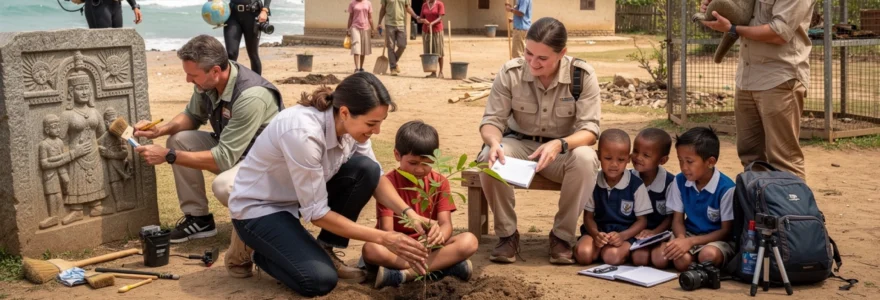
The convergence of travel and volunteerism has emerged as one of the most transformative approaches to global exploration, fundamentally reshaping how individuals perceive both personal growth and social responsibility. This phenomenon, often termed volunteer tourism or “voluntourism,” transcends traditional holiday experiences by embedding purpose-driven activities within adventurous journeys. Rather than merely observing destinations from a tourist’s perspective, participants immerse themselves in local communities, contributing meaningful labour whilst simultaneously gaining profound cultural insights that can reshape worldviews and create lasting memories.
The psychological impact of combining service with travel extends far beyond conventional tourism, offering participants the opportunity to develop authentic connections with local populations whilst addressing genuine community needs. This symbiotic relationship benefits both volunteers and host communities, creating sustainable models for cultural exchange and development assistance. Modern volunteer tourism has evolved from simple gap-year adventures into sophisticated programmes that prioritise ethical practices, community consent, and measurable impact outcomes.
Strategic volunteer tourism destinations for maximum cultural immersion
Selecting appropriate destinations for volunteer tourism requires careful consideration of multiple factors, including project sustainability, cultural sensitivity, and personal safety. The most successful volunteer experiences occur in locations where genuine community needs align with participant skills and interests, creating mutually beneficial arrangements that extend far beyond superficial cultural encounters.
Contemporary volunteer tourism has expanded beyond traditional development contexts to encompass diverse geographical regions and project types. Strategic destination selection involves evaluating factors such as local infrastructure, organisational credibility, project duration requirements, and post-volunteer impact sustainability. Many successful programmes operate in regions experiencing specific challenges, from environmental degradation to educational deficits, where international volunteers can provide meaningful assistance whilst gaining unprecedented cultural exposure.
UNESCO world heritage site conservation projects in nepal and peru
Heritage conservation volunteering offers participants the unique opportunity to preserve culturally significant sites whilst developing specialised skills in archaeological techniques and cultural preservation. Nepal’s post-earthquake reconstruction efforts have created numerous opportunities for volunteers to assist in rebuilding historic temples and monuments, particularly in the Kathmandu Valley region. These projects typically require commitments ranging from two weeks to several months, allowing volunteers to witness tangible progress whilst learning traditional construction techniques from local artisans.
Peru’s conservation initiatives extend beyond the famous Machu Picchu site to include lesser-known Incan ruins and colonial architecture throughout the Sacred Valley. Volunteers participating in these programmes often engage in detailed documentation work, structural stabilisation efforts, and community education initiatives. The experience provides profound insights into indigenous preservation philosophies whilst contributing to the safeguarding of irreplaceable cultural assets for future generations.
Marine conservation programmes in the maldives and great barrier reef
Marine conservation volunteering has gained significant prominence as coral reef systems face unprecedented threats from climate change and human activities. The Maldives offers exceptional opportunities for volunteers to engage in coral restoration, marine species monitoring, and community education programmes. These initiatives often combine scientific research with hands-on conservation work, enabling participants to contribute to vital ecosystem preservation whilst developing marine biology expertise.
Australia’s Great Barrier Reef conservation programmes provide volunteers with access to one of the world’s most complex marine ecosystems whilst contributing to critical research and restoration efforts. Projects typically involve coral propagation, water quality monitoring, and tourist education initiatives. The comprehensive nature of these programmes ensures that volunteers gain deep understanding of marine ecosystem dynamics whilst contributing to globally significant conservation efforts that extend far beyond their participation period.
Educational development initiatives in rural cambodia and guatemala
Educational volunteering in developing regions offers transformative experiences for participants whilst addressing critical community needs in literacy and numeracy development. Cambodia’s rural education programmes often focus on English language instruction, computer literacy, and infrastructure development for schools lacking basic resources. These initiatives require cultural sensitivity and adaptability, as volunteers must navigate complex social dynamics whilst respecting traditional educational approaches and community hierarchies.
Guatemala’s educational initiatives encompass both formal classroom instruction and community-based learning programmes designed to reach underserved populations. Volunteers often work alongside local educators to develop culturally appropriate curriculum materials and teaching methodologies. The experience provides profound insights into educational inequality whilst enabling participants to witness the transformative power of literacy in rural communities. These programmes typically require longer-term commitments to ensure continuity and meaningful impact development.
Wildlife rehabilitation centres in costa rica and south africa
These wildlife volunteering experiences in Costa Rica often involve supporting rescue centres that care for injured sloths, monkeys, birds, and reptiles affected by deforestation and road expansion. Volunteers may assist with food preparation, enclosure maintenance, behavioural enrichment, and data collection under the supervision of trained biologists and veterinarians. This type of wildlife rehabilitation work demands strict adherence to ethical animal handling protocols, including limited physical contact and a focus on eventual release into the wild wherever possible. Living near protected rainforests allows volunteers to experience extraordinary biodiversity while learning first-hand about conservation challenges such as habitat fragmentation and illegal wildlife trade.
In South Africa, wildlife rehabilitation volunteering commonly centres on species such as antelope, primates, and birds of prey, often rescued from snares, vehicle collisions, or conflict with farmers. Volunteers typically support daily operations at rehabilitation centres, helping with feeding routines, enclosure cleaning, and basic monitoring of animal behaviour. Many programmes incorporate conservation education, allowing volunteers to assist with school outreach events or guided tours that raise awareness about wildlife protection. By combining practical animal care with community engagement, these projects enable volunteers to contribute to long-term conservation outcomes while gaining unmatched exposure to African ecosystems and conservation strategies.
Community infrastructure projects in tanzania and ecuador
Community infrastructure volunteering in Tanzania often focuses on building and improving essential facilities such as schools, health clinics, rainwater harvesting systems, and sanitation blocks. Volunteers may work alongside local builders and engineers, engaging in tasks like bricklaying, painting, landscaping, and basic construction support. These projects are designed to enhance long-term community resilience rather than provide short-term fixes, ensuring that volunteer tourism contributes to sustainable infrastructure development. For many participants, the chance to see a classroom or clinic emerge from bare ground provides a powerful sense of achievement and a tangible reminder that travel can leave a lasting legacy.
In Ecuador, community infrastructure projects frequently take place in Andean villages or Amazonian communities, where geographical isolation has historically limited access to public services. Volunteers might help construct community centres, eco-friendly latrines, or small-scale renewable energy installations such as solar panels. Programmes often integrate environmental sustainability principles, using local materials and low-impact building techniques to reduce carbon footprints and preserve fragile ecosystems. By collaborating directly with community leaders, volunteers gain insight into local planning processes and learn how participatory development can empower residents to influence their own futures.
Digital documentation techniques for preserving volunteer experiences
Effectively documenting your volunteer travel experiences can deepen reflection, enhance cultural understanding, and create a long-term record of personal transformation. In an era where digital storytelling tools are readily available, volunteers have unprecedented opportunities to preserve memories and share meaningful narratives with global audiences. However, responsible documentation requires more than simply taking photos and posting them online; it calls for conscious attention to ethics, consent, and cultural sensitivity. When approached thoughtfully, digital documentation becomes a form of service in itself, amplifying local voices and raising awareness about important social and environmental issues.
By combining ethical photography, structured journaling, and intentional social media storytelling, volunteers can transform fleeting experiences into enduring knowledge. Digital tools help capture not only visual highlights but also the subtleties of cross-cultural communication, emotional growth, and project outcomes. Think of your documentation strategy as a personal impact archive: a curated collection of images, notes, and reflections that you can revisit when making future career decisions or planning new volunteer journeys. As we explore each technique, the goal is to help you create meaningful records without compromising the dignity or privacy of the communities you support.
Ethical photography protocols in vulnerable communities
Photography during volunteer tourism can be both powerful and problematic, particularly in vulnerable communities where histories of exploitation and misrepresentation persist. Ethical photography protocols begin with obtaining informed consent, especially when photographing children, patients, or individuals in distress. Volunteers should avoid images that sensationalise poverty or depict people as passive recipients of aid; instead, the focus should be on agency, resilience, and collaboration. Asking yourself, “Would I feel comfortable if this photo were taken of me and shared globally?” is a useful ethical checkpoint before pressing the shutter.
Additionally, volunteers should respect local norms regarding dress, religious spaces, and sacred ceremonies where photography may be restricted or inappropriate. It is often better to prioritise relationship-building over image capture, taking time to explain why you are taking photos and how they may be used. Many organisations now provide written guidelines for responsible visual storytelling, emphasising the importance of protecting identities in sensitive contexts such as refugee camps or healthcare settings. By adhering to these protocols, you help counter the trend of exploitative “poverty tourism” and instead use volunteer travel photography to support dignified, accurate representation.
Travel journaling applications for long-term memory retention
While photographs capture visual moments, written reflections are crucial for preserving the thoughts and emotions behind your volunteer experiences. Travel journaling applications such as Day One, Journey, or Evernote enable you to combine text, images, audio notes, and location data into a cohesive digital diary. Regular journaling has been linked to improved long-term memory retention, as the act of writing consolidates experiences and encourages deeper processing of complex cultural encounters. Over time, your entries become a valuable resource for understanding how specific volunteer projects shaped your perspectives on social justice, sustainability, and global citizenship.
To maximise the impact of your digital journal, consider establishing a simple daily structure with prompts such as “What surprised me today?”, “What challenged my assumptions?”, and “How did I contribute to the community’s goals?”. This intentional reflection helps transform raw experiences into actionable insights you can apply in future work or study. Many journaling apps also allow offline access, which is essential when volunteering in remote regions with limited connectivity. Think of your journal as both a private reflection tool and a reference library that captures the subtle lessons volunteering while traveling can offer long after your trip has ended.
Social media storytelling frameworks for authentic impact narratives
Social media can amplify the reach of your volunteer travel stories, but it also risks reducing complex realities to simplistic “before-and-after” posts. To create authentic impact narratives, consider using a storytelling framework such as “context–collaboration–change.” Begin by explaining the broader social or environmental context, then highlight how local communities and organisations are leading solutions, and finally describe how your role fits into these ongoing efforts. This approach prevents the common “saviour narrative” and instead foregrounds local leadership and partnership.
When sharing content on platforms like Instagram, TikTok, or blogs, transparency is essential: clarify the duration of your stay, your skill level, and the limits of your contribution. You might ask yourself, “Does this post educate my audience about structural issues, or does it simply showcase my presence in a disadvantaged community?” Incorporating quotes from local partners (with their consent) and linking to their official pages can further redirect attention towards community-driven initiatives. Over time, a consistent, ethical storytelling framework turns your social media feed into a curated portfolio of responsible volunteer tourism, inspiring others to engage in informed, reflective travel rather than superficial voluntourism.
Video documentation equipment for remote location filming
Capturing high-quality video in remote volunteer locations requires a balance between portability, durability, and technical capability. Compact mirrorless cameras, action cameras, or even modern smartphones with stabilisers can produce professional-grade footage without adding excessive weight to your luggage. Investing in basic accessories such as a lightweight tripod, external microphone, and weather-resistant bag ensures that your equipment withstands challenging environments, from tropical rainforests to dusty construction sites. As with photography, ethical considerations should guide your filming choices, prioritising consent and cultural sensitivity over dramatic shots.
In many remote areas, power supply and internet access are limited, so volunteers must plan for offline storage and charging solutions. Portable solar chargers, power banks, and high-capacity memory cards can keep your gear functional throughout extended fieldwork. Editing footage on lightweight laptops or even mobile devices allows you to create short, informative clips that organisations can later use for fundraising or educational campaigns. By treating video documentation as a collaborative tool rather than personal content, you contribute not only to your own visual storytelling archive but also to the long-term communication needs of your host projects.
Cross-cultural communication strategies during international volunteering
Effective cross-cultural communication is the foundation of successful international volunteering, often determining whether your efforts support or unintentionally hinder local initiatives. Language barriers, unspoken social norms, and differing expectations about time, hierarchy, and conflict can all influence daily interactions. Rather than viewing these differences as obstacles, you can approach them as opportunities to develop advanced intercultural competence—a skill set increasingly valued in global careers. The key is to combine humility, curiosity, and structured learning strategies throughout your volunteer placement.
Before departure, investing time in basic language skills—such as greetings, polite expressions, and key project terms—signals respect and facilitates trust-building. Once on site, active listening becomes essential: pay attention not only to words but also to body language, tone, and group dynamics. Asking clarifying questions, seeking feedback, and acknowledging misunderstandings openly can prevent minor miscommunications from escalating into conflicts. Think of cross-cultural communication like learning to dance with a new partner: at first you may step on each other’s toes, but with patience and attention, you gradually find a rhythm that works for both sides.
Psychological impact assessment of transformative travel volunteering
The psychological impact of volunteering while traveling extends far beyond the immediate satisfaction of helping others or exploring new destinations. Research in positive psychology and experiential education suggests that immersive service experiences can catalyse significant changes in identity, values, and long-term behaviour. At the same time, exposure to poverty, trauma, or environmental degradation can be emotionally overwhelming, requiring thoughtful processing and support. Understanding these psychological dimensions helps volunteers prepare for both the rewards and challenges of transformative travel, and encourages organisations to adopt evidence-based wellbeing practices.
To assess psychological impact, researchers and practitioners increasingly draw on concepts such as neuroplasticity, post-traumatic growth, empathy development, and behavioural change. These frameworks offer structured ways to measure how volunteer tourism shapes the mind and emotions over time. For volunteers, reflecting on these dimensions can be empowering: rather than seeing your trip as a one-off adventure, you begin to understand it as part of a longer journey of personal and professional evolution. In many ways, volunteering abroad functions like an intensive course in real-world psychology, where every interaction and challenge becomes a potential learning moment.
Neuroplasticity enhancement through cultural exposure and service learning
Neuroplasticity refers to the brain’s ability to reorganise itself by forming new neural connections—a process that is stimulated by novel environments, learning, and social interaction. Volunteering in unfamiliar cultural contexts provides a rich array of stimuli: new languages, unfamiliar social cues, different problem-solving strategies, and complex ethical dilemmas. Studies have shown that such environmental enrichment can enhance cognitive flexibility, creativity, and emotional regulation, especially when combined with purposeful activities like service learning. In essence, your brain is constantly rewiring as you adapt to new routines, relationships, and responsibilities abroad.
Consider how navigating a crowded market in rural Guatemala or coordinating a multilingual team meeting in Tanzania differs from your daily life at home. Each situation demands rapid interpretation of cues, adjustment of expectations, and selection of appropriate responses. Over time, these repeated challenges strengthen neural pathways associated with adaptability and perspective-taking. Much like cross-training for athletes, volunteering while traveling acts as a mental workout that engages a broad range of cognitive and emotional “muscles,” preparing you for complex, multicultural environments in your future career.
Post-traumatic growth measurement in challenging volunteer environments
Some volunteer placements involve exposure to highly challenging environments, such as disaster-affected regions, refugee camps, or communities facing extreme poverty. While such experiences can be distressing, research on post-traumatic growth (PTG) suggests that individuals may also report positive psychological changes after adversity, including increased appreciation of life, deeper relationships, and a stronger sense of purpose. Importantly, PTG does not minimise suffering; rather, it recognises that meaningful personal development can coexist with emotional pain. For volunteers, structured reflection and support are essential to transform potentially overwhelming experiences into sources of insight and resilience.
Measurement tools such as the Posttraumatic Growth Inventory (PTGI) are sometimes used in research to quantify changes across domains like personal strength, spiritual development, and life philosophy. Volunteer organisations can incorporate simplified versions of these assessments into pre- and post-programme evaluations, helping participants identify areas of growth and areas requiring further support. Access to debriefing sessions, peer discussion groups, or counselling services can also moderate the risk of burnout or secondary trauma. By acknowledging both the difficulties and the growth that may arise, we create a more honest narrative about the psychological impact of volunteering in high-need settings.
Empathy development metrics in cross-cultural volunteer settings
Empathy—the capacity to understand and share the feelings of others—is frequently cited as a core benefit of cross-cultural volunteering. Yet empathy is not simply an automatic by-product of travel; it develops through intentional engagement, perspective-taking, and critical self-reflection. Psychologists often distinguish between cognitive empathy (understanding another’s viewpoint) and affective empathy (emotionally resonating with their experience). Volunteer programmes that encourage home stays, language learning, and collaborative project design tend to stimulate both forms of empathy more effectively than short, purely task-focused trips.
To measure empathy development, researchers may use tools like the Interpersonal Reactivity Index (IRI) or context-specific surveys that assess changes in attitudes towards other cultures, migrants, or marginalised groups. On a personal level, you might track your own empathy growth by noticing how your initial assumptions evolve over the course of your placement. Do you find yourself listening more and judging less? Are you better able to hold multiple perspectives in mind at once? These shifts, while subtle, often indicate that volunteer tourism has moved beyond sightseeing and become a catalyst for deeper interpersonal understanding.
Long-term behavioural changes following immersive volunteer experiences
One of the most significant indicators of transformative volunteer travel is the extent to which it shapes long-term behaviour after returning home. Many former volunteers report changes in career direction, consumer choices, and civic engagement based on insights gained abroad. For instance, exposure to environmental degradation in marine conservation projects may lead to sustained reductions in plastic use or a shift towards careers in sustainability. Similarly, working with under-resourced schools can inspire long-term involvement in educational advocacy, fundraising, or mentorship programmes.
Longitudinal studies suggest that individuals who engage in meaningful volunteer tourism are more likely to vote, donate to charity, and participate in local community initiatives compared to those who travel purely for leisure. You can support this behavioural integration by setting specific post-trip intentions, such as committing to monthly volunteering, joining a global issues reading group, or maintaining contact with your host organisation. Think of your volunteer journey as a seed: its true impact is often measured not by what happens during a few weeks abroad, but by how it influences your daily choices and ethical compass over many years.
Sustainable volunteer tourism certification programmes and standards
As volunteer tourism has expanded, so too have concerns about its potential negative impacts, from displacing local workers to encouraging dependency or unethical wildlife interactions. In response, a range of certification programmes and standards have emerged to promote sustainable and responsible voluntourism. These frameworks help travellers identify organisations that prioritise community-led development, child protection, environmental stewardship, and transparent impact reporting. Much like fair-trade labels in the food industry, sustainability certifications aim to provide an accessible signal of quality and ethics in a crowded marketplace.
Examples of relevant standards include general tourism frameworks such as the Global Sustainable Tourism Council (GSTC) criteria, as well as specialised guidelines for volunteer sending organisations. Some accreditation bodies assess factors like local employment rates, community consultation processes, and rigorous background checks for volunteers working with vulnerable populations. When choosing a programme, you can look for publicly available safeguarding policies, independent evaluations, and clear explanations of how fees are distributed between administration and on-the-ground projects. By favouring certified or standards-aligned organisations, volunteers collectively create market pressure that rewards ethical practice and discourages exploitative models.
Beyond formal certifications, many NGOs and academic institutions publish best-practice guidelines for responsible volunteer tourism that emphasise skills matching, long-term partnerships, and avoidance of activities such as short-term orphanage volunteering. Before committing to a placement, asking critical questions—about community involvement, exit strategies, and monitoring and evaluation systems—serves as an informal “ethical audit.” In doing so, you position yourself not just as a traveller seeking meaningful memories, but as an informed partner in global development. Ultimately, sustainable volunteer tourism standards help ensure that the stories you bring home are ones of mutual respect, measurable impact, and shared growth for both visitors and host communities.