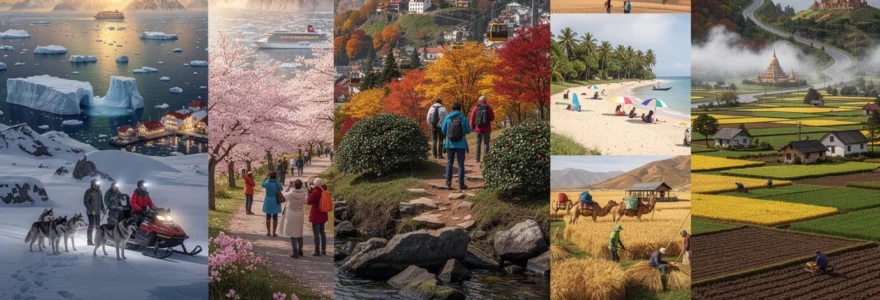
The world’s most captivating travel destinations undergo remarkable metamorphoses throughout the year, revealing entirely different personalities as seasons shift. From Canada’s northern wilderness regions plunging into months of darkness before exploding with midnight sun, to cherry blossom spectacles in Japan transforming into autumn displays, these seasonal transformations create distinct travel experiences within the same geographical location. Understanding these dramatic changes isn’t just about timing your visit—it’s about witnessing nature’s most spectacular performances and experiencing destinations at their seasonal peaks.
Climate patterns, light cycles, and natural phenomena create such profound changes that many destinations become virtually unrecognisable from one season to the next. These transformations offer travellers unique opportunities to experience the same place multiple times, each visit revealing completely different landscapes, activities, and cultural celebrations tied to seasonal rhythms.
Arctic and subarctic destinations: extreme seasonal light variations
Arctic and subarctic regions experience the most dramatic seasonal transformations on Earth, where extreme light variations create two completely different worlds within the same location. The transition from polar night to midnight sun represents perhaps the most profound seasonal change any destination can undergo, fundamentally altering not just the landscape but the entire human experience of place.
Svalbard’s polar night phenomenon and midnight sun tourism patterns
Svalbard exemplifies extreme seasonal transformation, where winter’s polar night creates an otherworldly landscape illuminated only by moonlight, stars, and the aurora borealis. From mid-November to late January, this Norwegian archipelago experiences continuous darkness, transforming settlements like Longyearbyen into ethereal outposts where artificial lighting creates intimate pockets of warmth against the vast arctic darkness. The polar night period attracts photographers and aurora enthusiasts seeking the most dramatic northern lights displays on Earth.
The transformation begins in March as daylight gradually returns, but the true metamorphosis occurs during Svalbard’s midnight sun period from April to August. The archipelago becomes a land of endless daylight, where temperatures rise dramatically and the frozen landscape gives way to surprising summer blooms. Wildlife patterns shift completely—polar bears become more active on the ice edges, while millions of seabirds return to clifftop colonies. This seasonal change creates two entirely different tourism seasons, each requiring different clothing, activities, and mental preparation for the unique light conditions.
Iceland’s geothermal activity contrast between winter aurora season and summer lupine blooms
Iceland’s seasonal transformation showcases how geothermal activity creates stunning contrasts against changing seasonal backdrops. Winter transforms the island into a dramatic stage for aurora displays, where geothermal features like geysers and hot springs create steam clouds that dance against the green curtains of northern lights. The contrast between ice formations and naturally heated pools reaches its peak during winter months, when travellers can experience the surreal combination of sub-zero temperatures and naturally heated outdoor bathing.
Summer brings a completely different Iceland, where the midnight sun illuminates vast fields of purple lupines that bloom from June through August. The same geothermal features that provided winter drama now sit surrounded by wildflower meadows, creating scenes that seem almost tropical compared to winter’s stark beauty. Highland roads open for the first time since autumn, revealing interior landscapes accessible only during the brief summer season. This transformation is so complete that summer and winter visitors often struggle to believe they’re experiencing the same country.
Northern norway’s lofoten islands: dramatic coastal weather system transformations
The Lofoten Islands demonstrate how coastal weather systems create some of the world’s most dramatic seasonal destination transformations. Winter brings violent storms that create towering waves against the dramatic peaks, while the aurora borealis reflects off snow-covered fishing villages perched on stilts above the sea. The combination of extreme weather, polar night conditions, and traditional fishing culture creates an almost mythological winter atmosphere.
Summer’s transformation reveals the islands’ hidden identity as a surprisingly temperate destination where traditional red fishing huts (rorbuer) sit surrounded by green meadows and wildflowers. The midnight sun allows for late-night hiking across peaks that were invisible during winter’s darkness, while the same coastal waters that produced winter storms become calm enough for sea kayaking and fishing expeditions. The weather systems that created winter’s drama become gentle summer breezes, completely altering both the landscape’s appearance and the range of possible activities.
Greenland’s ilulissat icefjord calving cycles and summer navigation windows
Few places on Earth illustrate seasonal transformation as clearly as Greenland’s Ilulissat Icefjord, a UNESCO World Heritage Site where one of the world’s most productive glaciers meets the sea. In winter, the fjord often locks under sea ice, creating a frozen highway used by local hunters and dog sled teams. Daylight is limited, and the horizon glows with pastel blues and pinks that reflect off the icebergs, giving the entire landscape a muted, sculptural quality. Winter visitors experience a still, almost silent world, broken only by the distant crack of shifting ice and the occasional boom of calving deep within the fjord.
As temperatures rise in late spring and summer, the Icefjord shifts from static sculpture to dynamic theatre. The sea ice breaks up, opening navigation windows for small boats to weave through towering icebergs that have recently calved from the Sermeq Kujalleq glacier. Calving events increase, sending cathedral-sized chunks of ice crashing into the fjord and creating powerful waves that can be felt kilometres away. This seasonal accessibility allows for boat tours, kayaking, and coastal hiking along ice-free paths, completely changing how travellers can experience Greenland’s glacial landscapes from one season to the next.
Temperate climate destinations with distinct four-season tourism cycles
In temperate climate zones, destinations often reinvent themselves four times a year, with spring blossoms, summer festivals, autumn colours, and winter snows shaping entirely different travel experiences. Rather than one peak season, these regions develop layered tourism cycles, with each season attracting a different type of traveller. For you as a visitor, that means the same town in May and October can feel like two separate destinations, each with its own rhythm, visual identity, and set of seasonal activities.
These transformations are particularly striking in places where culture syncs closely with nature’s calendar. Flower-viewing traditions, harvest festivals, and winter markets are not just add-ons for tourists; they’re long-standing local rituals that determine when cities feel most alive. If you time your trip around these four-season tourism cycles rather than simple “good weather,” you can tap into deeper, more authentic experiences that reflect how locals actually live through the year.
Japan’s sakura hanami season versus autumn kouyou foliage migration patterns
Japan offers one of the world’s most refined examples of seasonal tourism, with cherry blossom (sakura) and autumn foliage (kouyou) seasons driving distinct migration patterns across the archipelago. In spring, the Japan Meteorological Agency tracks the “sakura front” as it moves from Kyushu in the south to Hokkaido in the north, usually from late March to late April. Cities like Tokyo, Kyoto, and Osaka fill with hanami picnics under blooming trees, and parks, temples, and riversides become focal points for both domestic and international travellers chasing this brief seasonal spectacle.
Autumn brings a mirror-image phenomenon as the “kouyou front” moves from north to south, typically from October through late November. High-altitude regions such as the Japanese Alps and Nikko blaze first with red maples and golden ginkgo, followed weeks later by lower-lying cities. While sakura season is often associated with pastel transience and crowded picnic spots, autumn foliage season tends to feel calmer and more contemplative, with hikers following mountain trails and temple lovers seeking serene gardens framed in deep reds and golds. Choosing between sakura and kouyou isn’t just about colour—it’s about deciding whether you prefer the celebratory energy of spring or the reflective atmosphere of autumn.
New england’s fall foliage belt: peak colour timing from vermont to maine
New England’s fall foliage belt is so iconic that “leaf peeping” has become a tourism category in its own right, with entire itineraries built around tracking peak colour. In late September, autumn begins at higher elevations in northern Vermont and New Hampshire, where sugar maples, birches, and oaks erupt into oranges, reds, and yellows. By early to mid-October, the colour wave moves south and east through central Vermont, the White Mountains, and into coastal Maine, reshaping otherwise familiar landscapes into cinematic vistas that draw photographers and road-trippers from around the world.
This seasonal transformation does more than paint the hillsides—it reorganises the region’s economy and travel patterns. Inns and B&Bs that may be quiet in early spring suddenly sell out at weekends, scenic byways like Vermont’s Route 100 and New Hampshire’s Kancamagus Highway become moving galleries of colour, and even small towns transform into hubs for harvest festivals and farmers’ markets. Winter brings a second, very different tourism cycle based around skiing and snowshoeing, but it’s the short, intense fall peak that truly illustrates how a temperate destination can reinvent its identity within a matter of weeks.
European alpine region seasonal activity transitions in swiss and austrian valleys
Swiss and Austrian Alpine valleys undergo some of the most complete seasonal makeovers in Europe, with entire villages shifting from ski hubs to hiking bases as the year unfolds. In winter, resorts like Zermatt, St. Anton, and Kitzbühel operate around snow: ski lifts hum from dawn to dusk, frozen lakes host ice-skating, and mountain huts focus on hearty dishes designed to fuel long days on the slopes. The visual palette is dominated by white and slate-grey, with forests and peaks buried under deep snowpack, and the soundscape filled with the constant crunch of skis and snow underfoot.
By late spring and summer, these same valleys transform into a lush, green world of wildflower meadows, grazing cattle, and clear alpine streams. Ski runs become hiking and mountain biking trails, cable cars carry walkers and climbers, and the focus shifts to long, sunlit days outdoors. Alpine towns that once sold wax and thermal layers now highlight e-bikes, via ferrata gear, and lakeside picnics. For travellers, this means that planning a “trip to the Alps” is less about a fixed destination and more about choosing which version of the mountains—snowbound and adrenaline-filled, or meadow-rich and tranquil—you want to experience.
South korea’s jeju island camellia winter blooms and summer beach tourism dynamics
Jeju Island, off South Korea’s southern coast, offers a subtler but no less striking example of seasonal transformation. In winter, while much of the Korean peninsula is bare and cold, Jeju’s milder climate allows camellias and canola flowers to bloom between December and February. Trails like the Camellia Hill arboretum and rural roads lined with yellow rape blossoms create a surprisingly colourful winter landscape. This “secret season” attracts photographers and travellers seeking quieter paths, warm cafés, and volcanic scenery uncluttered by summer crowds.
Come summer, Jeju’s identity flips toward coastal leisure and water activities. Beaches such as Hyeopjae, Jungmun, and Hamdeok fill with domestic travellers drawn by turquoise water and black volcanic rock, while the island’s famous olle walking trails see a surge in hikers eager to explore lava tubes and Hallasan’s slopes under clear skies. The tourism dynamics shift from slow, scenic drives and flower viewing in winter to snorkelling, surfing, and seaside cafés in summer. If you visit Jeju twice in a year, you’re likely to find entirely different crowds, activities, and even marketing—proof of how flexible a temperate island can be in responding to its seasonal strengths.
Monsoon-affected regions: dramatic weather pattern tourism shifts
In monsoon-affected regions, the arrival of seasonal rains can feel as dramatic as flipping a switch. Dry riverbeds become flowing waterways, parched fields turn emerald green, and daily life rearranges itself around storm cycles. For tourism, this means some destinations are almost two different places: one during the dry season, when access is easiest, and one during monsoon, when landscapes are at their most lush but logistics can be unpredictable. Planning travel here is a bit like timing a visit to a theatre performance—you want to understand both the opening act and the climax.
Rain doesn’t simply “ruin” a holiday; in many of these regions, it creates the very scenery travellers come to see, from full waterfalls to navigable canals. The challenge, and the opportunity, lies in matching your expectations and activities to each phase of the monsoon cycle. Are you looking for mirror-like rice paddies and quiet towns, or guaranteed sunshine and straightforward transport? Knowing how destinations pivot between monsoon and dry season can help you make the most of both.
Kerala’s backwater navigation during southwest monsoon versus dry season tourism
Kerala’s famed backwaters are shaped by the southwest monsoon, which typically arrives in early June and continues through September. During this period, heavy rains replenish the intricate network of canals, lakes, and rivers, raising water levels and intensifying the deep greens of surrounding paddy fields and coconut groves. Houseboat cruises still operate, but itineraries may be shorter or more flexible to account for storms, and the experience becomes more about watching dramatic cloudscapes and listening to the rain drum on the roof than sunbathing on the upper deck.
By contrast, the dry season from November to February offers more predictable weather and calmer waters, ideal for longer overnight houseboat journeys and village walks along the embankments. Visibility improves, sunsets lengthen, and there’s a stronger emphasis on outdoor activities such as cycling, canoeing, and birdwatching. Interestingly, many Ayurvedic centres recommend the early monsoon as the best time for traditional treatments, when pores are more open and the body is considered more receptive. So when is “best”? If you prioritise easy logistics and clear skies, the dry season suits you; if you’re drawn to Kerala at its most lush and atmospheric, embracing the monsoon can be surprisingly rewarding.
Rajasthan’s desert climate extremes: summer heat restrictions and winter palace tourism
Rajasthan’s desert cities—Jaipur, Jaisalmer, Jodhpur, and Udaipur—undergo sharp seasonal swings that directly shape how and when travellers explore them. From April to June, daytime temperatures often exceed 40°C (104°F), making afternoon sightseeing uncomfortable or even unsafe. During this extreme summer period, activity patterns invert: locals and in-the-know visitors venture out at dawn and in the late evening, while the hottest hours are reserved for shaded courtyards, hotel pools, and long siestas. Certain desert safaris and outdoor experiences may be reduced or scheduled strictly around sunrise and sunset to avoid the worst of the heat.
Come winter, typically November to February, Rajasthan becomes one of India’s most comfortable and romantic destinations. Daytime temperatures settle between 20–25°C (68–77°F), ideal for exploring hilltop forts, lakeside palaces, and blue-washed old towns on foot. Palace hotels stage courtyard dinners under clear stars, camel safaris stretch into the dunes of the Thar Desert, and festivals like the Pushkar Camel Fair draw large crowds. The same sandstone architecture that radiates heat in summer now soaks up gentle winter sun, completely changing how it feels to wander through these historic cities.
Myanmar’s bagan archaeological zone access during monsoon and post-monsoon periods
Bagan, with its thousands of temples scattered across the plains of central Myanmar, shows how monsoon rhythms can profoundly alter access and atmosphere. The monsoon season, usually from June to October, brings regular but often short-lived downpours that turn dusty tracks into muddy pathways. Some unpaved roads and minor pagodas become harder to reach, and balloon flights—one of Bagan’s signature experiences—are generally suspended due to weather conditions. Yet the trade-off is quieter sites, cooler temperatures, and a fresh green backdrop to the brick stupas, which many photographers find especially appealing.
In the post-monsoon and dry seasons, from November to February, Bagan enters its classic tourism phase. Skies clear, humidity drops, and sunrise hot-air balloon rides resume, offering sweeping views over mist-draped temples. Access to remote pagodas improves as tracks dry out, making e-bike and bicycle exploration far easier. By March and April, the landscape dries and browns, temperatures climb, and midday sightseeing becomes more demanding, though the hazy light can lend a dreamlike quality to sunsets. If you’re deciding when to visit Bagan, ask yourself: do you want lush scenery and solitude with some logistical compromises, or peak accessibility and iconic balloon views with more company?
Agricultural landscape destinations: crop cycle visual transformations
Agricultural regions demonstrate some of the most rhythmically predictable yet visually dramatic seasonal transformations on the planet. Fields cycle from bare soil to tender shoots, full canopies, harvest-ready crops, and finally stubble, each stage giving the landscape a distinct texture and colour palette. For travellers, these crop cycles can be as compelling as any natural wonder, especially when combined with traditional farming practices and local festivals that mark sowing and harvest.
Think of the terraced rice fields of Bali and the Philippines, which shift from reflective, water-filled mirrors in planting season to rich green waves in mid-growth and finally to golden tiers at harvest. Or consider European wine regions such as Tuscany and Bordeaux, where vineyards change from skeletal winter vines to leafy summer rows heavy with grapes. Visiting an agricultural landscape without understanding its crop calendar can feel like arriving at a theatre between acts; time it right, and you’ll see the scenery at its most expressive.
Mediterranean climate zones: seasonal flora and fauna migration patterns
Mediterranean climates—characterised by wet winters and hot, dry summers—create sharply contrasting seasonal identities for coastal and inland destinations. In winter and early spring, hillsides are unexpectedly green, wildflowers carpet olive groves, and migratory birds use these regions as crucial stopovers. Coastal towns feel quieter, with a more local rhythm as residents reclaim promenades and harbour cafés. It’s a time when you can walk for hours under mild skies and see landscapes that summer visitors might never imagine exist.
By late spring and summer, the same areas shift toward sun-baked tones of gold and ochre, and tourism pivots to beaches, sailing, and long Mediterranean evenings. Islands in Greece and Croatia, for example, attract different species—and different travellers—depending on the season: birdwatchers in April and May, yachters and beachgoers in July and August. Just as swallows and other migratory birds time their journeys to blooms and insect hatches, savvy travellers can “migrate” with the seasons, choosing spring for hiking and nature watching, and summer for warm seas and vibrant nightlife.
High-altitude mountain destinations: elevation-based seasonal accessibility changes
High-altitude mountain destinations add another layer of complexity to seasonal transformation: elevation. Within a single valley, conditions at 1,500 metres can differ dramatically from those at 3,500 metres, and these differences shift throughout the year. In many Himalayan, Andean, and Rocky Mountain regions, high passes remain snowbound for much of the year, opening only for a short window in late spring or summer. This creates “micro-seasons” of accessibility, when specific treks, mountain huts, and viewpoints briefly become reachable before winter reclaims them.
Take Nepal’s trekking routes or Peru’s Cordillera Blanca, where lower villages may enjoy spring-like conditions while higher camps are still buried in snow. Trail operators and local communities plan intensely around these altitude-driven windows, concentrating maintenance, guiding, and supply runs into a few crucial months. For you as a traveller, understanding these elevation-based cycles is key: a destination that seems “open year-round” on paper may, in reality, offer very different experiences depending not just on the month, but on how high you intend to go. In that sense, high mountains don’t just change with the seasons—they stack multiple seasons vertically, offering entirely different worlds as you move uphill.