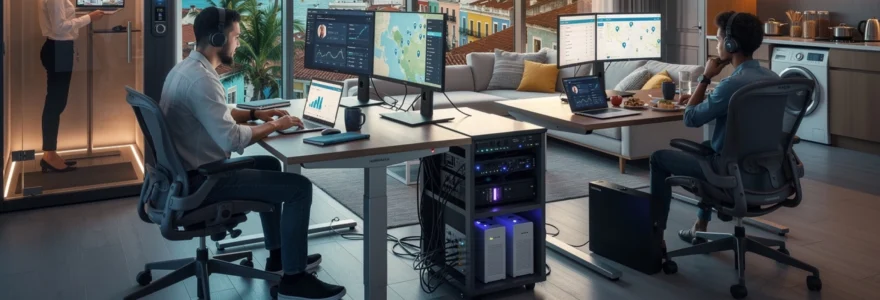
The modern workforce has undergone a seismic transformation, with over 35 million individuals worldwide now identifying as digital nomads according to recent 2024 data. This paradigm shift has created unprecedented demand for accommodation solutions that transcend traditional hospitality models. The digital nomad lifestyle requires environments that function simultaneously as productive workspaces, comfortable living quarters, and social hubs—a triad of needs that conventional hotels and rental properties often fail to address comprehensively.
Finding suitable accommodation remains one of the most significant challenges you’ll face as a location-independent professional. The stakes are high: your choice of lodging directly impacts productivity, mental wellbeing, networking opportunities, and ultimately, your professional success. As remote work continues its exponential growth trajectory, the accommodation industry has responded with innovative solutions ranging from purpose-built coliving complexes to reimagined serviced apartments, each designed to meet the unique demands of the mobile workforce.
Co-living spaces and colocation hubs: infrastructure for remote professionals
Co-living spaces represent the most purposeful response to digital nomad accommodation needs, offering integrated solutions that address connectivity, community, and comfort simultaneously. These purpose-designed facilities typically occupy converted hotels, apartment complexes, or newly constructed buildings specifically engineered for remote professionals. The fundamental distinction lies in their intentional architecture: every element, from spatial layout to technological infrastructure, prioritises the requirements of knowledge workers operating across time zones.
The economic model of coliving spaces differs substantially from traditional rentals. Rather than paying separately for accommodation, internet, utilities, coworking access, and social activities, you’ll typically encounter all-inclusive pricing structures. Monthly rates in Southeast Asian hubs average £800-1,400, European locations range from £1,200-2,500, and premium North American properties command £1,800-3,500. These figures reflect significant value propositions when you calculate the cumulative costs of obtaining equivalent services independently.
High-speed fibre optic connectivity and redundant internet solutions in nomad hubs
Internet reliability constitutes the non-negotiable foundation of digital nomad accommodation. Professional-grade coliving spaces implement redundant connectivity architectures featuring multiple internet service providers, automatic failover systems, and dedicated bandwidth allocation per resident. You’ll typically encounter symmetrical fibre optic connections offering 500 Mbps to 1 Gbps speeds, with backup 4G/5G systems engaging automatically during primary connection failures.
Advanced facilities install enterprise-grade networking equipment including managed switches, multiple access points for seamless roaming, and quality-of-service protocols that prioritise video conferencing traffic. The technical specifications matter profoundly when you’re conducting client presentations or participating in critical meetings. Leading coliving operators conduct weekly network performance audits, maintaining detailed uptime logs that frequently exceed 99.9% availability—a metric that surpasses most residential internet services by considerable margins.
Ergonomic workstation standards: herman miller chairs and adjustable standing desks
The physical workspace within coliving environments reflects ergonomic principles that protect your long-term health and enhance immediate productivity. Premium facilities standardise on commercial-grade furniture from manufacturers like Herman Miller, Steelcase, and Humanscale. You’ll encounter Aeron or Embody chairs calibrated to support extended sitting periods, paired with electrically adjustable desks accommodating both seated and standing work positions.
Beyond individual workstations, communal areas feature diverse seating configurations: high-back focus booths for concentration-intensive tasks, collaborative tables for group projects, and lounge arrangements for informal video calls. Lighting design incorporates both natural illumination and adjustable LED systems that minimise eye strain during extended screen time. These seemingly minor details compound significantly over weeks and months, directly influencing your work output quality and physical wellbeing.
Outsite network, selina properties, and sun and co: comparative analysis
The coliving market features distinct players with differentiated value propositions. Outsite operates approximately 20 locations across the Americas and Europe, emphasising smaller, community-focused properties housing 15-30 residents. Their model prioritises quality over scale, with curated member bases and structured networking activities. Monthly rates typically range from £1
,600–2,800 depending on location and season, with discounts for stays beyond 30 days. Outsite’s primary strength lies in its consistency: you know that wherever you book, you’ll have fast Wi‑Fi, work-ready common areas, and a curated digital nomad community.
Selina has pursued a different strategy, scaling quickly to more than 100 locations worldwide, often in prime leisure destinations from Mexico to Portugal. Properties typically combine hostel-style dorms, private hotel rooms, and coworking facilities under one roof, making them attractive if you value social energy and on-site events. However, quality can vary between locations, and Wi‑Fi reliability is sometimes less consistent than in smaller, premium coliving brands. Sun and Co, by contrast, operates a single flagship house in Jávea, Spain—focusing on deep community building, mastermind-style sessions, and structured professional development rather than pure scale. If you’re deciding between these options, consider your priorities: do you want predictable infrastructure across many countries, a budget-friendly social hub, or an intimate environment optimised for collaboration and focus?
24/7 access control systems and secure private office pods
Security and flexible access are critical for remote professionals who may be working across multiple time zones. Modern colocation hubs typically implement 24/7 access control systems using keycards, mobile app credentials, or biometric verification. This allows you to enter coworking areas, private offices, and common spaces at any hour without compromising building security. Many spaces also segment access rights, ensuring that only authorised residents can enter residential floors, equipment rooms, or storage areas.
For confidential client work or high-stakes calls, secure private office pods are increasingly standard. These sound-insulated booths feature acoustic treatment, integrated power outlets, and often height-adjustable desks, allowing you to handle sensitive discussions without worrying about eavesdropping or background noise. Some hubs even offer bookable “war rooms” or micro-offices on weekly or monthly terms, effectively giving you an on-demand headquarters. When evaluating a digital nomad accommodation, ask yourself: can you take a shareholder presentation at 03:00 without disruption—and without waking your neighbours?
Serviced apartments and extended stay hotels: balancing domestic comfort with professional requirements
While coliving spaces emphasise community and shared infrastructure, serviced apartments and extended stay hotels are designed for professionals who prioritise privacy and domestic comfort. These properties combine hotel-style services—reception, housekeeping, security—with the space and amenities of a self-contained apartment. For digital nomads staying one to six months, this hybrid model often provides an optimal balance between cost-efficiency, independence, and reliability.
In contrast to ad hoc peer-to-peer rentals, reputable serviced apartment brands adhere to consistent standards across locations. You can expect reliable high-speed internet, a functional desk or table, and clear billing that often includes utilities, cleaning, and sometimes even coworking access. The result is a “plug-and-play” living and working environment: you arrive with a suitcase and laptop, then get straight to work without negotiating contracts, buying furniture, or arranging utilities.
Aparthotels with dedicated workspace zones: citadines and adagio models
Aparthotels such as Citadines and Adagio have increasingly repositioned themselves for the “work from anywhere” demographic. Many properties now feature dedicated workspace zones in both private units and public areas. In-room, you’ll often find full-sized desks, task lighting, and multiple power outlets positioned to support dual-monitor setups or extensive peripherals. Public areas may include quiet lounges, semi-private booths, and meeting rooms bookable by the hour or day.
Citadines, part of The Ascott Limited, typically emphasises central urban locations close to business districts and transport hubs—ideal if you need quick access to client offices or consulates. Adagio, a joint venture between Accor and Pierre & Vacances, often leans toward residential neighbourhoods and slightly longer-stay guests, with communal spaces that feel more like shared living rooms than lobbies. When comparing aparthotels to classic hotels for digital nomad accommodation, the key differences are always the same: more space, purpose-built work zones, and infrastructure optimised for weeks or months rather than nights.
Kitchenette facilities and meal prep infrastructure for long-term stays
For extended stays, having a proper kitchenette is more than a convenience—it’s a major lever in your geographic arbitrage strategy. Cooking at home instead of relying on restaurants or delivery can reduce your monthly burn rate by 20–40%, particularly in higher-cost cities like London, Paris, or Singapore. Most serviced apartments include a hob, microwave or oven, fridge-freezer, and basic cookware, enabling you to batch-cook meals, prep healthy lunches, and adapt to dietary requirements without compromise.
Thoughtful properties go further by providing dishwashers, full-sized fridges, and sufficient countertop space for appliances such as blenders or coffee grinders. Some aparthotels partner with local supermarkets or meal-kit providers, offering discounts or delivery lockers on-site. The impact on your lifestyle is substantial: instead of structuring your workday around restaurant opening hours, you can align cooking and eating with your productivity rhythms—early-morning deep work, midday gym, evening meal prep—without leaving the building.
Weekly and monthly rate structures: cost-efficiency analysis
One of the main advantages of serviced apartments and extended stay hotels is their tiered pricing for medium- and long-term stays. While a nightly rate might appear similar to a standard hotel at first glance, weekly and monthly packages often deliver substantial savings. Discounts of 15–25% for stays over seven nights and 30–45% for stays beyond 28 nights are common, especially in shoulder seasons or secondary cities. When you spread this over a full month, the effective daily rate can rival or undercut many Airbnb options—without cleaning fees or surprise service charges.
To properly compare digital nomad accommodations, calculate the total monthly cost of occupancy: base rate, taxes, Wi‑Fi, utilities, cleaning, coworking passes (if needed), and commuting costs. In many cases, a centrally located aparthotel with strong internet and in-house workspace may be cheaper overall than a cheaper but remote rental that requires daily coworking passes and transport. Treat your accommodation budget like a business expense: where will each pound or dollar deliver the most productivity and quality of life?
Laundry services, housekeeping schedules, and minimal-disruption protocols
Operational details like laundry and housekeeping can significantly affect your working schedule, particularly if you take frequent calls or follow strict time blocks. Serviced apartments usually offer either in-unit washing machines or on-site laundry rooms, often supplemented by paid dry-cleaning services for business attire. This is a meaningful advantage over many hotels, where laundry is both expensive and slow, and over some colivings, where shared machines become bottlenecks.
Housekeeping schedules are another dimension to consider. Extended stay hotels often reduce cleaning frequency to once or twice per week for long-term guests, striking a balance between hygiene and privacy. Higher-end properties will proactively coordinate with you to minimise disruption, allowing you to specify preferred time windows or opt out on heavy workdays. In practical terms, this means you’re less likely to have a crucial client call interrupted by a knock at the door or a vacuum cleaner in the hallway.
Geographic arbitrage strategies: optimising accommodation costs across time zones
One of the most powerful levers available to digital nomads is geographic arbitrage—earning income in a high-value currency while incurring living costs in more affordable regions. Accommodation is usually the largest line item in this equation, and optimising where you stay can unlock substantial savings or upgrades in lifestyle. Rather than simply chasing the cheapest rent, sophisticated nomads weigh cost against infrastructure, safety, visa stability, and time zone alignment with clients.
Think of your accommodation choices as part of a broader portfolio strategy. You might spend three months in a low-cost hub like Chiang Mai to build savings, followed by a month in a premium city like Lisbon or Tokyo to network and meet clients. By planning your year around seasonal price fluctuations and visa rules, you can maintain or even improve your standard of living while reducing annual accommodation expenditure by thousands of pounds or dollars.
Southeast asian digital nomad hubs: bali, chiang mai, and da nang cost comparisons
Southeast Asia remains the epicentre of affordable digital nomad accommodation. In Chiang Mai, long-term rentals in modern condominiums with pools and gyms can start as low as £250–400 per month, with dedicated coliving and coworking bundles typically in the £600–900 range. Daily living costs—meals, transport, utilities—are similarly modest, making it realistic for a solo professional to live comfortably on £1,000–1,200 per month while retaining Western-level connectivity.
Bali, particularly Canggu and Ubud, offers a different value proposition. Accommodation costs are higher than northern Thailand, with private villas or coliving rooms commonly priced between £700 and £1,500 per month depending on location and amenities. However, Bali compensates with a dense ecosystem of coworking spaces, wellness options, and social events. Da Nang and nearby Hoi An in Vietnam sit somewhere between the two: beachfront apartments with fibre internet might cost £400–700 monthly, with rapidly improving infrastructure and a growing remote work community. When comparing these hubs, ask: which environment best supports your work focus, community needs, and lifestyle rituals—not just your accommodation budget?
European schengen zone navigation: lisbon, tallinn, and prague tax implications
Europe’s Schengen Area presents unique opportunities and challenges for digital nomads. On the one hand, you can move freely between 27 countries for up to 90 days in any 180-day period without complex visa applications if you hold a qualifying passport. On the other hand, spending extended periods in a single country may trigger tax residency or create reporting obligations. Cities like Lisbon, Tallinn, and Prague have become popular because they combine strong digital infrastructure with relative affordability and, in some cases, favourable regimes for foreign remote workers.
Lisbon has historically attracted nomads with its non-habitual resident (NHR) tax regime, though this has been undergoing revisions and may be less generous for new arrivals. Tallinn, Estonia’s capital, offers an e‑Residency programme that simplifies company formation and digital administration, although it doesn’t in itself grant the right to live there. Prague, while not as overtly “nomad-branded,” balances moderate accommodation costs with excellent infrastructure and central European connectivity. When planning your Schengen stays, track days carefully and consult a tax professional if you intend to base yourself in one country for more than 183 days in a year. Accommodation contracts, utility bills, and local registrations can all be factors in determining tax residency.
Latin american remote work visas: mexico city, medellín, and buenos aires regulations
Latin America has seen a surge in interest from remote workers seeking a blend of lower living costs, vibrant culture, and manageable time zones for North American clients. Mexico City has emerged as a major hub, with neighbourhoods like Condesa and Roma offering a dense supply of furnished apartments, colivings, and boutique hotels geared toward digital nomads. Mexico’s temporary resident visa can, under the right circumstances, provide multi-year stability, though many nomads still rely on shorter stays under tourist permissions—an approach that may not remain viable indefinitely as regulations tighten.
Medellín in Colombia—especially districts like El Poblado and Laureles—combines spring-like weather year-round with growing coliving and coworking infrastructure. Colombia’s digital nomad visa, introduced in recent years, offers a clearer legal pathway for remote workers who meet income thresholds and work for foreign employers. Buenos Aires, while economically volatile, offers high-quality accommodation at comparatively low prices due to currency fluctuations. However, frequent regulatory changes and inflation require closer monitoring. In all three cities, understanding local registration rules, proof-of-income requirements, and health insurance obligations is essential before committing to long-term accommodation contracts.
Booking platforms and aggregators: technology-driven accommodation discovery
The days of manually scouring classified ads or relying solely on generic hotel sites are long gone. Digital nomads now benefit from a sophisticated ecosystem of booking platforms and aggregators designed to surface work-friendly accommodation options. These tools do more than list rooms: they provide filters for Wi‑Fi speed, workspace quality, community features, and even average cost of living, allowing you to make data-driven decisions.
However, the abundance of choice introduces a new challenge: information overload. To avoid decision fatigue, it helps to treat these platforms as layers in your search stack. Start with broad discovery tools to shortlist cities, then move to more specialised platforms that focus on digital nomad accommodation. Finally, verify specific properties through reviews, community forums, and direct communication with hosts or operators.
Nomad list database filtering: wifi speed metrics and coworking proximity
Nomad List has become one of the most influential resources for remote workers comparing destinations worldwide. Rather than listing individual apartments or rooms, it aggregates city-level data: average Wi‑Fi speeds, cost of living, safety scores, air quality indices, and the density of coworking spaces. For accommodation planning, two metrics stand out in particular: actual internet performance based on user tests, and the proximity and quality of coworking infrastructure.
You can filter cities according to minimum Wi‑Fi speeds, time zone alignment, and budget constraints, then dive into user reviews and discussion threads to understand lived experiences. Think of Nomad List as the “top-of-funnel” research stage: it won’t tell you which apartment to rent, but it will help you decide whether, for example, Da Nang or Playa del Carmen is a better fit for your next three-month sprint. Once you’ve shortlisted destinations, you can move on to booking-specific platforms.
Airbnb work-friendly filters versus booking.com business travel categories
When it comes to reserving actual accommodation, Airbnb and Booking.com remain the dominant players for digital nomads. Airbnb’s “work-friendly” filters highlight properties with dedicated workspaces, strong Wi‑Fi, and self check-in—features essential for late arrivals and flexible work schedules. You can further refine results by reviewing host responsiveness, rating histories, and cancellation policies. However, as many nomads have learned, “Wi‑Fi included” does not always mean “Wi‑Fi robust enough for HD calls.” Always ask hosts for screenshots of speed tests and clarify whether the connection is shared with other units.
Booking.com has invested heavily in attracting business travellers and long-stay guests. Its “Business” or “Work-friendly” categories surface hotels, aparthotels, and serviced apartments that meet specific criteria around desk space, connectivity, and reliability. An advantage here is verification: properties are typically professional operators rather than individual hosts, reducing the risk of last-minute cancellations. Additionally, Booking.com’s long-stay rates and “pay at property” options can be particularly attractive if you need flexibility around visa approvals or client projects.
Niche platforms: nomadx, wifi tribe, and remote year curated programmes
Beyond mainstream booking portals, a growing number of niche platforms specialise in digital nomad accommodation and community. NomadX, for example, focuses on medium-term rentals for remote workers, often bundling utilities, Wi‑Fi, and sometimes coworking access into transparent monthly rates. Listings are curated for work-friendliness, reducing the need to manually vet every apartment for internet quality or furniture suitability.
Programmes like WiFi Tribe and Remote Year adopt a cohort-based model. Instead of booking a standalone apartment, you join a group of 20–50 professionals traveling together through a series of cities. Accommodation, coworking, and many logistics are handled for you, with pricing typically starting around £1,200–2,500 per month depending on region and room type. The premium you pay reflects not just convenience, but also the built-in community and professional network. These options can be attractive if you’re transitioning into the digital nomad lifestyle and want a structured on-ramp rather than handling every detail yourself.
Essential amenities and technical requirements for productive remote work
Regardless of where you stay—coliving, aparthotel, or private rental—the same core requirements determine whether a space truly qualifies as digital nomad accommodation. Think of these as your non-negotiable checklist. At the top is reliable, fast internet: aim for at least 30 Mbps down and 10 Mbps up for solo work, and higher if you routinely upload large files or host webinars. Latency and stability matter as much as raw speed; a connection that drops intermittently can be worse than a slower but consistent one.
Ergonomics are the next pillar. Extended laptop sessions on bar stools or sofas might be tolerable for a weekend trip, but they become harmful over months. Ideally, you should have access to a proper desk, an adjustable chair with lumbar support, and, where possible, an external monitor to minimise neck strain. Good lighting—both natural and adjustable artificial light—reduces fatigue and improves your on-camera presence during calls. Finally, consider sound: can you take a call without disruptive background noise? If not, you may need noise-cancelling headphones or access to quiet rooms or pods.
Legal and logistical considerations: visa compliance and tenancy agreements for mobile workers
Behind the Instagram-friendly side of digital nomad life lies a complex layer of legal and logistical realities. Visa compliance is the most important: staying in a country beyond the permitted period, or working in a way that violates the terms of your entry, can have serious consequences ranging from fines to future entry bans. Many countries tolerate remote work for foreign employers under tourist status, but this is rarely codified in law and can change without much notice. Increasingly, governments are introducing dedicated remote work or digital nomad visas, each with its own income thresholds, insurance requirements, and documentation.
Accommodation contracts intersect with these issues. Some long-term rentals require proof of local registration or tax numbers, while others are explicitly restricted to tourists. Shorter, flexible arrangements via serviced apartments or colivings can help you avoid entering into formal tenancy agreements that might imply tax residency. Yet even for short stays, it’s wise to review cancellation policies, deposit terms, and house rules carefully. Treat each booking as both a lifestyle choice and a legal document: understand what you’re committing to, ensure it aligns with your visa status, and keep digital copies of all agreements for your records.