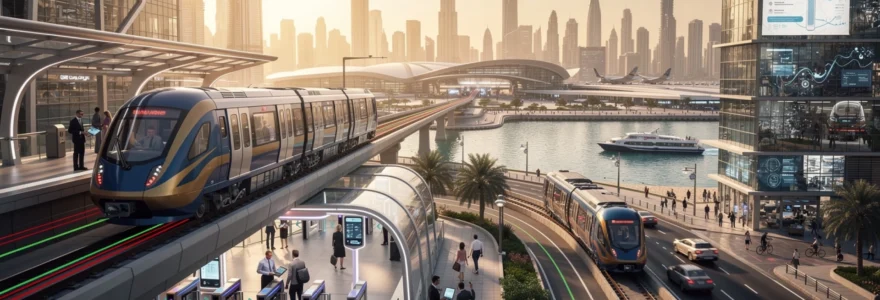
# Dubai’s Modern Transport Systems and Their Rapid Evolution
Dubai’s transformation from a modest trading port to a global metropolis represents one of the most remarkable urban development stories of the 21st century. At the heart of this evolution lies an extraordinarily ambitious transport infrastructure that has redefined what cities can achieve in a matter of decades. With a population surge from approximately 1.4 million in 2005 to over 3.6 million today, and projections reaching 5.8 million by 2040, Dubai faces unprecedented mobility challenges that demand solutions far beyond conventional engineering. The establishment of the Roads and Transport Authority in 2005 marked a pivotal moment, creating a unified vision for integrated transport that would leverage cutting-edge technology, artificial intelligence, and automation to move millions efficiently across limited physical space. Today, the emirate operates one of the world’s most sophisticated transport networks, where driverless trains, intelligent traffic systems, and zero-emission vehicles converge to create a blueprint for future urban mobility.
Dubai metro red and green line infrastructure and driverless technology
The Dubai Metro stands as the cornerstone of the emirate’s public transport revolution, operating as one of the world’s longest fully automated driverless rail systems. Since its historic launch on September 9, 2009—at precisely 9 seconds past 9 minutes past 9pm—the Metro has fundamentally altered how residents and visitors navigate the city. The system currently spans over 100 kilometres across its Red and Green Lines, serving millions of passengers who have abandoned private vehicles in favour of this technologically advanced alternative. The Red Line alone achieves remarkable throughputs of 25,720 passengers per hour per direction during peak periods, a testament to the sophisticated automation that enables trains to operate at headways as short as two minutes.
Mitsubishi heavy industries train systems and automated operation control
The technological sophistication underlying Dubai Metro’s operations relies on Thales Rail Signalling Solutions’ SelTrac IS communications-based train control (CBTC) technology, which represents the pinnacle of autonomous rail operation. This system facilitates continuous communication between trains and wayside equipment, enabling dynamic speed adjustments and precise positioning without any human intervention at GoA4 automation level—the highest grade of autonomous operation globally recognised. Over 3,000 CCTV cameras equipped with advanced video analytics monitor passenger flow and security incidents in real time, creating an unprecedented level of operational awareness. The trains themselves incorporate regenerative braking systems that capture kinetic energy during deceleration, feeding it back into the 750-volt DC power grid and reducing overall energy consumption by up to 15 percent compared to conventional systems. This energy efficiency demonstrates how automation and sustainability can work in harmony to create transport solutions that serve both operational and environmental objectives.
Route 2020 extension to expo sites and al maktoum international airport
The Route 2020 extension represented a significant expansion of the Red Line, adding 15 kilometres of track and seven new stations to connect directly with the Expo 2020 site and position the network for future integration with Al Maktoum International Airport. This strategic expansion showcased Dubai’s forward-thinking approach to transport planning, where infrastructure development anticipates future demand rather than merely responding to current needs. The extension employed advanced construction methodologies including tunnel boring machines for underground sections, demonstrating the emirate’s commitment to minimising surface disruption whilst expanding critical infrastructure. These sophisticated mechanical systems, featuring rotating cutter heads with precisely engineered disc cutters, can advance through varied geology whilst real-time monitoring systems track ground movement, water pressure, and structural integrity. The project exemplified how you can integrate major infrastructure works into a functioning metropolis without compromising operational continuity or quality of life for existing residents.
Platform screen door systems and Climate-Controlled station architecture
Dubai Metro stations represent architectural and engineering achievements that extend far beyond simple passenger boarding points. The platform screen doors, synchronised with train arrivals through millisecond-precise sensor arrays, serve dual purposes: enhancing passenger safety whilst maintaining climate control in stations—a critical consideration in Dubai’s extreme desert environment where outdoor temperatures regularly exceed 45 degrees Celsius during summer months. This climate control integration demonstrates how you must consider local environmental conditions when designing transport infrastructure, as the comfort and safety features that make the Metro attractive to passengers directly influence mode shift from private vehicles. The stations themselves incorporate intelligent lighting systems, advanced wa
ter and ventilation systems that respond to real-time occupancy and external weather conditions. Many stations are designed as semi-enclosed environments with high-performance glazing and insulation, allowing natural light in while minimising heat gain and energy loss. As a result, passengers experience consistently comfortable temperatures from the moment they enter the station to the time they board, which is no small achievement in a city built in the desert. These details may seem minor on their own, but together they create a seamless experience that makes using public transport not just bearable, but genuinely appealing for everyday travel.
Nol card integration and contactless fare collection technology
Central to Dubai’s modern transport systems is the Nol card, a unified smart ticketing solution that underpins almost every public mobility service in the emirate. Introduced in 2009 alongside the Metro, Nol has evolved from a simple stored-value card into a versatile contactless payment platform used across metro, tram, buses, water transport, and even for services such as parking and fuel payments. The system uses NFC technology and EMV-compatible architectures, enabling tap-and-go validation that reduces dwell times at gates and bus doors, and significantly speeds up passenger throughput. For a visitor arriving for the first time, the ability to use a single card across nearly all modes eliminates confusion and lowers the barrier to trying public transport.
Behind this apparent simplicity lies a complex back-office clearing and settlement system capable of processing millions of microtransactions each day. These systems perform real-time fare capping, distance-based calculations, and transfer discounts, while fraud detection algorithms monitor anomalies and misuse patterns. Integration with mobile wallets and the S’hail app means that you no longer need to queue at physical ticket machines to top up; digital top-ups post to cards almost instantly thanks to online account linking. This frictionless, contactless fare collection technology embodies a crucial lesson for any city: if paying for transport is slow, confusing, or fragmented, people default back to private cars. By contrast, when a single smart card or smartphone handles everything from metro rides to water buses, the public network becomes the default choice.
Roads and transport authority vision 2030 strategic framework
Dubai’s Roads and Transport Authority has not limited itself to building infrastructure; it has articulated a long-term strategic framework known as the RTA Vision 2030. This roadmap aims to cut average travel times by around 30 percent, increase operational productivity by roughly 40 percent, and reduce transport-related operating costs by about 20 percent by the end of the decade. These targets are not abstract aspirations but are tied to 81 specific projects and more than 40 AI-powered applications deployed across domains such as smart mobility, intelligent traffic management, and digital licensing systems. When we look at this framework, it becomes clear that Dubai’s modern transport system is less about adding new lanes and more about using data, automation, and autonomy to extract maximum performance from existing assets.
At the heart of Vision 2030 is a commitment to make 25 percent of all journeys in Dubai driverless by 2030, an ambition that has few parallels globally. This ambition spans everything from autonomous taxis and shuttles to self-driving marine craft and automated inspection vehicles. The framework is underpinned by digital infrastructure—fibre optic networks, 5G connectivity, and high-resolution mapping—that allows vehicles and control centres to communicate with low latency and high reliability. In many ways, the emirate is treating its entire transport ecosystem as a living laboratory, where pilot projects feed into policy, and policy in turn accelerates real-world deployments.
Autonomous vehicle trials in business bay and dubai silicon oasis
Among the most visible manifestations of this strategy are the autonomous vehicle trials taking place in zones such as Business Bay, Dubai Silicon Oasis, and selected residential communities. These trials involve a mix of low-speed shuttles, robo-taxis, and last-mile delivery pods operating in geofenced areas mapped in fine detail. Vehicles use a combination of LiDAR, radar, high-definition cameras, and GNSS to perceive the environment, with AI models classifying objects, predicting pedestrian behaviour, and planning safe routes in real time. For residents and office workers, these pilot services offer a glimpse of a future where you summon a driverless vehicle from an app and ride seamlessly to the nearest metro or tram station.
From an urban-planning perspective, these trials answer crucial questions: How do autonomous vehicles behave around busy curb spaces? What happens during sandstorms or intense rainfall? How do human drivers interact with self-driving cars at roundabouts and unsignalised junctions? Data from thousands of hours of operation is fed back into simulation platforms and digital twins of the city, allowing engineers to refine algorithms without putting passengers at risk. For other cities watching Dubai, the message is clear: you cannot move to large-scale deployment of autonomous mobility without carefully staged, real-world trials that expose vehicles to the messy complexity of actual streets.
Smart traffic management systems across sheikh zayed road corridor
While driverless technology grabs headlines, the less visible but equally transformative work happens in traffic control centres such as the Dubai Intelligent Traffic Systems Centre. Along the Sheikh Zayed Road corridor and other major arterials, the RTA has deployed what it calls UTC-UX Fusion smart traffic management, connecting 100 percent of the emirate’s traffic signals via an 820-kilometre fibre optic network. Data from hundreds of CCTV cameras, incident detection sensors, travel time probes, and weather stations is fed into AI-powered platforms that optimise traffic signal timings in real time. Think of it as moving from a fixed, pre-programmed orchestra of signals to a dynamic conductor that listens to traffic “music” and adjusts the tempo every few seconds.
Machine learning models forecast near-term congestion, detect abnormal patterns such as sudden slowdowns, and propose mitigation strategies like green-wave adjustments or reversible lane management. During major events or incidents, operators work with these algorithms to create detour plans, trigger Variable Message Signs, and coordinate with emergency services. For drivers along Sheikh Zayed Road, the benefits are measured in reduced delays—some corridors have seen travel-time improvements of up to 25 percent during peak periods. It shows how, without adding a single extra lane, a city can use intelligent traffic systems to extract the equivalent of a 15–20 percent capacity increase from existing infrastructure.
Integrated mobility platform and journey planner applications
Of course, optimisation behind the scenes only matters if people can easily access and understand their travel options. This is where Dubai’s integrated mobility platform, anchored by the S’hail app and other journey planner applications, plays a central role. These digital platforms aggregate real-time data from the metro, tram, buses, taxis, shared mobility providers, and even water transport, presenting them in a unified interface. You can compare door-to-door options, see estimated arrival times, check walking distances, and understand total trip costs before you set off. Unlike fragmented systems in many cities, Dubai’s journey planners treat modes as interchangeable building blocks rather than siloed competitors.
Advanced routing algorithms evaluate millions of possible combinations, factoring in live congestion levels, service disruptions, and user preferences such as avoiding transfers or prioritising lower fares. Push notifications and smartwatch integrations provide haptic alerts for upcoming departures, reducing the stress of making tight connections. As a result, public transport trips feel more predictable and controllable, addressing a key psychological barrier that often deters car users. For planners and policymakers, aggregated, anonymised data from these apps feeds back into demand models, helping them design new routes, modify service frequencies, and adjust infrastructure investments to match actual travel behaviour.
Dubai tram network along al sufouh road and jumeirah beach residence
Complementing the Metro is the Dubai Tram, which operates along Al Sufouh Road and Jumeirah Beach Residence, serving dense residential clusters, hotels, and key tourist destinations. Launched in 2014, the tram line was the first outside Europe to use ground-level power supply technology (Alstom’s APS system), eliminating the need for overhead catenary wires and preserving the visual aesthetics of the urban waterfront. With air-conditioned, platform-level boarding and full integration with the Nol fare system, the tram forms a critical east–west connector, feeding passengers into Dubai Marina and Jumeirah Lakes Towers Metro stations via dedicated footbridges.
The network might appear modest in length compared with the Metro, but its impact on urban mobility in the Marina–JBR corridor is significant. Before its introduction, this area relied heavily on private cars and taxis, leading to chronic congestion, especially during weekends and events. Today, residents and visitors can move between hotels, residences, and retail destinations using a fixed, reliable service that operates at regular headways. From an operational standpoint, the tram also benefits from grade separation at many intersections and priority signalling at others, helping maintain punctuality even in mixed-traffic environments. For any city considering modern tram systems, Dubai’s experience highlights how design choices—such as ground-level power and climate-controlled stations—can encourage ridership in extreme climates.
Water transport modernisation through dubai ferry and water taxi services
Water has always been central to Dubai’s identity, from its early days as a creek-side trading port to its current status as a global tourism hub. The RTA has leveraged this heritage through a modernised water transport network that includes Dubai Ferry, water taxis, and water buses. These services provide not only practical mobility options along the coast and through the Creek, but also offer scenic journeys that appeal to tourists and residents alike. In a city where road and rail corridors are heavily utilised, water transport acts as a parallel network, adding resilience and capacity to the overall system.
The Dubai Ferry connects key nodes such as Dubai Marina, Palm Jumeirah, Al Ghubaiba, and Dubai Canal, using high-speed catamarans with comfortable seating and onboard amenities. Water taxis, by contrast, offer on-demand, point-to-point services that can access smaller jetties and hotel docks, functioning much like premium aquatic ride-hailing. For visitors exploring the city, these modes create memorable experiences; for planners, they offer additional redundancy, especially during road closures or major events. Digital booking platforms and Nol integration mean that, in practice, you can plan a multimodal journey that combines metro, tram, and water transport within a single itinerary.
Traditional abra electrification programme in dubai creek
Perhaps the most symbolic element of Dubai’s water transport modernisation is the electrification of the traditional abra fleet on Dubai Creek. These small wooden boats, once powered exclusively by diesel engines, are being retrofitted or replaced with electric and hybrid propulsion systems that eliminate tailpipe emissions and dramatically reduce noise. The project preserves the visual and cultural identity of the abra—its shape, seating layout, and role in connecting Deira and Bur Dubai—while bringing the underlying technology into the 21st century. It is a powerful example of how a city can respect heritage while embracing sustainability.
From a technical standpoint, the electrification programme involves installing battery packs, electric motors, and smart control units that manage power flows based on load and operating conditions. Charging infrastructure is deployed along key berths, some of it integrated with solar canopies that offset grid consumption. For crew and operators, training programmes cover safety procedures, charging protocols, and basic diagnostics. The result is a fleet that produces fewer vibrations and fumes, improving passenger comfort and air quality for waterfront communities. It highlights a broader theme in Dubai’s transport evolution: not every innovation requires building something entirely new; sometimes, upgrading existing assets yields outsized benefits.
Dubai marina and business bay water bus route development
Beyond the Creek, Dubai has developed water bus and water taxi routes through man-made waterways such as Dubai Marina and Business Bay Canal. These corridors, lined with high-rise towers, hotels, and promenades, are natural candidates for short-hop marine transit that bypasses street-level congestion. Water buses operate on fixed routes and timetables, stopping at multiple piers where passengers can connect to nearby tram and metro stations. As mixed-use districts continue to densify, these services help distribute footfall more evenly and reduce pressure on limited road access points.
The development of these routes follows a data-driven approach, with demand modelling, origin-destination surveys, and pilot operations shaping final service patterns. By monitoring ridership trends—such as morning peak flows towards office clusters and evening flows towards dining and leisure destinations—RTA can adjust frequencies, vessel sizes, and operating hours. In the long run, as waterfront developments extend further inland, we can expect water bus networks to expand in tandem, forming a complementary grid that supports both daily commuting and tourism. For city planners elsewhere, Dubai’s water transport strategy illustrates how underused waterways can become high-value mobility corridors when integrated thoughtfully with land-based networks.
Hybrid marine propulsion systems and emission reduction targets
To align with the UAE’s Net Zero Strategy 2050, Dubai is investing in hybrid marine propulsion systems that combine diesel, electric, and, in some cases, solar-assisted power generation. Newer ferries and water buses feature hybrid drivetrains that allow them to operate in full-electric mode within sensitive zones—such as near residential waterfronts or heritage sites—and switch to diesel or combined modes in open water or at higher speeds. Battery energy storage systems are designed for fast charging during layovers, while onboard energy management software optimises power usage based on route profiles and passenger loads.
These innovations are more than technical curiosities; they contribute directly to quantified emission reduction targets for the marine segment of Dubai’s transport inventory. By cutting fuel consumption and local pollutants such as NOx and particulate matter, hybrid propulsion improves air quality and reduces operational costs over the lifecycle of each vessel. The RTA’s experience shows that maritime decarbonisation can progress in parallel with road and rail efforts, reinforcing a holistic sustainability narrative. If you consider how many coastal cities underuse their water assets, Dubai’s example suggests a playbook combining heritage vessels, modern ferries, and next-generation propulsion to create cleaner, more resilient transport ecosystems.
Hyperloop one feasibility studies for Dubai-Abu dhabi corridor
No discussion of Dubai’s modern transport systems would be complete without mentioning the ambitious Hyperloop vision connecting Dubai and Abu Dhabi. Concept studies, visualisations, and preliminary technical reviews have explored the possibility of moving passengers in low-pressure tubes at speeds approaching 1,000 kilometres per hour, slashing intercity travel times to around 12 minutes. While progress has been slower than early headlines suggested, feasibility work has nonetheless yielded valuable insights into route alignment constraints, safety requirements, and integration with existing hubs such as Dubai South and Abu Dhabi International Airport. In effect, Hyperloop serves as a testbed for understanding what ultra-high-speed, low-emission intercity travel could look like in the Gulf.
From an engineering perspective, the Hyperloop concept raises complex questions around tube construction in desert environments, thermal expansion, redundancy, and emergency evacuation procedures in vacuum or near-vacuum conditions. Economic models must also evaluate whether demand volumes justify the multi-billion-dirham investment, especially when high-speed rail, Seagliders, and improved highway networks are also in play. For now, Dubai’s approach appears pragmatic: maintain optionality, participate in global R&D, and be ready to capitalise if the technology matures to a commercially and regulatorily viable stage. For readers wondering whether they will ride a Hyperloop between Dubai and Abu Dhabi anytime soon, the honest answer is that timelines remain uncertain—but the groundwork being laid today could inform whatever next-generation intercity system ultimately prevails.
Electric vehicle charging infrastructure and zero-emission bus fleet expansion
While large-scale rail and futuristic concepts capture imaginations, much of Dubai’s decarbonisation progress will come from electrifying everyday road transport. The emirate is rapidly expanding its electric vehicle charging infrastructure and transitioning its public bus fleet towards zero-emission technologies. These efforts are coordinated with the Dubai Clean Energy Strategy and UAE Net Zero 2050 goals, ensuring that as the electricity grid incorporates more renewables, the climate benefits of transport electrification continue to grow. For residents, this translates into more visible charging options in malls, residential communities, and workplaces, reducing range anxiety and making EV ownership more practical.
The RTA has committed to making all public buses zero-emission by 2050, with interim milestones that ramp up the share of electric and hydrogen vehicles over the coming decade. This transition involves not just procuring new buses, but also redesigning depots, installing high-capacity chargers, and training maintenance staff on high-voltage systems and battery diagnostics. In many ways, the shift from diesel to electric buses is as significant as the move from cash-based fares to Nol cards was a decade earlier: it changes the fundamental operating model of the network and requires careful planning to ensure reliability and cost-effectiveness.
Tesla supercharger stations and DEWA green charger network
Supporting private EV adoption are two complementary charging ecosystems: manufacturer-specific networks such as Tesla Superchargers and the broader DEWA Green Charger network. Tesla has installed Supercharger stations at strategic locations along major corridors and in high-traffic destinations, offering ultra-fast DC charging that can replenish a significant portion of battery capacity in under 30 minutes. These sites are designed for long-distance travel and high turnover, making them especially valuable for inter-emirate commuters and fleet operators. For many early adopters, seeing Superchargers at malls and business districts provided a tangible signal that Dubai was serious about EVs.
In parallel, the Dubai Electricity and Water Authority (DEWA) has rolled out the Green Charger network, consisting of hundreds of AC and DC stations accessible to all compatible EVs. These chargers are located in public car parks, petrol stations, residential communities, and government facilities, ensuring a reasonably dense mesh of charging options across the emirate. Smart meters and online platforms allow users to locate stations, monitor charging status, and manage billing, while back-end analytics help DEWA forecast demand growth and plan grid upgrades. Together, these networks illustrate how a mix of proprietary and open infrastructure can coexist to accelerate the transition to electric mobility.
BYD electric bus deployment across dubai public transport routes
On the public transport side, Dubai has launched pilot operations and gradual deployments of electric buses from manufacturers such as BYD, integrating them into selected feeder and trunk routes. These buses feature high-capacity battery packs, regenerative braking, and energy-efficient HVAC systems designed for hot climates, where air conditioning can account for a substantial share of energy use. Initial trials on routes like F13, which connects metro stations with surrounding neighbourhoods, have provided real-world data on energy consumption, battery degradation, and charging logistics under Dubai’s challenging thermal conditions. This information is crucial for scaling up deployments without compromising service reliability.
As the fleet expands, route planning and depot operations are being rethought to align with charging windows and energy tariffs. For instance, overnight depot charging can take advantage of lower off-peak electricity rates, while opportunity charging at end-of-line terminals can top up batteries during layovers. Advanced telematics systems monitor battery health, motor performance, and driver behaviour, feeding data into predictive maintenance algorithms that flag potential issues before they cause breakdowns. For passengers, the most noticeable changes are quieter operations, smoother acceleration, and improved air quality along busy corridors—an everyday reminder that modern transport can be both efficient and environmentally responsible.
Hydrogen fuel cell pilot projects in al khail road transport hub
Recognising that not all use cases are ideally suited to battery-electric solutions, Dubai is also exploring hydrogen fuel cell technology, especially for heavier vehicles and longer routes. Pilot projects centred around hubs near corridors such as Al Khail Road involve fuel cell buses and heavy-duty vehicles using hydrogen produced from low-carbon sources. These vehicles combine the operational familiarity of conventional buses—with fast refuelling and long range—with zero tailpipe emissions, emitting only water vapour. For high-utilisation routes where downtime for charging would be problematic, hydrogen offers a compelling alternative.
Building a hydrogen ecosystem, however, is not just about the vehicles; it requires production, storage, and refuelling infrastructure, along with rigorous safety standards. Pilot-scale refuelling stations are being designed with multiple redundancies, gas detection systems, and remote monitoring to demonstrate safe operations in urban environments. Data from these pilots will inform future decisions on whether to scale hydrogen across larger segments of the fleet or reserve it for specific niches such as intercity coaches and logistics vehicles. As with Hyperloop and autonomous driving, Dubai’s approach is to test promising technologies in controlled conditions, learn from them, and then integrate the most effective solutions into its broader transport vision.