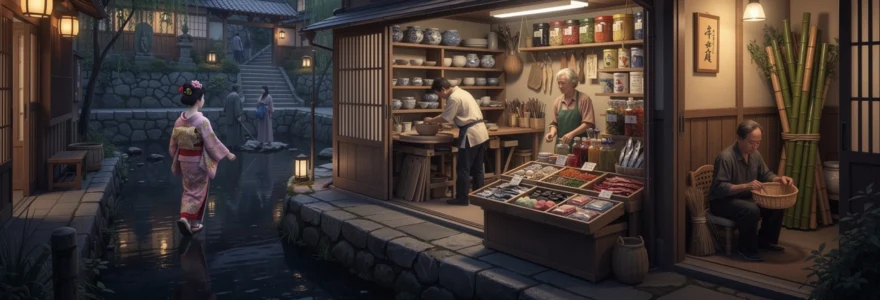
Kyoto’s magnetic allure extends far beyond the well-trodden paths to Kinkaku-ji and Fushimi Inari Shrine. While millions of visitors annually capture photographs at these UNESCO World Heritage sites, the city’s true essence lies hidden within its labyrinthine alleyways, traditional workshops, and neighbourhood shrines where centuries-old customs continue uninterrupted. This ancient imperial capital reveals its most authentic character to those willing to venture beyond tourist circuits, offering immersive encounters with living traditions that have shaped Japanese culture for over a millennium.
The distinction between surface-level tourism and deep cultural immersion becomes particularly pronounced in Kyoto, where modern life seamlessly integrates with practices dating back to the Heian period. Understanding this duality requires patience, curiosity, and often the guidance of local artisans, temple practitioners, and neighbourhood residents who serve as custodians of intangible heritage.
Hidden cultural quarters: exploring kyoto’s traditional machiya districts
Kyoto’s traditional wooden townhouses, known as machiya, form the architectural backbone of the city’s historic districts. These narrow, deep structures were originally designed for merchant families, featuring living quarters above ground-floor shops. Today, many have been meticulously preserved or restored, housing everything from artisan workshops to intimate dining establishments that maintain centuries-old recipes.
The preservation movement has transformed these districts into living museums where you can observe traditional Japanese urban life continuing much as it has for generations. Unlike the reconstructed historical areas found in many cities, Kyoto’s machiya districts remain functional neighbourhoods where families have lived for multiple generations, maintaining customs and business practices passed down through direct lineage.
Pontocho alley’s ochaya teahouses and geisha entertainment heritage
Pontocho Alley represents one of Kyoto’s most atmospheric hanamachi (flower districts), where the tradition of refined entertainment continues in exclusive ochaya teahouses. This narrow passageway, barely wide enough for two people to pass, contains over 100 establishments ranging from centuries-old teahouses to modern interpretations of traditional dining.
The ochaya system operates on relationships built over decades, with many establishments accepting new patrons only through introductions from existing clients. This exclusivity preserves the intimate atmosphere necessary for traditional entertainment forms, including classical dance, shamisen music, and sophisticated conversation that characterises authentic geisha culture.
Nishiki-koji market’s 400-year culinary artisan legacy
Nishiki-koji Market, stretching over 390 metres through central Kyoto, functions as the city’s culinary heart where specialised food artisans have perfected their crafts across multiple generations. Each of the market’s 126 shops typically focuses on a single category of product, whether handmade tofu, traditional sweets, or artisanal sake, maintaining quality standards established centuries ago.
The market’s significance extends beyond commerce to cultural preservation, as many vendors continue using traditional preparation methods that would otherwise disappear. Observing the morning preparation rituals, from grinding fresh soy milk for tofu to hand-rolling traditional sweets, provides insight into the meticulous attention to detail that characterises Kyoto’s culinary philosophy.
Gion shirakawa’s preserved edo period architecture
The Gion Shirakawa area showcases Kyoto’s most photogenic collection of preserved Edo period buildings, where traditional architecture creates an almost theatrical backdrop for contemporary life. Unlike heavily touristed sections of Gion, this district maintains its residential character, with many buildings continuing to serve their original purposes as private homes and small businesses.
The area’s charm lies in its authenticity—residents still use traditional architectural features like wooden lattice windows (koshi) and hanging curtains (noren) as they were intended, creating natural interactions between historical preservation and daily functionality that cannot be replicated in museum settings.
Kamishichiken’s authentic hanamachi geisha district traditions
Kamishichiken stands as Kyoto’s oldest and most traditional geisha district, maintaining customs and practices with
remarkable continuity. Unlike more commercialised hanamachi, Kamishichiken remains closely tied to its local community and shrines, particularly the nearby Kitano Tenmangū. Seasonal events such as the plum blossom viewing Baikasai, where geiko and maiko serve tea in the shrine garden, offer rare opportunities to witness traditional arts in an environment that still feels primarily local rather than theatrical.
For visitors seeking to experience Kyoto beyond its iconic landmarks, Kamishichiken rewards slower, more observant exploration. Evening strolls reveal lantern-lit facades, subtle nameplates indicating okiya (geisha houses), and the muted sound of shamisen practice drifting from behind closed doors. While formal access to performances often requires local connections or specialist agencies, even simply walking these streets with cultural sensitivity provides insight into how centuries-old entertainment traditions continue to adapt within a modern city.
Artisanal craft workshops: learning traditional kyoto manufacturing techniques
Beyond temple complexes and geisha districts, Kyoto’s identity is inseparable from its role as a historic manufacturing centre for refined crafts. From textiles woven for the imperial court to ceramics used in tea ceremony, these artisanal traditions represent sophisticated technologies developed long before the advent of modern industry. Stepping into a working studio offers a very different perspective on the city than simply browsing finished products in shops or galleries.
Participating in workshops or guided visits allows you to observe how artisans balance preservation with innovation, often integrating contemporary design while maintaining techniques codified during the Muromachi or Edo periods. Many family-run studios now open their doors to small groups, providing hands-on experiences that transform abstract concepts like “heritage craft” into tactile, memorable encounters. You not only see objects being made; you begin to understand the rhythms, decision-making, and embodied knowledge that sustain Kyoto’s reputation for meticulous craftsmanship.
Kiyomizu-yaki pottery studios in higashiyama district
Kiyomizu-yaki, sometimes referred to as Kyoto ware, flourished in the hills around Kiyomizu-dera Temple, where high-quality clay deposits and abundant water created ideal conditions for ceramics production. Today, the Higashiyama district still hosts numerous small kilns and studios producing everything from tea bowls and sake cups to contemporary tableware for high-end restaurants. Walking the side streets off the main temple approach reveals workshops where potters fire gas, electric, and traditional climbing kilns, often in the same compound.
Many Kiyomizu-yaki ateliers offer short classes in wheel-throwing or hand-building, typically lasting one to two hours, with finished pieces shipped to you after firing and glazing. These experiences highlight the delicate balance between form and function that defines Kyoto ceramics: walls must be thin yet durable, glazes expressive but food-safe, shapes elegant yet comfortable in the hand. As you work the clay yourself, the complexity becomes apparent—like trying to learn calligraphy in an afternoon, you gain deep respect for the decades of training behind a seemingly simple tea cup.
Nishijin-ori silk weaving workshops and textile heritage
The Nishijin district in northern Kyoto has been Japan’s premier centre for luxury silk weaving for over 1,200 years, supplying fabrics for imperial robes, Noh costumes, and formal kimono. What appears from the street as an unassuming townhouse often hides a multi-story weaving operation, where Jacquard looms, handlooms, and design studios coexist in tightly organised spaces. The rhythmic clatter of looms forms a distinctive soundscape that has defined this neighbourhood for generations.
Specialist museums and workshops in Nishijin now provide structured programmes where you can observe both hand-weaving and computer-assisted pattern design. Short experiences might include trying a simple weave pattern on a small loom or assembling a woven accessory under the guidance of a craftsperson. These interactions reveal how Nishijin-ori functions like a living archive: each pattern encodes stories of families, patrons, and historic events, much as manuscripts preserve textual history. Understanding this context changes how you perceive every obi belt or kimono fabric you see in Kyoto’s streets.
Kyoto yuzen dyeing techniques at traditional ateliers
Kyoto’s Yuzen dyeing tradition emerged in the 17th century as a method for creating highly detailed pictorial designs on silk without the need for woven patterns. Artisans use a combination of rice-paste resist, fine brushwork, and multiple dye baths to achieve the distinctive soft-edged motifs associated with formal kimono. In dyeing districts along the Kamo River and in Fushimi, narrow alleys still conceal long, open-air drying racks where fabrics catch the breeze on clear days.
Several Yuzen ateliers welcome visitors for introductory workshops where you can try stencil dyeing on handkerchiefs or small cloths using simplified versions of traditional methods. As you apply dyes and watch colours blend, the process becomes almost meditative—each brushstroke commits you to a sequence of irreversible steps, much like composing a photograph with film rather than digital editing. These experiences foster appreciation not only for the visual beauty of Yuzen textiles, but also for the logistical and environmental challenges artisans face in maintaining water-intensive processes in an urban setting.
Bamboo craft making at arashiyama’s specialised studios
While Arashiyama’s bamboo grove has become one of Kyoto’s most photographed sites, the district’s deeper connection to bamboo lies in its centuries-old craft industry. Local artisans have traditionally converted raw culms into baskets, tea ceremony utensils, and architectural elements, making full use of bamboo’s strength and flexibility. Small studios tucked behind main streets display racks of split bamboo strips, specialised knives, and finished works ranging from everyday kitchen tools to museum-quality ikebana baskets.
Hands-on bamboo craft workshops typically focus on simple, achievable projects such as chopsticks, small trays, or flower vases, guiding you through basic splitting, shaving, and weaving techniques. Working directly with the material quickly reveals why bamboo is compared to a living steel: resistant yet responsive, it demands both precision and sensitivity. By the time you leave, the famous Arashiyama grove ceases to be just a photogenic backdrop and instead becomes the origin point of a complex craft ecosystem that has shaped local livelihoods for generations.
Seasonal festival participation: engaging with local matsuri communities
Experiencing Kyoto beyond its iconic landmarks also means aligning your visit with the city’s dense calendar of seasonal festivals, or matsuri. These events, often linked to Shinto shrines or Buddhist temples, function as community rituals that reaffirm local identity while marking agricultural cycles, historical anniversaries, or spiritual observances. Rather than spectacles staged solely for visitors, many remain organised and funded by neighbourhood associations, with participation passed down through families.
Major festivals such as Gion Matsuri in July, Aoi Matsuri in May, and Jidai Matsuri in October attract national attention, yet even smaller district celebrations offer meaningful insight into Kyoto’s social fabric. You might encounter portable shrines carried through residential streets, children in traditional attire performing dances, or elders carefully arranging lanterns and offerings. For respectful engagement, it is advisable to research basic etiquette—such as when to bow, how to approach shrine spaces, and when photography might be intrusive—so that your presence supports rather than disrupts these living traditions.
Off-the-beaten-path temple complexes and spiritual practices
While Kiyomizu-dera and Kinkaku-ji dominate most itineraries, Kyoto’s religious landscape includes hundreds of lesser-known temples and shrines where spiritual practices unfold at a quieter rhythm. These sites provide space to experience Buddhism and Shinto not as tourist attractions, but as ongoing disciplines embedded in daily life. Reaching them often requires longer travel times by bus or train, followed by walks through residential neighbourhoods or mountain paths—journeys that become part of the contemplative experience.
Exploring these off-the-beaten-path complexes invites a different mindset: instead of collecting famous names, you begin to notice subtler elements such as the sound of temple bells echoing through valleys, the scent of incense mixing with cedar trees, or the way moss gradually claims stone steps. Many locations offer structured activities—meditation sessions, sutra copying, or seasonal rituals—that allow visitors to participate rather than simply observe. In this sense, Kyoto becomes less like an open-air museum and more like a network of living spiritual communities.
Sanzen-in temple’s alpine garden meditation sessions
Located in the rural village of Ōhara, north of central Kyoto, Sanzen-in Temple is renowned for its atmospheric gardens and quiet, mountain-framed precincts. The journey itself—typically a bus ride followed by a walk through small farms and local shops—emphasises the temple’s separation from the dense urban core. Within the grounds, moss gardens, stone statues of jizō guardians, and carefully composed vistas create an environment designed to gently shift your attention inward.
Sanzen-in periodically hosts seated meditation and sutra-copying sessions, usually conducted in Japanese but often accessible to respectful, non-fluent participants. Sitting on tatami mats facing a garden where maples filter light like stained glass windows, you begin to sense why such spaces were developed: they function as three-dimensional mandalas, supporting concentration through orchestrated views, sounds, and textures. For many visitors, this kind of structured stillness offers a more transformative experience of Kyoto than any number of crowded temple photo opportunities.
Kurama-dera mountain pilgrimage routes and fire festivals
North of the city, Kurama-dera Temple crowns a forested peak accessible via a funicular and mountain trails, offering a combination of physical exertion and spiritual exploration. The main pilgrimage route from Kurama to Kibune follows a ridge path lined with cedar trees and small shrines, inviting a walking meditation as you adjust your pace to the terrain. Even outside formal rituals, the climb itself serves as a reminder that, in Japanese religious practice, landscape and spirituality are deeply intertwined.
Kurama is also associated with dramatic autumn events, particularly the Kurama Fire Festival (Kurama-no-Himatsuri), where participants carry massive flaming torches through village streets. While this spectacle has gained international attention, it remains rooted in local religious observances and can be overwhelming for unprepared visitors due to crowds and intense heat. If you choose to attend, planning in advance—arriving early, wearing non-flammable clothing, and following official guidance—helps ensure that you witness the ritual respectfully and safely, rather than treating it as a mere pyrotechnic display.
Daigo-ji temple’s esoteric buddhist ceremonies
Daigo-ji, a sprawling temple complex in southeastern Kyoto, is a key centre for Shingon, an esoteric school of Buddhism that emphasises ritual, mantra, and visualisation practices. The site includes both lower and upper precincts connected by forest trails, offering a layered experience of architecture, nature, and religious symbolism. Its five-story pagoda, dating from the 10th century, stands as one of Kyoto’s oldest surviving wooden structures.
Visitors with an interest in religious practice, rather than only historical architecture, can sometimes observe or participate in public ceremonies such as goma fire rituals, where priests burn wooden prayer tablets while chanting mantras. Watching these rites, with their precise choreography and sensory intensity, is akin to attending a carefully staged performance whose script has been refined over centuries. To engage thoughtfully, it is important to follow posted instructions, avoid obstructing participants’ movements, and remember that for practitioners, these are not performances but acts of devotion.
Adashino nenbutsu-ji’s stone memorial grounds
On the fringes of the Arashiyama area, Adashino Nenbutsu-ji Temple maintains a hauntingly beautiful field of stone statues, each representing anonymous souls once buried in unmarked graves. Over time, these statues—now numbering in the thousands—have been carefully collected and arranged, transforming the grounds into a contemplative space that confronts the impermanence of life. Visiting in the late afternoon, when light slants across the stones, can be a particularly moving experience.
Seasonal events such as the sentō kyouka candle illumination, held in late summer, see each statue lit by a small flame, creating an ocean of flickering lights that feels both intimate and vast. Unlike more crowded illumination events elsewhere in Kyoto, this gathering tends to attract fewer visitors, amplifying the atmosphere of quiet remembrance. Spending time here encourages a different pace of travel, one in which you reflect not only on Kyoto’s aesthetic beauty but also on the layers of human experience that underlie its landscapes.
Authentic kaiseki dining beyond tourist establishments
No exploration of Kyoto’s deeper cultural layers is complete without engaging with its culinary pinnacle: kaiseki cuisine. Often described as Japan’s analogue to haute cuisine, kaiseki developed alongside tea ceremony as a multi-course meal that balances flavour, seasonality, and visual presentation. In Kyoto, many of the most respected kaiseki restaurants operate quietly in residential districts, known primarily to locals and repeat visitors rather than to casual tourists.
Securing a reservation at these establishments can require advance planning, and in some cases, assistance from your accommodation or a local contact. Yet the rewards are significant: menus change monthly or even weekly to reflect micro-seasons, ingredients are sourced from specific farmers or foragers, and plating often references classical literature or seasonal festivals. When you sit down to such a meal, you are not just eating; you are participating in a centuries-old conversation between chef, landscape, and guest—a dialogue conducted through texture, temperature, and taste rather than words.
Traditional ryokan experiences in kyoto’s residential neighbourhoods
Finally, choosing to stay in a traditional ryokan within Kyoto’s residential neighbourhoods offers one of the most effective ways to experience the city beyond its iconic landmarks. Unlike large hotels concentrated near major stations, many ryokan occupy renovated machiya or purpose-built wooden structures on quiet side streets. This setting allows you to observe ordinary routines—neighbours commuting by bicycle, local schoolchildren walking in groups, shopkeepers opening shutters—framing your visit within the city’s everyday rhythms rather than isolating you in a tourist enclave.
A typical ryokan stay introduces multiple facets of Kyoto culture in a single environment: tatami rooms with sliding shōji screens, futon bedding laid out each evening, communal baths designed for relaxation rather than hurried hygiene, and meticulously prepared breakfasts featuring regional specialities. Hosts often serve as informal cultural interpreters, offering advice on less-visited temples, seasonal events, or nearby sentō public baths. By the time you depart, you may find that what lingers most vividly in memory is not a single monument, but the cumulative texture of daily life glimpsed from within the fabric of a Kyoto neighbourhood.