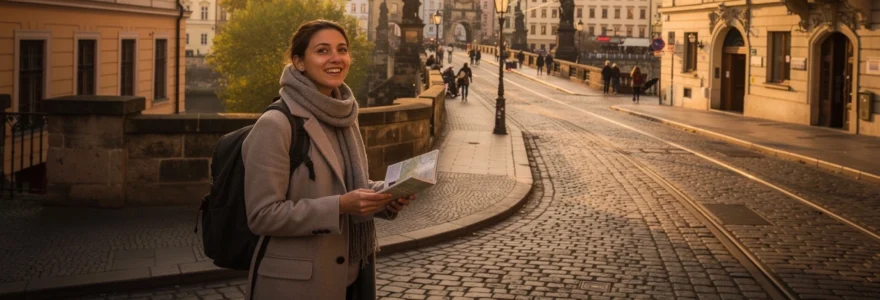
Prague’s cobblestone streets weave through centuries of history, creating a labyrinthine cityscape where intentional disorientation becomes an art form. The Czech capital’s urban fabric, shaped by Gothic, Baroque, and Art Nouveau influences, rewards those who abandon rigid itineraries in favour of spontaneous exploration. From the winding passages of Old Town to the steep ascents of Castle Hill, Prague’s geography naturally encourages meandering, transforming navigation from a practical necessity into a profound cultural experience. The city’s unique charm lies not merely in its architectural marvels, but in the unexpected discoveries that emerge when you surrender to its intricate street network and allow serendipity to guide your journey.
Prague’s medieval quarter navigation: mastering old town’s labyrinthine street network
Prague’s Old Town presents one of Europe’s most complex medieval street patterns, where traditional grid systems dissolve into organic pathways that evolved over eight centuries. The quarter’s navigation challenges stem from its historical development, as merchant routes, defensive considerations, and royal decrees shaped streets that prioritise character over efficiency. Understanding this urban maze requires appreciating how medieval city planning prioritised community centres rather than linear connectivity.
The Old Town’s street network operates on a hub-and-spoke model, with key squares serving as gravitational centres that draw pedestrians through interconnected alleyways. Pařížská Street represents the district’s most significant 19th-century intervention, cutting through medieval fabric to create a direct boulevard between Old Town Square and the Jewish Quarter. However, the surrounding streets maintain their medieval irregularity, creating fascinating contrasts between planned thoroughfares and organic passages that developed naturally over centuries.
Wenceslas square to astronomical clock: decoding central route algorithms
The journey from Wenceslas Square to Prague’s famous Astronomical Clock reveals the city’s layered navigation logic, where multiple route options reflect different historical periods and urban planning philosophies. The most direct path follows Václavské náměstí toward Můstek, then transitions through the pedestrianised zone via Na Příkopě Street, offering a glimpse into Prague’s commercial evolution from medieval market town to modern European capital.
Alternative routes through Jungmannovo náměstí and Národní třída showcase the Habsburg-era street widening projects that attempted to impose order on medieval chaos. These pathways demonstrate how different rulers approached urban planning, with each era leaving distinct architectural signatures that modern visitors can decode through careful observation. The navigation experience becomes a lesson in urban archaeology, where street patterns reveal political and economic priorities across different centuries.
Lesser town’s baroque architecture wayfinding through kampa island districts
Kampa Island’s unique geography creates navigation opportunities that blend natural topography with human design, offering visitors a chance to experience Prague’s relationship with the Vltava River. The island’s position between the main river channel and the Čertovka mill stream creates a microclimate of narrow bridges, waterside paths, and elevated viewpoints that provide constant orientation references while maintaining an intimate, village-like atmosphere within the broader urban context.
Baroque architecture dominates the island’s visual language, with curved facades and ornate decorative elements that create natural wayfinding landmarks. The contrast between grand palatial buildings and modest artisan workshops reflects the area’s historical function as both aristocratic retreat and working neighbourhood. Navigation becomes intuitive when you understand how Baroque architects used visual symmetry and monumental scale to create memorable reference points that guide movement through complex urban spaces.
Charles bridge approach strategies via křižovnická and mostecká streets
Approaching Charles Bridge requires understanding how medieval traffic patterns still influence modern pedestrian flow, with Křižovnická Street from Old Town and Mostecká Street from Lesser Town serving as primary arteries that funnel visitors toward this iconic crossing. Both approaches offer distinct perspectives on the bridge’s Gothic towers and statue-lined parapets, demonstrating how medieval urban planners created dramatic reveals that maximise visual impact while managing crowd movement.
Křižovnická Street’s approach emphasises the bridge’s role as a sacred passage, with the Gothic Old Town Bridge Tower serving as a ceremonial gateway that historically marked the transition from secular commercial space to royal territory. Mostecká Street provides a more intimate approach, winding through Baroque palaces before emerging
at the base of the Lesser Town Bridge Tower. This sequencing creates a narrative journey, inviting you to pass from shaded, human-scale streets into the broad, open panorama of the Vltava River and Prague Castle. By paying attention to how your view widens and contracts along these approach routes, you begin to understand medieval Prague as a stage set, carefully designed to reveal its landmarks with theatrical precision.
For travellers trying to avoid the densest crowds on Charles Bridge, timing and micro-route selection become critical elements of bridge approach strategy. Early morning and late evening passages via Křižovnická and Mostecká allow you to experience the same choreography of space without constant disruption from tour groups and vendors. Choosing parallel side streets for part of the approach, then joining the main artery just before the towers, gives you a more contemplative experience while still preserving the iconic reveal. This combination of practical route planning and historical awareness turns a standard tourist crossing into a richer exploration of Prague’s medieval wayfinding logic.
Castle hill ascent routes: nerudova street versus new castle steps analysis
Ascending Castle Hill presents a fundamental route choice that shapes your perception of Prague’s topography and urban history: follow the gently winding Nerudova Street or tackle the steeper, more direct New Castle Steps. Nerudova Street, named after the 19th-century Czech writer Jan Neruda, exemplifies Baroque-era urban design, with a sinuous alignment that softens the hillside climb. Its sequence of house signs, ornate doorways, and varying facade heights creates a visual rhythm that distracts from the incline, making the ascent feel like a curated gallery walk rather than a workout.
The New Castle Steps (Nové zámecké schody), by contrast, offer a more ascetic route that foregrounds physical effort and panoramic reward. This staircase, formalised in the 18th and 19th centuries, compresses vertical gain into a shorter horizontal distance, appealing to visitors who prioritise efficiency and viewpoint access. From a navigation perspective, the steps function as a high-speed vertical corridor, connecting Malá Strana to the castle precinct with minimal lateral deviation. However, because the route is more exposed, weather and seasonal conditions have a greater impact on comfort and safety, particularly during winter ice or summer heat.
Choosing between Nerudova and the New Castle Steps is less about “right” or “wrong” navigation and more about aligning your route with your exploratory goals. If you are interested in architectural details, historical house signs, and the feel of a lived-in neighbourhood, Nerudova’s gentle curve and dense frontage provide constant micro-discoveries. If, on the other hand, you treat the climb as a focused transition between districts, the steps offer a clear, unambiguous trajectory, punctuated by broad landings that double as informal viewing platforms. In practice, many visitors combine both options, ascending via Nerudova and descending via the steps, thereby experiencing two distinct spatial narratives of the same hillside.
Psychogeographic exploration methodologies in prague’s urban landscape
Beyond conventional sightseeing, Prague rewards those who apply psychogeographic exploration techniques to its layered urban landscape. Psychogeography, a term popularised by mid-20th-century theorists, examines how the built environment influences our emotions, behaviours, and sense of orientation. In a city where medieval alleys intersect with socialist boulevards and post-industrial spaces, these techniques become a powerful way to understand Prague not just as a tourist destination, but as a living, evolving organism.
When you treat the act of getting lost in Prague as a deliberate method rather than an accident, the city transforms into a laboratory for urban experience. Different neighbourhoods exert distinct “emotional climates”, from the calm regularity of Vinohrady to the bohemian unpredictability of Žižkov. By consciously varying your routes, resisting the urge to default to main arteries, and paying attention to how each street makes you feel, you begin to map Prague according to atmosphere rather than solely by coordinates. This shift from conventional mapping to experiential mapping is at the heart of psychogeographic exploration in the Czech capital.
Situationist dérive techniques applied to vinohrady neighbourhood wandering
The Vinohrady district, with its late 19th-century grid, broad avenues, and leafy parks, provides an ideal setting for applying Situationist dérive techniques to Prague exploration. A dérive—literally “drift”—involves abandoning planned routes and allowing subtle environmental cues to guide your movements. In Vinohrady, this might mean following the strongest sunlight along tree-lined streets, turning toward the faint sound of a tram bell, or choosing your direction based on the colour of facades at each intersection. Instead of moving from one checklist attraction to another, you navigate by mood, light, and texture.
Because Vinohrady was largely developed during Prague’s rapid growth in the Austro-Hungarian period, its rational street plan differs sharply from the medieval maze of Old Town. This regularity creates a kind of safe playground for dérive experimentation: even if you drift far from your starting point, major landmarks like Náměstí Míru, Riegrovy Sady, and Jiřího z Poděbrad Square act as reliable anchors. For travellers who are nervous about “getting lost in Prague”, Vinohrady offers a comfortable compromise—its predictable grid provides a subtle safety net while still allowing for serendipitous encounters with cafés, courtyards, and local markets.
To structure a dérive in Vinohrady, you might set a loose time limit rather than a destination, asking yourself: “Where will the next 45 minutes of unplanned walking take me?” You can also introduce playful constraints: only turning left when you see a green balcony, or choosing streets with the fewest parked cars to maximise openness. These simple rules disrupt habitual navigation patterns in Prague and train you to notice details that traditional guidebooks often overlook. Over time, such dérives build a richer, more personal map of the city in your memory, tied to feelings rather than just place names.
Cognitive mapping disruption through malá strana’s irregular grid systems
Malá Strana, the Lesser Town beneath Prague Castle, presents a very different psychogeographic challenge. Its irregular grid system—formed by centuries of piecemeal development, monastic landholdings, and hillside constraints—disrupts the neat cognitive maps that visitors build in more orderly districts. Streets that appear parallel suddenly converge, squares emerge without warning, and steep lanes twist back on themselves in surprising ways. For many travellers, this feels disorienting; for psychogeographic exploration, it is an opportunity.
In Malá Strana, the goal is not to impose order on the street network but to accept its complexity and observe how it reshapes your sense of movement. You might notice, for instance, how the presence of Prague Castle as a constant visual reference point prevents you from feeling fully lost, even when the streets themselves defy easy mental mapping. The district functions like a mountain trail network: the summit is always visible, but the exact path to reach it remains ambiguous until you commit to each segment. This tension between visual certainty and route uncertainty lies at the heart of Malá Strana’s navigational charm.
Practically, one way to explore Malá Strana’s irregular grid is to select a single landmark—such as St. Nicholas Church or the Wallenstein Garden—and approach it from different directions on separate days. By varying your starting points and consciously avoiding streets you have already used, you allow your internal map of the district to grow organically rather than as a simplified diagram. Over time, you will notice how certain corners acquire emotional weight: a quiet square where you once heard a busker, or a narrow lane that unexpectedly opened onto a view of the river. These emotional anchors become just as important as physical ones in your personal navigation of Prague.
Temporal navigation shifts: medieval versus habsburg-era street layouts
One of the most intriguing aspects of wandering through Prague is the way time itself becomes a navigational layer. As you move from medieval Old Town into Habsburg-era boulevards, your walking experience changes in ways that are both subtle and profound. Medieval streets, shaped by foot traffic and horse-drawn carts, prioritise proximity and enclosure; they bend and narrow to accommodate topography, property lines, and defensive needs. Habsburg-era avenues, by contrast, reflect the age of empires and railways: they are wide, axial, and designed for processions, parades, and efficient circulation.
Understanding these temporal navigation shifts can help you read Prague’s history through your feet. When you move along Na Příkopě or Václavské náměstí, your stride naturally lengthens, matching the scale of the boulevard; when you re-enter the Old Town maze, your pace slows and your awareness narrows to immediate surroundings. This is not just a matter of aesthetics but of psychological impact: broad 19th-century vistas encourage goal-oriented walking, while medieval lanes foster curiosity and lateral attention. Recognising this, you can deliberately choose which “era” to inhabit based on how you want to feel during a particular segment of your day.
For travellers interested in deepening their understanding of Prague’s urban evolution, a useful exercise is to plan a route that intentionally crosses these temporal layers. Start in a medieval square such as Staroměstské náměstí, transition via a Habsburg boulevard like Národní třída, and end in a 20th-century development near the river or railway. As you walk, ask yourself: “How is this street asking me to move? Is it inviting me to linger, to pass through quickly, or to look up and admire grand facades?” This kind of reflective navigation turns an ordinary city stroll into a living seminar on European urban history.
Serendipitous discovery patterns in žižkov’s post-industrial quarters
Žižkov, once a working-class and industrial district, has become one of Prague’s most dynamic areas for serendipitous exploration. Its dense fabric of tenement blocks, former factories, and steep streets creates a pattern of discovery that differs markedly from the polished centre. Here, the charm of getting lost in Prague is tied less to monumental architecture and more to sudden encounters with street art, hidden bars, and unexpected viewpoints. The district’s elevation changes, cut by staircases and sloping lanes, ensure that even short walks produce surprising shifts in perspective.
From a psychogeographic standpoint, Žižkov operates like a three-dimensional maze, where vertical movement is as important as horizontal drift. You might follow a main road like Seifertova only to be drawn up a side staircase by a glimpse of greenery or a mural, emerging in a quiet residential pocket that feels far removed from the traffic below. These small deviations accumulate into a complex mental map, where your memory of the neighbourhood is tied to micro-experiences—an evening beer garden perched on a hill, a miniature park wedged between apartment blocks, a view of the TV Tower suddenly appearing between roofs.
To encourage serendipitous discovery in Žižkov, consider starting near a well-known anchor point such as the Žižkov Television Tower or Viktoria Žižkov stadium, then deliberately avoiding the most obvious routes. Let tram lines, staircases, or even the direction of the setting sun determine your turns. Because Žižkov remains a residential district first and a tourism zone second, you will encounter everyday scenes of Prague life that rarely appear in guidebooks. This balance between unpredictability and authenticity makes the district an ideal testing ground for travellers who want to push beyond the centre while still navigating without constant digital assistance.
Digital detox navigation: analogue wayfinding through prague’s historic districts
In an era dominated by smartphone mapping apps, choosing to navigate Prague’s historic districts without constant digital guidance can feel radical—and deeply rewarding. Analogue wayfinding in the Czech capital means relying on physical landmarks, printed maps, tram lines, and even the position of the sun or the sound of church bells to orient yourself. This approach slows your pace and heightens your sensory engagement, turning every wrong turn into an opportunity rather than a problem to be instantly corrected.
Prague is particularly well-suited to digital detox travel because its historic centre is compact, richly signposted, and punctuated by unmistakable reference points like Prague Castle, the Vltava River, and the twin spires of Týn Church. Rather than checking your phone at every junction, you can adopt simple analogue strategies: walking gently uphill if you aim for the castle, gravitating toward the sound of trams when you want to find a major transport hub, or using church towers as north stars. Street-name signs on building corners, often overlooked, become active tools again, helping you build a mental map of the city one intersection at a time.
Of course, going offline in a foreign city raises practical questions: how do you ensure you still reach your hotel, catch your train, or make it to a booked tour on time? One effective compromise is to use digital maps only at the start and end of each outing, allowing yourself a generous “free-roaming zone” in between where you deliberately avoid looking at screens. Another analogue technique is to carry a small paper map or even sketch your own simplified diagram of key districts; the act of drawing reinforces spatial memory much more effectively than passive GPS following. Over several days, you will likely find that you need your phone less and less to navigate Prague, as the city’s shapes, slopes, and silhouettes settle into your mind.
Hidden courtyard networks: accessing prague’s concealed passages and arcades
One of Prague’s greatest gifts to wandering travellers lies behind its facades: a network of hidden courtyards, passages, and arcades that stitch together entire city blocks. These semi-public spaces, often created as commercial shortcuts or residential enclaves, allow you to move through the urban fabric in unexpected ways. Discovering them transforms Prague from a city of streets into a layered spatial puzzle, where every open gateway suggests the possibility of a new connection.
Unlike the clearly mapped passages of some modern shopping complexes, many of Prague’s courtyards reveal themselves only to those who look closely. A modest archway between two shops might lead to an ornate Art Nouveau interior; a narrow corridor off Wenceslas Square could open into a tranquil garden. Learning to spot these entry points—often marked by small signs, open doors, or glimpses of light beyond—turns your walk into a continuous series of invitations. Once you start using these hidden routes, you experience the city on a different wavelength from the crowds confined to main thoroughfares.
Lucerna passage and světozor arcade: commercial thoroughfare shortcuts
The Lucerna Passage and Světozor Arcade form one of central Prague’s most significant micro-networks of indoor shortcuts, linking Wenceslas Square to Národní třída and adjacent streets. Built in the early 20th century, these passages embody the transition from open-air market streets to climate-controlled commercial environments, while still reflecting Prague’s love of architectural ornament. For travellers, they offer not only shelter from rain or heat, but also alternative, less congested routes through the heart of the city.
Entering the Lucerna Passage from Wenceslas Square, you pass under ornate ceilings and vintage shopfronts, moving through a space that feels both grand and intimate. The passage’s internal axis bends subtly, leading you deeper into the block rather than offering a straightforward line of sight to the exit; this encourages leisurely wandering and chance discoveries, from independent cinemas to small cafés. Connected laterally, the Světozor Arcade extends this network toward Františkánská zahrada (Franciscan Garden) and beyond, granting you multiple options for re-emerging into the street network.
From a navigation standpoint, Lucerna and Světozor function like interior “desire lines” that reflect how pedestrians actually want to move between key points in central Prague. Once you learn these routes, you can dramatically shorten walking times between major squares while avoiding surface-level crowding. For example, instead of battling the full length of Wenceslas Square at street level, you can weave through passages, emerging closer to your tram stop or meeting point. Over time, these arcades become anchor elements in your personal map of Prague, akin to covered rivers running beneath the visible city.
Ungelt courtyard medieval trading post exploration techniques
Ungelt, also known as Týn Courtyard, is a former medieval customs yard tucked just behind Old Town Square, illustrating how historic trading infrastructure still shapes modern navigation. Enclosed by buildings and accessed through narrow passageways, Ungelt once served as a secure compound where merchants stored goods and paid duties. Today, it operates as a semi-hidden courtyard filled with restaurants, galleries, and small hotels, yet it retains the palpable sense of an enclosed, protected space.
Reaching Ungelt requires a willingness to step off the obvious paths around Old Town Square. You might enter via Týnská street, slipping through a short tunnel-like passage that suddenly opens into the courtyard, or find your way from the direction of Celetná, following discrete signage. This spatial sequence—compression, then release—is typical of Prague’s medieval courtyards and creates a strong emotional imprint; the courtyard feels like a discovered secret, even though it is only metres from one of the city’s busiest plazas. Exploring Ungelt at different times of day reveals how its atmosphere shifts from quiet refuge to lively social hub.
To make the most of Ungelt and similar courtyards, consider adopting the mindset of a medieval merchant or traveller. Ask yourself: where would I store goods safely? How would I move discreetly between market and lodging? This mental exercise turns the courtyard network into an experiential history lesson on Prague’s role in European trade. It also trains you to notice other, less famous courtyards scattered throughout the Old Town and Jewish Quarter, many of which reward curiosity with unexpected art installations, peaceful seating areas, or glimpses of centuries-old architectural details.
Franciscan garden secret entrances via wenceslas square connections
Franciscan Garden (Františkánská zahrada) is one of central Prague’s most surprising green spaces, hidden in plain sight between Wenceslas Square and Jungmannovo náměstí. Surrounded by buildings on all sides, this former monastic garden now serves as a public park accessible only through a series of passages and arcades. For travellers navigating the dense commercial corridors of the New Town, discovering the garden feels like stepping through the back of a wardrobe into a different world—an analogy that captures the almost magical shift in noise, light, and pace.
The most intuitive entrances to Franciscan Garden are via the Světozor Arcade or the passage beside the Church of Our Lady of the Snows. From Wenceslas Square, you can slip into a side arcade lined with shops, following small pictograms or green-space icons that hint at the garden beyond. The transition from tiled floors and window displays to gravel paths and rose bushes is abrupt and delightful. Because the garden is lower than surrounding streets in terms of both sound and visual exposure, it functions as a quiet navigation waypoint where you can pause, reorient, and decide your next analogue route through Prague’s centre.
In practical terms, learning the garden’s entrances allows you to create mid-block shortcuts between key downtown axes without relying on main intersections. For instance, you can move from the upper part of Wenceslas Square to Jungmannovo náměstí while minimising your time in heavy pedestrian flows. More importantly, Franciscan Garden teaches you to look for similar green or semi-public interior spaces across the city. Once you realise that Prague hides parks and courtyards behind many of its busiest streets, you start actively seeking these relief valves, transforming your navigation strategy from endurance to enjoyment.
Seasonal navigation variables: weather-dependent route optimisation in czech capital
Prague’s navigational character changes with the seasons, making weather-aware route planning an essential skill for anyone who wants to wander comfortably. In winter, cobblestone streets can become slippery, especially on inclines around Castle Hill and in shaded alleys of Malá Strana. Routes that feel charming in dry conditions may become treacherous after snowfall or freezing rain, nudging you toward wider, better-maintained avenues or indoor passage networks like those around Wenceslas Square. Choosing sun-exposed streets when temperatures drop can make a significant difference in perceived cold.
Summer presents the opposite challenge: heat accumulation in narrow, stone-lined streets can be intense, particularly in the midday sun. Here, shaded lanes, riverside promenades, and tree-lined parks such as Letná and Petřín become vital components of your navigational toolkit. When planning a day of aimless wandering in Prague, you might sketch a loose loop that alternates between denser built-up areas and cooler refuges, using courtyards, gardens, and churches as periodic rest points. In this sense, your route optimisation resembles adjusting sails to changing winds—responsive rather than rigid.
Spring and autumn, with their more variable weather, demand flexible thinking about cover and exposure. Sudden showers can turn exposed plazas into uncomfortable spaces but pose little problem if you know the location of nearby arcades, passages, and metro entrances. Incorporating sheltered connectors like Lucerna Passage or the covered walkways around the National Theatre into your mental map gives you options when the sky changes faster than your itinerary. Over time, you begin to factor seasonal elements into your assessment of “best routes” through Prague, realising that the optimal path in January may be quite different from the ideal stroll in June.
For travellers combining digital detox goals with seasonal awareness, a useful habit is to check the day’s weather once in the morning, then plan no more than two or three key waypoints. Between these, let conditions guide your exact streets: follow sunlit facades on chilly days, gravitate toward shade and water in the heat, or stay near tram lines and passages when storms threaten. This light-touch planning keeps you safe and comfortable while preserving the spontaneity that makes getting lost in Prague so memorable.
Local interaction protocols: engaging prague residents for authentic directional guidance
No matter how skilled you become at analogue navigation and psychogeographic wandering, there will be moments when you need to ask for directions in Prague. Approaching these interactions with cultural sensitivity not only helps you find your way but also opens windows into local perspectives on the city. While many Prague residents, especially younger ones, speak English, beginning with a simple Czech greeting such as “Dobrý den” (good day) signals respect and often results in warmer responses. A brief apology—“Promiňte” or “Prosím” to get someone’s attention—goes a long way in busy urban settings.
When asking for help, it is usually more effective to mention a landmark or tram stop than a precise address, because locals often navigate by nodes rather than house numbers. For example, saying “Jak se dostanu na Malostranské náměstí?” (How do I get to Malostranské Square?) is more immediately meaningful than citing a side street name that even residents rarely use. Many people will respond with a mix of spoken directions and hand gestures, tracing routes in the air or pointing toward visible reference points like church towers or bridges. Paying close attention to these non-verbal cues can be as important as understanding every word.
Respecting personal space and context is also part of good local interaction protocol. People waiting at tram stops, standing in bookshops, or working in cafés are often more receptive to questions than those hurrying along narrow pavements. If someone seems rushed or uncomfortable, it is courteous to thank them quickly—“Děkuji”—and try another person rather than pressing for more detail. You may find that older residents provide route descriptions rich in historical references (“Go where the old synagogue used to be”), while younger ones pull out their phones to show you live maps; both approaches reflect genuine care for how you experience their city.
Perhaps the most valuable aspect of asking for directions in Prague is the chance to glimpse how locals themselves conceptualise their urban environment. Do they describe routes in terms of tram numbers, street names, or landmarks? Do they warn you about steep hills, tourist traps, or areas under construction? Each interaction subtly recalibrates your internal map, adding layers of lived knowledge that no app can fully replicate. In this way, engaging residents for guidance becomes more than a practical tool—it evolves into another form of wandering, where human conversation helps you navigate not only space, but also the stories that give Prague its enduring charm.