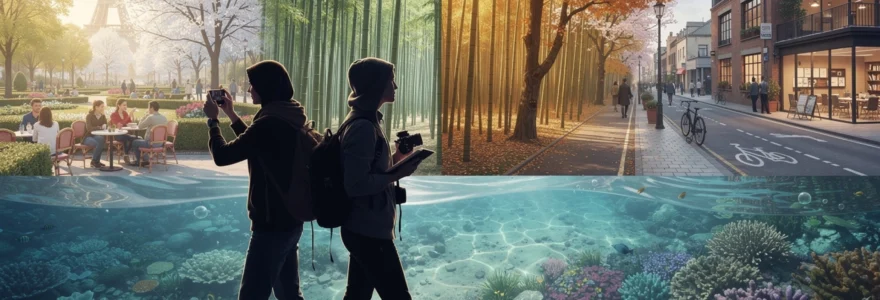
Travel transforms us, but what happens when we return to a place we’ve already visited? The familiar streets, landmarks, and landscapes we once knew can appear remarkably different on subsequent visits. This phenomenon isn’t merely about physical changes to a destination—though these certainly occur—but rather involves a complex interplay of psychological shifts, seasonal variations, sociocultural evolution, and our own personal transformations. Each return journey offers an opportunity to experience the same location through fresh eyes, creating what researchers call « iterative tourism experiences » that can be just as rewarding, if not more so, than first-time discoveries. Whether you’re contemplating a return to Paris, Kyoto, or any other cherished destination, understanding how and why these places change—both objectively and in your perception—can enrich your travel experiences immeasurably.
Psychological mechanisms behind perception shifts in familiar destinations
The human brain possesses a remarkable capacity for reinterpreting experiences based on accumulated knowledge and emotional states. When you revisit a destination, your perception operates through entirely different neural pathways than during your initial visit. This isn’t simply about nostalgia or memory—it involves fundamental changes in how your brain processes environmental information.
Neuroplasticity and memory reconsolidation in travel experiences
Every time you recall a travel memory, your brain doesn’t simply replay a recording. Instead, it reconstructs the experience, and during this reconstruction, the memory becomes temporarily malleable. This process, known as memory reconsolidation, means that your original memories of Barcelona’s Gothic Quarter or Tokyo’s Shibuya Crossing are constantly evolving. When you physically return to these locations, you’re not comparing reality against a fixed memory, but rather against a fluid, reconstructed version that has been influenced by subsequent life experiences, photographs you’ve viewed, and stories you’ve told.
Neuroplasticity—the brain’s ability to form new neural connections—plays a crucial role in how you experience familiar destinations differently. Research indicates that adults can develop new neural pathways when exposed to familiar environments in novel contexts. You might walk the same Venetian alleyways you explored a decade ago, but if you’re now a parent travelling with children, an aspiring photographer, or recovering from a significant life event, your brain literally creates new connections as it processes these familiar sights through your current identity and circumstances.
Cognitive dissonance theory applied to repeated tourism
When your expectations of a place clash with the reality you encounter upon returning, you experience cognitive dissonance—a psychological discomfort that compels you to reconcile conflicting beliefs. Perhaps you remembered a coastal town as pristine and undeveloped, only to find it transformed by tourism infrastructure. This dissonance forces your brain to either update your cherished memories or find ways to explain away the differences you observe.
Interestingly, this cognitive dissonance can enhance your travel experience rather than diminish it. The mental effort required to reconcile past and present creates deeper engagement with a destination. You become an active observer rather than a passive consumer of tourist experiences, analysing what has changed, why it matters, and how you feel about these transformations. This analytical approach often leads to more meaningful insights about both the destination and yourself.
Seasonal affective patterns and environmental psychology in destination perception
Your emotional response to environments is profoundly influenced by seasonal variations, a phenomenon environmental psychologists have studied extensively. The same Scandinavian city visited during the bright, endless days of summer creates an entirely different psychological impact than when experienced during the dark, contemplative winter months. These aren’t merely aesthetic differences—they trigger distinct hormonal and neurological responses that fundamentally alter how you perceive and remember places.
Light levels, temperature, and seasonal activities all contribute to what researchers call « place attachment »—the emotional bond between people and locations. When you return to a destination during a different season, you’re essentially experiencing a different place entirely. The neural networks that encoded your summer visit to Greece won’t predict your winter experience there, creating what feels like a genuinely novel encounter despite geographical familiarity.
The role of personal life transitions in altering travel perspectives
Perhaps the most powerful factor in changing how you perceive familiar destinations is personal transformation. Career changes, relationships,
relationships, parenthood, health challenges, or even subtle shifts in values can all reshape how you interpret a place. A bustling nightlife district you adored in your twenties may feel overwhelming or trivial if you return a decade later seeking slower, more meaningful experiences. Conversely, a destination you once dismissed as « boring » might become deeply appealing when you’re craving stability, wellness, or cultural depth.
These life transitions function like new filters on an old photograph: the underlying image is the same, but the colours and contrasts change dramatically. When you revisit the same destination after a major life event, you may notice different details, choose different activities, and connect with different people. By acknowledging that you are not the same traveller you once were, you can set more realistic expectations and consciously design repeat visits that align with your current needs, whether that’s reflection, celebration, healing, or discovery.
Temporal variations: how paris, kyoto, and barcelona transform across seasons
Time is one of the most powerful variables in how we experience familiar destinations. Even if the built environment remains largely unchanged, seasonal patterns and annual cycles of tourism can completely alter your perception of a city or landscape. Returning to the same destination in a different month—or even at a different time of day—can feel like stepping into an alternate version of reality. This is particularly vivid in cities such as Paris, Kyoto, Barcelona and climate-sensitive regions like Iceland, where weather, light, and cultural calendars profoundly shape the travel experience.
For travellers planning a return trip, thinking in terms of « temporal layers » rather than single snapshots can help you appreciate how dynamic a place really is. Instead of asking, « Have I been there already? », you might ask, « In what season, in what light, and in what mood did I know this place? » The answers can inspire you to revisit familiar destinations strategically—seeking out cherry blossoms instead of autumn leaves, winter solitude instead of summer crowds, or midnight sun instead of northern lights.
Cherry blossom metamorphosis: kyoto’s arashiyama bamboo grove in spring versus autumn
Kyoto’s Arashiyama district illustrates how the same destination can offer two radically different travel experiences depending on the season. In spring, nearby hills and temple gardens burst into soft pinks and whites as cherry blossoms frame the iconic Togetsukyo Bridge, drawing both domestic visitors and international tourists. The atmosphere is almost theatrical: picnic blankets spread under sakura trees, festival food stalls, and a palpable sense of celebration in the air. Walking from the bustling riverfront into the Arashiyama Bamboo Grove, you experience a transition from pastel brightness to cool, filtered green light.
Return in late October or November, however, and you encounter an entirely different palette and mood. The maple trees around Tenryu-ji Temple and the surrounding hills blaze with crimson and gold, while the bamboo forest itself takes on a more tranquil, almost contemplative feel as temperatures drop and crowds thin during weekdays. Photographers who have visited both seasons often describe the contrast as moving from a spring festival to an autumn meditation. If your first visit focused on cherry blossom viewing, planning a second trip for peak koyo (autumn foliage) allows you to see familiar paths and temples through an entirely new seasonal lens.
Paris’s jardin du luxembourg through summer crowds and winter solitude
Jardin du Luxembourg in Paris is another example of how seasonality reshapes a familiar destination. Visit in July or August and you are met with a lively, almost cinematic scene: children sailing toy boats on the central basin, students sunbathing in metal chairs, tourists queuing for ice cream, and locals meeting friends under the chestnut trees. The gardens feel like an outdoor living room for the city, buzzing with energy and informal social interactions. Noise, movement, and colour dominate your sensory impression.
Return in January or February and you may hardly recognise the emotional tone of the same park. Many chairs sit empty, fountains are quieter, and bare branches trace delicate patterns against a pale winter sky. The pathways that once required navigation through crowds become open avenues for solitary walks or quiet reflection. This seasonal solitude can invite a deeper appreciation of the park’s design, sculptures, and architectural details of the Luxembourg Palace itself. For travellers who experienced Paris only at the height of summer tourism, a winter return visit reveals a more introspective, local-focused side of the city that can feel like discovering a different destination altogether.
Barcelona’s la rambla: post-tourist boom infrastructure changes since 2015
Not all transformations are seasonal; some unfold over years in response to tourism trends and urban policy. Barcelona’s La Rambla, once romanticised as a tree-lined promenade for flâneurs, has become a case study in how repeated tourism can fundamentally alter a destination. Visitors who first walked La Rambla around 2015 may remember dense crowds, street performers, an abundance of souvenir shops, and a growing local backlash against overtourism. Since then, city authorities have introduced measures to rebalance public space, prioritise residents, and diversify the area’s commercial mix.
Returning travellers now encounter subtle but meaningful shifts: stricter regulations on unlicensed street vendors, more emphasis on cultural institutions such as the Liceu Opera House and La Boqueria market, and efforts to reduce short-term rentals in nearby neighbourhoods. These changes don’t erase the tourist character of La Rambla, but they do influence how you move through and interpret the space. If you felt overwhelmed by the promenade on your first visit, a later trip—especially in the shoulder season—can offer a more nuanced experience where you notice historical façades, local businesses, and side streets that previously escaped your attention.
Iceland’s golden circle route: midnight sun versus northern lights phenomena
Iceland’s Golden Circle route, which typically includes Þingvellir National Park, Geysir geothermal area, and Gullfoss waterfall, showcases how extreme light conditions transform both landscape and perception. Travel in June or early July and you may experience the surreal phenomenon of the midnight sun, where twilight seems to stretch endlessly and nights never become fully dark. This extended daylight allows for flexible itineraries, late-evening photography, and a dream-like sense of time dilation as you explore familiar stops at unconventional hours.
Return between October and March, and the same route can feel starkly different. Short days, low-angle light, and snow-covered vistas change the visual character of each site, and the possibility of witnessing the aurora borealis adds an entirely new dimension to the journey. Practical considerations also shift: roads may be icy, tours operate on different schedules, and your pace naturally slows as you contend with weather and reduced visibility. For travellers considering whether it’s « worth » revisiting Iceland, planning one trip around the midnight sun and another around northern lights phenomena allows you to experience the Golden Circle as two distinct destinations separated not by geography, but by time.
Sociocultural evolution and urban regeneration in repeat destinations
Beyond individual perception and seasonal change, cities and regions themselves are constantly evolving in response to economic forces, cultural trends, and policy decisions. When you revisit the same destination after several years, you aren’t just returning to a familiar map—you are stepping into a new chapter of the place’s ongoing story. Neighbourhoods gentrify, infrastructure improves or declines, creative communities migrate, and global events such as pandemics accelerate transformation.
For repeat visitors, this sociocultural evolution can be both exciting and disorienting. You might delight in new restaurants and cultural venues, yet feel nostalgic for the small businesses or subcultures that have disappeared. Understanding these processes—gentrification, post-pandemic recovery, heritage management, and the rise of digital nomad hubs—helps you interpret what you’re seeing and engage more thoughtfully with destinations that seem « the same but different » each time you return.
Gentrification impact: brooklyn’s williamsburg neighbourhood transformation 2010-2024
Brooklyn’s Williamsburg is often cited as a textbook example of rapid gentrification, and returning visitors can witness this transformation first-hand. In the early 2010s, the area was widely associated with converted warehouses, underground music venues, independent boutiques, and relatively affordable artist lofts. Many travellers sought out Williamsburg precisely because it felt like an alternative to more polished parts of New York City—a place to experience creative energy, experimental food, and emerging street art.
By the mid-2020s, rising property values and major real estate developments had significantly altered the neighbourhood’s socio-economic profile. Upscale hotels, luxury riverfront apartments, global retail brands, and carefully curated food halls now coexist with the remnants of the older creative scene. If your first visit predates these shifts, a return trip can trigger strong cognitive dissonance: is this still the « same » Williamsburg you remember? As a repeat traveller, you can respond by exploring adjacent neighbourhoods like Greenpoint or Bushwick to understand how cultural scenes relocate and adapt, rather than simply lamenting change.
Post-pandemic hospitality landscape shifts in southeast asian backpacker hubs
The COVID-19 pandemic radically disrupted global tourism, and its aftershocks are particularly visible in Southeast Asian backpacker hubs such as Bangkok’s Khao San Road, Bali’s Kuta, or Vietnam’s Old Quarter in Hanoi. Before 2020, these areas were synonymous with budget hostels, crowded bars, and dense networks of tour agencies catering to long-term travellers. Many repeat visitors built strong place attachment to these neighbourhoods, returning year after year to familiar guesthouses or cafés.
Post-pandemic, the hospitality landscape has changed in complex ways. Some long-standing businesses closed permanently, while others adapted by upgrading facilities, targeting domestic tourists, or embracing remote workers rather than short-stay backpackers. Health protocols, digital check-ins, and flexible cancellation policies are now standard, and in some destinations, there is a noticeable shift toward higher-quality, mid-range accommodation. If you last visited Southeast Asia in 2018 and return in 2025 or later, you’ll likely find familiar streets populated by a different mix of travellers, entrepreneurs, and experiences—offering a unique opportunity to compare pre- and post-pandemic tourism ecosystems.
UNESCO world heritage site management changes: angkor wat’s visitor flow restrictions
Heritage management strategies can also reshape how travellers experience familiar sites. Angkor Wat in Cambodia, part of the larger Angkor Archaeological Park, has implemented progressively stricter visitor regulations over the past decade in response to concerns about overcrowding and preservation. Earlier visitors may remember climbing steep temple staircases with minimal oversight, exploring less-monitored structures freely, and watching sunrise from heavily congested vantage points.
More recent policy changes have introduced designated walkways, restricted access to fragile areas, capped daily visitor numbers in certain temples, and clearer signage directing visitor flow. While these measures can initially frustrate repeat travellers who remember « freer » exploration, they serve to protect the site’s physical integrity and improve overall safety. If you’re returning to Angkor Wat after several years, approaching it with an understanding of these sustainability goals can transform perceived limitations into a more meaningful, conservation-aware travel experience. You may also find that regulated flows distribute crowds more evenly, making it easier to appreciate architectural details and spiritual ambience in quieter corners of the complex.
Digital nomad infrastructure: lisbon and bali’s co-working space proliferation
The rise of remote work has turned certain destinations into long-stay digital nomad hubs, altering not just the visitor profile but also the urban fabric. Lisbon and Bali are prominent examples where repeat visitors can clearly see this shift. In Lisbon, neighbourhoods like Cais do Sodré and Marvila now host numerous co-working spaces, start-up incubators, and cafés optimised for laptop workers, alongside traditional pastelarias and tascas. The city’s reputation as a « workation » destination has led to new community events, from meet-ups to tech conferences, which were far less visible a decade ago.
In Bali, areas such as Canggu and Ubud have undergone a similar transformation, with co-working hubs, wellness centres, and long-stay villas catering to location-independent professionals. For travellers returning after several years, the shift from short-term holiday culture to semi-permanent nomad communities can be striking. This digital nomad infrastructure impacts everything from rental prices to restaurant menus, and it changes how you might structure a repeat visit—for instance, by combining sightseeing with remote work, or by joining co-working communities to experience a destination as a temporary resident rather than a traditional tourist.
Photography techniques and visual documentation strategies for return visits
Revisiting the same destination offers a powerful opportunity to deepen your visual storytelling. Instead of trying to capture « everything » in one trip, you can approach subsequent visits with more intentional photography techniques and documentation strategies. Think of your first journey as a wide-angle establishing shot and your later visits as a series of close-ups, details, and contrasts that complete the narrative. This mindset not only improves your travel photography but also sharpens your awareness of how places evolve over time.
One effective approach is to create thematic projects that span multiple visits. For example, you might photograph the same street corner in Barcelona at different times of day and in different seasons, or document how a coastal village in Portugal changes before and after the summer high season. By returning to identical vantage points and re-framing familiar scenes, you create a visual archive that reveals subtle shifts in light, architecture, and human activity that you might otherwise overlook.
Experimenting with different technical choices on return visits also helps you « see » the same destination differently. If your first trip relied heavily on smartphone snapshots, you might bring a prime lens and focus on depth of field and composition the next time. Alternatively, you could switch from colour to black-and-white photography to highlight textures, shadows, and structural forms that get lost in vibrant tourist scenes. Long exposure techniques can transform busy streets or waterfalls into dreamy, time-smoothed images, providing a creative counterpoint to the more literal photos from your initial visit.
Beyond still images, consider keeping a simple visual log that pairs photographs with dates, locations, and brief notes on your emotional state. Over multiple trips, this becomes a personal « time-lapse » of both your relationship with the destination and your own inner journey. You may notice that your framing becomes calmer, your subjects more intimate, or your focus shifting from iconic landmarks to everyday life—clear signs that repeat travel is enriching not just your memories, but also your way of seeing the world.
Sustainable tourism practices: observing ecological changes over multiple visits
Repeated visits to the same destination can make you a witness to environmental change in a way that single trips cannot. Where a first-time traveller might simply admire a glacier, reef, or savannah, a repeat visitor can compare present conditions with past impressions, photographs, or field notes. This longitudinal perspective turns you into an informal citizen scientist, able to observe trends that align with broader research on climate change, biodiversity loss, and ecosystem resilience.
Incorporating sustainable tourism practices into your return trips—such as supporting conservation-focused operators, reducing your carbon footprint, and engaging with local environmental initiatives—can transform your role from passive observer to active steward. Rather than asking only, « What can this place give me? », you also begin to consider, « How can my repeated tourism support the long-term health of this destination? » Nowhere is this more evident than in fragile natural environments like coral reefs, glaciers, and wildlife-rich savannahs.
Coral reef degradation monitoring: great barrier reef and maldives comparative analysis
Travellers who have snorkelled or dived the Great Barrier Reef or Maldivian atolls over the past two decades often report visible changes in coral health. Episodes of mass bleaching linked to rising sea temperatures have transformed once-vibrant sections of reef into areas of dead or recovering coral. If you first visited in the early 2000s and return in the mid-2020s, you may notice reduced colour diversity, fewer branching corals, or a different mix of fish species in some locations.
By comparing your own underwater photos or dive logs across visits, you can conduct a simple, personal « before and after » analysis. While this is not a substitute for scientific monitoring, it increases your awareness of how climate change and local stressors such as overfishing or pollution impact marine ecosystems. On repeat visits, you can choose operators that follow strict reef-safe practices, avoid touching or standing on coral, use mineral-based sunscreens, and support organisations working on coral restoration. This approach allows you to continue enjoying familiar dive sites while contributing, in small but meaningful ways, to their long-term survival.
Glacier recession documentation: patagonia’s perito moreno versus swiss alps
Glaciers offer another stark illustration of environmental change visible to repeat visitors. In regions like the Swiss Alps, many glaciers have retreated significantly over the past few decades, leaving exposed rock and newly formed lakes where thick ice once existed. Travellers who return to the same viewpoints—marked by information boards or historic photographs—can literally see the shrinking ice fields, making abstract climate data feel immediate and personal.
Patagonia’s Perito Moreno Glacier in Argentina is a notable outlier, as it has remained relatively stable compared with many others, though local conditions still fluctuate. Returning to Perito Moreno after several years may reveal changes in the glacier’s front shape, calving frequency, or surrounding icebergs, but not necessarily the dramatic long-term retreat observed elsewhere. This contrast between Perito Moreno and receding Alpine glaciers can spark valuable reflection: why do some ice masses remain more stable than others, and what does that say about regional climate patterns? By photographing the same vantage points over time and engaging with local guides who follow glaciological research, repeat visitors can deepen their understanding of these complex dynamics.
Wildlife population fluctuations in serengeti and masai mara ecosystems
In East Africa’s Serengeti and Masai Mara ecosystems, repeat safaris expose travellers to the rhythms and vulnerabilities of wildlife populations. The annual Great Migration of wildebeest and zebra is a dynamic spectacle, with routes and timings that can shift in response to rainfall patterns and human activities. Returning in different months or years allows you to see how herds move, where predator-prey interactions concentrate, and how park management strategies evolve to balance conservation with tourism.
Over longer intervals, you may notice more systemic changes: increased regulations on vehicle numbers at sightings, new buffer zones or conservancies, or—less positively—declines in certain species due to poaching or habitat pressure. By choosing responsible safari operators, respecting viewing guidelines, and supporting community-based conservation projects, repeat visitors can help ensure that their continued presence contributes to, rather than detracts from, ecosystem resilience. In this way, your evolving perception of a familiar savannah becomes intertwined with the long-term story of the wildlife that calls it home.
Experiential tourism methodologies: immersive versus observatory approaches in familiar locations
One of the most powerful ways to see a familiar destination differently is to change how you engage with it. On a first visit, many travellers adopt an observatory approach: they move through the city or landscape as onlookers, ticking off key sights, photographing landmarks, and absorbing information from a comfortable distance. On return visits, there is an opportunity to shift toward a more immersive methodology—participating in local life, learning new skills, or contributing to community projects.
Think of the difference like watching a film versus joining the cast. As an observatory traveller, you sit in the audience, attentive but separate from the action. As an immersive traveller, you step onto the stage, accepting that you will make mistakes, ask questions, and occasionally feel out of your depth. In a destination you already know geographically—where to stay, how to navigate public transport, which areas feel safe—you are often better equipped to experiment with this deeper involvement than on a first-time visit.
Practical shifts from observatory to immersive travel can include enrolling in multi-day workshops (such as cooking classes in Kyoto, tango lessons in Buenos Aires, or pottery courses in Lisbon), joining local hobby groups or language exchanges, or volunteering with carefully vetted organisations. You might stay in neighbourhood guesthouses instead of central hotels, shop at weekly markets rather than only at flagship stores, or structure your itinerary around a single curiosity—like tracing the history of a particular architectural style or food tradition. Each of these choices encourages slower, more engaged tourism that reveals aspects of a destination you likely missed on your initial, more surface-level encounter.
At the same time, it’s important not to dismiss observatory travel entirely. There are moments—particularly after stressful life events or during short breaks—when a more detached, contemplative way of experiencing a familiar destination can be restorative. Sitting in the same Parisian café you visited years ago, simply watching the world go by, can be just as meaningful as joining a local book club or volunteering in a community garden. The key is to recognise that with each return visit, you can consciously choose your experiential methodology, toggling between immersive and observatory modes according to your energy, goals, and the evolving relationship you have with that place.