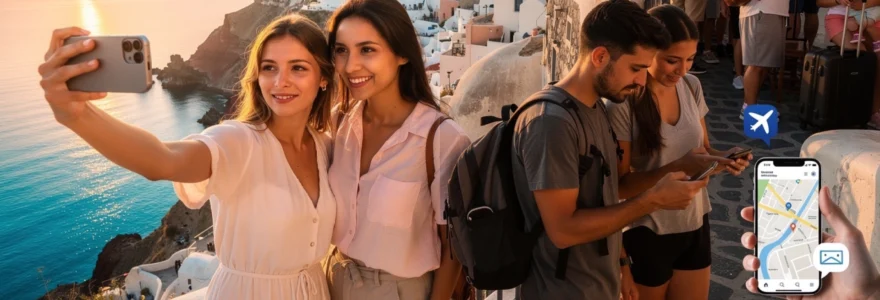
The moment you book a flight to a dream destination, a peculiar transformation begins. In your mind, the Santorini sunset glows with impossible intensity, Machu Picchu emerges pristine from morning mists with no other souls in sight, and Parisian cafés overflow with charm but never with tourists jostling for tables. This mental imagery, curated from countless digitally enhanced photographs and AI-perfected travel content, creates a dangerous precedent. When reality inevitably presents itself—complete with crowds, weather patterns, jet lag, and authentic imperfections—the disconnect between expectation and experience can transform what should be an extraordinary journey into a profound disappointment. This expectation-reality gap has widened dramatically in recent years, fuelled by algorithmic content curation and image enhancement technologies that have fundamentally altered how destinations are marketed and perceived.
Understanding this psychological and practical divide isn’t merely academic; it represents one of the most significant challenges facing modern travellers. The proliferation of digitally manipulated imagery, combined with carefully curated social media narratives, has created an unprecedented situation where visitors arrive at world-renowned locations already primed for dissatisfaction. What follows is an examination of the multifaceted dimensions of this expectation-reality chasm—from visual distortions to hidden costs, physical demands to cultural barriers—and how these factors collectively shape contemporary travel experiences in ways the industry rarely acknowledges.
The instagram aesthetic trap: when santorini sunsets meet overcrowded reality
The visual economy of modern travel operates on a foundation of enhancement, filtration, and strategic omission. Every image that populates your Pinterest boards or Instagram feeds has undergone some degree of manipulation—whether through professional editing software, AI-powered enhancement tools, or the simple act of waiting hours for the perfect moment when crowds temporarily disperse. These images establish visual benchmarks that real-world experiences struggle to match, creating a pervasive sense of inadequacy when you finally stand at the same viewpoint.
Social media curation versus authentic travel documentation
The fundamental problem with social media travel content lies not in its beauty but in its selectivity. A travel influencer might spend four hours at a location to capture fifteen minutes of content that appears spontaneous and effortless. The resulting imagery systematically excludes the waiting, the repositioning, the crowds kept just outside the frame, and the dozens of failed attempts that preceded the perfect shot. When you arrive with expectations shaped by these curated narratives, the authentic experience—complete with its logistical complexities and human density—feels diminished by comparison. Research indicates that approximately 68% of travellers report feeling disappointed when a destination doesn’t match its social media representation, yet few question the authenticity of the original imagery that shaped their expectations.
Peak season tourism density at oia’s blue domes
Santorini’s iconic blue-domed churches in Oia represent perhaps the most photographed vista in the Mediterranean, yet images rarely convey the reality of visiting this location. During peak summer months, an estimated 15,000-20,000 tourists descend daily on an island with a permanent population of just 15,000 residents. The famous sunset viewpoint in Oia becomes so congested that local authorities have implemented crowd control measures, with visitors arriving up to three hours early to secure viewing positions. The narrow pathways leading to the blue domes transform into human traffic jams, where progression occurs in shuffled increments rather than leisurely strolls. Photography becomes a competitive exercise rather than a contemplative practice, with the average person having approximately 45 seconds at prime positions before social pressure compels them to move along.
The queue economics of iconic photo locations
Time investment at world-famous photography locations has become a currency rarely factored into travel planning. At Machu Picchu’s Guardian House viewpoint—the source of countless postcard images—visitors routinely queue for 30-90 minutes during peak hours for the opportunity to photograph the ruins without other tourists visible. Similar patterns emerge at the Trevi Fountain in Rome, where optimal photography angles require strategic positioning often achieved only through extended waiting periods. This queuing economy extends beyond photography to encompass virtually every aspect of visiting popular sites, yet promotional imagery consistently presents these locations as accessible and uncrowded. The psychological impact of spending substantial portions of limited travel time waiting in lines significantly diminishes the
overall satisfaction of travel, particularly when travellers have limited vacation days and high expectations. When a single photograph demands the same time investment as an entire museum visit, the implicit promise of effortless, spontaneous exploration collapses. Understanding this queue economics helps recalibrate expectations: iconic shots are rarely « quick stops » but rather scheduled activities that compete with meals, rest, and genuine unstructured wandering.
Filter culture and the distortion of natural landscapes
Beyond crowds and queues, digital filters fundamentally alter how we perceive natural landscapes. Saturation tools intensify blues and greens until alpine lakes resemble tropical lagoons, while AI sky-replacement features swap overcast conditions for dramatic sunsets that may occur only a few days per year. Cliffs appear higher, sand looks whiter, and water seems impossibly translucent, constructing a travel fantasy that the physical world cannot sustain. When you arrive to find muted colours, hazy horizons, or seaweed on the shore, it is not the destination that has failed you but the filtered imagery that set an unrealistic benchmark.
This filter culture creates a feedback loop: travellers, disappointed by the « ordinary » reality, feel compelled to apply their own enhancements when sharing photos, further distancing future viewers from unedited truth. Over time, the baseline for what counts as a « beautiful » travel image shifts away from authenticity and toward digital idealisation. To counter this, deliberately seek out unedited or minimally edited images on platforms where photographers disclose their process, and consider following creators who share behind-the-scenes comparisons between raw and processed photos. This simple habit can dramatically improve your ability to set realistic visual expectations before you travel.
Budget miscalculations and hidden costs in popular destinations
While visual expectations often dominate pre-trip fantasies, financial expectations can be equally misaligned. Online budget calculators and influencer breakdowns of « how I did Paris for $50 a day » frequently omit key variables: dynamic pricing, seasonal surcharges, city taxes, and the premium you pay simply for being within walking distance of major attractions. Many travellers arrive with spreadsheets built on off-season averages or pre-pandemic pricing, only to discover that their real-world expenses exceed estimates by 20–40%. This budgeting gap can turn a dream trip into a source of ongoing financial stress, overshadowing positive experiences with constant mental arithmetic.
The modern travel industry increasingly uses algorithms to adjust prices in real time based on demand, events, and even browsing behaviour. Accommodation rates, internal flights, and popular experiences now fluctuate like stock prices, making static « average cost » figures increasingly unreliable as planning tools. Recognising this fluidity is crucial if you want your travel budget expectations to align with the actual cost of being there. Building in buffers, understanding how tourist taxes work, and accounting for high-season mark-ups are no longer optional; they are essential strategies for avoiding mid-trip shock.
Dynamic pricing algorithms in venice and barcelona accommodation
Venice and Barcelona exemplify how algorithm-driven pricing can shape, and often distort, travel budgeting. In both cities, accommodation platforms use machine learning to adjust nightly rates not only by season but by day of the week, local festivals, cruise ship arrivals, and even weather forecasts. A room that costs €120 on a rainy Tuesday in March may surge to €320 during a sunny weekend in June when multiple events overlap. Annual averages published in guidebooks or travel forums rarely capture these spikes, leading travellers to underestimate the real cost of staying in central neighbourhoods.
Compounding this, many price comparisons overlook cleaning fees, resort charges, or minimum-stay requirements, which can raise effective nightly costs significantly. For instance, an apartment in Barcelona’s Gothic Quarter might advertise at €150 per night, but a mandatory €60 cleaning fee on a two-night stay adds an invisible €30 per night to your budget. To better align expectations with reality, cross-check prices across several dates, clear your browser cookies or use incognito mode when searching, and always recalculate the total cost including taxes and fees before finalising your plans. Treat quoted rates as starting points rather than fixed truths, especially in highly dynamic urban markets.
Tourist tax structures across mediterranean hotspots
Tourist taxes, often framed as « city tax » or « sustainability fee, » are another area where expectation and reality frequently diverge. Many Mediterranean destinations, including Venice, Dubrovnik, and parts of the Greek Islands, now levy nightly per-person charges that can add a noticeable amount to your total spend. While a €2–€5 fee per night may sound minor, for a family or group staying a week, this can translate into an unplanned expense equivalent to an extra meal or excursion. These fees are rarely highlighted in glossy marketing materials, yet they are non-negotiable and usually collected at check-in or check-out.
Some cities, anticipating or responding to overtourism, are experimenting with variable tourist taxes that increase during peak season or when visitor numbers exceed certain thresholds. This means the « official » tax you read about in a blog post from two years ago may not match what you pay on arrival today. Before you travel, verify current tourist tax rates on official municipal or tourism board websites, and factor them into your per-night budget rather than treating them as incidental. By acknowledging these structural costs upfront, you protect yourself from the frustration of feeling nickel-and-dimed once you are already on the ground.
Transportation surcharges during high season periods
Transport costs are another area where travellers frequently underestimate seasonal variability. In many resort regions and historic cities, airport transfers, ferries, and even local taxis adjust rates upward during high season or late-night hours. A water taxi from Venice’s Marco Polo Airport, for example, can cost double in summer compared to winter, while last-minute ferry tickets between Greek islands often command steep mark-ups on popular weekends. These surcharges rarely appear in the inspirational content that first lured you to the destination, yet they can easily consume a significant chunk of a carefully planned budget.
Public transport, while generally more stable, is not immune to disruption or temporary price adjustments linked to strikes, fuel costs, or special events. If you assume that off-season fares or older blog posts reflect current conditions, you may allocate too little for moving between locations once you arrive. To manage expectations, consult real-time route planners and official transport apps a few weeks before departure and again just before you travel. Building a 10–20% contingency into your transport budget allows you to adjust on the fly without feeling that every change or surcharge is a personal financial failure.
Restaurant pricing disparities in tourist-centric districts
Dining costs are perhaps the most visible example of how « average price » expectations clash with on-the-ground realities. In many historic centres—from Venice’s St. Mark’s Square to Barcelona’s La Rambla and Dubrovnik’s Old Town—restaurants operate on a dual-pricing logic: one for locals in peripheral neighbourhoods and another for tourists in high-footfall areas. Menus may appear comparable at first glance, but hidden charges for seating, live music, or bread and water can quietly inflate the bill. In some European capitals, a coffee that costs €2 at a neighbourhood café can jump to €8–€10 when accompanied by a view of a famous monument.
This disparity can lead to a sense of betrayal when your carefully planned « affordable » city break turns out to be peppered with unexpectedly expensive meals. To bridge the gap between budget and reality, treat major landmarks as visual experiences rather than default dining zones. Walk a few blocks away from central squares, look for menus posted in the local language first and English second, and check whether cover charges are listed at the bottom in small print. By adjusting your expectations of where value is found, you often discover better food, more authentic interactions, and prices that align more closely with your initial travel planning.
The physical toll of ambitious itineraries
Beyond money and images, one of the most underestimated elements of travel expectations is physical capacity. Social media itineraries frequently condense multiple cities, countries, or landmarks into impossibly tight schedules that ignore basic human needs: sleep, recovery, digestion, and unstructured downtime. In pursuit of « seeing it all, » many travellers construct agendas that would challenge professional athletes, then feel guilty or frustrated when fatigue forces them to slow down. The gap between the imagined version of ourselves who « wakes up early, walks all day, and still goes out late » and our actual energy levels can be as jarring as any visual disappointment.
The human body does not adjust to new time zones, altitudes, and climates on command simply because a flight has been booked. Jet lag, dehydration, changes in diet, and prolonged sitting all extract a physiological cost that compounds over multi-city trips. When your itinerary leaves no room for these realities, even the most beautiful destination can blur into a tiring sequence of obligations rather than a joyful exploration. Acknowledging the physical dimension of travel planning is not a sign of weakness; it is a strategy for ensuring that the experiences you do have are vivid, enjoyable, and memorable.
Sleep deprivation patterns in multi-city european tours
Multi-city European tours, especially those compressed into one- or two-week holidays, are notorious for generating chronic sleep deficits. Travellers often schedule early-morning trains, late-night dinners, and full-day sightseeing back-to-back, leaving six hours or less per night for rest. Factor in unfamiliar beds, street noise, and the mental stimulation of new environments, and actual restorative sleep may be even less. Over several days, this pattern leads to irritability, reduced attention, and a diminished capacity to appreciate even the most extraordinary sights.
Research on travel fatigue suggests that sleep deprivation significantly affects mood and decision-making, which in turn amplifies feelings of disappointment when destinations do not match expectations. A crowded museum or a brief rain shower can feel dramatically more frustrating when you are operating on limited rest. To narrow this expectation-reality gap, deliberately build « light days » into your itinerary, schedule at least one morning to sleep in after long travel segments, and accept that you may enjoy fewer attractions more deeply rather than skimming many in a state of exhaustion. Think of your energy as a finite resource that must be budgeted just as carefully as money.
Altitude adjustment challenges at machu picchu and high-elevation sites
Destinations such as Machu Picchu, Cusco, and La Paz introduce another underappreciated physical variable: altitude. Promotional images show travellers smiling effortlessly against dramatic Andean backdrops, yet they rarely depict the headaches, shortness of breath, and fatigue that can accompany rapid ascents above 2,500 metres. Many visitors fly into high-altitude cities and attempt full-day excursions within 24 hours, underestimating how altitude sickness can slow walking pace, reduce appetite, and sap enthusiasm. When your body is working harder just to climb a flight of stairs, the gap between the imagined « epic hike » and the reality of frequent rest stops becomes stark.
Mitigating altitude-related disappointment starts long before you board the plane. Build acclimatisation days into your schedule, ascending gradually when possible rather than jumping straight to the highest elevation. Stay hydrated, moderate alcohol intake, and listen to local advice about pacing and medication. By accepting that your first day or two may feel slower and more demanding than expected, you can frame physical adaptation as part of the travel experience rather than an unwelcome distraction. In high-altitude environments, realistic expectations are as important as sturdy shoes.
Jet lag recovery timeframes across time zone boundaries
Jet lag is another invisible factor that travel content routinely glosses over. Photographs of sunrise walks along the Seine rarely mention that the traveller went to bed at 8 p.m. the night before to adjust from a nine-hour time shift. As a general guideline, the body requires about one day of adjustment per time zone crossed, particularly when travelling eastward. This means that a long-haul journey from North America to Europe or from Europe to Asia can leave you feeling out of sync for several days, even if you are determined to « push through. »
When itineraries assume full energy and alertness from day one, the reality of grogginess, early-morning awakenings, and midday crashes can feel like a personal failing rather than a predictable biological response. Instead of planning your most anticipated experiences for the first 24 hours after arrival, schedule lower-stakes activities: neighbourhood walks, outdoor meals, or light sightseeing that allow you to adjust at your own pace. By aligning your expectations with a realistic jet lag recovery timeframe, you give yourself permission to ease into the destination rather than sprinting from the airport to the nearest iconic landmark.
Cultural immersion barriers and language limitations
Many travel narratives promise « authentic cultural immersion » as though it were an item to be checked off a list rather than a complex, relational process. In reality, deep cultural connection depends on time, language skills, social context, and a willingness to move beyond comfort zones—factors that short trips and resort-based stays rarely accommodate. Visitors who expect instant, meaningful interaction with local communities may feel disheartened when most exchanges are transactional: ordering food, checking into hotels, booking tours. The romantic idea of « living like a local » for a week often clashes with the structured, time-bound nature of modern tourism.
Language barriers further complicate these expectations. While translation apps have lowered some practical hurdles, they also create an illusion that all cultural nuances can be mediated through technology. Misunderstandings, missed jokes, and subtle social cues rarely translate cleanly, and the resulting distance can make travellers feel like perpetual outsiders. Recognising these limitations, and adjusting your concept of what realistic cultural immersion looks like on a short trip, can transform frustration into curiosity.
The tourist bubble effect in phuket and bali resort areas
Popular beach destinations such as Phuket and Bali illustrate the « tourist bubble » phenomenon with particular clarity. Large resort complexes, international restaurant chains, and tour operators create a self-contained environment where visitors can spend days—or entire stays—without meaningfully engaging with local life beyond service interactions. Within these bubbles, menus are translated, prices are fixed in foreign currencies, and activities are curated to match foreign expectations of « tropical paradise. » For travellers who imagined themselves discovering hidden coves or intimate village rituals, the homogeneity of the resort experience can feel disappointingly generic.
Escaping the tourist bubble requires intentional choices rather than wishful thinking. This might mean staying in smaller guesthouses, allocating time to explore local markets away from the main strips, or booking experiences led by community-based organisations rather than large intermediaries. Importantly, it also involves accepting that not every interaction will be seamless or comfortable. By redefining cultural immersion as a series of small, imperfect, but genuine encounters rather than a cinematic narrative, you narrow the gap between what you hoped to experience and what is realistically possible in a limited timeframe.
Translation app dependencies and authentic local interaction
Translation apps have become indispensable tools for navigating foreign-language environments, but they introduce their own expectation-reality tensions. On one hand, they empower travellers to order food, read signs, and ask for directions with relative ease. On the other, they can create a false sense of fluency that glosses over tone, politeness levels, and cultural context. A phrase that appears harmless in machine translation might sound abrupt or overly formal to a native speaker, subtly influencing the warmth and depth of the interaction.
Overreliance on apps can also discourage travellers from learning even basic local phrases, reducing opportunities for connection and mutual goodwill. Authentic interaction often emerges not from perfect vocabulary but from visible effort and humility—a halting greeting attempted in the local language, or a shared laugh over mispronunciation. Instead of expecting apps to eliminate all communication friction, treat them as support tools while still prioritising face-to-face engagement, gestures, and attentive listening. This mindset shift helps you appreciate the human dimension of cross-cultural contact, even when the words themselves are imperfect.
Cultural faux pas navigation in tokyo and middle eastern destinations
Destinations with distinct social norms, such as Tokyo or many Middle Eastern cities, magnify the potential for cultural missteps. Expectations cultivated by globalised media—open displays of affection, casual dress, or spontaneous street performances—may clash with local standards of propriety. In Tokyo, eating while walking or speaking loudly on public transport can be seen as inconsiderate, while in parts of the Middle East, dress codes and gender norms require thoughtful adaptation. When travellers are unaware of these expectations, even minor corrections or disapproving glances can feel jarring, creating a sense that the destination is « unwelcoming » rather than simply operating under different rules.
Proactively learning about local etiquette before arrival substantially reduces the risk of such disconnects. Many tourism boards and cultural institutes publish concise etiquette guides covering topics like tipping, greetings, religious site behaviour, and photography consent. Approaching these norms with genuine curiosity rather than defensiveness reframes cultural differences as part of the learning experience rather than obstacles to enjoyment. In practice, a few minutes of preparation can prevent awkward moments that might otherwise colour your perception of an entire city or region.
Guided tour constraints on spontaneous discovery
Guided tours promise efficiency, safety, and curated insight, yet they also shape the texture of your experience in ways that may not align with your initial vision of independent exploration. Fixed departure times, pre-approved restaurant stops, and tightly scheduled sightseeing blocks leave little room for serendipity—the unexpected side street that catches your eye, the café where you decide to linger, the conversation with a local that stretches longer than planned. Travellers who imagined themselves wandering freely may feel subtly constrained when they realise that every hour of their day has been predetermined by an itinerary.
This does not mean guided tours are inherently incompatible with authentic travel, but rather that expectations must be calibrated to the format. Think of organised excursions as structured frameworks that deliver specific benefits—access to expert knowledge, logistical simplicity, safety in unfamiliar areas—while accepting that they will limit your autonomy during the tour window. To balance structure and spontaneity, consider mixing guided days with completely unplanned days, or choosing smaller-group or private tours where you can influence pacing and stops. In doing so, you preserve room for surprise and personal discovery without sacrificing the practical advantages that guided experiences provide.
Infrastructure realities versus marketing imagery
Marketing materials for emerging and established destinations alike tend to foreground idealised infrastructure: empty highways, spotless metro stations, pristine beaches, and boutique hotels with uninterrupted ocean views. On arrival, travellers may instead encounter construction sites, intermittent public transport, limited accessibility, or environmental wear that was carefully excluded from promotional frames. This discrepancy can be particularly stark in developing tourism markets, where rapid growth has outpaced investment in roads, waste management, or public services. When your mental image is built on polished brochures and carefully composed drone footage, the sensory reality of noise, crowds, and imperfect facilities can come as a shock.
Recognising that every destination is a living, evolving place—subject to maintenance cycles, policy changes, and climate pressures—helps temper the desire for static perfection. Infrastructure is not a backdrop designed solely for visitors; it is the practical framework that locals rely on daily, with all the messiness and compromise that entails. By adjusting expectations from « seamless experience » to « functional but occasionally flawed systems, » you can adapt more gracefully when buses run late, streets are dug up, or hotel rooms do not match their online aesthetic exactly.
Beach erosion and pollution at maldives resort islands
Images of the Maldives typically feature overwater bungalows hovering above crystal-clear turquoise waters and untouched stretches of white sand. In reality, many resort islands face ongoing challenges related to coastal erosion, coral bleaching, and marine pollution drifting in from distant shorelines. To protect beaches and infrastructure, some properties install sandbags, sea walls, or artificial replenishment systems that may not appear in marketing photos. Guests who arrive expecting unbroken natural perfection can feel disillusioned when they encounter erosion control measures, discoloured coral, or occasional debris on otherwise beautiful beaches.
These environmental realities are not unique to the Maldives; they reflect broader climate and waste-management issues affecting coastal destinations worldwide. Understanding this context allows you to interpret promotional images as best-case scenarios taken under optimal conditions rather than guaranteed daily realities. When choosing where to stay, look for resorts that openly discuss sustainability initiatives and environmental challenges on their websites, rather than those that maintain a veneer of effortless paradise. Aligning your expectations with the complex realities of fragile ecosystems can deepen your appreciation for the beauty that remains and the efforts being made to preserve it.
Public transport reliability in developing tourism markets
In many developing tourism markets, public transport reliability can differ dramatically from what visitors are accustomed to at home. Timetables may be aspirational rather than precise, routes can change without extensive public notice, and vehicles may be older or more crowded than promotional images suggest. A bus that appears in a blog post as a colourful, character-filled mode of local travel might, in practice, involve long waits in the heat, limited seating, or unpredictable stops. Travellers expecting metro-level efficiency can become quickly frustrated when services run on flexible or informal schedules.
Instead of interpreting these differences purely as shortcomings, it can be helpful to view them as reflections of broader economic and infrastructural contexts. Build additional time into your plans when relying on buses or shared taxis, and have contingency options—such as ride-hailing apps or private transfers—for critical connections like airport departures. By anticipating variability rather than assuming seamlessness, you shift from feeling at the mercy of the system to actively managing your movement within it. This reframing reduces stress and fosters more empathy for the daily realities faced by residents who navigate the same networks year-round.
Accommodation standards discrepancies in online booking platforms
Online booking platforms present accommodation through a combination of professional photography, guest reviews, and amenity lists, yet the gap between digital presentation and lived experience can be substantial. Wide-angle lenses make small rooms appear spacious, strategic framing conceals nearby construction, and carefully chosen review excerpts may downplay recurring issues like noise, inconsistent hot water, or thin walls. A « sea view » might mean a sliver of blue visible from one corner of the balcony, while « walking distance to the centre » can translate into a 25-minute uphill trek in high humidity.
To close this gap, treat listings as starting points for investigation rather than definitive representations. Read the most recent reviews, paying particular attention to recurring themes rather than isolated complaints or praises. Use satellite view and street-level imagery where available to cross-check location claims, and look for user-uploaded photos that show unedited room conditions. By approaching accommodation research with a critical but fair eye, you increase the likelihood that what you find when you open the door matches, rather than contradicts, the mental picture you formed while planning.
Psychological impact of unmet travel expectations
When reality fails to align with the highly curated visions that inspired a trip, the consequences extend beyond fleeting disappointment. Travel is emotionally and financially significant for most people, often tied to long periods of anticipation, sacrifice, and planning. When the experience itself feels underwhelming or misaligned with expectations, travellers may question not only their choices but their ability to derive joy from future journeys. This emotional fallout can manifest in subtle ways: a reluctance to look at photos, a sense that the trip was « wasted, » or a nagging feeling that everyone else is somehow travelling « better. »
Understanding the psychological mechanisms behind these reactions helps reframe them as natural responses to expectation management rather than personal failures. The mind tends to amplify imagined futures, smoothing out inconveniences and elevating highlights, while memory often compresses complex experiences into a few standout moments. When the lived journey does not conform to the idealised script, a recalibration process begins—one that, if acknowledged, can ultimately lead to more grounded, satisfying travel planning in the future.
Post-trip depression and the anticipation-experience gap
Many travellers report a subtle emotional dip upon returning home, sometimes referred to as post-trip depression. Part of this downturn stems from the abrupt shift from novelty back to routine, but another component arises from the gap between what was anticipated and what was actually experienced. Months of planning and daydreaming can create a narrative in which the trip functions as a kind of life milestone or turning point. When reality, with its queues, weather changes, and occasional miscommunications, feels more ordinary than transformative, the return to everyday life may be accompanied by a sense of anticlimax.
One way to soften this impact is to consciously value the imperfect moments as integral to the story rather than as distractions from it. Instead of asking, « Did the trip live up to the hype? » you might reflect on questions such as, « What surprised me? » or « What did I learn about myself as a traveller? » This shift from outcome-focused evaluation to experience-focused reflection honours the full spectrum of the journey. Over time, these more nuanced memories often become the ones we cherish most, precisely because they reflect the layered complexity of real travel rather than a flawless fantasy.
Comparison anxiety in the age of travel influencers
Social comparison has always influenced how we perceive our experiences, but the rise of travel influencers has intensified this dynamic. After returning from a destination, you may scroll through feeds filled with images of others seemingly enjoying more dramatic sunsets, emptier beaches, or more luxurious stays at the very places you visited. Even if you were content with your trip at the time, this constant exposure to idealised versions of « your » destination can provoke second-guessing and regret. Why didn’t my photos look like that? Did I choose the wrong hotel, the wrong season, the wrong itinerary?
This comparison anxiety often ignores the behind-the-scenes realities of influencer content: sponsorships, off-season visits, extensive editing, and staged moments designed specifically for the camera. Remembering that these images are curated productions rather than neutral documentation can help you reclaim confidence in your own, less polished memories. Intentionally limiting post-trip social media exposure to destination hashtags, or following creators who share more balanced, realistic portrayals, can further protect your sense of satisfaction. Your experience does not become less valid simply because it was not optimised for engagement metrics.
Recalibrating future travel planning based on lived experience
Perhaps the most constructive outcome of confronting travel expectation gaps is the opportunity to recalibrate how you plan future journeys. Each trip, whether dazzling or disappointing, generates data about your preferences, energy levels, and tolerance for uncertainty. Do you thrive in bustling cities or feel drained by crowds? Did tightly scheduled days excite you or leave you exhausted? Were the most meaningful moments tied to famous landmarks, or to small, unplanned encounters in side streets and cafés? Honest answers to these questions form a personalised template that no generic itinerary can match.
In practical terms, recalibration might mean choosing fewer destinations per trip, allocating more budget to experiences than to photo-ready views, or prioritising shoulder seasons over peak periods to better balance atmosphere and affordability. It could also involve setting explicit « soft expectations »—broad themes or intentions for a journey rather than detailed fantasies about specific scenes. By viewing each journey as a feedback loop rather than a final exam, you gradually align your mental imagery, logistical planning, and on-the-ground reality. The result is not a perfect trip—because no such thing exists—but a more resilient capacity to find depth, beauty, and meaning in whatever unfolds once you step off the plane.