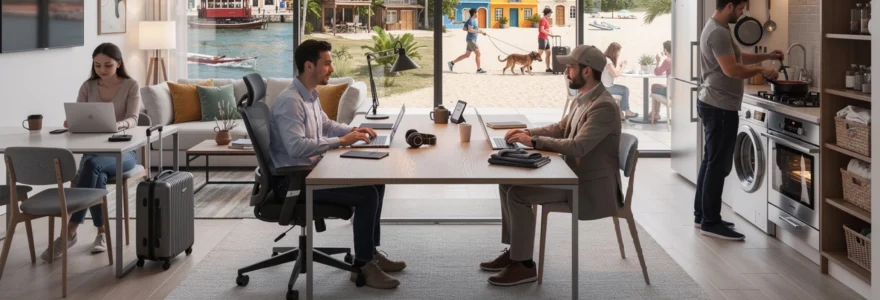
The travel industry is witnessing a fundamental transformation as travellers increasingly favour extended stays over traditional short-term holidays. This paradigm shift, driven by remote work flexibility and changing lifestyle priorities, represents more than a temporary trend—it’s reshaping the entire tourism landscape. Extended stays, typically defined as visits lasting two weeks to several months, offer travellers deeper cultural immersion, better value for money, and the opportunity to establish temporary roots in new destinations. The implications extend far beyond individual travel preferences, influencing accommodation providers, destination marketing strategies, and the very infrastructure of tourism itself.
Digital nomadism and remote work revolution driving extended stay demand
The rise of remote work has fundamentally altered the relationship between employment and location, creating unprecedented opportunities for extended travel. Companies worldwide have embraced flexible work arrangements, with many organisations discovering that productivity remains high—or even improves—when employees work from diverse locations. This shift has liberated millions of professionals from traditional office constraints, enabling them to pursue workations that blend professional responsibilities with travel experiences.
The demographics of extended stay travellers reveal interesting patterns. Millennials and Generation Z professionals, who prioritise experiences over material possessions, comprise the largest segment of this market. However, the trend extends across age groups, with experienced professionals seeking career sabbaticals and early retirees exploring semi-permanent relocations. The appeal lies not merely in scenic destinations but in the ability to maintain professional momentum while experiencing new cultures and environments.
Airbnb and VRBO monthly discount structures for Long-Term bookings
Short-term rental platforms have rapidly adapted to accommodate extended stay preferences through sophisticated pricing models and enhanced features. Airbnb’s monthly discount structure typically offers reductions of 20-50% for stays exceeding 28 days, making extended travel financially viable for many professionals. These platforms have introduced specialised search filters for long-term stays, highlighting properties with dedicated workspaces, reliable internet connectivity, and essential amenities for extended living.
VRBO has similarly evolved its offerings, partnering with property managers to provide comprehensive extended stay solutions. The platform now features properties specifically designed for digital nomads, complete with ergonomic workstations, high-speed internet guarantees, and flexible lease terms. Property owners have recognised the value of longer-term guests, who provide steady income with reduced turnover costs and property maintenance concerns.
Co-living spaces: selina, outsite, and WeWork live integration models
The co-living sector has emerged as a crucial component of the extended stay ecosystem, offering purpose-built environments for location-independent professionals. Selina has pioneered the hospitality-meets-co-living model, operating properties across Latin America and Europe that combine accommodation, workspace, and community elements. Their properties feature flexible booking options, from single nights to monthly memberships, accommodating the varying needs of digital nomads and extended stay travellers.
Outsite operates a global network of co-living spaces specifically designed for remote workers, offering membership-based access to properties worldwide. Members can book stays ranging from weeks to months, with consistent amenities and community standards across locations. This model addresses the challenge of accommodation uncertainty that often deters extended travel, providing reliable, standardised options in multiple destinations.
Corporate extended stay policies: microsoft and google remote work accommodation strategies
Forward-thinking corporations have developed comprehensive policies to support employee extended travel while maintaining business continuity. Microsoft’s flexible work policy allows employees to work remotely for up to 50% of their time, with provisions for extended international assignments that blur the lines between business travel and lifestyle choices. The company provides stipends for co-working spaces and ensures access to necessary technology and support systems regardless of location.
Google’s approach emphasises location flexibility within defined parameters, offering employees the opportunity to work from different offices globally or approved remote locations for extended periods. Their policies address tax implications, visa requirements, and equipment provisioning for extended stays, recognising that supporting employee mobility enhances retention and job satisfaction. These corporate initiatives legitimise extended travel as a viable work arrangement rather than a temporary perk.
Visa requirements for digital nomads in portugal, estonia, and barbados
Governments worldwide have recognised the economic potential of digital nomads
through tailored visa programmes designed to attract location-independent earners. Portugal’s D7 visa, Estonia’s Digital Nomad Visa, and Barbados’s Welcome Stamp all offer streamlined pathways for remote workers to reside legally for extended periods while working for foreign employers or clients. These visas typically require proof of stable income, health insurance, and background checks, but they remove the uncertainty associated with short-term tourist visas and border runs.
Portugal’s D7 visa, for instance, allows non-EU citizens to reside in the country with relatively modest income requirements compared to other EU states, making it especially attractive for freelancers and early retirees. Estonia’s pioneering digital nomad visa formalised the status of remote workers in the EU’s digital-first nation, aligning with its e-residency initiative. Barbados’s Welcome Stamp, launched during the pandemic, demonstrated how small island economies can offset declines in traditional tourism by welcoming longer-stay visitors who contribute to local economies over many months.
Accommodation infrastructure transformation for extended travellers
As travellers opt to stay longer in one destination, accommodation providers are rethinking their infrastructure and service models. Traditional hotels, built around short-term occupancy and rapid turnover, are adapting to cater to guests who measure their stay in weeks or months rather than nights. This shift has sparked innovation in room design, amenity packages, and pricing strategies, with brands repositioning themselves as temporary homes rather than transient lodging. For extended stay travellers, the right accommodation can make the difference between a sustained, productive lifestyle and a trip that quickly feels unsustainable.
We are seeing a convergence between hospitality and residential real estate, with hybrid models that combine the flexibility of hotels with the comfort of apartments. Providers are investing in features like fully equipped kitchens, separate living and sleeping areas, and integrated workspaces to meet evolving expectations. The extended stay market is no longer a niche segment aimed only at corporate travellers on assignment; it has become a core pillar of modern travel demand that influences how new properties are conceived, financed, and marketed.
Serviced apartments vs traditional hotels: marriott executive apartments case study
Serviced apartments have emerged as a preferred option for long-stay guests seeking more space, privacy, and autonomy than a conventional hotel room can provide. Marriott Executive Apartments, for example, operate in key business hubs across Europe, Asia, and the Middle East, offering fully furnished apartments with hotel-style services such as housekeeping, security, and concierge support. These properties typically feature separate bedrooms, living rooms, and kitchens, creating a sense of residential normalcy for guests staying 30 days or more.
Compared to traditional hotels, serviced apartments generally deliver better value on a per-night basis for extended bookings, especially when you factor in the ability to cook at home and do laundry on-site. Marriott’s extended stay strategy demonstrates how a major brand can segment its offering: transient business travellers might choose Courtyard or Marriott Hotels, while project teams, relocating employees, and digital nomads gravitate towards Executive Apartments. This layered approach allows the company to capture different types of long-term tourism revenue without diluting brand standards or guest expectations.
Kitchen facilities and workspace integration in hyatt house properties
For many extended stay travellers, having a functional kitchen and a dedicated workspace is non-negotiable. Hyatt House has built its brand around these needs, designing suites that include full-size refrigerators, stovetops, dishwashers, and ample storage space. This emphasis on self-catering allows guests to manage dietary preferences, reduce food costs, and maintain healthier routines than would be possible with restaurant dining alone. Over a month-long stay, being able to prepare meals can significantly change the financial and lifestyle calculus of a trip.
Equally important is the integration of ergonomic workspaces into room layouts. Hyatt House rooms often feature large desks, comfortable seating, abundant power outlets, and high-quality lighting, recognising that many guests will spend full workdays in their suites. This blend of kitchen and office functionality effectively turns each unit into a small live-work studio. For remote workers planning extended travel, such properties answer a critical question: can this place realistically support my daily life, not just my sleep?
Laundry services and storage solutions in extended stay america locations
When you stretch a trip from a few days to a few months, everyday practicalities like laundry and storage become central to the accommodation decision. Extended Stay America has built its model around these fundamentals, offering on-site laundry facilities, generous closet space, and room layouts that accommodate luggage, sports equipment, and work gear. While these features may seem mundane, their impact on traveller comfort over time is substantial. Constantly searching for laundromats or living out of a suitcase quickly erodes the appeal of long-term travel.
Extended Stay America properties also provide kitchenettes and simplified housekeeping schedules tailored to longer occupancy. This reduces operational costs while aligning with guest preferences for privacy and autonomy. Think of these properties as the “utility vehicles” of the hospitality world: they may not always be as glamorous as resort hotels, but they are engineered for reliability and day-to-day usability. For budget-conscious digital nomads, relocating families, or medical tourists, such practical amenities can make extended stays not only affordable but genuinely sustainable.
High-speed internet infrastructure requirements for business travellers
Reliable, high-speed internet has become the lifeblood of extended stay travel, particularly for remote workers and business travellers. A beautiful apartment or beachfront villa holds little value if video calls constantly drop or large files fail to upload. Recognising this, many extended stay brands now treat connectivity as a core utility, investing in fibre-optic connections, enterprise-grade routers, and backup systems to minimise downtime. Some properties explicitly advertise bandwidth figures and business-grade Wi-Fi to attract long-term guests.
From the traveller’s perspective, verifying internet quality before booking has become as important as checking location or price. Tools such as remote speed tests, user reviews mentioning latency, and guarantees offered in listings help reduce uncertainty. In effect, we are seeing a shift from “Wi-Fi available” as a generic amenity to internet performance as a measurable competitive differentiator. As remote work normalises, destinations and properties that cannot deliver stable connectivity risk being excluded from the extended stay economy entirely.
Economic impact analysis of long-term tourism revenue models
Extended stay tourism is transforming not only how people travel but also how destinations earn and manage tourism revenue. While traditional tourism prioritised high visitor volumes and short stays, the long-term model emphasises fewer visitors who stay longer and spend more consistently. Studies from destinations such as Madeira and Estonia suggest that digital nomads and long-stay visitors often spend 30–50% more per trip than short-term tourists, even if their daily spend is slightly lower. Over a three-month stay, routine expenses on groceries, co-working, fitness, and local services add up to substantial local economic contributions.
From a policy perspective, this shift offers both opportunities and challenges. On the positive side, extended stays can smooth out seasonal demand, supporting year-round employment in hospitality, retail, and services. They also encourage the development of higher-value local businesses, from language schools to speciality coffee shops, that serve both locals and visitors. However, unmanaged growth in long-term tourism can place pressure on housing markets, pushing rents higher for residents. Cities like Lisbon and Mexico City have already begun to regulate short-term rentals and design specific digital nomad zones to balance economic benefits with social equity.
Destination marketing strategies for extended stay tourism
Destination marketing organisations are rapidly updating their playbooks to attract travellers who plan to stay weeks or months, not days. Traditional campaigns focused on iconic sights and short itineraries are being complemented by messaging around liveability, cost of living, and long-term visa options. Instead of asking, “Why visit for a weekend?”, many tourism boards are now effectively asking, “Why not move here for a season?” This repositioning reflects a recognition that extended stay tourism can bring more stable, diversified revenue streams and foster deeper connections between visitors and communities.
To appeal to extended stay travellers, destinations highlight elements such as safety, healthcare access, reliable infrastructure, and a welcoming local culture. Marketing materials increasingly feature co-working spaces, residential neighbourhoods, and testimonials from existing digital nomads. It’s a subtle but important shift: destinations are selling a temporary lifestyle rather than a short-lived escape. Let’s look at how specific countries and cities are implementing these extended stay marketing strategies in practice.
Portugal’s D7 visa marketing campaign targeting remote workers
Portugal has emerged as one of Europe’s most prominent hubs for digital nomads and long-term visitors, thanks in large part to the D7 visa and savvy destination marketing. Campaigns from national and regional tourism boards promote the country not only for its beaches and historic cities, but also for its affordable cost of living, strong internet infrastructure, and vibrant expatriate communities. Lisbon, Porto, and Madeira are frequently showcased as places where you can enjoy a high quality of life while maintaining a global career.
Marketing content aimed at remote workers often includes practical information on the D7 visa, from income thresholds to application timelines, presented alongside lifestyle imagery of co-working spaces, surf spots, and café culture. By demystifying the bureaucratic process, Portugal lowers the psychological barrier to committing to a multi-month stay. The message is clear: this is not just a holiday destination, but a place where you can realistically live and work for an extended period with legal certainty.
Thailand’s special tourist visa programme for long-term visitors
Thailand, long a favourite for backpackers and short-term holidaymakers, has reoriented part of its tourism strategy towards attracting longer-stay, higher-value visitors. The Special Tourist Visa (STV), introduced during the pandemic and iterated since, allows certain nationalities to stay for extended periods, often up to 90 days with options for renewal. While policy details have evolved, the broader signal has remained consistent: Thailand wants guests who are prepared to invest time and money in the country beyond a brief beach vacation.
Tourism authorities have marketed the STV and related schemes by emphasising Thailand’s extensive infrastructure for remote workers, including co-working hubs in Bangkok, Chiang Mai, and Phuket. Campaigns highlight low daily living costs, world-class cuisine, and modern healthcare facilities as key selling points for long-stay visitors. For digital nomads eager to stretch their budgets while enjoying a rich cultural environment, Thailand’s combination of flexible visas and supportive infrastructure is highly compelling.
Mexico’s temporary resident visa appeal to north american nomads
Mexico’s Temporary Resident Visa has become a cornerstone of its appeal to North American remote workers and retirees seeking extended stays. This visa typically allows stays from six months to four years, far exceeding the 180-day tourist allowance for many nationalities. For Canadians and Americans in particular, the ability to live seasonally in destinations such as Mexico City, Playa del Carmen, and Puerto Vallarta while maintaining professional ties back home is a significant draw.
Destination marketing campaigns emphasise proximity to the United States and Canada, relatively straightforward visa processes, and the availability of modern amenities in popular expat hubs. Messaging often blends practical guidance—such as cost-of-living comparisons and healthcare access—with imagery of coastal living, cultural festivals, and dynamic urban neighbourhoods. In doing so, Mexico positions itself as a convenient, culturally rich base for long-term living rather than just a winter escape.
Local business ecosystem development in lisbon, canggu, and playa del carmen
Extended stay tourism has catalysed the development of new local business ecosystems in cities and towns worldwide. In Lisbon, a wave of co-working spaces, speciality coffee shops, and bilingual service providers has emerged to serve a growing population of remote workers. Neighbourhoods like Cais do Sodré and Alcântara have transformed into hubs where locals and long-term visitors mingle in shared offices, creative studios, and community events. This ecosystem reinforces Lisbon’s reputation as a long-stay-friendly destination.
Canggu in Bali and Playa del Carmen in Mexico offer similar examples. Both started as relatively low-key beach towns and have evolved into digital nomad hotspots, with dense clusters of co-working venues, yoga studios, healthy eateries, and mid-range long-stay accommodation. While this growth brings economic opportunity, it also raises important questions: how can communities preserve local character and affordability while embracing an influx of international residents? Policymakers, residents, and business owners are increasingly engaged in finding a sustainable balance.
Technology platforms facilitating extended travel planning
Planning an extended trip is far more complex than booking a week-long holiday, and technology platforms have stepped in to simplify the process. Beyond standard booking sites, new tools help travellers compare long-term accommodation costs, assess internet quality, and coordinate logistics like co-working access and visa requirements. Platforms that aggregate serviced apartments, co-living spaces, and extended stay hotels allow you to filter specifically for properties geared towards multi-week or multi-month stays, reducing the time spent sifting through unsuitable options.
We are also seeing growth in specialised communities and apps for digital nomads that offer destination reviews tailored to long-term living, including safety, healthcare, and local community dynamics. Some platforms integrate budgeting tools and cost-of-living calculators, helping travellers decide whether, for example, three months in Lisbon is more viable than six weeks in New York. Just as flight comparison engines revolutionised short-term travel, these extended stay planning tools are quietly reshaping how people design their lifestyles across borders.
Health insurance and medical access considerations for extended travellers
Spending months abroad introduces health-related considerations that short-term tourists can often overlook. Standard travel insurance policies may not cover extended stays or remote work activities, leaving long-term travellers exposed to medical and financial risk. In response, a new generation of international health insurance products has emerged, specifically tailored to digital nomads, expats, and slow travellers. These plans typically combine emergency coverage with routine care options, allowing policyholders to access doctors, prescriptions, and clinics in multiple countries.
Access to quality healthcare is a critical factor when choosing where to stay longer. Many remote workers now research hospital standards, availability of English-speaking doctors, and telemedicine options alongside accommodation and internet quality. Destinations that can offer modern medical facilities and clear information about healthcare access gain a competitive edge in attracting long-term visitors. Ultimately, as extended stays become more common, health planning is no longer an afterthought—it is a central pillar of sustainable, long-term travel lifestyles.