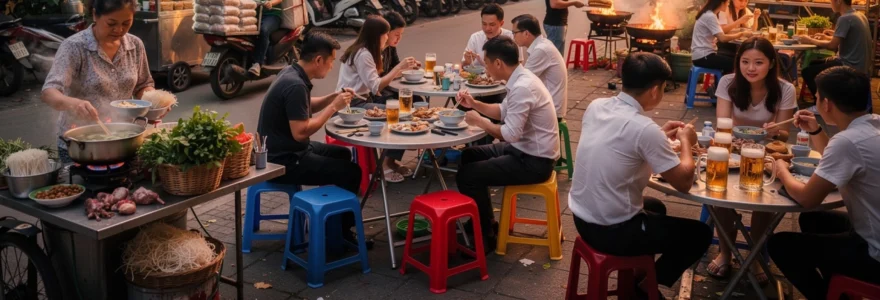
The cobblestone streets of Vietnam’s capital pulse with an energy that transcends mere urban hustle, creating a symphony of sizzling woks, clinking chopsticks, and animated conversations that define the soul of Hanoi’s street dining culture. From dawn’s first light when steaming bowls of pho emerge from tiny kitchens to midnight’s final bite of bánh mì, the city’s culinary landscape operates as a living organism, breathing life into narrow alleyways and transforming humble sidewalks into vibrant social theatres. This intricate web of food vendors, regular customers, and spontaneous encounters forms the backbone of Vietnamese urban society, where plastic stools become community centres and street corners evolve into cultural crossroads that have sustained generations of Hanoians through their daily rhythms.
Culinary geography of hanoi’s street food ecosystem
The spatial organisation of Hanoi’s street food network reveals a sophisticated understanding of urban flow patterns, customer demographics, and logistical efficiency that has evolved over decades of trial and refinement. Each district maintains its own culinary personality, shaped by historical development, residential patterns, and the natural migration of food traditions from different regions of Vietnam. This geographic specialisation creates distinct food clusters that serve both locals and visitors, establishing micro-economies within the broader urban framework.
Old quarter’s pho gia truyen and traditional breakfast networks
The Old Quarter operates as Hanoi’s culinary heart, where century-old family recipes intersect with modern urban demands to create an unparalleled breakfast ecosystem. Pho vendors occupy strategic corner positions, capitalising on morning commuter traffic while maintaining visibility for tourists exploring the historic district. The legendary Pho Gia Truyen represents the pinnacle of this tradition, serving generations of customers who queue patiently for bowls of aromatic broth that embody decades of culinary refinement.
These breakfast networks function through carefully orchestrated supply chains that begin before sunrise, with vendors receiving fresh herbs, noodles, and meat from wholesale markets located within walking distance. The proximity of ingredients ensures optimal freshness while minimising transportation costs, creating an efficient distribution system that supports dozens of small businesses within a compact geographical area.
Dong xuan market’s vendor clustering patterns and supply chain dynamics
Dong Xuan Market serves as the logistical epicentre for street food operations throughout central Hanoi, creating vendor clustering patterns that maximise both competition and collaboration. The market’s wholesale operations supply ingredients to hundreds of street vendors, establishing pricing standards and quality benchmarks that ripple throughout the city’s food network. Vendors often specialise in complementary offerings, creating natural clustering around the market’s perimeter that encourages customer exploration and repeat visits.
The supply chain dynamics reveal remarkable efficiency, with vendors making multiple daily trips to source fresh ingredients, ensuring that popular items rarely sell out completely while minimising food waste. This just-in-time inventory system allows small-scale operators to compete effectively with larger establishments by maintaining ingredient freshness and adapting quickly to customer demand fluctuations.
Hoan kiem district’s evening food circuit and spatial distribution
As daylight fades, Hoan Kiem District transforms into a sprawling evening food circuit where office workers, tourists, and local families converge around strategically positioned food stalls. The spatial distribution follows pedestrian traffic patterns, with higher-volume vendors claiming premium locations near major intersections while speciality food sellers occupy quieter side streets where customers specifically seek their offerings.
This evening ecosystem operates on different temporal rhythms than morning markets, with vendors often preparing ingredients throughout the afternoon to meet peak demand between 6 PM and 9 PM. The circuit nature encourages food tourism, as customers develop routes that include multiple stops for different courses, creating a progressive dining experience that spans several blocks and multiple hours.
West lake area’s seafood specialisation and Tourist-Local dining segregation
The West Lake area demonstrates how geographic features influence culinary specialisation, with proximity to water sources historically supporting seafood vendors who now serve both traditional preparations and tourist-friendly adaptations. This district exhibits clear segregation between establishments catering primarily to locals and those designed for international visitors, creating
distinct price tiers, menu translations, and service styles. Lakeside seafood restaurants targeting tour groups often feature extensive picture menus, air-conditioned interiors, and fixed-price seafood sets, while nearby family-run eateries focus on seasonal fish, freshwater crabs, and simple grilled dishes designed for repeat local customers. For travellers seeking a more authentic West Lake dining experience, venturing a few streets back from the waterfront usually reveals quieter venues where the rhythm of daily life remains the main attraction, not just the view.
Temporal rhythms and peak service patterns in vietnamese street gastronomy
Beyond geography, Hanoi’s street dining scene follows distinct temporal rhythms that mirror the city’s working patterns and social routines. Understanding when specific dishes appear and disappear from pavements can feel a bit like decoding a public transport timetable, where each time slot has its own culinary « route ». Vendors adapt their operating hours to match commuter flows, school schedules, office breaks, and nightlife peaks, creating an informal yet highly efficient system of food availability that seasoned locals navigate almost instinctively.
Dawn trading hours: pho and banh mi distribution networks
The earliest wave of Hanoi street dining begins well before sunrise, typically between 5 AM and 7:30 AM, when pho, cháo (rice porridge), and bánh mì stalls serve the first wave of workers and students. These vendors rely on finely tuned distribution networks, often coordinating with butchers, bakers, and herb suppliers who deliver ingredients in the pre-dawn darkness. A pho stall might sell out its entire batch of broth by 8 AM, closing down until the next day, underscoring how tightly production is calibrated to morning demand.
Mobile bánh mì carts exemplify the agility of these dawn networks, positioning themselves near bus stops, school gates, and office entrances for just a few peak hours. Many operate on established « routes », stopping at pre-agreed corners where regular customers expect them, similar to a neighbourhood coffee truck. For visitors, following the scent of grilled pork and cilantro through quiet streets can offer a rare glimpse of the city before traffic builds, when Hanoi’s street food ecosystem hums at its most efficient and unhurried pace.
Midday rush dynamics: office worker food delivery systems
By late morning, the focus of street dining shifts toward the midday rush, when office workers fuel a dense network of cơm văn phòng (office rice) vendors and noodle stalls. While some diners still eat on tiny stools under awnings, a growing share of midday meals are now delivered directly to offices through phone calls and app-based services. This hybrid model blends traditional home-style cooking with modern logistics, allowing small kitchens to serve hundreds of portions daily without expanding their physical footprint.
In commercial districts like Ba Dinh or near Hoan Kiem, it is common to see motorbikes loaded with stacked lunch boxes weaving through traffic between 11 AM and 1 PM. Many vendors prepare set menus that change daily, optimising prep time and inventory while offering regular customers variety across the week. The result is an intricate midday choreography: cooks plate, pack, and dispatch; riders navigate tight delivery windows; and office workers coordinate group orders, turning the lunch break into a collective, time-sensitive ritual embedded in Hanoi’s urban routine.
Evening street food convergence: bia hoi corner social clustering
As the heat of the day fades, Hanoi’s street dining scene enters its most sociable phase, with evening stalls and open-air beer joints drawing diverse crowds. Nowhere is this convergence more visible than around the famous Bia Hoi Corners scattered near the Old Quarter, where fresh draught beer and shared plates transform intersections into impromptu social clubs. Here, food is as much about conversation and connection as it is about sustenance, with groups spilling out into the street on clusters of low stools that seem to multiply as the night progresses.
The clustering effect at these corners is striking: grilled skewers, fried spring rolls, peanuts, and boiled peanuts circulate from small sidewalk kitchens to surrounding tables, creating a shared pool of snacks that blurs the boundary between separate groups. Sociologists might describe this as « third place » dining, where neither home nor office sets the tone, but rather the informal, communal energy of the street itself. For travellers, joining a table at Bia Hoi Corner offers an accessible entry point into Hanoi’s evening rhythms, where language barriers often dissolve under the combined influence of cold beer and warm hospitality.
Late-night food stall operations and urban night economy integration
After 10 PM, when many restaurants close, a different layer of Hanoi’s street food economy emerges to serve late-night workers, night-shift drivers, and social night owls. These stalls specialise in dishes suited to cooler temperatures and post-evening cravings, such as phở gà, sticky rice (xôi), or sizzling stir-fries prepared to order. Operating hours can stretch well past midnight, especially on weekends, positioning these vendors as an essential part of the city’s night-time infrastructure alongside taxi ranks and convenience stores.
Late-night operations require careful navigation of regulations, residential noise concerns, and fluctuating demand, pushing vendors to develop flexible setups that can be assembled and dismantled quickly. You might notice how a spot that hosted a coffee stand in the morning transforms into a noodle stall at night, demonstrating how pavement space is continuously recycled across the 24-hour cycle. This integration into the urban night economy also supports informal employment, offering income opportunities for students or migrants who balance daytime commitments with nocturnal street food shifts.
Traditional cooking methodologies and equipment infrastructure
Behind every steaming bowl or fragrant skewer lies a backbone of traditional cooking methods and equipment that shapes the flavour profile of Hanoi’s street food. Many vendors still rely on charcoal braziers, heavy cast-iron pans, and large aluminium stockpots, tools that may look modest but allow for precise control over heat and texture. These setups are often optimised over years of trial and error, with each family fine-tuning their equipment layout to maximise output from a few square metres of pavement or a narrow kitchen.
Consider the slow-simmering broth of pho: large stockpots bubble for hours, sometimes across multiple days, extracting marrow and aromatics to achieve the dish’s signature clarity and depth. Charcoal grills, meanwhile, impart a subtle smokiness to bún chả or skewered meats that gas burners struggle to replicate, making equipment choice directly tied to perceived authenticity. Even seemingly simple tools, like the wire strainers used to blanch noodles or the bamboo baskets for draining herbs, play critical roles in maintaining consistency, speed, and food safety in challenging outdoor environments.
Street vendors also operate as inventive engineers, adapting their equipment infrastructure to fit Hanoi’s compact urban spaces and evolving regulations. Mobile carts often feature customised compartments for gas canisters, hidden water storage, and folding work surfaces that allow for quick relocation when needed. In recent years, there has been a gradual transition toward cleaner fuels and improved waste management systems, particularly in central districts, as city authorities work with vendors to balance traditional street dining culture with air quality and hygiene goals.
Social architecture of hanoi’s pavement dining culture
Beyond the food itself, Hanoi’s street dining experience is defined by its unique social architecture: how people sit, interact, and share space on the pavement. Sidewalks become extensions of living rooms, meeting rooms, and community halls, where strangers can easily become temporary neighbours over a shared condiment tray. This informal yet structured use of public space makes street dining not only a culinary practice but also a social technology that helps the city negotiate density, diversity, and daily stress.
Plastic stool seating arrangements and community formation
The iconic plastic stool, often barely 25 centimetres off the ground, is the building block of pavement dining layouts across Hanoi. These stools and matching low tables can be rearranged in seconds, expanding and contracting to match the ebb and flow of customers. Sitting so close to the ground subtly changes social dynamics: hierarchies flatten, conversations feel more intimate, and you become physically closer to both your food and the people around you, almost like sharing a picnic in the middle of the city.
Stool arrangements often follow unspoken rules. Solo diners might be placed at the outer edge of a cluster, while larger groups are guided to the back or along the wall, creating efficient mini-zones where staff can move freely with trays and hot pots. Curious how locals end up talking to each other across tables? The seating density and proximity make it easy for neighbouring groups to exchange recommendations, trade chilli sauces, or comment on a passing street scene, turning a quick meal into a micro-community event that lasts well beyond the last bite.
Multi-generational vendor family business structures
Many of Hanoi’s most beloved street food stalls are not individual enterprises but multi-generational family operations where roles are carefully distributed across ages. Grandparents may handle slow, skilled tasks such as seasoning broth or rolling spring rolls, while middle-aged members coordinate purchasing, finances, and customer relationships. Younger relatives often manage social media, delivery apps, or English-language interactions with tourists, illustrating how traditional food businesses adapt to contemporary tools without sacrificing core identity.
This family-based structure provides resilience in a sector that can be vulnerable to weather, regulatory changes, and economic fluctuations. When one member falls ill or steps away, another can step in, supported by shared recipes, memorised routines, and collective memory. For customers, returning to the same stall over years or even decades creates an emotional continuity: watching a child who once played under the tables grow into the vendor now preparing your bowl serves as a living reminder that Hanoi’s street dining culture is not a static attraction but an evolving family saga.
Customer loyalty systems and neighbourhood regular dynamics
Unlike formal loyalty programmes with cards and points, Hanoi’s street food vendors cultivate customer loyalty through memory, trust, and small gestures. Regulars might have their preferred order started as soon as they appear at the corner, their usual level of chilli or garlic already known without discussion. Payment can be flexible for long-time patrons, with informal credit extended until the next visit, reflecting relationships that blur the line between customer and acquaintance.
Neighbourhood dynamics further reinforce these bonds. A stall that has served the same cluster of homes and offices for years becomes part of the local identity, with residents recommending « their » vendor to visiting friends as a point of pride. You may notice how staff greet certain guests with extended chat or jokes, even during busy periods, signalling a social hierarchy based on shared history. This intricate web of micro-relationships supports a stable customer base, helping small street businesses weather competition from new cafés, chains, and delivery-only kitchens.
Economic microstructures of street food entrepreneurship
Street dining in Hanoi may appear casual and spontaneous, but beneath the surface lies a complex set of economic microstructures that determine who can enter the market, stay afloat, and eventually grow. Start-up costs are relatively low compared with brick-and-mortar restaurants, often limited to a cart, basic equipment, initial ingredient stock, and informal access rights to a chosen patch of pavement. This lower barrier enables a wide range of entrepreneurs—from rural migrants to urban graduates—to test food concepts with real-time customer feedback.
Revenue models, however, are finely balanced. Margins on individual dishes can be slim, sometimes just a few thousand đồng per serving, so vendors rely on volume and turnover rather than high mark-ups. Many stalls diversify across time slots or products to stabilise income; a morning xôi vendor might switch to selling sweet desserts in the afternoon, or a coffee cart might add sandwiches to capture lunchtime trade. Flexibility becomes a core entrepreneurial skill: recipes, opening hours, and even locations can shift in response to construction projects, changing traffic flows, or new competitors.
Informal partnerships are another pillar of this micro-economy. Vendors often form loose alliances with nearby businesses, sharing storage space, electricity, or even staff during peak hours. Some collaborate with delivery riders or app platforms on a commission basis, trading a slice of profit for extended reach. At the same time, regulatory frameworks continue to evolve, with the city experimenting with licensing schemes, hygiene training, and designated street food zones. Navigating this landscape requires not only culinary talent but also negotiation skills, risk tolerance, and a keen sense of urban opportunity.
Cultural preservation through generational recipe transmission
At the heart of Hanoi’s street dining culture lies a quieter, more intimate process: the transmission of recipes, techniques, and taste memories from one generation to the next. Many iconic dishes served on the pavement today are the result of incremental refinements, where each new cook adjusts seasoning by a tiny margin or modifies cooking time based on decades of observed feedback. These recipes often exist only in embodied form—measured in handfuls, pinches, and glances rather than written grams and millilitres—making apprenticeship within the family essential.
How do these traditions survive in a rapidly modernising city where global food trends arrive with a swipe on a screen? In many cases, younger family members pursue formal culinary education or outside work while still returning to the family stall, blending new knowledge with inherited methods. Some vendors experiment with more sustainable packaging or digital ordering systems yet keep their broth base or grilling technique unchanged, viewing these core elements as non-negotiable guardians of authenticity. This balance between evolution and preservation is delicate, but it is precisely what allows Hanoi’s street food to feel both timeless and alive.
For visitors, recognising this layer of cultural preservation adds depth to the simplest street-side meal. When you sit on a plastic stool and taste a bowl of bún, you are not just sampling a recipe; you are participating in a living archive of the city’s history, shaped by migration, scarcity, celebration, and everyday resilience. Each stall becomes a small museum of flavour, curated not by curators but by families who have chosen, again and again, to keep cooking in the same spot, at the same hour, for neighbours who have become extended kin. In this sense, street dining in Hanoi is more than a way to eat—it is one of the city’s most enduring forms of storytelling.