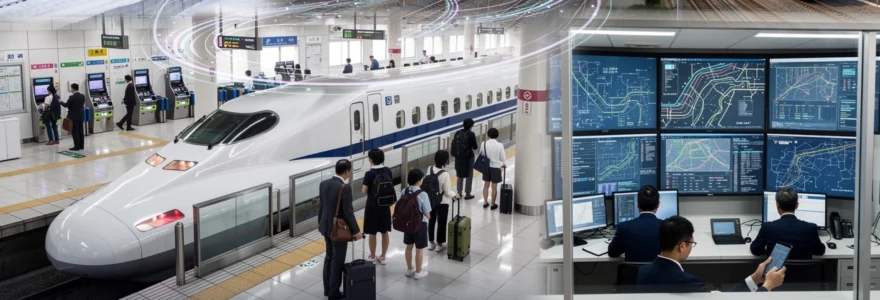
Japan’s railway system stands as a testament to engineering excellence and operational precision, transforming the way millions experience travel across the archipelago. With an average delay time of just 1.6 minutes on the Tokaido Shinkansen and a punctuality rate that exceeds 99%, Japan’s rail network represents the gold standard for public transportation worldwide. This extraordinary level of reliability stems from decades of technological innovation, meticulous planning, and a cultural commitment to excellence that permeates every aspect of the system. From the bustling metropolitan networks of Tokyo and Osaka to the remote rural lines connecting Japan’s most isolated communities, the railway infrastructure demonstrates how precision engineering can create seamless connectivity across diverse geographical challenges.
The integration of cutting-edge technology with traditional Japanese values of respect and efficiency has created a transportation ecosystem that moves over 40 billion passengers annually with remarkable consistency. Understanding the intricate systems behind this success reveals not just impressive statistics, but a comprehensive approach to solving complex logistical challenges that other nations continue to study and emulate.
JR group’s integrated railway infrastructure and operational excellence
The Japan Railway Group, formed after the privatisation of the Japanese National Railways in 1987, operates as a sophisticated network of six regional passenger companies and one freight operator, each specialising in their respective territories while maintaining seamless interconnectivity. This decentralised yet coordinated approach allows each company to focus on regional needs whilst adhering to national standards for safety, punctuality, and passenger service. The operational excellence achieved by the JR Group stems from their commitment to continuous improvement, with each company investing heavily in infrastructure upgrades, staff training, and technological innovations that enhance both safety and efficiency.
The backbone of this system relies on sophisticated maintenance schedules that ensure track integrity and rolling stock reliability across more than 19,500 kilometres of railway lines. Preventive maintenance protocols are scheduled with military precision, often conducted during brief overnight windows to minimise disruption to passenger services. This proactive approach significantly reduces the likelihood of equipment failures that could cascade into system-wide delays, maintaining the reliability standards that Japanese passengers have come to expect.
Shinkansen High-Speed rail network architecture and engineering standards
The Shinkansen network exemplifies Japanese engineering prowess through its dedicated track infrastructure that separates high-speed services from conventional rail traffic. These purpose-built lines feature standard gauge tracks with minimal curves and gradients, enabling sustained speeds of up to 320 kilometres per hour on commercial services. The engineering standards incorporate advanced concrete slab track systems that provide superior stability and reduced maintenance requirements compared to traditional ballasted tracks, whilst sophisticated drainage systems prevent flooding and maintain operational safety during Japan’s challenging weather conditions.
Seismic isolation technology integrated into the Shinkansen infrastructure allows the system to automatically halt services when earthquake sensors detect potentially dangerous ground motion, protecting both passengers and equipment. This early warning system has successfully prevented casualties during numerous earthquakes, demonstrating how safety-first engineering principles can be seamlessly integrated with high-speed operations without compromising efficiency or reliability.
JR east’s Computer-Aided traffic control (COMTRAC) system implementation
COMTRAC represents one of the most sophisticated traffic management systems in the world, processing real-time data from thousands of sensors across JR East’s network to optimise train movements and prevent conflicts. The system continuously monitors train positions, speeds, and schedules, automatically adjusting signal timings and route allocations to maintain optimal flow through complex junction areas. When disruptions occur, COMTRAC can rapidly calculate alternative routing solutions and communicate these changes to both train operators and passengers within seconds of the initial incident.
The integration of artificial intelligence algorithms within COMTRAC enables predictive analysis that can identify potential bottlenecks before they impact passenger services. This proactive approach allows dispatchers to implement preventive measures, such as slightly adjusting departure times or routing decisions, to maintain overall network punctuality even when individual services experience minor delays.
Automatic train control (ATC) technology and safety protocols
ATC systems on Japanese railways provide continuous speed monitoring and automatic braking intervention, creating multiple layers of safety protection that prevent human error from causing accidents. The technology monitors train speeds against predetermined safety curves for each section of track, automatically applying brakes if operators exceed safe parameters for curves, gradients, or approach speeds to stations. This continuous supervision ensures that even if operators
momentarily lose concentration, the train will still remain within strict safety margins. In dense urban environments and on high-speed Shinkansen lines, ATC works alongside cab signalling and continuous communication-based systems, reducing reliance on lineside signals and enabling closer headways without compromising safety. Combined with rigorous driver training and regular simulation exercises, these protocols contribute to one of the world’s most impressive safety records, with no fatal accidents due to train collisions or derailments on the Shinkansen since operations began in 1964.
Beyond the core ATC framework, Japanese railways employ layered safety systems such as Automatic Train Stop (ATS), overspeed protection, and platform screen doors on many busy lines. These measures are supported by comprehensive incident reporting and root-cause analysis practices, ensuring that any irregularity, however minor, feeds back into improved rules and procedures. In effect, safety becomes a living system: technology, human expertise, and organisational culture continually reinforce one another to keep trains both punctual and secure.
Station platform management and real-time passenger flow optimisation
Precision in Japan’s railway network is not confined to the tracks; it extends to platform operations and passenger flow management in some of the busiest stations on earth. Major hubs such as Tokyo, Shinjuku, and Osaka handle millions of passengers daily, yet queues remain orderly and dwell times are kept remarkably short. This is achieved through clear platform markings indicating door positions, boarding queues, and priority seating areas, which help passengers line up before the train arrives. As a result, boarding and alighting become almost choreographed movements rather than chaotic scrambles.
Behind the scenes, railway operators utilise real-time passenger counting systems, CCTV analytics, and demand forecasting tools to adjust operations dynamically. Train formations can be lengthened during peak demand, and platform staff are redeployed to congestion hotspots to guide flows and prevent bottlenecks. In some metropolitan networks, digital signage is updated in real time to indicate less crowded cars, encouraging more even distribution along the platform. For travellers, this means that even during rush hour, the experience of moving through enormous stations feels surprisingly efficient and predictable.
Digital ticketing systems and seamless multi-modal integration
One of the defining characteristics of traveling across Japan by train is how little friction there is between different modes of transport. From the moment you land at an airport to the time you reach a remote onsen town, digital ticketing systems and interoperable cards allow you to transfer between rail, metro, bus, and even some ferries with a simple tap. This seamless multi-modal integration is a core reason why the Japanese railway system works so well for both residents and visitors. Instead of wrestling with complicated fare tables at every step, you can focus on where you want to go and what you want to experience.
These digital platforms sit on top of a complex web of private and JR-operated lines, yet they present a unified face to the passenger. Common standards, back-end settlement systems, and shared data protocols ensure that, regardless of which company owns the line, your journey feels continuous. For the frequent traveller or the first-time visitor intimidated by Japanese characters, this consistent experience transforms what might have been a logistical puzzle into a smooth, intuitive process.
IC card technology: suica, PASMO, and ICOCA interoperability standards
At the heart of Japan’s everyday rail travel is a family of contactless smart cards such as Suica, PASMO, and ICOCA. These IC cards use FeliCa, a high-speed RFID technology developed by Sony, enabling tap-in and tap-out transactions in a fraction of a second. What makes them particularly powerful is their interoperability: a Suica card issued by JR East can be used on private railways, subways, and buses across most major regions, while PASMO and ICOCA function in much the same way outside their home territories. For you as a passenger, this means you rarely need to think about which company operates a given line.
Behind that simplicity lies a robust set of interoperability standards and revenue-clearing mechanisms between operators. Travel data is securely recorded on the card and transmitted to back-end systems that reconcile fares among dozens of companies, ensuring that every operator is compensated accurately. For occasional visitors, many regions now offer Welcome Suica or similar tourist-oriented cards that avoid the need for long-term registration. Compared with traditional paper tickets, this approach reduces queuing times, eliminates confusion over fares, and significantly speeds up passenger throughput at busy gates.
Jr-west’s smart ICOCA and mobile ticketing platform integration
JR-West has taken IC card convenience a step further with Smart ICOCA, combining the flexibility of a rechargeable card with the convenience of online account management. Linked to credit cards, Smart ICOCA allows automatic top-ups, transaction history checks, and integration with loyalty programmes, which is particularly attractive for frequent travellers within the Kansai region. It exemplifies how Japanese rail operators view digital ticketing not just as a payment method, but as a broader customer relationship platform.
In parallel, mobile ticketing has grown rapidly, especially through the integration of IC functionality into smartphones and smartwatches. On compatible devices, you can load Suica, PASMO, or ICOCA into your digital wallet, effectively turning your phone into a rail pass that also connects with shopping, vending machines, and lockers. JR-West and other operators are increasingly linking these mobile platforms with seat reservation apps, real-time alerts, and travel history tools. For business travellers trying to optimise their schedules, or tourists keen to avoid queueing at ticket machines, this convergence of hardware, software, and transport access delivers a notably smoother experience.
Hyperdia and google transit API integration for route planning
Knowing that trains are frequent and punctual is one thing; being able to plan a multi-leg journey across several regions is another. This is where digital route planners such as Hyperdia, Jorudan, and Google Maps (via the Google Transit API) become indispensable tools for navigating Japan’s extensive rail network. These services aggregate timetable data from JR and private operators, allowing you to compare journey times, platform numbers, and fare options in seconds. For complex itineraries involving Shinkansen connections, local lines, and metro transfers, they function almost like an extra layer of navigation infrastructure.
Many of these route planners also allow users to filter out specific train types—for example, excluding Nozomi services when travelling on certain rail passes—or prioritise routes with fewer transfers. As open data initiatives expand, third-party apps continue to improve their accuracy and usability, particularly for non-Japanese speakers. For travellers planning weeks in advance or making last-minute changes on a station platform, this real-time journey planning transforms a potentially daunting system map into a simple, step-by-step route.
Reserved seat allocation algorithms and dynamic pricing models
On long-distance services such as the Shinkansen and Limited Express trains, reserved seating is managed through sophisticated allocation algorithms designed to maximise occupancy while keeping the booking process intuitive for passengers. When you make a reservation, the system considers existing bookings, carriage configurations, and group sizes to assign seats that minimise fragmentation and make it easier for families or groups to sit together. Over time, these systems “learn” from booking patterns, adjusting allocation strategies for popular routes and peak travel periods such as Golden Week or Obon.
Although Japan has traditionally favoured transparent, stable fares over aggressive airline-style yield management, elements of dynamic pricing are increasingly visible, especially on premium or tourist-focused services. Early-bird discounts, off-peak promotions, and flexible seat classes offer more options without undermining the sense of fairness that Japanese passengers expect. For international visitors trying to strike a balance between cost and comfort, understanding these seat reservation and pricing models can unlock significant savings while still ensuring access to the fastest and most convenient trains.
Precision scheduling methodologies and delay mitigation strategies
How does a network with thousands of daily services maintain average delays measured in mere seconds rather than minutes? A key factor is the precision scheduling methodology used by Japanese rail operators. Timetables are constructed with granular attention to dwell times, acceleration profiles, and inter-line connections, often calibrated down to the second. Planners run detailed simulations to test new schedules, accounting for everything from passenger loading patterns to seasonal weather variations. The end result is a timetable that appears simple to the user but is the product of complex modelling and relentless refinement.
Equally important are the built-in buffers and contingency plans that allow the system to absorb small disturbances without cascading into widespread disruption. Short recovery margins between major junctions, flexible platform assignments, and standby rolling stock provide operators with tactical tools to recover from incidents quickly. When a delay does occur—due to a medical emergency, for example—control centres can reorder train priorities, turn services short, or deploy relief crews to restore normal operations. Passengers are informed through clear announcements, real-time displays, and, increasingly, mobile notifications, so they can adjust their own plans with minimal stress.
Regional connectivity networks beyond major metropolitan areas
While Tokyo and Osaka often attract the most attention, one of the most impressive aspects of traveling across Japan by train is how well smaller cities and rural communities are connected. Regional JR companies and private railways maintain lines that thread through mountains, coastlines, and agricultural heartlands, ensuring that economic and social life does not concentrate solely in urban centres. These local and regional lines may operate less frequently than metropolitan routes, but they play a vital role in enabling students, workers, and tourists to move efficiently between remote towns and regional hubs.
From scenic branch lines with single-car diesel trains to electrified corridors linking secondary cities, this mesh of services forms the “capillaries” of Japan’s transport circulatory system. For visitors, it opens up opportunities to discover hot spring villages, castle towns, and UNESCO-listed shrines that lie far beyond the typical Tokyo–Kyoto–Osaka axis. For residents, it provides dependable access to healthcare, education, and employment, underlining the social function of rail beyond pure commercial metrics.
JR hokkaido’s remote line operations and winter weather adaptations
Hokkaido presents some of the toughest operating conditions anywhere in the Japanese rail network, with heavy snowfall, freezing temperatures, and strong winds a regular part of winter. JR Hokkaido has responded with a combination of specialised rolling stock, snow-clearing equipment, and infrastructure adaptations designed to keep lines open as safely and reliably as possible. Trains are equipped with snowploughs and reinforced undercarriages, while track sections in snow-prone areas may feature heated points and snow shelters. For passengers, this means that even in mid-winter, it is often still practical to move between cities such as Sapporo, Hakodate, and Asahikawa by rail.
Operationally, JR Hokkaido employs conservative timetabling and robust contingency plans when severe weather is forecast. Speed restrictions are applied, extra inspection runs are carried out, and communication with passengers becomes even more crucial. Real-time updates via station displays, websites, and apps help travellers adjust itineraries or seek alternative routes. Although extreme conditions can and do cause suspensions for safety reasons, the combination of engineering and procedural measures has significantly improved resilience over the past decade, offering a valuable model for other cold-climate railways around the world.
JR kyushu’s limited express services and tourism-focused route design
In contrast to Hokkaido’s harsh winters, Kyushu showcases how regional operators can use rail to support tourism and regional branding. JR Kyushu is renowned for its distinctive Limited Express services, many of which feature themed interiors, panoramic windows, and regionally inspired design. Trains such as the Yufuin no Mori, A-Train, and Sonic are more than just transport; they are carefully curated travel experiences that showcase local cuisine, craftsmanship, and scenery along the route. For travellers, stepping onto one of these trains often feels like entering a boutique hotel on rails.
Route design plays a key role in this strategy. Many Limited Express services connect major cities like Fukuoka with hot spring towns, historic sites, and coastal resorts, encouraging visitors to explore beyond a single urban base. Timetables are often coordinated with local bus services and tourist attractions, creating smooth door-to-door journeys to destinations that might otherwise be difficult to reach. In this way, JR Kyushu leverages the inherent strengths of Japanese rail—punctuality, comfort, and frequency—to drive sustainable tourism and economic development across the island.
Local line integration with express services in rural prefectures
Beyond the flagship Limited Express trains, a great deal of thought goes into how local lines connect with faster services in rural prefectures across Japan. Typically, local trains are scheduled to arrive a few minutes before an express service departs, allowing passengers to make confident connections without long waits. In many cases, cross-platform transfers are designed so that you simply step from one side of the same platform to the other, minimising walking distances and confusion—especially welcome if you are carrying luggage or travelling with children.
Coordination also extends to fare structures and information systems. Through-tickets and IC card compatibility mean that a journey involving a local branch line and a mainline express can be paid for in a single transaction. Station signage and on-board announcements highlight key transfer points, while staff are on hand at smaller stations to assist when needed. For residents of rural areas, this integration ensures that they can access regional hubs and national Shinkansen routes without relying on private cars. For visitors, it makes venturing off the beaten path far less intimidating than it might appear on a dense rail map.
Technological innovations in japanese rail travel experience
Japan’s reputation for rail excellence does not rest solely on punctuality; it is also about the quality of the passenger experience on board. Over the past decade, operators have systematically introduced innovations that make journeys more comfortable, informative, and engaging. From ergonomic seating and improved Wi-Fi coverage to advanced suspension systems that reduce vibration at high speed, many of these improvements are subtle yet highly effective. You might not notice a specific piece of technology, but you will notice how easy it is to work, read, or simply relax while the landscape rushes by.
Another area of innovation is accessibility. Low-floor designs, wider doorways, tactile paving, and accessible toilets have become standard on newer rolling stock, ensuring that elderly passengers, wheelchair users, and families with strollers can use the network confidently. Multilingual audio-visual information systems provide stop-by-stop guidance in major languages, while some Shinkansen and Limited Express trains feature dedicated family or quiet cars to cater to different travel preferences. For international visitors, these details add up to a sense that the system has been thoughtfully designed with diverse needs in mind.
Cross-platform journey planning and real-time information systems
As rail networks grow in complexity, having clear, consistent information becomes just as important as the physical infrastructure itself. Japan’s rail operators have invested heavily in cross-platform journey planning tools and real-time information systems that keep passengers informed from the moment they start researching a trip to the moment they step off the train. Mobile apps, station kiosks, and web portals now share a common data backbone, ensuring that timetable changes, disruption alerts, and platform assignments are synchronised across channels.
For travellers, this means you can plan a door-to-door journey that may involve multiple operators, modes, and transfers with a high degree of confidence. If a delay or disruption does occur, notifications are pushed directly to your phone or displayed prominently on concourse screens, often accompanied by suggested alternative routes. In many major stations, multilingual staff and information counters provide an additional human layer of support. The combination of digital tools and on-the-ground assistance transforms what could be a confusing maze of options into a clear, navigable system—allowing you to experience the full precision of Japan’s railway network, rather than worry about how to get from one platform to another.